

What Is Transcreation in Translation? a Practical Guide
Transcreation recreates a message for a specific audience so it keeps the original intent, tone and emotional effect, rather than swapping words one for one.
You've written a catchy headline for an international campaign, but its translated version sounds strangely flat. It's like retelling a joke: you can explain every word correctly and still lose the laugh. The practical question is which parts of your message must survive, and which parts you can change to help a new audience understand and respond.
What Transcreation Means and Where the Term Came From
A transcreator starts by asking what the original message does. Does it reassure a nervous traveler, make a brand sound playful, or encourage someone to book a trip? The answer determines what the new version needs to achieve.
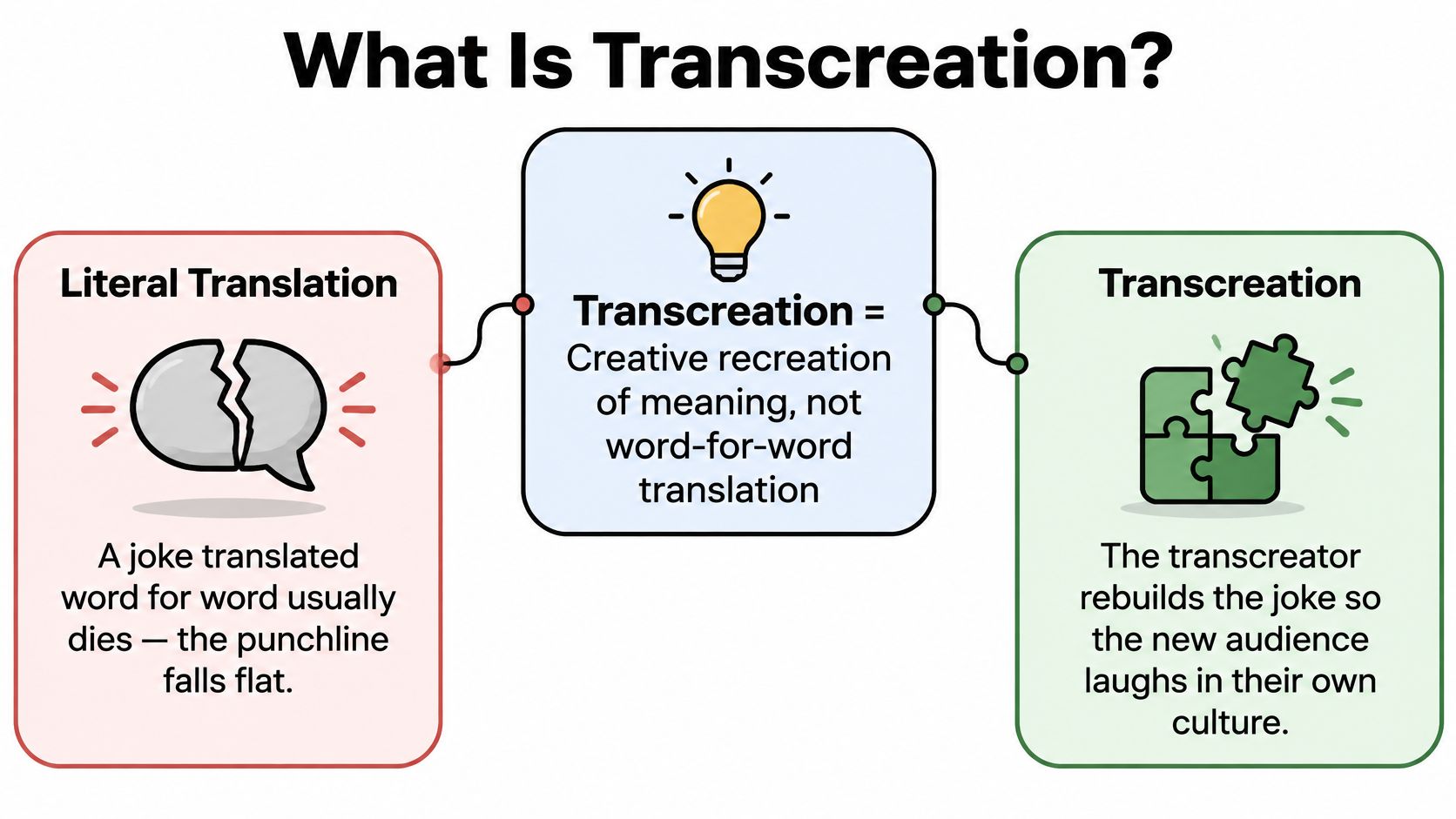
With a joke, the important element may be surprise rather than the original punchline. A transcreator might replace a language-specific pun with a different comic setup, provided the result still fits the speaker, audience and purpose.
What Needs to Survive
Transcreation protects several connected elements:
- Intent: What the writer wants the audience to understand or do.
- Tone: Whether the message feels warm, irreverent, reassuring or authoritative.
- Imagery: The mental picture or association, which may require a different metaphor.
- Emotional effect: The amusement, confidence, curiosity or belonging the message aims to create.
These aren't instructions to preserve every image. If an image carries the wrong association locally, replacing it may be the most faithful way to communicate the idea.
The distinction is easier to see as a comparison of outcomes.
A Literary Practice Before a Marketing Service
The practice has roots in creative approaches to Sanskrit texts, and Indian poet and scholar Purushottama Lal used the term in 1957 for his Sanskrit-to-English translations of classical Indian drama, emphasizing the Hindu tradition within the texts rather than language alone, as described in the historical overview of transcreation.
Commercial use became widespread in the early 2000s, particularly among language-service providers distinguishing creative adaptation from conventional translation, according to the systematic literature review published in The Journal of Specialised Translation. That history matters because transcreation isn't just a new name for using technology to rewrite advertisements.
Some practitioners and scholars debate whether it differs from excellent creative translation. For a buyer, the useful distinction is the assignment: give the writer explicit permission to rebuild the expression while holding the purpose accountable.
Transcreation isn't a stylistic upgrade every text needs. It's a deliberate choice about what must remain equivalent.
It isn't limited to literature, and it doesn't guarantee a better campaign without a clear brief. If you're asking what is transcreation in translation, the simplest answer is creative freedom in service of a defined communicative purpose.
Transcreation, Translation and Localization Side by Side
Transcreation vs translation vs localization
| Dimension | Translation | Localization | Transcreation |
|---|---|---|---|
| Main goal | Accurate transfer of meaning | Make a product work in a locale | Same persuasive effect in a new market |
| Fidelity focus | Source meaning, closely mirrored | Function, format, legal and interface fit | Intent, tone, emotion and imagery |
| Creative freedom | Low | Medium, within strings and formats | High, within the brief |
| Typical output | Target text that mirrors the source | Localized app, help pages, currency and dates | Rewritten or new copy and visuals |
| Typical example | Translated user manual | Localized checkout screen | Rewritten slogan built on local humor |
| Who works on it | Translator | Localization team with engineers and translators | Transcreator working with a copywriter and art director |
These are useful working distinctions, not rigid professional boundaries. A good translator doesn't mechanically substitute words, and a localization team may include creative writers.
The main goal determines the assignment. Translation transfers meaning accurately. Localization makes the broader experience appropriate and usable in a particular locale, while transcreation gives the writer room to rebuild a persuasive expression.
How to Read the Differences
Fidelity means being faithful to the right thing. In a manual, the sequence of actions and technical meaning must remain dependable; in a campaign, a formally similar sentence may be less useful than a different sentence that expresses the intended personality.
Creative freedom follows those obligations. Translators can restructure sentences for naturalness, but they shouldn't invent product claims; transcreators can propose a new headline, but they still can't invent claims.
The output changes accordingly. A translated document remains recognizably connected to its source, whereas a localized checkout also involves formats and interface behavior. A transcreated campaign may require revised copy and a different visual concept.
The example and staffing rows show why buying everything as text replacement creates problems. Engineers help resolve interface constraints, while art directors help ensure a rewritten headline still works with the image.
A review of transcreation definitions in advertising describes the activity as goal-oriented, with the intended marketing effect taking priority over formal equivalence. For persuasive copy built around wordplay or cultural references, a literal version is therefore a reference, not automatically a launch-ready asset.
The Ordinary Translation Test
Say you're launching a travel app. You need accurate translation for contractual terms, localization for menus and date formats, and potentially transcreation for the launch tagline.
Ask whether a natural, accurate translation lets the audience understand the message and respond as intended. If it does, ordinary translation is enough. If the missing ingredient is the joke, emotional cue or cultural association, consider transcreation.
How Transcreation Works Step by Step
Start with a document that explains the assignment, not just a file containing the source copy. The writer needs to know which choices are negotiable before exploring alternatives.
Academic discussion in Translation plus cultural adaptation emphasizes preserving communicative function rather than producing an exact replica. That gives reviewers a better question than whether every sentence matches: does the target version do the intended job?
From Brief to Market Review
-
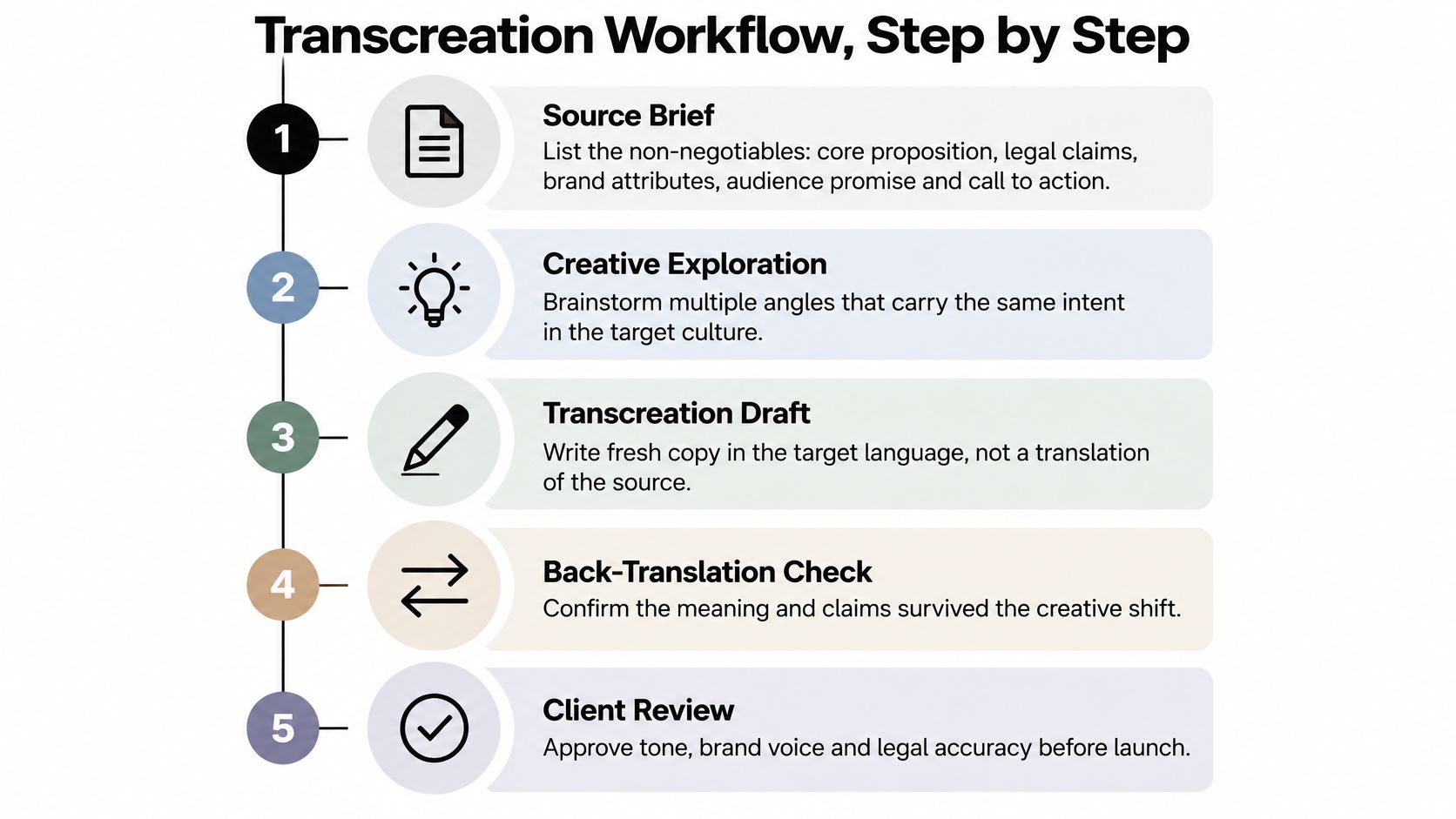
Write the source brief. Record the core proposition, legal claims, brand attributes, audience promise and call to action, plus how far the writer may depart from the source. Separating fixed requirements from flexible expression prevents a creative idea from accidentally changing the offer.
-
Investigate the intended audience. Examine expectations, humor, familiar references, taboos and competing messages in the target market. Define an actual audience, such as first-time business travelers, rather than treating everyone who speaks a language as culturally identical.
-
Develop creative alternatives. Rewrite metaphors, wordplay and examples where they obstruct understanding, and propose new headlines or visuals when necessary. Give each alternative a rationale so reviewers can distinguish purposeful adaptation from an arbitrary rewrite.
-
Co-create with the creative team. Have the transcreator discuss drafts with a copywriter or art director, as in the collaborative Spanish beer campaign discussed below. A headline that depends on a visual joke can't be evaluated properly while the image remains outside the conversation.
-
Arrange native-speaker and specialist review. Ask an in-market reviewer to assess naturalness, tone and unintended implications, and involve a qualified specialist for regulated wording. Native fluency doesn't automatically establish legal or medical expertise.
-
Test the material with its intended audience. Check what people understand, how they feel and whether they recognize the intended next action. Sentence-level accuracy can pass inspection even when people misunderstand the offer or don't know what to do next.
A compact production diagram helps keep the creative and approval stages visible.
Make Approval Understandable Across Languages
When stakeholders don't speak the target language, provide a back-translation, a plain explanation of what the adapted copy says. Add a note explaining the reference, rhythm or emotional cue that a literal back-translation won't communicate.
Don't reject an option just because its English explanation sounds less elegant than the original headline. Judge the target-language execution with qualified reviewers, while using the explanation to check the proposition and claims.
Approval rule: A back-translation helps you inspect meaning. It doesn't prove that the target copy sounds persuasive.
The workflow has worked when reviewers can explain how the adapted version preserves intent, sounds natural and supports the intended response. Audience testing provides evidence of that response, not a guarantee that every market will behave identically.
Rules That Protect Meaning and Cut Rework
Sending a literal draft to market and calling it finished confuses linguistic correctness with campaign readiness. The opposite mistake is giving a writer unlimited freedom and discovering that the revised copy promises something the product can't deliver.
A localization study of transcreation describes creative work bounded by strategic, cultural, legal and format requirements. Those boundaries should make decisions easier, not turn every review into a debate about personal taste.
Practical Guardrails
-
Protect the purpose, not the wording. In a hypothetical coffee campaign, the promise of freshness every morning stays fixed, while a brewing pun becomes a locally recognizable morning ritual. Don't let a clever replacement turn freshness into an unsupported health claim.
-
Ask for alternatives with reasons. Request contrasting approaches, such as a playful line, a rhythmic statement and a direct question. The rationale should explain why each approach suits the audience, not merely say that it sounds better.
-
Review slogans and hashtags in context. Put the wording on a billboard mockup, in a social feed and beside the product description. A hashtag may look clear in a spreadsheet but become ambiguous when words run together or sit beside an image.
-
Check the actual format. In a hypothetical layout, a headline that occupies 60 characters may need a 35-character version for a smaller card. Those are project constraints, not universal platform limits; ask the writer to preserve the proposition rather than remove the final words.
-
Maintain approved terminology. Keep the product name stable while allowing its descriptor to adapt naturally. PostSyncer's resource on building a brand voice guide can help organize voice rules before multiple markets develop inconsistent interpretations.
-
Treat machine output as input. A machine draft can help the writer inspect the source meaning, but it shouldn't dictate the final creative structure. Otherwise, reviewers may polish an unsuitable concept instead of replacing it.
Separate Preference From Risk
Give feedback in actionable categories: incorrect claim, inappropriate tone, unclear reference or layout problem. A comment such as make it more exciting doesn't tell the transcreator what to change.
For teams handling broader cross-cultural business communication, identify who resolves cultural disagreements before production begins. Keep the governing rule simple: protect the purpose, not the wording.
Transcreation Examples in Marketing and Everyday Use
Estrella Damm's advertising provides a concrete example of creative work extending beyond text replacement. A 2023 case study of 14 commercials released between 2019 and 2021 identified creativity, co-creation, internationalisation and adaptation as components of advertising transcreation.
Translators and art directors worked in dialogue, international use was considered from the outset, and final material was adapted to target-language and cultural conventions. The lesson is organizational: adaptation belongs in creative development, not only at the point when someone exports the final script.
The beach-bar setting illustrates why visual atmosphere belongs in the creative discussion.

Hypothetical Examples of What Changes
A coffee brand entering Japan: Suppose its English headline uses a home-brewing pun that has no useful equivalent in Japanese. The transcreator could explore a morning ritual familiar to the specific target audience, then validate it locally rather than assume all Japanese consumers share the same routine.
The wordplay changes, but the promise of an enjoyable start to the day remains. The photograph might also change if it depicts a routine the intended audience doesn't recognize.
A travel promotion built around sport: Suppose an advertisement compares booking a holiday to scoring in a sport unfamiliar to the new audience. A locally understandable discovery metaphor could replace the sporting reference while preserving the feeling of achievement and anticipation.
For social versions, Social Media Scheduler's scroll-stopping hook ideas can provide starting structures. The transcreator still needs to decide whether the hook fits the audience and the actual offer.
Motion, delivery and pacing add further creative constraints to audiovisual work.
Beyond Advertising
- Public health messages: Adapt an unfamiliar example or action prompt while preserving the approved health guidance.
- Greeting cards: Replace a rhyme or joke while retaining affection, sympathy or celebration.
- Product names: Explore associations and pronunciation while preserving the intended positioning.
- Social posts: Change a topical reference while keeping the brand's attitude and central point.
For video translation services, also assess subtitles, spoken timing and on-screen references. The reusable pattern is to identify what changed, what stayed and why the audience needs that change.
Choosing Transcreation or Machine Translation by Situation
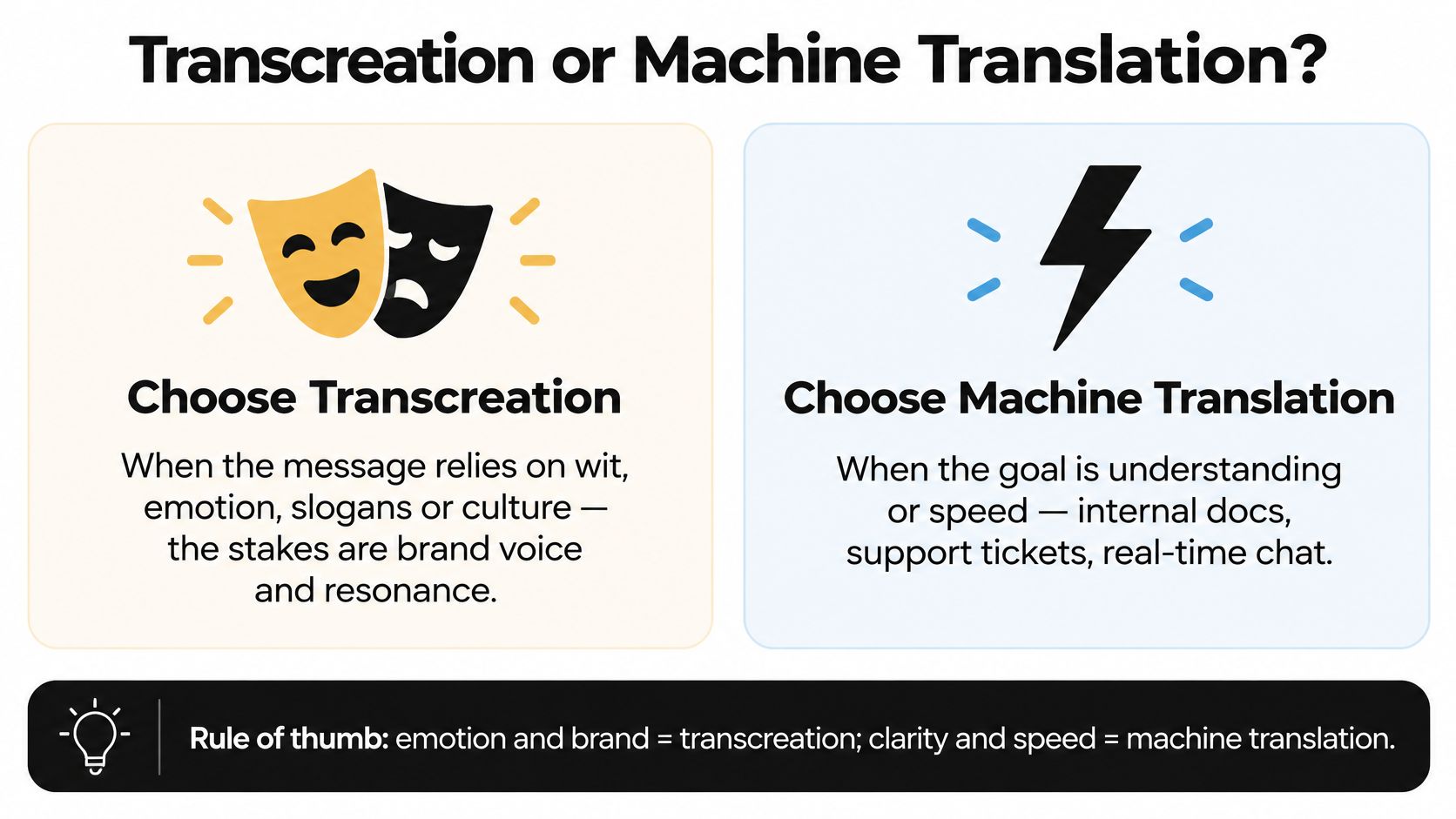
A delayed flight announcement and a perfume tagline fail in different ways. The announcement fails if travelers miss the gate number. The tagline fails if shoppers feel nothing. Transcreation is a decision about which parts of a message must survive the move into another language. Meaning must survive for instructions. Feeling, wordplay and cultural fit must survive for persuasion.
Use that test to assign the work. When accuracy alone lets the reader act correctly, ordinary translation plus review is enough. When the reader must laugh, desire or click, literal accuracy is not enough, and the wording needs creative rebuilding.
Match the Tool to the Consequence
Transcreation or machine translation by situation
| Situation | Machine or AI translation | Transcreation | Best tool |
|---|---|---|---|
| Live two-way conversation | Strong fit for real-time understanding | Too slow for live talk | Live voice translation app |
| Product manual or help article | Good first draft that needs human review | Usually overkill | Machine draft plus qualified review |
| Campaign tagline or headline | Literal output often misses wordplay | Best fit | Human transcreator |
| Legal, medical or safety text | Only with full post-editing | Not needed, accuracy comes first | Qualified translator |
| Humorous social post or ad | Risky without review | Best fit | Human transcreator with an in-market test |
| Quick email to a colleague | Good for speed | Usually unnecessary | Machine translation |
A safety instruction should not become more imaginative during translation. A humorous advertisement should not be approved solely because its vocabulary is accurate.
The ISO description of ISO 17100:2015 sets requirements for translation-service processes and resources while excluding raw machine-translation output plus post-editing from its scope. That exclusion defines the standard's coverage. It does not prove that every human translation is good or that every machine translation is unsuitable.
For sensitive text, full post-editing means checking the entire output against the source, including terminology, omissions and potentially harmful ambiguity. If you are unsure how automated output is produced, understanding what machine translation is helps clarify where human responsibility begins.
Using Translate AI for Live Conversations
Live talk belongs to conversation tools, not to creative rewriting. Translate AI uses AI to recognize context in translations and supports two-way conversations in over 80 languages. You speak in your language and your partner hears it in theirs. The translation is shown and spoken immediately after speaking.
Getting started is straightforward:
- Select the languages. Choose your native language and your partner's language from the app's list of languages.
- Start speaking. Tap the microphone button and speak naturally.
Speaker mode is available for hands-free chats. Check the app itself for supported languages and earbud or AirPods compatibility before planning a particular setup. The app is designed for travel, work and everyday chats.
Campaign copy still needs a human transcreator to develop and assess creative choices.
Use conversational translation to understand the person in front of you. Use creative adaptation when you are designing how an audience should experience a message.
Hire or Test a Transcreator Before Your Next Campaign
Shortlist a small group of transcreators and run a paid test on a representative asset before committing to a full campaign. A portfolio shows finished work; a paid test shows how the writer handles your audience, constraints and feedback.
Transcreator Evaluation Checklist
| Criterion | Strong signal | Red flag |
|---|---|---|
| Portfolio | Before and after copy for a named market | Only word lists or glossary samples |
| Market fluency | Native speaker or long-term resident of the target market | Relies on dictionary checks |
| Briefing habits | Asks about audience, goal and limits before writing | Accepts copy without a brief |
| Collaboration | Works with copywriters and art directors | Works alone and returns one literal version |
| Review method | Scores intent, tone, cultural fit, emotion and action | Judges by sentence accuracy alone |
| Pricing model | Quotes per project, close to creative fees | Quotes per word only |
Market fluency is a starting signal, not proof of copywriting ability. Ask candidates to explain the audience and commercial reasoning behind their portfolio choices.
A translator-training project at Universidad Pablo de Olavide during the 2016–2017 academic year examined advertising assignments including TopShop's Lady Garden slogans and hashtags, and described transcreation fees as closer to marketing and publicity-campaign fees than conventional translation or localisation fees. A per-word-only quote is therefore a reason to inspect the scope, not automatic evidence that a provider is unsuitable.
For a Latin American target market, LatHire's Hire talent from Latin America resource can broaden your candidate search. Still assess the individual's language pair, audience knowledge and creative portfolio rather than treating regional location as sufficient qualification.
Run a Paid Test You Can Evaluate
- Set a bounded assignment. Provide a short slogan, contrasting audience profiles and explicit limits on claims, terminology and tone. Tell candidates how the copy will appear.
- Request distinct options. Ask for alternatives with a brief rationale and a plain back-translation. Make clear that you're paying for creative exploration, not seeking free campaign concepts.
- Score against the purpose. Use a simple low-to-high scale for intent, tone, cultural fit, emotional resonance and actionability. Record why a version earns its rating rather than relying on a total alone.
- Check the strongest option locally. Have an independent native reviewer assess it in the actual layout, then give the candidate focused feedback and evaluate the revision.
Hire the writer whose options preserve your purpose and sound natural to the intended audience. The most literal version isn't necessarily the most faithful communication.
Translate AI offers live two-way voice translation for travel, work and everyday conversations, helping you understand someone when you don't share a language. Visit Translate AI for conversational translation, and reserve a human transcreator for campaign messages whose tone, humor and emotional effect need deliberate adaptation.