

A Practical Guide to Cross Cultural Business Communication
Ever left a meeting with an international partner feeling like you were speaking different languages, even though you were both using English? You’re not alone. In today’s global market, a simple misstep in communication can stall a project, kill a deal, or damage a crucial relationship. The problem isn’t what you say—it’s how your message is received across cultural divides.
This guide is built to solve that problem. Our goal is to give you specific, actionable strategies to navigate these tricky waters. You'll learn to decode unwritten rules, lead successful global meetings, and avoid common pitfalls, turning potential misunderstandings into your greatest competitive advantage.
Why Cross Cultural Communication Is a Core Business Skill
In a globalized economy, your team's ability to communicate across cultures isn't a "soft skill"—it's a critical business competency with a direct impact on the bottom line. When teams can't navigate cultural nuances, projects get delayed, negotiations fall apart, and talented employees become disengaged. The financial toll is staggering; research shows that poor communication costs businesses billions annually in lost productivity and missed opportunities.
This isn't just about being polite. It's about understanding the unwritten rules that govern trust, respect, and decision-making in different parts of the world. Mastering cross cultural business communication is the key to building strong, profitable international relationships.
The Real-World Impact of Cultural Fluency
Think of cultural fluency as learning the playbook for a new game. Every culture has its own set of rules for key business interactions:
- Building Trust: Do you need to build a personal relationship before talking business, or is it better to get straight to the point?
- Giving Feedback: Is direct, blunt feedback seen as honest and efficient, or is it considered disrespectful and embarrassing?
- Negotiating Deals: Is the pace fast and decisive, or slow and consensus-driven?
Ignoring these differences is like trying to navigate a new city without a map—you're bound to get lost. This guide will provide you with that map, giving you clear, actionable steps to ensure your message is not just heard, but understood and respected. A crucial first step is often learning how to overcome language barriers, which can be the biggest hurdle of all.
Decoding The Unwritten Rules Of Global Business
To succeed in global business, you must understand the invisible "software" your international counterparts are running. Every culture operates on a set of unwritten rules—deeply ingrained assumptions about respect, time, and hierarchy that shape every interaction. Ignoring this cultural programming is where most friction in cross-cultural business communication originates, leading to confusion and deals that fall apart for no apparent reason.
Think of it this way: some cultures hand you a detailed instruction manual for every conversation, while others expect you to read the atmosphere. Once you learn to spot these patterns, you can adapt your approach and build much stronger connections.
High-Context Versus Low-Context Communication
One of the most powerful frameworks for understanding these differences is the concept of high-context and low-context cultures. This isn't about being complicated or simple; it's about where the true meaning of a message is found.
- Low-Context Cultures: In countries like the United States, Germany, and the Netherlands, communication is explicit and direct. Words carry the majority of the information. People value clarity, precision, and getting straight to the point.
- High-Context Cultures: In places like Japan, China, and many Arab nations, communication is more nuanced and indirect. The real message is often found in the surrounding context—non-verbal cues, shared history, and the relationship between speakers. What isn't said can be as important as what is.
For example, giving feedback in a low-context culture might sound like: "This proposal won't work because the financial projections are inaccurate." In a high-context culture, the same feedback could be framed as: "This is a thoughtful start. Perhaps we can explore a few other angles to strengthen the financial case." The goal is the same, but the delivery is designed to preserve harmony.
High-Context vs Low-Context Communication Cheat Sheet
Use this quick reference to identify and adapt to different communication styles.
| Characteristic | High-Context Cultures (e.g., Japan, Arab nations) | Low-Context Cultures (e.g., USA, Germany) |
|---|---|---|
| Communication Style | Indirect, implicit, and nuanced. | Direct, explicit, and precise. |
| Message Focus | Meaning is in context, non-verbal cues, and shared understanding. | Meaning is conveyed through spoken or written words. |
| Relationships | Long-term relationships and trust are built first. | Business relationships are often task-oriented and built quickly. |
| Agreements | A person's word or a handshake can be as binding as a contract. | Written contracts and detailed agreements are essential. |
| Disagreement | Expressed subtly to avoid confrontation and save face. | Disagreements are stated openly and seen as constructive. |
| Feedback | Delivered gently, with positive framing, to protect relationships. | Direct, specific, and focused on the task at hand. |
Remember, these are frameworks, not rigid boxes. But knowing the environment gives you a massive head start in decoding what's really going on.
Understanding Key Cultural Dimensions
Beyond directness, a few other cultural dimensions shape business engagement. Being aware of these helps you avoid major missteps.
One key dimension is power distance—the degree to which a culture accepts hierarchical differences. In high power-distance cultures, decisions flow from the top down, and challenging a superior is rare. In low power-distance cultures, organizations are flatter, and employees are encouraged to contribute ideas.
Another critical factor is how a culture views time.
Some cultures have a monochronic view of time (e.g., North America, Western Europe). Time is a limited resource. Punctuality is crucial, schedules are rigid, and meetings start and end on time. In contrast, polychronic cultures see time as fluid, prioritizing relationships over strict schedules.
Effective communication is the engine that drives deals, growth, and relationships in the global marketplace.
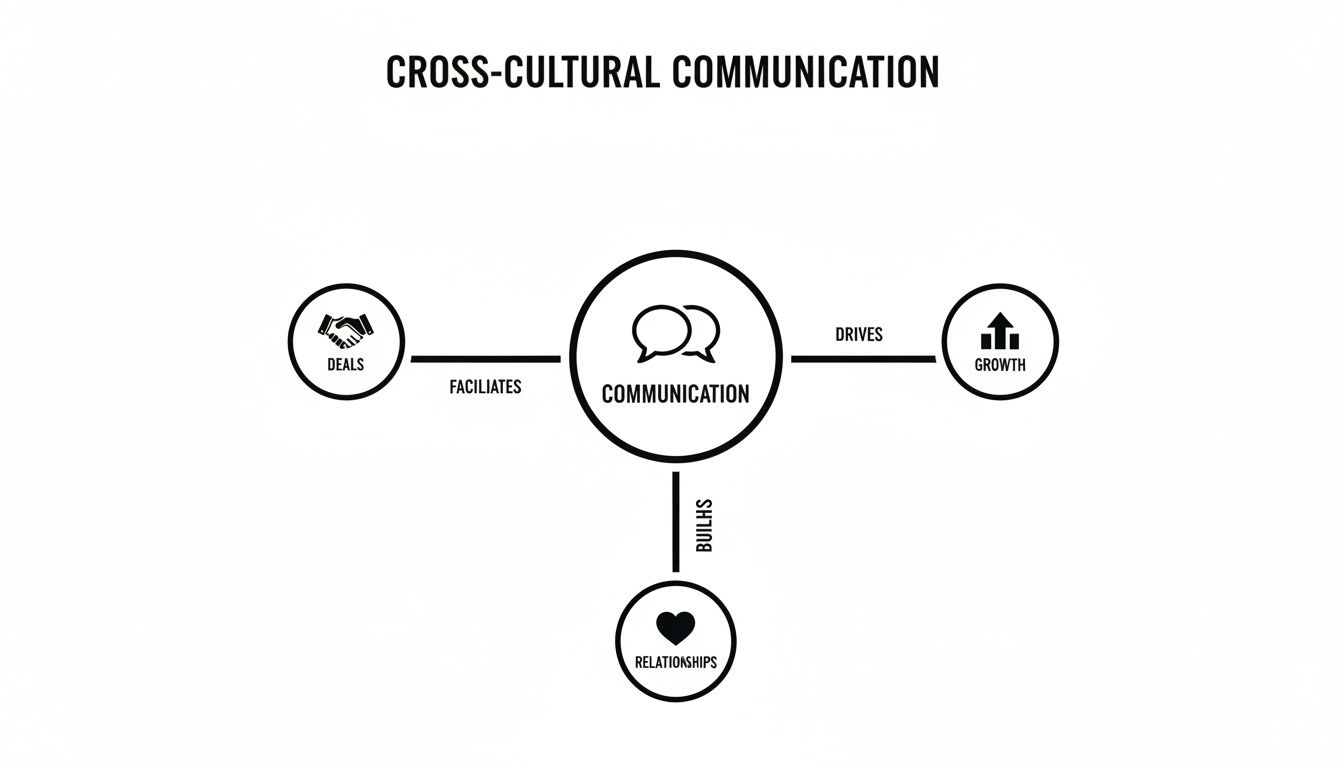
These are practical tools for decoding behavior and adapting your strategy. Learning to read these unwritten rules is the first step toward becoming truly fluent in global business.
How To Lead Successful Global Meetings And Negotiations
High-stakes meetings and negotiations are where your cultural intelligence truly matters. In these critical conversations, understanding cross-cultural communication becomes a deal-making necessity. With international business surging, a more nuanced approach is essential.
Recent data shows a massive 72.7% increase in international negotiations among Fortune 100 professionals, driven by the need for resilient global supply chains. This means more of us are navigating the unwritten rules of cross-border deals. You can discover more insights about navigating these cultural differences in negotiation.
Closing these deals requires a strategy that respects and adapts to your counterparts' cultural playbook.

Actionable Tip 1: Prepare Culturally, Not Just Commercially
Success is often determined before anyone sits at the table. Your preparation must go beyond slide decks and include cultural homework.
- Research Business Etiquette: Understand the core values that drive behavior in your counterpart's region.
- Check Norms on Punctuality: Is showing up on time a sign of respect, or is the schedule more fluid? In Germany, punctuality is non-negotiable. In many Latin American cultures, relationships often take priority over a strict agenda.
- Know Greeting Protocols: A firm handshake is standard in the U.S., but a slight bow is customary in Japan. Getting this right shows you've made an effort.
- Understand Gift-Giving: In parts of Asia, a thoughtful gift builds rapport. In some Western cultures, it could be misinterpreted or violate company policy.
A critical part of preparation is anticipating the meeting's flow. Will it be a rapid-fire, agenda-driven discussion, or a slower, more deliberate conversation where building personal rapport is the first order of business? Knowing this helps you manage your own expectations and pace.
Actionable Tip 2: Adapt Your Negotiation Style in Real-Time
Once the meeting begins, your ability to adapt is everything. A direct, "let's get to the bottom line" approach common in low-context cultures can seem aggressive in high-context cultures where harmony is prized.
- Embrace Silence: In many East Asian cultures, a pause is a moment for thoughtful consideration. Rushing to fill it can signal impatience and weaken your position.
- Identify the Decision-Maker: In hierarchical cultures, only the most senior person may have final authority. In collectivist cultures, the team may need to huddle privately to reach a consensus.
- Read Non-Verbal Cues: Pay close attention to body language, facial expressions, and tone of voice. These cues often say more than words, especially in high-context cultures.
These dynamics are equally important in virtual settings. For more guidance, check out our guide on essential tips for virtual meeting etiquette.
Actionable Tip 3: Use Technology to Bridge Language Gaps
Even with the best cultural prep, language remains a hurdle. A simple misunderstanding can create friction and halt progress. Modern tools can ensure everyone is on the same page.
Overcome Language Barriers with Translate AI
When you need your message to land exactly as intended, a tool like Translate AI is a game-changer. It offers real-time voice translation, allowing for a natural, conversational flow. Imagine speaking in English and having your counterpart instantly hear your words in their native language through their earbuds. This cuts out awkward pauses and lets you focus on building a genuine connection, closing the language gap practically and respectfully.
Avoiding Common Cross-Cultural Communication Mistakes
Navigating cross-cultural business communication can feel like walking through a minefield. A friendly gesture in one country might be offensive in another. Fortunately, most blunders are preventable. By knowing the common pitfalls, you can sidestep them with simple, proactive strategies.

Mistake 1: Making Assumptions Based on Stereotypes
Relying on stereotypes is the fastest way to kill a professional relationship. Assuming your German colleague will be brutally direct or your Japanese partner will remain silent ignores individual personality and professional experience.
- The Fix: Treat every person as an individual. Research their company and professional background, not just their culture. Focus on the person, not the passport, to build a foundation of genuine respect.
Mistake 2: Misinterpreting Non-Verbal Cues and Gestures
Non-verbal communication is a notorious trap. A "thumbs up" is a sign of approval in the U.S. but a vulgar insult in parts of the Middle East.
Misreading non-verbal cues is like misreading the most important terms in a contract. It leads to fundamental misunderstandings about intent, respect, and agreement.
- The Fix: When in doubt, use a "less is more" approach. Maintain a neutral, open posture. Observe how your counterparts communicate with each other and subtly mirror their level of formality.
Mistake 3: Using Humor and Slang That Doesn't Translate
Humor is intensely cultural and rarely travels well. Ironic comments, sarcasm, or local metaphors can be confusing or offensive to someone from a different background.
- The Fix: Keep your language clear, simple, and professional. The goal is clarity, not comedy. Save the inside jokes for your local team.
Mistake 4: Mistaking Silence for Agreement or Weakness
In many Western cultures, silence can feel awkward. We feel an urge to fill it. However, in many East Asian cultures, silence is a sign of respect and thoughtful consideration.
- The Fix: Learn to embrace the pause. When your counterpart goes silent, give them space to think. Count to ten in your head before speaking. This simple act of patience shows cultural awareness and strengthens your position.
Using Technology to Bridge Communication Gaps
While deep cultural awareness is the bedrock of any global partnership, the most immediate hurdle is often language. A single missed word can stall a negotiation or spark a misunderstanding. Modern technology offers powerful ways to close these linguistic divides, making cross-cultural business communication clearer and more accurate than ever. These tools let teams focus on what matters—the ideas, the strategy, the relationship—instead of getting bogged down by the mechanics of translation.
From Clunky to Conversational
Not long ago, real-time translation was slow and awkward. Today, modern tools are built for actual business interactions.
- Real-Time Accuracy: Advanced AI delivers translations that are culturally appropriate, not just literal.
- Conversational Flow: The best tools support two-way dialogue, allowing a fluid exchange without long, awkward pauses.
- Accessibility: Solutions now work with hardware you already own, like a smartphone or earbuds.
This means technology is now a strategic asset for any global team. If you're curious about the specifics, our guide on how to translate a conversation in real time can be helpful.
The goal of modern translation technology isn't just to make you understood; it's to make the language barrier feel like it isn't even there. True success is when you can forget about the tool and focus entirely on the person you're speaking with.
Empower Your Team with Translate AI
For professionals needing clear, immediate dialogue, an app like Translate AI offers a game-changing solution. It delivers real-time, two-way voice translation in over 80 languages right through your earbuds or AirPods. This creates a natural, conversational flow, letting you build relationships and close deals without wrestling with a language barrier. It's a must-have tool for clarity and confidence in any international meeting.
Your Action Plan For Building A Culturally Fluent Team
Turning theory into a practical strategy is what delivers results. Cultural competence isn't a "soft skill"; it's a core business strategy that leads to a measurable return through stronger partnerships, fewer costly misunderstandings, and better deals. Here’s a simple action plan to make it happen.

Step 1: Launch Targeted Cultural Awareness Training
Generic, one-size-fits-all training doesn't work. To have a real impact, training must be ongoing, interactive, and directly tied to your team's daily challenges.
- Focus on Key Markets: If your engineers work with a team in India, training should zero in on the nuances of that relationship, like navigating hierarchy or indirect feedback styles.
- Make it Practical: Use real-world scenarios and role-playing exercises that your team can apply immediately.
Effective cultural training has a proven link to higher customer satisfaction during global expansions. You can review the full research on cultural training effectiveness to see the data.
Step 2: Develop Practical, Easy-to-Use Resources
Back up training with simple, accessible resources for in-the-moment guidance.
The goal is to make cultural intelligence an effortless part of your team's workflow, not an academic exercise. Equip them with simple, actionable tools they can use right before a call or negotiation.
- Create Pre-Meeting Checklists: A one-page guide for international calls prompting team members to consider time zones, communication styles, and decision-making norms.
- Build Country-Specific "Cheat Sheets": Brief, scannable guides for your primary markets covering greetings, gift-giving, and negotiation tactics.
- Share Case Studies: Anonymize and share short stories of past cross-cultural wins and blunders from within your company. Nothing teaches a lesson better than a real-world example.
Step 3: Cultivate a Culture of Curiosity and Respect
Ultimately, tools and training can only go so far. The most culturally fluent teams are those where curiosity is a core value championed from the top down.
- Encourage Questions: Build an environment where asking for clarification is seen as a sign of strength, not ignorance.
- Appoint "Cultural Liaisons": Identify team members with deep experience in a key market to serve as informal advisors.
- Lead by Example: When leaders demonstrate empathy and a willingness to learn, the entire organization follows suit.
This foundation of curiosity is the secret to navigating any cross-cultural challenge with confidence and skill.
Frequently Asked Questions
Here are straightforward answers to some of the most common questions about cross-cultural business communication.
What Is The Most Important Skill For Effective Cross Cultural Communication?
The single most important skill is adaptability. It’s the ability to listen, observe what's really happening, and adjust your style to make the other person comfortable. Instead of sticking to your own way of doing things, being adaptable builds the trust needed for any global partnership to succeed.
How Can I Prepare For A Meeting With A Culture I Am Unfamiliar With?
Focus your homework on three key areas:
- Greetings and Formality: How do people greet each other? Knowing this avoids awkward first impressions.
- Attitudes Toward Time: Is punctuality rigid (monochronic) or is the schedule more fluid (polychronic)?
- Communication Styles: Is the culture direct (low-context) or indirect (high-context)?
Avoid stereotypes, and if possible, talk to a colleague with experience in that region. Above all, enter the meeting with genuine curiosity and humility.
Are Real-Time Translation Apps Reliable For Important Business Meetings?
Yes, modern AI-powered translation apps have become incredibly accurate and are a massive help for business. They are fantastic for clarifying specific points, overcoming a language hurdle, or ensuring everyone is aligned during a critical negotiation.
While you’ll still want a human interpreter for signing complex legal documents, a good app is an invaluable partner for almost every other business conversation. It helps keep the dialogue flowing and cuts down on misunderstandings.
For those moments when you need crystal-clear understanding, Translate AI offers a seamless experience. You can instantly translate conversations in over 80 languages right through your earbuds, ensuring you catch every single word. See how you can close the language gap and communicate with total confidence by checking out Translate AI.