

How to Overcome Language Barriers with Confidence
Stuck in a foreign train station, unable to ask for directions? Fumbling through a business lunch with clumsy gestures? That sinking feeling of being lost in a conversation isn't just awkward—it's isolating. We've all felt that jolt of anxiety when trying to decipher a menu or simply find the nearest restroom.
You're not just facing a minor inconvenience; you're missing out on genuine connection, losing opportunities, and dealing with real stress. This article is your guide to turning those frustrating moments into confident conversations. Our goal is to give you specific, actionable strategies—both low-tech and high-tech—so you can communicate clearly in any situation.
This Isn't Just a "Travel Problem" Anymore
Feeling cut off by language isn't limited to a vacation. It's a daily reality for millions, even in places you might not expect.
In the United States alone, for instance, about 60.6 million people speak a language other than English at home. More importantly, nearly 26 million of them have limited English proficiency, creating a significant communication gap in our own communities. You can dig into more of the data on the impact of these barriers over at BrombergTranslations.com.
This is a shared struggle that affects everything from getting proper healthcare to simply making friends with a neighbor.
The goal isn’t to become fluent overnight. It's about finding smart, practical ways to turn those moments of frustration into opportunities for genuine connection.
Once we see this as a common challenge, we can stop focusing on the problem and start looking at the solutions. And the good news? The tools to bridge these communication gaps have never been better or more accessible. They can help turn a stressful encounter into a successful one.
Preparing For Confident Communication Before You Go
Real confidence begins before you board the plane. A bit of focused preparation can turn travel jitters into calm assurance, giving you the tools you need to handle any conversation that comes your way.
Prioritize Key Phrases And Cultural Norms
Instead of trying to memorize a dictionary, focus on actionable phrases you’ll actually use. Think about what will solve your most common problems.
- Emergency Phrases: “Help,” “I need a doctor,” “Call the police.”
- Dietary Needs: “I am allergic to peanuts,” “No dairy, please.”
- Basic Navigation: “How much does this cost?” “Can you help me find this address?”
Alongside words, spend a few minutes on local etiquette—how to greet people, what hand gestures to skip, and when to maintain distance. A thumbs-up means “great” in many Western countries but can offend in parts of the Middle East.
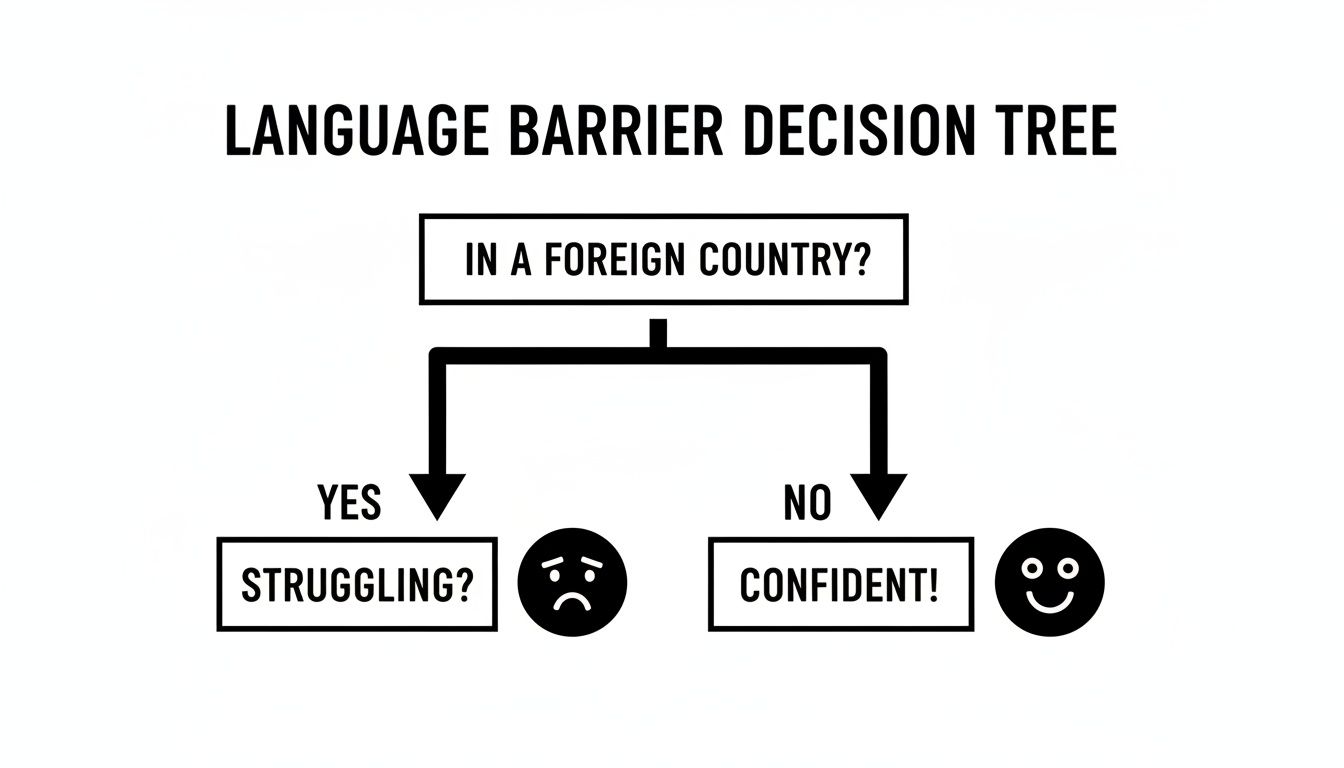
That flowchart lays it out: walk in prepared, and you tap into confidence; walk in unprepared, and you risk feeling adrift.
Build Your Communication Toolkit
No single trick covers every situation. Blend tried-and-true methods with modern tools so you have options if one approach falls short.
If you want extra tips on polishing your conversational skills, check out our guide on how to practice speaking English. A small phrasebook needs no power and always works. A translation app, on the other hand, handles unexpected twists and supports real-time back-and-forth.
Don’t aim for perfection; aim for connection. Even imperfect effort shows respect and invites others to meet you halfway.
Comparing Communication Tools For Travelers
Here’s a quick look at traditional methods versus digital options when you’re on the move.
| Method | Best For | Limitations |
|---|---|---|
| Phrasebook | Quick reference when your battery dies | Limited phrases; no audio or context cues |
| Smartphone Translation App | Real-time, two-way conversations | Depends on battery life and network access |
| Gestures & Body Language | Simple messages without any device | Can be misread across cultures |
Each approach has its merits—your job is to know which tool to reach for in the moment.
By combining essential phrases, a dash of cultural insight, and a solid app, you’ll step into any foreign setting with genuine confidence. Preparation isn’t about flawless fluency; it’s about opening doors one phrase at a time.
Real-Time Strategies to Keep Conversations Flowing
You’ve landed, you’re face-to-face with someone, and the conversation hits a wall. When the right words won’t come, your ability to adapt can turn a frustrating dead-end into a real connection.
The good news is you already have the tools you need: your body language, your tone of voice, and that little supercomputer in your pocket. These are your lifelines for navigating those tricky in-the-moment language gaps.
Master Non-Verbal Communication
A huge chunk of communication isn’t about words. When language fails, your body language becomes your best friend.
- Use Open Posture: Uncross your arms, offer a genuine smile, and make eye contact. This instantly dials down the pressure.
- Rely on Universal Gestures: Stick to simple, widely understood actions. Pointing to an item on a menu, using your hands to show "big" or "small," or giving a simple nod can get your message across instantly.
Adjust Your Verbal Approach
Even when you’re struggling with vocabulary, how you speak makes a massive difference.
- Speak Slowly and Clearly: Enunciate each word. This isn't about being loud; it’s about giving the other person time to process what you're saying.
- Simplify Your Language: Ditch slang and complex sentences. Instead of, "Excuse me, could you possibly tell me where I might find the nearest ATM?" just try, "Where is ATM?"
Phrasing things as simple, direct questions dramatically increases your chances of being understood. For more on this, our article on how to improve conversation skills has great tips that work in any language.
The goal isn't just to be heard, but to be understood. Simplifying your language is a sign of respect for the other person's effort to communicate with you.
Let Visuals Do The Talking
Your smartphone is your secret weapon for breaking down language barriers on the spot. It's a visual aid that's always in your pocket.
Trying to find a specific landmark? Pull up a photo of it. Need to buy something specific at a pharmacy? Show them a picture of the box. This simple trick bypasses language entirely and gives you an unmistakable reference point.
Using Technology to Communicate Naturally
Sometimes, hand gestures and a friendly smile just won't cut it. When you need to get specific—like explaining a food allergy or negotiating a price—your smartphone becomes an indispensable buddy.
The goal isn’t just to translate words; it’s to have a real conversation. Forget the clunky routine of typing a message, showing your screen, and waiting. Modern tools can make the tech feel almost invisible, keeping the focus on the person in front of you.
Getting The Most From AI Translators
To get accurate, real-time results, you need to work with your translation app, not against it. AI is powerful, but it needs clear instructions.
- Speak in Short, Direct Sentences: Instead of saying, "I was wondering if you could possibly point me toward the place where they sell tickets," just try, "Where can I buy train tickets?" Shorter inputs are far less likely to get scrambled.
- Avoid Slang and Idioms: Your app won't know what "it's raining cats and dogs" means. Stick to clear, universal language.
- Pause Between Thoughts: Give the app a beat to process what you’ve said. This ensures accuracy and keeps the conversation from feeling rushed.
Making these small adjustments can make a massive difference. You can find more tips in our guide on how to translate a conversation in real time.
Your Personal Pocket Translator: Translate AI
The right tool makes all the difference. An app like Translate AI shines here, as it's built for seamless, two-way dialogues in over 80 languages.
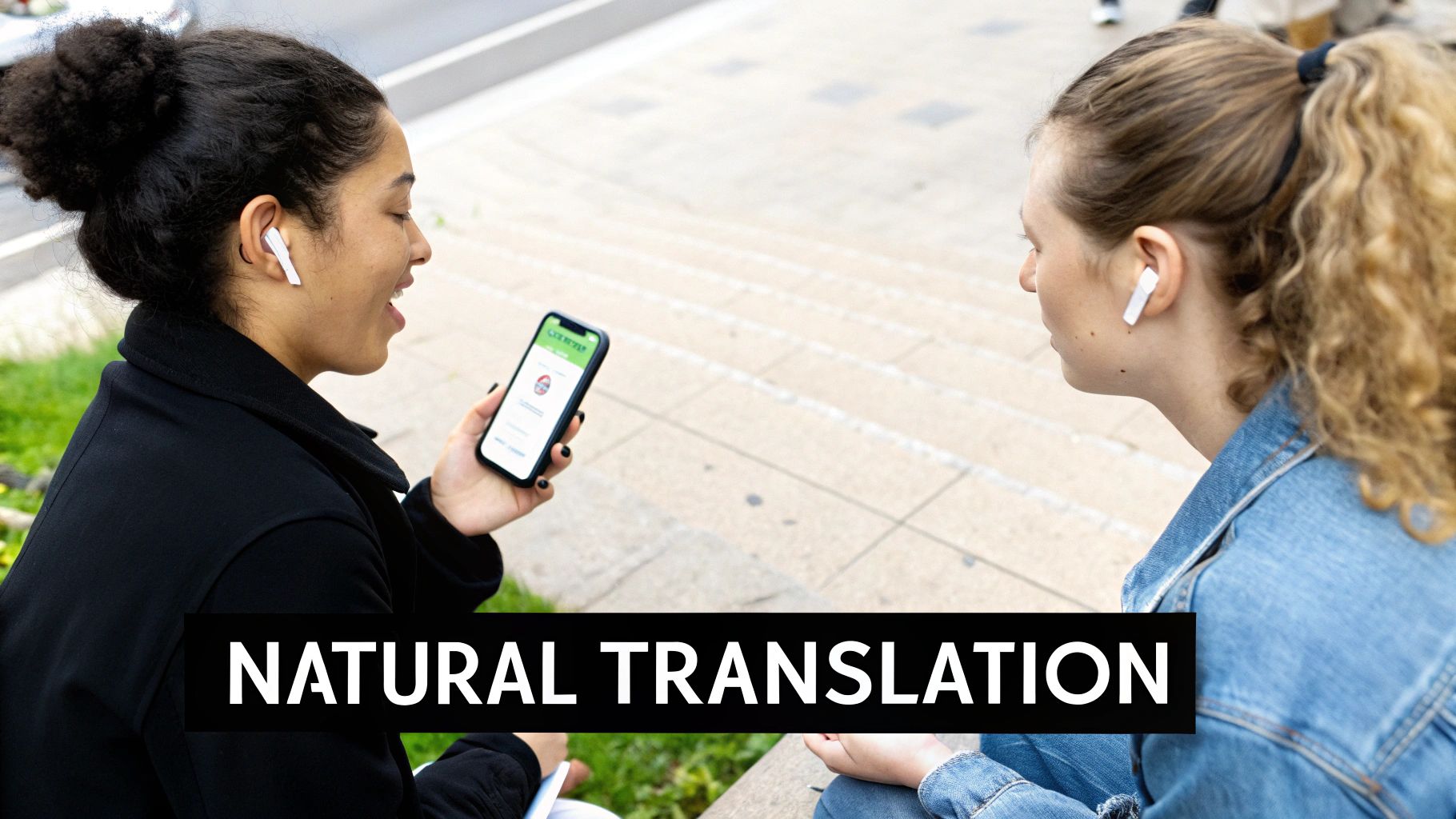
One of its best features is compatibility with standard earbuds or AirPods. You and your conversation partner can each wear an earbud, letting the app deliver translations discreetly. This creates a fluid, hands-free experience where you can maintain eye contact and natural body language. The technology fades into the background, making the interaction feel genuinely human.
The best technology for overcoming language barriers is the kind that fades into the background, allowing human connection to take center stage.
The need for tools like this is only growing. With global linguistic diversity expanding, the ability to communicate across languages is more essential than ever. In 2025, it's estimated that roughly 1.53 billion people will speak English either natively or as a second language, a number that highlights the massive scale of global interaction. Technology is the key to making these connections meaningful. You can dig into more of the numbers with these bilingualism statistics on Preply.com.
Building Lasting Confidence Across Cultures
Getting through a single conversation is one thing, but building the confidence to connect with people time and time again is the real goal. This last part is all about mindset—shifting from seeing every interaction as a test to viewing it as a chance to learn, grow, and make a genuine human connection.
It comes down to patience and curiosity. When you walk into a conversation with the goal of understanding, rather than just being understood, the pressure melts away.
Moving From Temporary Fixes to Long-Term Growth
The aim isn't just to survive a conversation; it's to become comfortable in unfamiliar territory. Technology is an incredible bridge, but it’s also a fantastic learning partner.
Use it to supplement your own efforts and reinforce what you’re learning along the way.
- Check Your Pronunciation: After you try a new phrase, use the app’s text-to-speech feature to hear how a native speaker would say it.
- Confirm Vocabulary on the Fly: Not sure if you’re using the right word? Quickly type it into your translator to see if the meaning matches what you intend.
- Deconstruct Sentences: When you hear a phrase you don't understand, use the app to translate it. This helps you connect new words to real-life contexts.
This approach turns a passive reliance on tech into an active learning process. You're not just translating; you're actively engaging with the language.
Embrace Technology as Your Confidence Booster
While traditional language learning is invaluable, it’s not always practical. Modern tools can fill that gap, giving you the support you need to step outside your comfort zone and start a conversation you might otherwise avoid.
An app like Translate AI is designed for exactly this. It handles the heavy lifting of translation, so you can focus on the person you're speaking with. The confidence that comes from knowing you have a reliable backup in your pocket is immense. It frees you up to smile, make eye contact, and connect on a human level.
The most profound benefit of overcoming language barriers isn’t just smoother travel or better business deals. It’s the rich tapestry of friendships, perspectives, and experiences that opens up when you can truly connect with someone from another culture.
Ultimately, every effort you make to bridge a communication gap—whether it’s learning a new phrase, using a gesture, or tapping into technology—is an act of respect. It shows you value the other person and are willing to meet them halfway. And that simple act is the true key to breaking down barriers and building lasting relationships, anywhere in the world.
Got Questions? We've Got Answers
Thinking about bridging language gaps can bring up a lot of questions. We've tackled some of the most common ones here with straightforward, practical answers to help you communicate with confidence.
Are Translation Apps Accurate Enough for Important Conversations?
For most day-to-day situations—like traveling, casual business meetings, or chatting with new friends—today's AI-powered apps are surprisingly good. They've gotten much better at understanding context, so your meaning usually comes across loud and clear.
That said, for high-stakes conversations involving legal, medical, or highly technical details, you'll still want a professional human interpreter. But for the 99% of other scenarios? A solid app is more than reliable enough.
Can I Really Get by Without Learning the Language?
Absolutely. While learning a new language is an amazing experience, it’s not always practical. Your attitude and willingness to try are what really count. A combination of a few simple tools can work wonders:
- Learn a handful of basic phrases like "hello," "please," and "thank you."
- Use gestures and clear body language—a smile is universal.
- Let a powerful translation app do the heavy lifting for the rest.
This mix-and-match approach lets you build bridges and have meaningful conversations without spending years in a language class.
How Can I Avoid Offending Someone by Mistake?
A little bit of homework goes a long way. Before you travel, spending just 10 minutes Googling the local etiquette can save you from an awkward moment.
The goal isn't to become an expert overnight. It’s about showing you care enough to try. That small gesture of respect builds a ton of goodwill and makes every interaction smoother.
Look up simple things like greetings (is it a handshake or a bow?), personal space norms, and common hand gestures. When you're unsure, just be observant, smile, and be polite. People are almost always forgiving and appreciative of the effort.
Your Pocket Translator for Seamless Conversations
When you need reliable, on-the-spot help, technology is your best friend. A great app designed for real, back-and-forth conversations can turn a potentially stressful situation into a genuinely enjoyable one.
One tool that nails this is Translate AI. It offers two-way, real-time voice translation that makes talking feel natural, without awkwardly passing your phone around. It’s built to help you focus on the person you're with, not the tech in your hand.
Ready to break down barriers and connect with confidence? Download Translate AI today and start speaking the world's languages. Visit the App Store to get started.