

How to Improve Conversation Skills: Your Guide to More Confident Dialogue
Ever felt that knot in your stomach when a conversation stalls? We’ve all been there. You’re racking your brain for something—anything—to say, but the silence just keeps getting louder. It’s frustrating, and it can make you want to avoid social situations altogether.
If that sounds familiar, this guide is for you. My goal is to give you a set of simple, actionable tools to help you feel more confident and connected in any conversation. This isn't about memorizing scripts or becoming someone you're not. It’s about learning the fundamental skills that make conversations click, so you can stop worrying and start enjoying the connection.
We'll focus on three core areas: active listening, asking better questions, and keeping the conversation flowing. By shifting your focus from just talking to genuinely connecting, you’ll build the confidence to handle any chat, from small talk to deep discussions.
This diagram breaks down the three pillars we’ll be exploring throughout the guide.
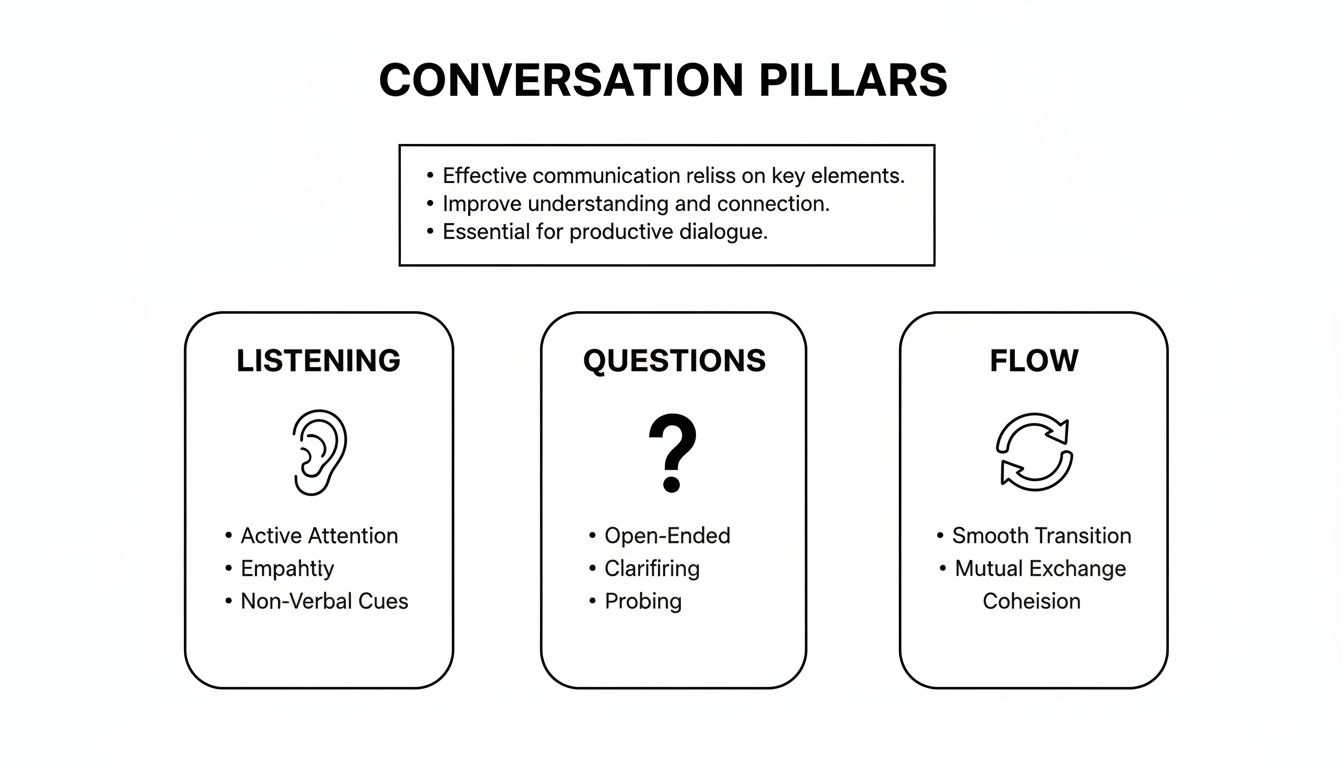
Mastering these three skills—listening to truly understand, asking questions that invite stories, and managing the natural rhythm of a chat—forms the foundation of every great conversation you've ever had.
What to Expect From This Guide
This guide cuts through the generic advice. Forget vague tips like "be yourself" or "just be more interesting." Instead, we'll dive into concrete techniques you can start using today, whether you're at a networking event, traveling abroad, or simply trying to connect more deeply with friends and family.
Here's what you'll learn:
- Listen actively to catch the hidden details that spark deeper topics.
- Ask engaging questions that can't be shut down with a simple "yes" or "no."
- Navigate lulls and pauses without hitting the panic button.
- Tell better stories that capture attention and make you memorable.
The goal isn't to perform perfectly but to connect authentically. The best conversationalists aren't always the most talkative people in the room. They're often the best listeners who make others feel seen and heard.
To give you a roadmap of where we're headed, this table summarizes the core skills we'll be building.
Core Pillars of Effective Conversation
| Pillar | What It Is | Why It Matters |
|---|---|---|
| Active Listening | Paying full attention to not just the words, but the meaning and emotion behind them. | It shows genuine interest, builds trust, and gives you everything you need to keep the conversation going. |
| Engaging Questions | Asking open-ended questions that invite stories, opinions, and feelings, rather than simple facts. | It moves the conversation beyond surface-level small talk and into more meaningful territory. |
| Conversational Flow | The ability to smoothly transition between topics, manage pauses, and share the floor naturally. | It makes interactions feel effortless and enjoyable, preventing those dreaded awkward silences. |
Think of these as your fundamental building blocks for better, more rewarding conversations.
Why Strong Conversation Skills Matter More Than Ever
Developing these abilities is more than just a social nicety; it's a critical life skill. Good conversational skills are a massive advantage for career growth and personal well-being. But there's a huge barrier many people face that we often overlook.
UNESCO estimates that about 40% of people globally don't have access to education in a language they fully understand. When you can't learn and practice in your strongest language, fundamental communication skills—like asking clarifying questions or reading social cues—naturally develop more slowly. You can read more about these challenges in the full UNESCO report.
This guide will give you the tools to build connections, no matter your starting point or background. Let's get started.
The Real Secret to Great Conversations is Listening
We’ve all been there: so caught up in what we’re going to say next that we completely miss what the other person is saying. We’re taught to speak well, but the most powerful tool in any interaction is the one we practice the least: listening.
Most guides just tell you to "listen more." But great listening isn't passive. It’s an active, engaged process that can turn a simple chat into a genuine connection.
The secret is to shift your goal. Stop waiting for your turn to talk and start trying to truly understand the other person's world. When someone feels heard, they relax, open up, and are far more likely to remember you as a fantastic conversationalist.

This means tuning into more than just the words. Pay attention to the emotion and meaning hiding behind them. Are they excited? Frustrated? Hesitant? Catching these little cues gives you everything you need to ask better questions and build real rapport.
Actionable Tip: From Hearing to Understanding
Active listening is a skill, and like any other, you get better with practice. It involves specific techniques that show you're not just physically present, but mentally and emotionally engaged.
Here are a few core moves you can start using today:
- Reflect: Paraphrase what someone just said to make sure you've got it right. Saying, "So, it sounds like you felt really frustrated by that deadline…" shows you're processing their feelings, not just the facts.
- Clarify: Don't just nod along when you're confused. Ask questions to fill in the gaps. Instead of pretending to understand, try, "When you say it was complicated, what was the most challenging part?"
- Summarize: In a longer story, briefly recap the main points. It shows you've been following along and keeps you both on the same page.
These aren't just tricks; they validate the other person's experience and make them feel genuinely understood. This process is foundational, and you can learn more about how to improve listening comprehension to really strengthen this skill.
The biggest mistake in communication is the illusion that it has taken place. True listening bridges the gap between what is said and what is actually understood.
Actionable Tip: Use Non-verbal Cues
A huge chunk of communication happens without a single word. Your body language can either signal "I'm listening!" or completely undermine your efforts.
To show you're engaged, focus on these non-verbal signals:
- Maintain eye contact: It shows you're present and that they have your full attention.
- Nod occasionally: This simple gesture signals encouragement and tells them to keep going.
- Lean in slightly: This physically conveys your interest and involvement in what they're saying.
Think about a client meeting where they mention a "slight concern" but their arms are crossed. An active listener picks up on that disconnect and might gently probe further, uncovering a major issue before it spirals.
Building Your Conversational Toolkit
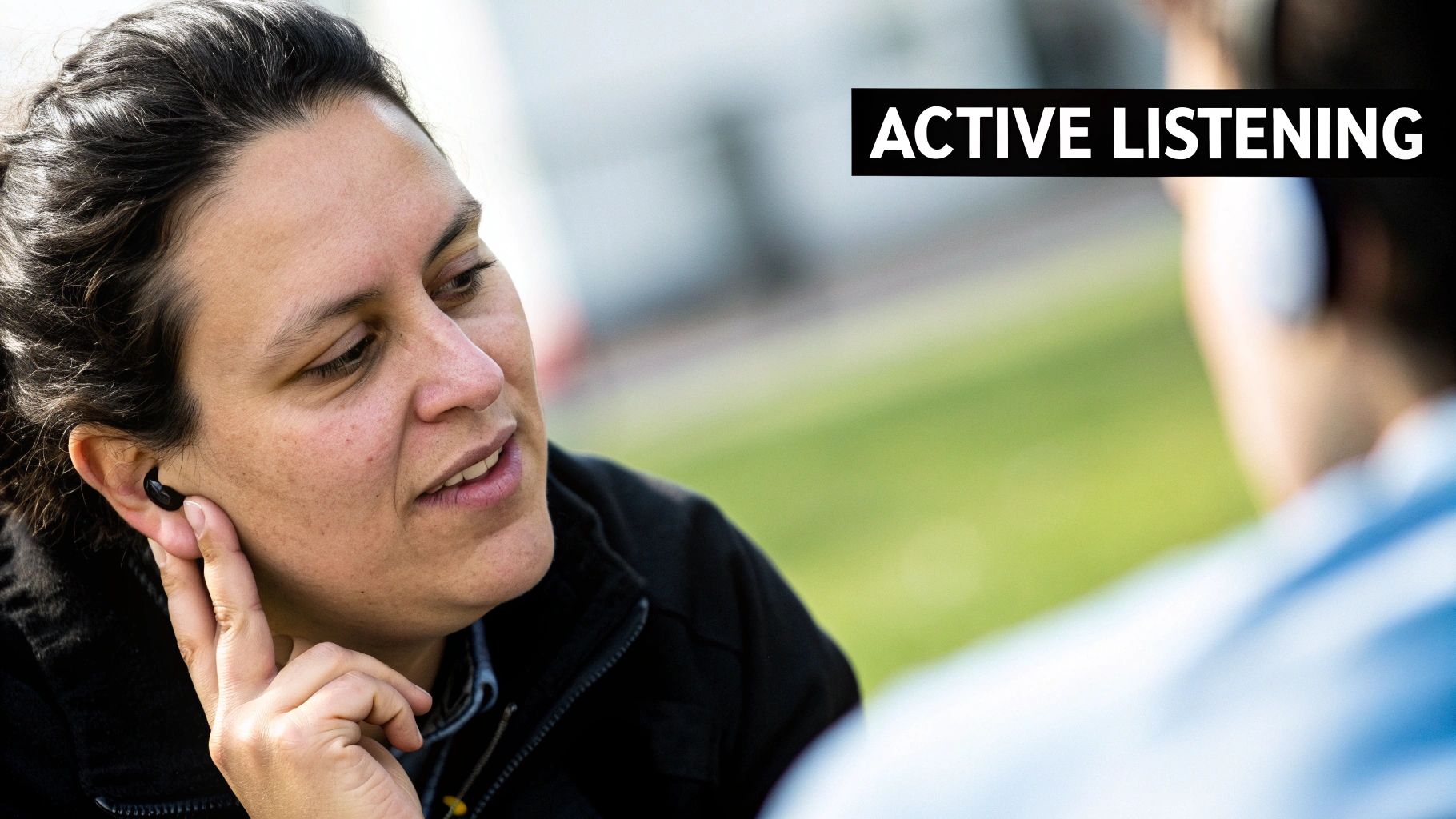
Real confidence in conversation doesn't come from memorizing clever lines. It comes from having a solid toolkit you can rely on—a set of go-to techniques for starting, sustaining, and smoothly ending any chat. Think of it less like learning scripts and more like understanding the mechanics of what makes dialogue work.
One of the most powerful tools is the open-ended question. These are the questions that can't be shut down with a simple "yes" or "no." They invite the other person to share stories, feelings, and opinions.
For example, instead of asking, “Did you have a good weekend?” try this instead: “What was the most interesting part of your weekend?” That tiny shift changes everything.
Actionable Tip: Master the Follow-Up
Asking a good opening question is just the start. The real magic happens in the follow-up. When someone shares something, your next move shows whether you were actually listening.
Let's say they answer, "I spent the weekend hiking." You could just nod and say, "Cool." Or, you could dig a little deeper with a follow-up:
- Dive into their experience: "Oh, awesome. What's one thing that surprised you on the trail?"
- Connect it to their life: "Is hiking something you do often to unwind?"
- Ask for their expertise: "I've been wanting to find a good spot. Where would you recommend going around here?"
Each of these keeps the spotlight on them, making them feel interesting and valued.
Actionable Tip: Weave Better Stories
A good conversation isn't an interrogation. Sharing your own experiences is just as important. A well-told story makes you more relatable and helps the other person feel a connection.
You don't need some dramatic tale. Even a simple story about your commute can be engaging if you give it a little structure.
A simple framework is the Situation-Action-Result (SAR) model. Briefly set the scene (Situation), explain what you did (Action), and then share what happened (Result). This tiny bit of structure adds clarity and makes your anecdotes easy to follow.
This is especially true when dealing with language barriers. The ability to communicate a clear, simple story can have a massive real-world impact. In the United States alone, about 26 million people have limited English proficiency. In a healthcare setting, this communication gap can lead to devastating outcomes, as detailed in research on language barriers in health care. Clear, structured communication isn't just a social nicety; it’s a vital skill.
Navigating Conversational Roadblocks with Translate AI
Even with the best toolkit, a language gap can bring a great conversation to a screeching halt. This is where technology can step in and become a powerful ally, especially when you're trying to practice your skills across different languages. An app like Translate AI can act as your safety net, using real-time translation to keep the dialogue flowing naturally. This lets you focus on the art of the conversation—the timing, the questions, the emotional connection—without the stress of perfect vocabulary. It's like having an interpreter in your pocket, turning a barrier into an opportunity to connect.
How to Navigate Cross-Cultural Conversations
If you’ve ever lived, worked, or even just traveled abroad, you know that conversations can come with an extra layer of complexity. What lands as a friendly joke back home might fall completely flat—or worse, be seen as inappropriate—somewhere else. Understanding these unspoken rules is the first step toward building real connections across borders.
In some cultures, people value direct, get-to-the-point communication. In others, you're expected to read between the lines. Learning to spot and adapt is key.
Understanding the Global Scale of Language
It helps to see just how common it is for people to be talking across language barriers. English is a global connector, with around 1.5 billion speakers, but most aren't native speakers. With hundreds of millions of native speakers in Mandarin Chinese, Spanish, and Hindi, countless daily chats involve at least one person operating in a second or third language.
On top of that, a 2023 analysis found that over 3,277 languages—roughly 46% of all languages spoken on Earth—have almost no digital support, creating even more communication hurdles. You can explore the full report on global language trends to dig into the data yourself.
This is where cultural awareness becomes so important. For example, in many East Asian cultures, the concept of "saving face" is a big deal, which often leads to a more indirect communication style. We touch on this more in our guide to traveling in Japan.
In a cross-cultural conversation, the real goal isn't just to be understood—it's to understand. You have to shift your mindset from, "Am I saying this right?" to "How is this being received?"
Practical Strategies for Bridging Gaps
So, how do you actually start bridging these gaps? It boils down to observation and patience. Before you dive into a conversation, take a moment to watch how people around you are interacting.
- Observe Body Language: Notice gestures, personal space, and eye contact. These non-verbal cues often say more than words.
- Simplify Your Language: Now is not the time for slang or complicated metaphors. Stick to clear, simple sentences to get your point across.
- Ask for Clarification Gracefully: If you're not sure what someone means, just ask! A simple, "Could you explain what you mean by that?" shows you're paying attention and want to understand.
Using Technology to Connect with Anyone Anywhere
We’ve all been there. You have great conversational skills, but a language barrier stops everything. The anxiety of fumbling for the right word can kill the natural flow of a chat, turning a potential connection into pure frustration.
This is where the right tools make all the difference. Think of technology as a bridge that lets you focus on what actually matters—the person in front of you.
Tools designed for real-time conversation let you sidestep the language hurdle. Instead of getting tangled up in vocabulary, you can put your energy into active listening, picking up on non-verbal cues, and asking thoughtful questions. The tech handles the words, freeing you up to practice the art of conversation.
From Barrier to Breakthrough
Imagine these scenarios becoming simple:
- Doing Business Internationally: You’re in a critical deal with a partner overseas. Instead of a third-party interpreter, you communicate directly. Your tone and intent come through perfectly clear.
- Traveling with Purpose: You stumble upon a local artisan in a new city. A quick, easy chat about their craft becomes possible, leading to a memorable cultural exchange.
- Building Real Friendships: You meet someone from another country. You can dive into a deep conversation, making them feel heard without the awkward pauses of a language gap.
Technology doesn't replace conversation skills; it enables them. By removing the primary obstacle of language, you can apply all the principles of great communication—curiosity, empathy, and active listening—in any situation, with anyone.
The latest tools are becoming incredibly sophisticated. If you're curious about the hardware side of this evolution, learn more in our article on real-time language translator earbuds.
Experience Seamless Conversations with Translate AI
Ready to tear down language barriers for good? An app like Translate AI lets you have fluid, real-time conversations that feel natural. It allows you to be heard and understood, turning your next interaction into a genuine connection.
Your Action Plan for Building Lasting Confidence

We've covered a lot of ground. You now have a foundation built on active listening, a versatile toolkit, and the smart use of technology. But knowing isn't the same as doing. Real confidence begins now, with consistent practice.
Lasting confidence is the result of small, steady wins that prove to you, again and again, that you can handle any conversation. The key is to start small and build momentum.
Don't try to master everything at once. Instead, pick just one skill and focus on it for a full week. This approach turns theory into a real, lasting habit.
Create Your Weekly Challenge
Your first move is to choose a single, specific action. Make it something you can easily track.
Here are a few ideas to get you started:
- The Three-Question Goal: In every chat this week, your mission is to ask at least three open-ended questions. Turn "Did you have a good day?" into something like, "What was the most interesting part of your day?"
- The Follow-Up Challenge: Don't just nod when someone finishes talking. Your job is to ask a relevant follow-up question. If a coworker mentions a new project, ask, "What's the most challenging part of that so far?"
- The Storytelling Drill: Once a day, practice telling a simple story about something that happened using the Situation-Action-Result framework. It's a great way to get comfortable sharing your experiences without rambling.
The most important thing is to be intentional. Before you walk into a coffee shop or join a video call, take a second to remind yourself of your one goal. This tiny act of preparation makes a huge difference.
Use Technology as Your Practice Partner
Language gaps can make practicing feel intimidating. But instead of avoiding those situations, you can lean into them. The right tech can act as your safety net, letting you focus on the art of conversation without stressing over vocabulary.
Boost Your Confidence with Translate AI
If you find yourself talking with someone who speaks another language, let Translate AI handle the words. This frees you up to practice your active listening and question-asking skills in a live, real-world setting. You get to build confidence in your ability to connect with another person, which is the whole point.
By focusing on one skill at a time and celebrating those small wins, you'll build the genuine, unshakable confidence you need to master the art of conversation for good.
A Few More Questions We Hear a Lot
Even with a solid game plan, a few doubts can creep in. Let's tackle some of the most common hurdles people hit when they decide to really work on their conversation skills.
How Do I Get Past the Nerves When Starting a Conversation?
Feeling nervous is normal—it means you care about connecting. The trick is to lower the stakes. Your goal isn't to have a life-changing chat; it's just to ask the barista how their day is going.
The real secret weapon? Shift your focus. Stop worrying about your own performance and get genuinely curious about the other person. What's their story? When you start listening to understand, the pressure melts away.
Here’s something to remember: most people are more wrapped up in their own anxieties than they are in judging you. Your genuine interest will always outshine any tiny mistake you think you made.
What Happens If My Mind Goes Completely Blank?
It happens to everyone. When it does, your best tool is curiosity. Ask a follow-up question based on the last thing they said. For example, if they mention a recent project, you could ask, “What was the most challenging part of that?”
It’s also fine to let a moment of silence hang in the air. A brief pause isn't necessarily awkward; it can give you both a second to think. And if you're really stuck, comment on your shared environment—the event you’re at or the music playing.
Can I Really Improve If English Isn’t My First Language?
Absolutely. In fact, focusing on the skills of conversation is one of the fastest ways to improve your fluency. Real connection isn't about perfect grammar; it's built on genuine interest and active listening.
People will always respond more positively to someone who is engaged and curious, even if their language isn't flawless, than to someone with perfect English who shows zero interest.
Using Translate AI to Build Confidence
This is where tech can be an amazing practice partner. When the language gap feels like a wall, a good translation tool can build a bridge. It lets you practice the mechanics of conversation—the timing, the questions, the back-and-forth—without the stress of searching for the right word.
- Use an app like Translate AI in your practice sessions to keep the dialogue moving smoothly.
- This helps build your confidence in the most important part of the equation: your ability to connect.
Ready to put these skills into practice without letting language barriers get in the way? Download Translate AI and start having the kind of confident, natural conversations you've always wanted, with anyone, anywhere.
Get started on the App Store today and turn your next chat into a real connection.