

A Guide to Real Time Language Translator Earbuds
You've probably felt it before—that moment of anxiety when you’re in another country, trying to ask for directions, order food, or just have a simple chat, but the words just don't connect. It's a common fear for travelers and professionals alike.
Real-time language translator earbuds are designed to solve exactly that. They’re compact, hands-free devices that deliver near-instant voice translation right into your ear, aiming to make conversations between people who speak different languages feel natural and smooth.
Instantly Break Language Barriers
Imagine navigating a bustling market in a foreign city or connecting with new colleagues, all without the stress of being misunderstood. This is the promise of real-time language translator earbuds. For anyone who has felt that knot of frustration during a conversation abroad, this technology offers a real path to clear communication.
This guide is for you—the adventurer, the global professional, the expat, and the curious learner. We’ll dive into how these devices, and some powerful app-based alternatives, can turn confusing exchanges into genuine connections. Our goal is to demystify the tech and give you actionable advice so you can choose the right translation solution for your needs.
The Problem You Face
The core challenge is simple but profound: you want to understand and be understood. Fumbling with a phrasebook is slow and awkward, and holding up a handheld translator can interrupt the natural flow of a conversation. You need a solution that feels seamless.
To be effective, it has to be:
- Fast: It needs to keep pace with a real conversation, avoiding those long, awkward pauses.
- Accurate: The translation must capture the right meaning and nuance to prevent miscommunications.
- Convenient: It should be easy to use, portable, and not feel like you’re juggling multiple gadgets.
This is where modern technology steps in, offering a much more integrated experience than ever before.
Your Solution: App-Based Translators
While dedicated translator earbuds are a great option, you don't always need to shell out for expensive, specialized hardware to get top-notch translations. For many, the most powerful tool is already sitting in their pocket.
By pairing your smartphone with a smart app, you can turn any standard pair of earbuds—including your AirPods—into a powerful translation device. This approach gives you flexibility, saves you money, and ensures you always have access to the latest AI improvements.
A perfect example is the Translate AI live translator app. It uses your phone's processing power to deliver accurate, two-way conversations in over 80 languages without you needing to buy new hardware. This guide will help you figure out the right solution for your needs, whether that's a dedicated device or a versatile app.
How Translation Earbuds Actually Work
Using a pair of real-time translator earbuds can feel like something straight out of science fiction. You hear someone speak in a language you don't understand, and a moment later, a clear translation is whispered directly into your ear. It seems like magic, but what's really happening is a rapid, three-step process powered by some seriously smart AI that acts as your personal digital interpreter.
First, it all starts with listening. The earbud's tiny microphone has to capture what's being said, a critical first step known as Automatic Speech Recognition (ASR). This tech grabs the sound waves of the spoken words and converts them into digital text a computer can read. Think of it as a lightning-fast stenographer taking notes on the conversation.
Of course, this is a lot harder than it sounds. The AI has to be sharp enough to filter out background noise, make sense of different accents or speaking speeds, and correctly parse every single word. A quiet office is one thing, but a bustling street market? That's a real test for the ASR, and the quality of this initial step directly shapes how accurate the final translation will be.
The AI Brain Translating in Milliseconds
Once the speech is turned into text, it’s sent to the core of the operation: the translation engine. This is where Neural Machine Translation (NMT) takes over. NMT isn't just a simple word-for-word swap like an old-school dictionary. Instead, this powerful AI analyzes the entire sentence to get a feel for the context, grammar, and all the subtle nuances.
For example, imagine trying to translate the English idiom "it's raining cats and dogs." A literal, word-for-word translation would just be bizarre in another language. A good NMT model gets that it's a figure of speech for heavy rain and finds the right local equivalent. This ability to grasp context is what makes modern AI translation sound so much more human than the robotic tech of the past.
The journey from a confusing foreign phrase to clear understanding is what this is all about.
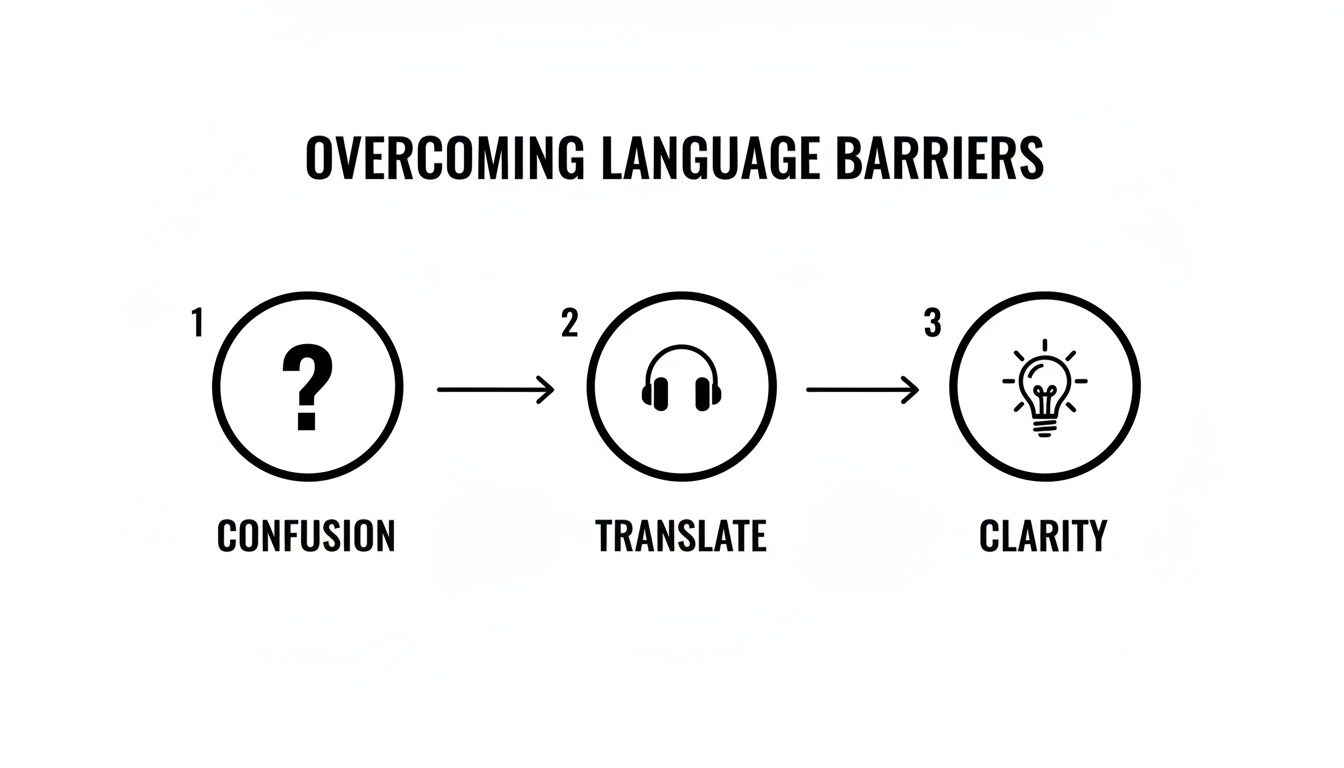
This simple flow captures the essence of the technology: turning a moment of misunderstanding into one of connection.
After the NMT brain figures out the best translation, the final step kicks in. This part is called Text-to-Speech (TTS), where the translated text is turned back into spoken words. The TTS system generates a natural-sounding voice that speaks the translation right into your ear, completing the loop. The whole point is to create a voice that’s clear and well-paced, making the conversation feel as smooth as possible.
Real-World Performance: Latency and Accuracy
In a perfect world, this entire process—listen, translate, speak—would happen instantly. In reality, there's always a tiny delay, which we call latency. This is the fraction of a second it takes for the audio to be captured, sent to the cloud, processed, and beamed back to your earbud. The best devices and apps aim for a latency under 0.5 seconds to keep conversations from feeling awkward and stilted.
Latency is that unavoidable pause between someone speaking and you hearing the translation. Tech is getting better at shrinking this gap all the time, but a small delay is just part of how these devices work for now.
Accuracy is the other half of the equation. Modern systems can hit up to 95% accuracy under ideal conditions—think quiet rooms with clear speakers. But in the real world, a few things can throw a wrench in the works:
- Background Noise: A loud café or busy train station can make it tough for the microphone to isolate the speaker's voice.
- Strong Accents and Slang: Thick regional dialects and super informal slang can sometimes confuse the AI.
- Internet Connection: Most real-time translation leans on powerful cloud servers to do the heavy lifting. A spotty or slow connection will increase latency and can even hurt the accuracy.
Knowing how the tech works under the hood helps you set realistic expectations and figure out which translation solution is truly the right fit for you.
Dedicated Devices vs. Translation Apps
When you start looking into real time language translator earbuds, you hit a fork in the road almost immediately. Do you shell out for a specialized gadget built to do one thing, or just use a powerful translation app with the earbuds you already own? It really boils down to what you value most: cost, convenience, or performance.
For some people, a dedicated device is the dream—an all-in-one, purpose-built tool. The hardware and software are designed to work together perfectly, often promising the lowest possible lag and microphones tuned specifically for picking up speech. It’s an appealing idea for frequent business travelers who just want a reliable gadget that only translates.
But that laser focus comes at a price, and not just the one on the sticker. Dedicated devices can be expensive, and they're one more thing you have to remember to buy, charge, and pack. This is where using a translation app on your phone becomes a seriously compelling alternative.
The Case for App-Based Solutions
The biggest advantage of using an app is that you probably already own everything you need: a smartphone and a pair of earbuds. This approach turns the gear in your pocket into a powerful translation system without dropping hundreds of dollars on new hardware. It's the most accessible and wallet-friendly way to start breaking down language barriers.
The numbers back this up. Recent stats show 72% of travelers say translation accuracy over 90% is a must-have, and 55% would rather use an app with their existing earbuds to avoid the $200+ premium on specialized hardware. As travel bounced back after 2020, searches for 'AI translator earbuds' shot up by 300% by late 2024, showing a massive public appetite for translation tech that doesn't break the bank.
Another huge plus for apps? They're always getting better. Developers can push out new features, add more languages, and improve the AI with a simple software update. Your translation tool evolves over time, whereas a piece of hardware can start feeling dated much faster.
Key Comparison Points
To help you figure out what's right for you, let's put these two options head-to-head. The best choice really depends on your priorities—whether you crave the sleek integration of a special gadget or the flexible power of an app.
Here’s a look at how dedicated devices stack up against using an app like Translate AI with your own earbuds.
Dedicated Translator Earbuds vs. App-Based Solutions
Choosing between specialized hardware and a translation app with standard earbuds is a key decision. This table breaks down the main differences to help you decide which path fits your travel style and budget.
| Feature | Dedicated Translator Earbuds | App-Based Solution (e.g., Translate AI) |
|---|---|---|
| Cost | Higher Initial Investment: Quality devices often run between $150 and $300. | Lower or No Hardware Cost: Works with the smartphone and standard earbuds you already own. |
| Convenience | Self-Contained: A single-purpose device that's ready to go once charged. No phone setup needed for its core function. | Highly Versatile: Your phone is your all-in-one travel tool; the app is just one more feature. |
| Performance | Optimized Hardware: Microphones and processors are fine-tuned for translation, which can sometimes result in lower latency. | Powerful and Evolving: Taps into your smartphone's powerful processor and benefits from continuous AI and software updates. |
| Language Support | Often Limited: Typically supports around 40 languages, with an even smaller selection available for offline use. | Extensive and Growing: Apps like Translate AI support over 80 languages, with more added regularly via updates. |
| Flexibility | Single-Purpose: It's a translator. That's pretty much it. | Multi-Functional: The app lives on the device you already use for maps, photos, and everything else. |
At the end of the day, you're weighing a perfectly integrated but limited device against a slightly less streamlined but far more flexible and affordable system. For most travelers, the power and adaptability of an app are pretty tough to argue with.
The Power of Translate AI with Your Earbuds
This is exactly where an app like Translate AI comes in. It was built to bridge that gap, giving you a top-tier translation experience without forcing you to buy special hardware. You can pair it with any earbuds you love—from AirPods to any other brand—and unlock clear, two-way conversations.
- Universal Compatibility: No need to worry if your earbuds will work. If they connect to your phone via Bluetooth, they'll work with the app.
- Massive Language Library: Talk to people in over 80 languages, which is far more than most dedicated translator devices offer.
- Ease of Use: The interface is dead simple. Just pick your languages, tap the button to speak, and let the app do the rest.
By going with an app-based solution, you're not just saving money. You're choosing a smarter, more adaptable tool that grows with technology. For a closer look at the best options out there, check out our guide on the best translation apps for travel in 2025. It's a full rundown to help you find the perfect match for your next adventure.
Essential Features to Look For
So, you're ready to pick a translation tool. It's easy to get lost in flashy marketing, but let's cut through the noise and focus on what actually matters for a clear, stress-free conversation. Whether you’re eyeing a pair of dedicated real time language translator earbuds or a flexible app, the core features are what will make or break your experience.
Don't feel overwhelmed by the options. We can break it down into a few key areas that simplify the decision. From language support to whether you need an internet connection, each feature plays a huge role in how useful your translator will be out in the real world.
Language Support and Accuracy
This is the most obvious place to start. A device or app might boast support for 100 languages, but that number is meaningless if it doesn't include the ones you actually need for your trip or business meeting. Always check the specific list.
Accuracy is just as critical. Look for solutions that claim 95% accuracy or higher, at least under ideal conditions. That level of precision is the difference between a smooth conversation and an embarrassing misunderstanding.
Remember that peak accuracy usually depends on a solid internet connection. The powerful, cloud-based AI models are far more nuanced than the trimmed-down offline versions packed into a device. Online performance is the best yardstick for a system's true potential.
It's no surprise this tech is booming. The global market for real-time language translator earbuds was valued at USD 1.5 billion in 2023 and is expected to rocket to USD 3.5 billion by 2031. Top players now offer models supporting up to 40 languages with impressive accuracy. However, be aware that the offline modes on budget models often lag, sometimes only supporting 13-20 languages. You can find more insights on this growing market over at Verified Market Research.
Connectivity: Online vs. Offline Mode
Your access to the internet while traveling will directly shape your translator's performance. Most of the high-quality translation magic happens in the cloud, which means you need a stable Wi-Fi or cellular connection for the best results.
But let’s be real—internet can be spotty. A reliable offline mode can be an absolute lifesaver in remote areas, on airplanes, or in cafes with sketchy Wi-Fi. When you're looking at offline features, ask these questions:
- How many offline languages? This list is almost always shorter than the online one. Make sure your target languages are on it.
- How good is the offline translation? Without the cloud, translations can be more literal and miss a lot of context. If you can, test it out to see if it’s good enough for basic communication.
- How easy is it to use? Downloading language packs for offline use should be simple and shouldn't gobble up all your device's storage.
Battery Life and Durability
For a device you're counting on all day, battery life is everything. Look for earbuds and a charging case that give you a combined total of at least 15-20 hours of power. There's nothing worse than your translator dying right when you're trying to ask for directions.
Durability is another practical thing to think about. If you’re an adventurous traveler, find a model with some level of water or dust resistance. Your gear needs to handle the journey, whether that’s a sudden downpour or a dusty market street.
Advantage: App-Based Flexibility with Translate AI
While weighing all these hardware features, it’s worth remembering the freedom that an app-based solution offers. An app like Translate AI dodges many of these issues by using the powerful device you already have in your pocket: your smartphone.
- Battery: Your phone's battery is the only limit, and you’re probably already carrying a power bank for it anyway.
- Connectivity: It uses your phone's Wi-Fi or cellular data, which you’re already managing for your trip. No extra device to worry about.
- Language Updates: You get instant access to an ever-growing library of over 80 languages through simple app updates, not by buying new hardware.
By pairing a versatile app like Translate AI with the earbuds you already own and love, you get a powerful, adaptable, and cost-effective translation tool. This approach keeps you equipped with the latest tech without locking you into a single-purpose gadget.
Putting Translation Tech into Practice
Theory and technical specs are one thing, but how does this technology actually perform out in the wild? This is where real-time language translator earbuds and app-based solutions truly prove their worth, turning stressful situations into moments of genuine human connection.
From navigating a bustling market in Marrakesh to sealing a deal in Tokyo, the right tool can make all the difference.

Think about a solo traveler confidently ordering a specific dish at a family-run trattoria in Rome. Instead of just pointing at the menu, they're actually asking the owner for their recommendation. Or picture a business professional in Shanghai picking up on subtle conversational cues during a negotiation because the translation is both fast and accurate.
These aren’t futuristic fantasies. They're practical, real-world scenarios happening every day.
Real-World Scenarios and Use Cases
The impact of this technology goes far beyond just tourism. Consider an expat who needs to clearly describe symptoms to a doctor in a new country, or a student trying to keep up in an international workshop. In these moments, clarity isn't just a convenience—it's essential.
Here’s where this tech really shines:
- For the Global Traveler: Effortlessly asking for directions, haggling prices in a local market, or simply chatting with locals to get an authentic travel experience. A reliable internet connection is crucial for this, which is why it's smart to plan ahead. For more tips, check out our guide on how to get internet access while traveling abroad.
- For the Business Professional: Ensuring nothing gets lost in translation during client meetings, presentations, or international conferences. It helps you focus on the substance of the conversation, not the language barrier.
- For the Expat and Student: Handling daily errands, making appointments, and building relationships within a new community without the constant struggle of feeling misunderstood.
This technology isn't just about swapping words from one language to another. It's about empowering people to navigate important situations with confidence and independence.
Adoption is growing fast across different sectors. North America commands a 35% share of the market, driven by high smartphone use. Recent reports also show that 42% of global firms are now piloting AI translation wearables, which has helped slash miscommunication errors by 60% in multilingual teams. In education, university adoption has jumped 150% since 2022 to better support international student exchanges. You can find more insights on these market trends.
Why an App is Your Most Flexible Tool
While dedicated translator devices have their place, the sheer versatility of an app-based solution is often the more practical choice for these diverse situations. It means you can adapt to any conversation without being locked into a single-purpose gadget.
The true advantage of an app is its ability to turn the device you already carry—your smartphone—into a universal communication tool. It’s always with you, always updated, and ready for whatever conversation comes your way.
This is exactly where an app like Translate AI excels. It’s designed to transform your standard earbuds into a powerful translation device, giving you clear, on-the-go conversations.
- Spontaneous Conversations: Did you meet someone interesting at a hostel or a coffee shop? Just open the app, pick your languages, and start talking. There’s no friction.
- Multi-Purpose Tool: Your phone is already your camera, map, and travel guide. Adding a top-tier translator to its toolkit just makes sense.
- Cost-Effective Power: You get access to a massive library of over 80 languages and continuous AI improvements without having to shell out for expensive new hardware.
By using an app like Translate AI, you can confidently step into any conversation knowing you have a reliable and powerful tool right there in your pocket.
Using Translate AI with Your Earbuds
Look, for most of us, the best way to get real-time translation isn't to run out and buy a brand-new, single-purpose gadget. It’s about using the powerful little computer we already carry everywhere: our smartphone. App-based solutions are perfect for anyone who wants a flexible, affordable way to turn their existing phone and earbuds into a translation powerhouse.
This is exactly where the Translate AI app comes in. It’s built to work with the gear you already own, transforming any regular pair of earbuds into a tool for clear, two-way conversations.
The biggest win here is simplicity. You don't have to drop hundreds of dollars on specialized real time language translator earbuds. Instead, you can lean on an app that’s always getting smarter with new AI updates and a constantly growing list of languages.
Getting Started with Translate AI
Setting up Translate AI is dead simple, getting you into a real conversation in just a few minutes. The whole app is designed to be intuitive so you can focus on the person in front of you, not on fiddling with your phone.
Here’s the simple 4-step process to start translating:
- Download and Install the App: First, grab the Translate AI live translator from the App Store. It’s a quick install.
- Select Your Languages: Pop open the app and pick your language and the language of the person you're talking to. The app supports over 80 languages, so you're covered for almost any trip.
- Connect Your Earbuds: Pair your Bluetooth earbuds—AirPods or any other brand—to your phone just like you normally would.
- Start the Conversation: Tap the big microphone icon and start talking. The app captures what you say, translates it, and plays it for the other person. When they reply, you'll hear the translation whispered right into your earbuds.
This screenshot gives you a feel for the app's clean, no-fuss interface. You’ve got your language selectors right at the top and a clear microphone button to kick things off. It’s all designed to get out of your way so you can start talking with just a couple of taps.
Why This Approach Works So Well
Using an app like Translate AI has some real advantages that just make sense for modern travel and work. It's a system that bends to your needs, rather than making you buy new hardware.
The real power of an app-based solution is its versatility. You get a world-class translation experience that evolves with software updates, ensuring you always have the best technology without being locked into a single-purpose gadget.
This method gives you a few key benefits:
- Universal Compatibility: It works with pretty much any earbuds you already have. No need to buy new gear.
- Extensive Language Support: With access to over 80 languages, you’re ready for conversations almost anywhere on the planet.
- Continuous Improvement: The AI models get regular tune-ups and features are always being added, which means your translator actually gets better over time.
By pairing the convenience of your phone with a powerful translation app, you get a solid, reliable way to break down language barriers. If you want to dig deeper into how it all works, you can find more on the official Translate AI website. This approach puts you in the driver's seat, making global communication feel easy and accessible.
Still Have Questions? Let's Clear Things Up
You've got the basics down, but a few questions always pop up before deciding. Here are some quick, honest answers to the most common ones we hear.
How Accurate Are These Things, Really?
In a quiet room with someone speaking clearly, the best translator earbuds and apps can hit up to 95% accuracy. It's pretty impressive.
But let's be real—travel is rarely a quiet room. Heavy accents, fast talkers, local slang, and the noise of a busy market will absolutely lower that number. They're fantastic for navigating daily travel or business chats, but I wouldn't rely on them for a high-stakes legal negotiation where every single word is critical.
Do I Absolutely Need an Internet Connection?
For the best quality, yes. Most of these translation tools need an active internet connection (Wi-Fi or cellular data) to work their magic. This lets them tap into powerful cloud-based AI engines, which deliver the most accurate and natural-sounding translations across the widest range of languages.
Some dedicated translator earbuds and a few apps offer limited offline translation for a handful of major languages. Think of it as a great backup plan for the subway or a remote area, but the quality and language options are almost always better when you're online.
Can I Use Them to Translate a Phone Call?
This is a classic "it depends" situation. A few high-end translator earbuds are built specifically for translating phone calls, making them a huge asset for international business.
Most solutions, however, especially app-based ones like Translate AI, are designed for face-to-face conversations where your phone's mic can pick up both voices. If you want to translate a phone call with an app, you'd usually need to put the call on speakerphone so the app can "hear" the other person and do its job.
Ready to turn the earbuds you already own into a powerful translator? With Translate AI, you can have clear, two-way conversations in over 80 languages without dropping hundreds on new hardware. Download Translate AI from the App Store today and start talking to the world.