

What Is Machine Translation? Your Guide to How It Really Works
Ever pointed your phone's camera at a menu in a foreign country and watched the words magically morph into your own language? Or maybe you've tried to chat with a new friend online who speaks a different language. If you've ever felt that frustrating wall of a language barrier, you've looked for a solution—and that solution is machine translation (MT).
This guide is designed to show you exactly what machine translation is, how it works, and how you can use it confidently to break down those barriers. At its core, MT is the process of using artificial intelligence to automatically translate text or speech from one language to another, no human intervention required.
Decoding the Magic of Instant Translation
Machine translation is one of the most practical and widespread uses of AI in our daily lives, completely changing how we connect across borders. It's not just a fancy digital dictionary that swaps words one by one.
Think of modern MT as a skilled interpreter. Instead of just looking at individual words, it analyzes the entire context of a sentence to figure out what it really means. Only then does it generate a translation that sounds fluent and natural.
This ability to grasp context is what makes today's translation tools feel so much more human and accurate than the clunky versions we had just a decade ago.
Machine Translation at a Glance
Let's quickly break down what machine translation is all about.
| Aspect | Simple Explanation |
|---|---|
| What It Does | Automatically converts text or speech from a source language to a target language. |
| How It Works | Uses artificial intelligence (specifically neural networks) to analyze context, meaning, and grammar. |
| Primary Purpose | To break down language barriers and make global communication accessible to everyone. |
Essentially, it's technology designed to solve one of the oldest human challenges: understanding each other.
The Core Purpose of Machine Translation
At its heart, machine translation exists to tear down the language barrier. Its main goal is to make information and communication accessible to anyone, no matter what language they speak. This technology helps people and businesses in a few huge ways:
- Instant Communication: It enables real-time conversations with people from different cultures, whether you're traveling, sitting in a business meeting, or just making a new friend online.
- Access to Information: It opens up a world of content that was previously locked away, from foreign news sites and academic papers to product reviews and social media posts.
- Global Scalability: For businesses, it's an affordable way to reach international customers by translating websites, product details, and support documents.
Machine translation bridges the gap between languages, making global interaction more seamless and immediate than ever before. It has grown from a niche scientific experiment into an essential tool for daily life.
From Simple Text to Real-Time Voice
This tech isn't just for translating blocks of text on a website anymore. Recent breakthroughs have made it possible to translate spoken words, instantly. This is where the power of MT gets personal.
Live voice translation apps effectively turn your smartphone into a universal translator, allowing for fluid, two-way conversations. You can speak in your native tongue, and the person you're with will hear the translation in theirs almost immediately.
This is a game-changer for travelers navigating new cities, a situation where having the right tool can make all the difference. If you're planning a trip, checking out some of the best translation apps for travel in 2025 can show you just how helpful this technology can be.
Understanding what machine translation is today sets the stage for appreciating just how far it's come—from rigid, rule-based systems to the sophisticated AI that powers the tools we now can't imagine living without.
The Journey From Clunky Rules to Fluent AI
The seamless translation you get from an app today didn't just appear out of nowhere. It's the result of a long, fascinating journey, moving from clunky, dictionary-like systems to the fluid, context-aware AI that now fits in our pockets. This wasn't just a small upgrade; it was a complete shift in how machines think about language.
The story really kicks off with a burst of optimism during the Cold War. In a famous 1954 demonstration, the Georgetown–IBM experiment managed to translate about 60 Russian sentences into English. This got people excited, with some predicting that fully automatic translation was just a few years away. That excitement quickly wore off as researchers slammed into the wall of just how messy and complex human language is. Early systems just couldn't get past basic word-for-word swaps. You can dive into the full history of machine translation to see how those first steps set the stage for everything that came later.
The Era of Rule-Based Machine Translation
The first serious attempt was Rule-Based Machine Translation (RBMT). Picture trying to translate a sentence by hand, using a massive grammar rulebook and a dictionary for both languages. That's pretty much what RBMT did.
Linguists and programmers would team up to create gigantic, complex sets of grammatical rules and huge bilingual dictionaries. The system would then try to parse a sentence based on these rules and rebuild it, piece by piece, in the new language.
It sounded logical, but the results were often painfully literal and awkward. RBMT systems had a terrible time with idioms, slang, or any of the countless exceptions that litter every language, leading to translations that felt robotic and just plain wrong.
The Shift to Statistical Probability
By the 1990s, a much smarter approach started to take over: Statistical Machine Translation (SMT). Instead of trying to teach a computer grammar rules, SMT acted like a master pattern-finder.
It worked by feeding the system enormous databases of texts that had already been translated by humans (called bilingual corpora). By analyzing millions of these sentence pairs, the system learned the statistical probability that a certain word or phrase in one language would correspond to a word or phrase in another.
SMT didn't "understand" grammar like we do. It was all about making highly educated guesses based on the data, essentially asking, "Given the millions of times I've seen this phrase before, what's the most likely way a human would translate it?"
This was a huge leap forward. SMT produced far more natural-sounding translations than RBMT ever could because it was learning from real human language, not a set of rigid, pre-programmed rules. This is the tech that made machine translation genuinely useful for the first time, powering major web services in the mid-2000s.
The Dawn of Neural Machine Translation
The latest and most powerful chapter in this story is Neural Machine Translation (NMT), which really began to change the game around 2014. This approach is modeled loosely on the way the human brain works, using interconnected networks of artificial "neurons" to process language.
Unlike SMT, which chopped sentences into smaller phrases, NMT looks at the entire sentence as a single unit. It reads the source text, captures its full meaning and context in a complex mathematical form, and then generates a brand new sentence from scratch in the target language.
This holistic approach is what gives modern translation its magic. NMT can:
- Understand Context: It gets the nuance of a full sentence, leading to translations that are not just accurate, but also make sense.
- Handle Complex Grammar: NMT models learn grammatical structures organically from all the data they're trained on, so they don't need to be told the rules explicitly.
- Produce Human-Like Text: The output from NMT systems is often so smooth it can be tough to tell it wasn't written by a person.
This is the technology that powers the advanced translation tools we all rely on today. It’s what makes real-time, high-quality communication across different languages a daily reality for millions of people around the world.
How Neural Networks Learned to Translate
So, how does a machine actually learn a language? The real magic behind modern translation isn't just about swapping words; it’s about understanding meaning. This is where Neural Machine Translation (NMT) comes in, an approach that works a lot like a skilled human interpreter.
Imagine an interpreter listening to a full sentence, getting a complete mental picture of what it means, and then describing that picture fluently in another language. NMT models do something very similar. Instead of just matching statistical patterns, they process the entire context of a sentence to capture its underlying meaning before even starting to generate a translation.
This is what makes the results in today's best translation apps feel so fluid and human-like.
The Encoder-Decoder Architecture
At the heart of NMT is a clever two-part system called the encoder-decoder architecture. Each part has a very specific job, and together, they mimic the human process of understanding and then speaking.
-
The Encoder: This is the "reader." Its job is to process the source sentence—say, in English—and compress all of its meaning, grammar, and context into a dense mathematical representation called a vector. You can think of this vector as the machine's "mental picture" of the sentence's meaning.
-
The Decoder: This is the "writer." It takes that vector from the encoder and uses it as a blueprint to generate a brand new sentence in the target language, like Spanish. It builds the translation word by word, making sure it’s grammatically correct and faithfully reflects the original idea.
This two-step process was a huge leap forward. For the first time, a machine could consider the whole sentence at once, rather than just translating in small, disconnected chunks.
This infographic shows how machine translation technology has progressed through these different stages.
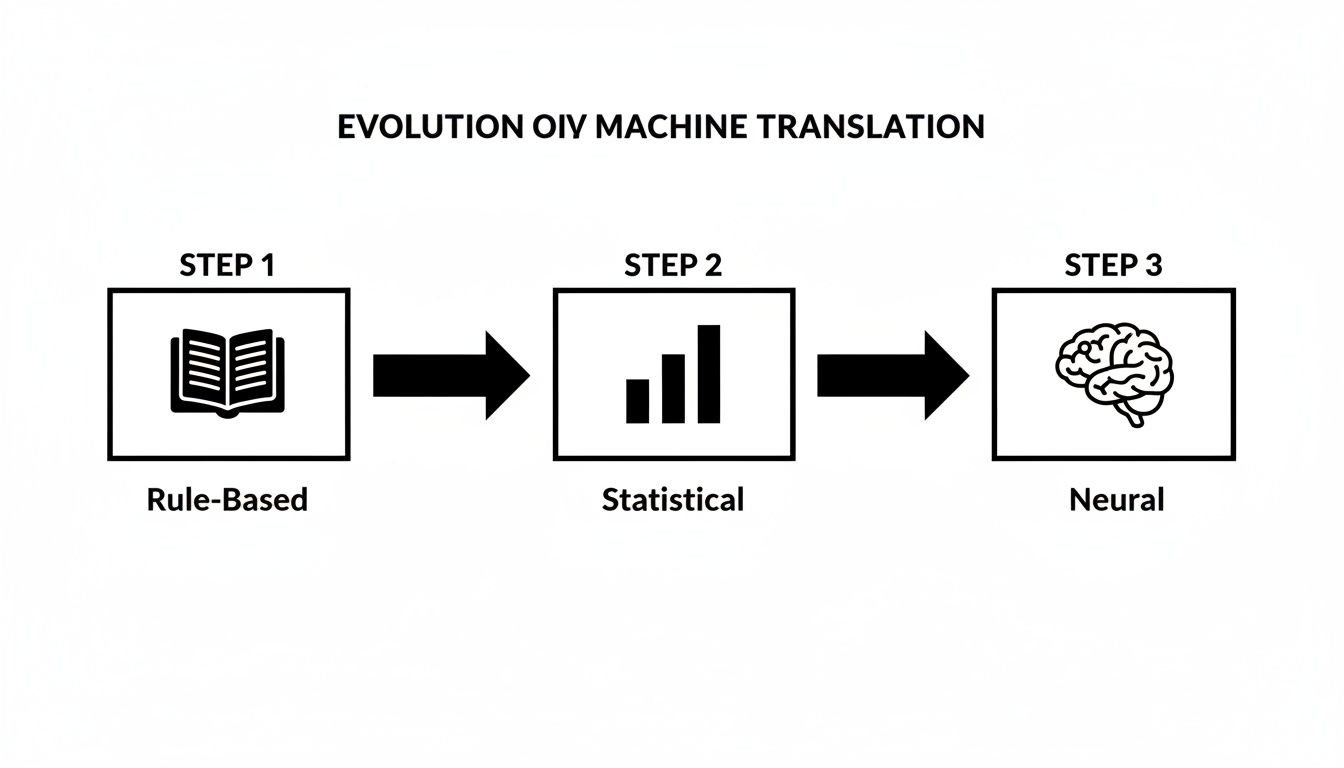
The visualization clearly shows the jump from rigid, rule-based systems to the more sophisticated and context-aware neural networks that power modern translation.
The Breakthrough Attention Mechanism
While the encoder-decoder model was powerful, early versions had a pretty big weakness. The encoder had to cram the meaning of a very long sentence into a single, fixed-size vector. This was like asking our human interpreter to remember every single detail of a long, complex story after hearing it just once—some details were bound to get lost in the process.
This is where the attention mechanism came in. Introduced around 2014, this addition completely changed the game. It allows the decoder to "look back" at the original sentence as it builds the translation and "pay attention" to the most relevant words at each step.
For example, when translating the Spanish word "ella," the attention mechanism helps the decoder focus on the English word "she." When it gets to the verb, it might focus on the action word from the original text.
The attention mechanism acts like a translator's selective memory. It lets the model zero in on specific parts of the source text right when they're needed, ensuring no crucial detail gets lost, especially in longer sentences.
This simple but brilliant idea dramatically improved the accuracy and fluency of NMT, making it the gold standard for machine translation.
How NMT Powers Your Favorite Apps
The modern understanding of machine translation is inseparable from this shift from rule-based to statistical and then to neural approaches. It was around 2014 that landmark research introduced NMT, which used deep neural networks to model entire sentences rather than just isolated phrases. Baidu launched the first large-scale NMT system in 2015, and Google followed suit in 2016.
NMT systems typically require just a fraction of the memory of older SMT models while delivering far more fluent, human-like output. For anyone using live voice translation tools, this evolution matters directly: the same neural architectures that power global web services now run on-device or cloud speech-to-speech translation. You can learn more about the evolution of translation technology and how it impacts the tools we use daily.
Actionable Tip: Try a Modern NMT App
The best way to see this technology in action is to use it. An app like Translate AI leverages this advanced NMT to provide real-time, conversational translations that feel natural. By understanding context and nuance, the underlying models turn your phone into a true universal translator, letting you have fluid, two-way conversations without awkward pauses.
Where Machine Translation Is Changing Lives Today
So, we've walked through the evolution from clunky, rule-based systems to the neural networks humming away on servers today. But what does all that technical history mean for you, right now? This technology isn't just an abstract concept for developers; it's actively tearing down language barriers for millions of people every single day.

Machine translation has exploded beyond those simple text boxes on websites. It’s scaled from a niche tool into a global market worth tens of billions, a growth spurt directly tied to globalization. With hundreds of millions of people traveling, working, or studying abroad each year, the demand for instant communication has never been higher. You can dig deeper into the history and impact of MT on nimdzi.com.
Navigating the World with Confidence
Picture a traveler, let's call her Alex, wandering through a vibrant market in Tokyo. The sights and sounds are incredible, but the language gap is a real wall. She spots a beautiful, handmade ceramic bowl she wants to buy from a local vendor, but she has no idea how to ask the price or bargain respectfully.
Instead of flipping through a worn-out phrasebook, Alex just pulls out her phone and opens a live voice translation app. She speaks into it, "How much is this beautiful bowl?" and the app immediately plays her question in fluent Japanese. The vendor replies, and Alex hears the translated answer in her own ear: "It is three thousand yen, a very special price for you." Just like that, a moment of potential anxiety becomes a successful, friendly exchange.
This is where modern MT shines, empowering travelers to:
- Engage Authentically: Go beyond just pointing and gesturing to have actual conversations with local people.
- Handle Practical Tasks: Breeze through everything from ordering food and buying train tickets to asking for directions.
- Travel Independently: Explore off-the-beaten-path destinations with the confidence that communication won't hold you back.
Bridging Gaps in Global Business
Now, let's shift gears to a business professional in New York. She’s leading a virtual meeting with her team in Brazil. Not too long ago, this kind of collaboration would have been a mess of delays—waiting for a human interpreter or trying to make sense of poorly translated meeting notes after the fact.
Today, real-time translation tools built right into meeting software can transcribe and translate every word as it’s spoken. The professional in New York speaks English, and her Brazilian colleagues see accurate Portuguese subtitles pop up on their screens instantly. This makes brainstorming fluid, feedback clear, and decision-making immediate. The distance just melts away.
By eliminating communication delays, machine translation accelerates international business operations, fosters better collaboration, and ensures everyone on a global team feels heard and understood.
Easing into Daily Life Abroad
For an expat living in Spain, machine translation is a daily lifeline. It’s not about the big, dramatic moments, but the countless small tasks that make up a life in a new country. They might use an app to chat with a neighbor over the garden fence, understand a notice from their child's school, or set up utility services over the phone.
Each of these little interactions, powered by MT, helps them build connections and weave themselves into their new community. The technology lifts the constant stress of misunderstanding, making the whole experience of living abroad less isolating and way more enjoyable. The evolution of this tech into tools like real-time language translator earbuds shows just how personal and integrated these solutions have become.
Actionable Tip: Put Real-Time Conversation in Your Pocket
This whole journey—from text boxes to live speech—has culminated in powerful tools designed for instant, natural conversation. Translate AI is a perfect example, built to turn your phone into a universal translator for smooth voice-to-voice dialogues.
It supports over 80 languages and works with the earbuds you already own, making it an ideal companion for travelers, professionals, and anyone needing to communicate on the go. You can experience this next step in translation by downloading the app directly from the App Store.
Knowing When to Trust AI Translation
Even though modern machine translation feels like something out of science fiction, it’s not perfect. Like any powerful tool, you get the most out of it when you understand its limits. Knowing where it shines and where it stumbles will help you decide when to trust it completely versus when you might need a human expert for something important.
The goal isn't to scare you away from these amazing tools. It's to help you become a smarter user. Once you know the weak spots, you can confidently use machine translation for the right tasks—like figuring out a menu in a new city or getting the general idea of an email—while steering clear of embarrassing mistakes.
Where Nuance Gets Lost in Translation
One of the biggest hurdles for even the smartest AI is picking up on the subtle layers of human communication. Translation models learn from mountains of text data, but they can still completely miss the delicate meanings that a human translator would catch in a heartbeat.
These slip-ups usually happen in a few key areas:
- Cultural Nuances: A phrase that’s perfectly polite in one culture can come across as blunt or even rude in another. AI often misses these unwritten social rules.
- Sarcasm and Humor: Witty comments and sarcastic jabs rely heavily on tone and shared context—two things that algorithms have a notoriously hard time interpreting correctly.
- Complex Idioms: While AI is getting much better with common idioms like "break a leg," it can get tripped up by more creative or obscure phrases that don't have a direct, one-to-one translation.
Machine translation is brilliant at conveying the literal, nuts-and-bolts meaning of a sentence. It’s the emotional and cultural subtext where it can fall flat. For creative marketing slogans or sensitive diplomatic messages, a human’s touch is still irreplaceable.
Protecting Your Privacy in a Translated World
Beyond just accuracy, there's another huge factor to consider: data privacy. When you type text or speak into a translation app, where does that information actually go? It’s a critical question, especially if you're dealing with anything sensitive or confidential.
Think twice before translating:
- Personal Information: Avoid typing in things like passwords, credit card numbers, or private medical details into just any online tool.
- Confidential Business Data: Company secrets, legal documents, or internal memos should never be run through a free, unsecured translation service.
The fix is pretty simple: stick with trusted apps that are upfront about how they handle your data. Reputable apps that are built with user security in mind, making sure your conversations stay private. Always give an app's privacy policy a quick look before using it for anything you wouldn't want to be made public.
Choosing the Right Tool for the Job
So, when is machine translation your best friend, and when should you hit pause? The answer comes down to one thing: context. It all depends on what you're translating and what the consequences are if something goes wrong. Think of it as a spectrum of risk.
A good rule of thumb is to weigh the content's purpose:
| Use Case | Recommended Approach | Why It Works |
|---|---|---|
| Low-Stakes Communication | Machine Translation | Perfect for understanding menus, asking for directions, or reading online reviews where getting the gist is all you need. |
| Internal Business Documents | MT with Human Review | Great for quickly translating internal emails or drafts, followed by a quick human check to make sure the key points are spot on. |
| High-Stakes Content | Professional Human Translation | Non-negotiable for legal contracts, official documents, creative marketing, or anything where precision and nuance are absolutely critical. |
Ultimately, knowing what machine translation is also means understanding its boundaries. Use it for its strengths—speed, convenience, and accessibility—and bring in human experts for the tasks that demand deep cultural insight and flawless accuracy. That way, you can navigate our multilingual world with both confidence and wisdom. For tasks like translating video content where accuracy and context are key, you can learn more about the different options by exploring our guide on professional video translation services.
Actionable Tip: Choose a Secure Translation App
For tasks that involve personal conversations, make sure to choose an app that prioritizes your privacy. Translate AI is built with user security at its core, ensuring your voice and text translations remain confidential.
Your Questions About Machine Translation Answered
Even after getting the basics down, you probably still have a few questions about how all this works in the real world. Let's tackle some of the most common ones to clear things up so you can use this tech with confidence.
How Accurate Is Modern Machine Translation?
For everyday situations, today's Neural Machine Translation (NMT) is surprisingly good, especially between common languages like English and Spanish. It’s more than capable of handling conversations, emails, and helping you understand an article online, usually capturing the right grammar and context.
That said, accuracy can take a hit with rare languages, creative writing like poetry, or highly specific technical jargon. For general travel or business chats, the results are solid. But if you're translating a critical legal document, getting a final review by a human is still a very smart move.
Will AI Translators Replace Human Translators?
It's looking more like a collaboration than a replacement. MT is a fantastic tool for raw speed and efficiency, churning through massive amounts of text that would be impossible for a person to translate alone.
But human translators are still essential for work that needs deep cultural understanding, creativity, or a specific emotional tone.
Think of MT as a powerful assistant that produces a solid first draft. The human expert then comes in to add the final polish, nuance, and critical thinking. This tag-team approach is called "post-editing," and it's quickly becoming the standard in the translation industry.
Is It Safe to Use Translation Apps for Private Information?
This really comes down to the app you pick. Established apps from well-known developers usually use encryption and have clear privacy policies to protect your data. The real risk comes from using those free, obscure online tools that might not have strong security.
Always be cautious before pasting in sensitive personal, financial, or confidential business information. It only takes a moment to check an app's privacy policy, and it’s well worth it to see how your data is being handled.
Can Machine Translation Understand Slang and Idioms?
It’s getting much, much better. Because modern NMT models train on enormous amounts of real-world text from the internet, they can often figure out common slang and idioms. For example, it will probably know that "break a leg" means "good luck."
However, it can still get tripped up by very new slang, hyper-regional dialects, or obscure phrases. This is one of the areas where the technology is still playing catch-up, and a human's cultural radar still has the clear advantage.
Actionable Tip: Put It All Together with Translate AI
The key is to match the tool to the job. For secure, real-time voice conversations, an app like Translate AI is built specifically for the demands of modern communication. Its focus on privacy and high-quality NMT makes it a reliable choice for travelers, professionals, and anyone needing to connect across languages.
Ready to break down language barriers in your own conversations? Translate AI turns your phone into a powerful, real-time voice translator, making communication feel natural and effortless. Experience the future of translation and connect with the world by downloading the app from the App Store today.