

Your Guide to Video Translation Services: How to Reach a Global Audience
You've poured hours into creating a fantastic video. The script is sharp, the visuals are stunning, and the message is powerful. But once it's live, it hits an invisible wall—the language barrier. For creators, marketers, and businesses, this means your amazing content is only reaching a fraction of its potential audience, locking you out of global markets.
Feeling stuck? You're not alone. The great news is that breaking down these barriers is more achievable than ever. This guide is your roadmap. We'll walk you through the specific, actionable steps to choose the right video translation services, making your content accessible and impactful for viewers worldwide.
Why Your Content Needs a Passport to Go Global

Your video content is a powerful asset, but what happens when it hits a language barrier? It stops dead in its tracks. For creators, marketers, and businesses, this invisible wall means missed opportunities and a much smaller audience than you could have.
These days, translating your video isn't just a "nice-to-have" — it's a core part of any real growth strategy. It’s about giving your content a passport to travel across borders, connect with new markets, and build real relationships with diverse communities.
Actionable Tip #1: Tap into Global Markets
The internet may have erased geographical lines, but language barriers are still very much there. Translating your videos opens the door to untapped markets and customer segments you previously couldn't reach.
Think of it this way: if your video is only in English, you're potentially ignoring over 75% of the world's internet users who speak other languages.
By providing content in a viewer's native tongue, you're showing respect and understanding. That small effort dramatically improves engagement and trust. This isn't just about swapping words; it's about making your story resonate universally, ensuring your message is both heard and felt, no matter where someone is watching.
The demand for multilingual content is skyrocketing. People don’t just prefer content in their own language—they expect it. Meeting this expectation is the first step toward building a truly global brand presence.
The Rise of AI in Video Translation
This global demand is fueling some incredible leaps in technology. The AI video translation market is seeing explosive growth, projected to jump from USD 2.68 billion to a massive USD 33.4 billion over the next decade. This boom is driven by the soaring need for multilingual content in entertainment, marketing, and e-learning. You can find more details on this fast-growing market over at market.us.
This shift is making professional-quality video translation services more accessible and affordable than ever before, putting global communication within reach for businesses of all sizes.
What Are Your Video Translation Options? A Practical Breakdown
Choosing the right way to translate your video can feel overwhelming. Do you need a simple, quick fix or a more immersive solution? It all comes down to your audience, your content, and your budget. Getting it right means your message won’t just be understood—it’ll actually connect.
Let’s walk through the main choices, so you can pick the best tool for your specific goal.
Subtitles and Captions: The Quick & Cost-Effective Win
This is the most straightforward and budget-friendly route. Subtitling is simply placing a text translation of the dialogue at the bottom of the screen. It's perfect for things like social media clips where people watch on mute, educational videos, or foreign films where you want to preserve the original actors' voices.
A close cousin to subtitles is closed captions (CC). They look similar, but captions were first designed for viewers who are deaf or hard of hearing. That’s why they include descriptions of other important sounds, like [door closes] or [dramatic music]. These days, with a whopping 80% of social media videos watched on mute, captions have become a must-have for just about everyone.
Voice-Over Narration: Clear and Professional
Think of a voice-over like an invisible narrator explaining things. The original audio is still there, just turned down low in the background, while a new audio track with the translated script is laid on top.
You see this all the time in documentaries, corporate training videos, and news reports. It’s a great middle-ground option—less distracting than reading subtitles but much cheaper than full-on dubbing because the new voice doesn't have to perfectly match the speaker's lip movements. It’s all about getting the information across clearly and efficiently.
Dubbing and Lip-Sync: The Most Immersive Experience
Here's where we get into the most immersive experience. Dubbing completely replaces the original audio with a new one recorded in the target language. Professional voice actors perform the translated script, carefully timing their words to match the on-screen characters' lip movements—a process called lip-sync.
This creates a seamless illusion. The audience feels like the characters are actually speaking their language, which is why it's the gold standard for big-budget movies and TV shows where emotional connection is everything.
To help you decide, here’s a quick-glance comparison of the main methods.
Comparing Video Translation Methods
| Method | Best For | Pros | Cons |
|---|---|---|---|
| Subtitles/Captions | Social media, e-learning, films, videos watched on mute | Cost-effective, fast turnaround, preserves original audio | Can be distracting, less immersive |
| Voice-Over | Documentaries, news, corporate training | Clearer than subtitles, cheaper than dubbing | Not lip-synced, original audio can sometimes be heard |
| Dubbing | Feature films, TV series, animated content | Highly immersive, seamless viewer experience | Most expensive, complex, time-consuming |
| Localization | Global marketing, culturally sensitive content | Maximum cultural relevance and engagement | Highest cost and effort, requires deep market knowledge |
Each of these has its place, but sometimes you need to go even deeper.
Full Video Localization: The Ultimate Adaptation
Localization is the final boss of video translation. It’s not just about swapping words; it’s about adapting the entire video to feel native to a specific culture. This is a much deeper process.
It can involve things like:
- Adapting visuals: Changing on-screen text, graphics, or even swapping out entire scenes to be culturally appropriate.
- Adjusting humor and idioms: What’s funny in one country might fall flat—or even be offensive—in another. Localization finds equivalent jokes and expressions.
- Modifying cultural references: Replacing examples or metaphors that wouldn't make sense to a new audience.
True localization makes your content feel like it was created for that market, which builds a huge amount of trust. It’s the most intensive option, for sure, but it delivers the biggest impact for global marketing campaigns. This goal of bridging cultural gaps is similar to what drives advanced communication tools; you can explore this further in our guide on how voice translation devices work.
The Journey From Source to Screen: A 3-Step Process
Ever wonder what actually happens when you hand a video over to a professional translation service? It’s not just a simple word swap. It’s a finely tuned production process designed to make sure the final product feels seamless and natural to a new audience.
Knowing this process helps you see the craft involved and, more importantly, helps you spot a quality provider from one that just cuts corners.
Step 1: Transcription and Translation
Before you can translate anything, you have to know exactly what was said and when. The first step is transcription, where a specialist meticulously listens to your video and creates a time-stamped script. This script is the blueprint for everything that comes next.
With the script in hand, a skilled linguist performs the actual translation. Their job is to capture the original speaker's tone, intent, and cultural nuances. A literal, word-for-word translation can often sound clunky or even lose the entire meaning, especially with complex subjects. If you want to go deeper on this, our article on English to German audio translation breaks down some of these tricky challenges.
Step 2: Timing and Synchronization
So, you have a translated script. Now the real technical magic begins: making it fit the video. This stage is all about timing and synchronization, where the new text or audio is perfectly aligned with the on-screen action.
This flowchart lays out the typical workflow for subtitles, voice-overs, and dubbing.
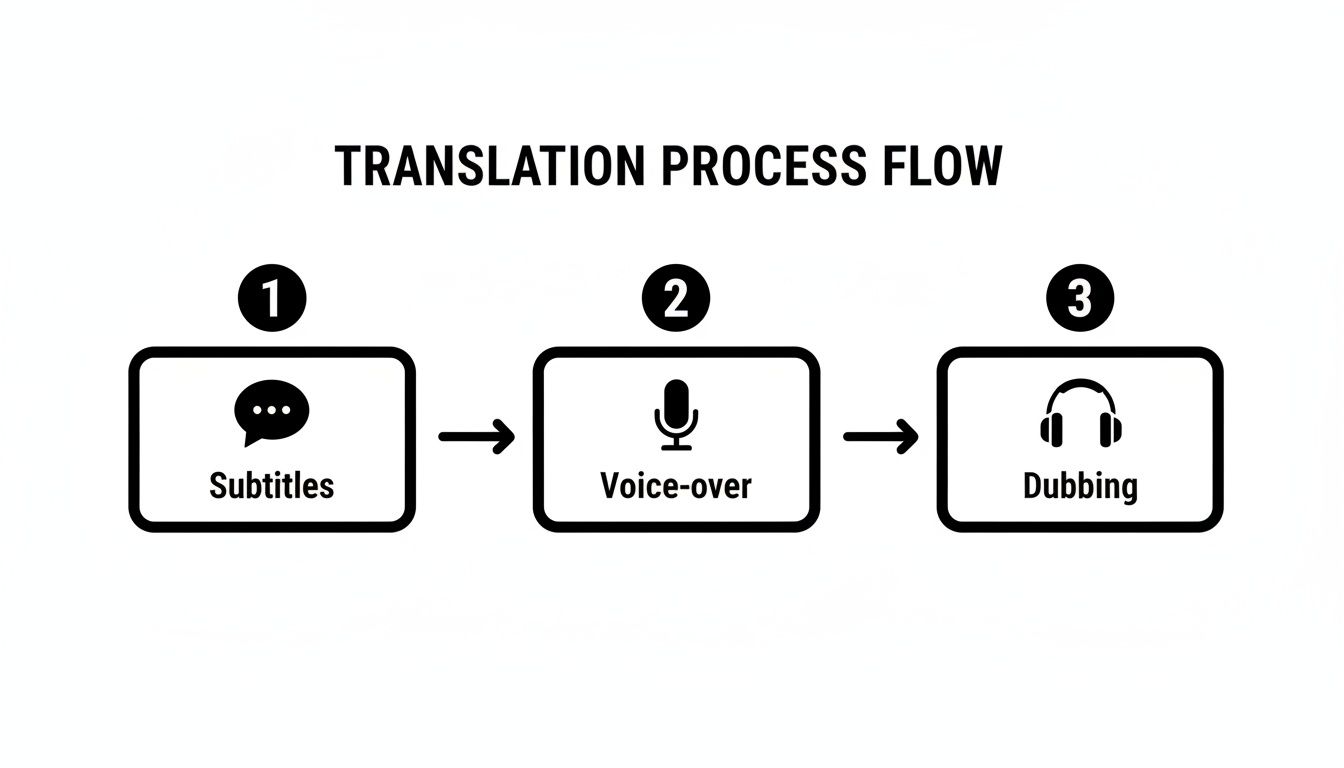
As you can see, no matter which path you take, getting the timing right is non-negotiable. For subtitles, this means text appears and disappears at the exact right moment. For dubbing, it’s an even greater challenge, as the voice actor’s performance must match the original actor's lip movements and emotions.
Step 3: Quality Assurance and Delivery
Finally, no project leaves the studio without a rigorous quality assurance (QA) check. A second linguist or a project manager watches the entire video from start to finish, hunting for any issues.
They’re looking for things like:
- Accuracy: Is every translation correct and context-appropriate?
- Timing: Does the new audio or text sync perfectly with the video?
- Technical Glitches: Are there any formatting errors, audio pops, or other weird bugs?
This final check is the safety net that catches small mistakes before they become big, embarrassing problems for your audience. It’s what guarantees the final video is polished, professional, and ready to make a great impression.
Once it gets the green light from QA, the video files are packaged up in whatever format you need and delivered.
Choosing Between Human Artistry and AI Speed
When it comes to translating your video, you have two main choices: a human expert or a smart algorithm. This isn't a simple "one is better" situation. It’s like choosing between a master chef and a high-tech kitchen robot. The right choice depends entirely on your goal.
A human translator is an artisan. They understand jokes, cultural nuances, and the emotional tone that makes your video connect with people. That human touch is priceless when nuance is everything.
AI, on the other hand, is all about speed and scale. It's like a futuristic assembly line, churning out translations at a pace and cost that humans simply can't match. This makes it a fantastic tool for big projects or when you need something done right now.
Actionable Tip #2: Know When to Invest in the Human Touch
Professional human translation is your go-to when your content needs to do more than just inform—it needs to persuade, entertain, or build a real connection.
You’ll want a human for things like:
- Creative Content: Think feature films, scripted shows, or marketing campaigns with a specific artistic vision.
- High-Stakes Business Communication: There's zero room for error when you're translating sensitive legal documents or critical financial reports.
- Deep Cultural Localization: If your script is full of idioms and specific humor, you need a human who can find the right local equivalent that lands perfectly.
Actionable Tip #3: Know When to Leverage AI Efficiency
AI-powered video translation has gotten incredibly good, making it a practical choice for a huge range of modern content needs. Even huge platforms like YouTube are using AI for auto-dubbing features. You can learn more about how new trends are reshaping the translation industry.
AI is an excellent choice for:
- Large-Scale Projects: Need to translate an entire library of e-learning courses or hundreds of product demos? AI can handle that volume quickly.
- Internal Communications: For company-wide training videos, AI offers a fast, functional way to get the message out.
- Time-Sensitive Content: When you need subtitles for a social media video that has to go live in an hour, AI is your best bet.
The smartest move is often a hybrid one. Many services now use AI for the initial heavy lifting, creating a first-pass translation that a human editor then polishes. This process, called post-editing, gives you the best of both worlds: the speed of a machine and the finesse of a human expert.
Enhance Your Workflow with the Translate AI App
While professional video translation services get your content ready for a global audience, what about the live interactions that follow? Say you've just shared a perfectly localized marketing video and now you're hosting a live Q&A with potential customers from around the world.
This is where real-time tools come in. An app like Translate AI can bridge that gap, offering seamless two-way voice translation that effectively turns your phone into a personal interpreter for those live conversations.
How to Find the Right Translation Partner

Choosing a video translation services provider is a critical decision. The right partner ensures your message lands authentically with a new audience. Making a smart choice starts with asking the right questions—not just about them, but about your own project.
First, define your "why." Is this video meant to sell, train, or entertain? A high-energy marketing video needs a completely different touch than a dense, technical e-learning module. Your goal is the single biggest factor in your decision.
Then, think about who you're talking to. A good partner will ask about your target viewers to help you side-step cultural landmines so your content feels natural and respectful.
Actionable Tip #4: Evaluate a Potential Provider with This Checklist
Once your goals are clear, use this checklist to size up potential partners:
- Industry Expertise: Do they understand your niche? Whether you’re in finance, healthcare, or gaming, you need translators who know the lingo. Bad terminology can kill your credibility.
- Quality Control Methods: Ask them to walk you through their quality assurance (QA) process. A reliable service will have a multi-step check, always ending with a final review by a native speaker.
- Technical Capabilities: Can they handle your video formats? Make sure they can work with your specific files and deliver the final product ready for YouTube, your website, or wherever else it's headed.
The broader language services market is huge and growing. Subtitling specifically is set to grow at a speedy 6.1% CAGR. This means you have more options than ever, but you also have to be extra careful to pick a good one. You can read up on these market trends at GlobeNewswire.
Extend Your Reach with the Translate AI App
A perfectly translated video is a fantastic starting point, but what about the real-time conversations that happen next? Say you’ve just shared a localized demo video and now you want to host a live Q&A with potential customers from another country.
This is where an app like Translate AI comes in. It provides smooth, two-way voice translation, essentially turning your phone into a universal translator. It’s the perfect tool to bridge the gap between your polished, pre-translated content and the spontaneous, active engagement that closes deals.
Check out the Translate AI app's features to see how it can complete your communication toolkit.
Your Next Step: Go Global
We’ve covered everything from the nuts and bolts of subtitling to the fine art of cultural localization. The key takeaway is this: reaching a global audience is no longer an impossible dream. With the right video translation services, it's entirely within your grasp.
You don’t need a grand, complicated strategy to get started. Just take one small, actionable step today.
Actionable Tip #5: Take That First Step
Find one video you’ve already made that could connect with people in a new market.
Think about who you want to talk to, then pick a translation method from this guide that fits your goal and budget. Is the nuanced work of a human translator the right call, or does the speed of AI make more sense for this first project?
Taking this one small step is the beginning of a much larger global conversation. It’s your first move toward transforming your content from a local message into a worldwide story.
That single action creates momentum. It gives you real-world feedback on what works, feeding valuable insights back into your larger international content plans. Every global brand you admire started with a single translation.
Bridge Gaps in Live Communication with the Translate AI App
A professional service can handle your polished, pre-recorded videos. But what about all the conversations that happen in the moment? The meetings, the calls, the quick chats? That’s where a tool like Translate AI fits perfectly alongside your main strategy, making sure no conversation gets lost in translation.
A Few Common Questions
Getting started can feel like a big leap, so here are a few quick answers to the questions that pop up most often.
How Much Should I Expect to Pay for Video Translation?
It depends. The price can swing pretty wildly based on what you need. Subtitling is almost always the most affordable route, usually billed by the minute. At the other end, professional dubbing costs the most because you’re paying for voice actors, studio time, and intensive audio engineering.
Other factors that affect the final quote:
- The Languages: Common language pairs (e.g., English to Spanish) are generally cheaper.
- Turnaround Time: A tight deadline will cost more.
- Human vs. AI: AI-powered services are often more budget-friendly than end-to-end human-led projects.
What’s the Real Difference Between Translation and Localization?
This is a great question. Translation is all about the words. Its job is to take the script from one language and convert it into another, making sure it’s linguistically accurate.
Localization, on the other hand, goes way deeper. It’s about adapting the entire experience so it feels native to the local audience. This means adjusting everything from on-screen text and graphics to humor, cultural references, and even date formats.
Think of it this way: Translation changes what your video says. Localization changes how your video feels.
How Long Does It Take to Translate a Video?
The timeline is all over the map. It comes down to the video’s length, the service you choose, and who you’re working with. For a quick social media clip, you could have AI-generated subtitles ready in just a few minutes.
But if you’re looking at a high-quality, human-led dub for a feature-length film, that can easily take several weeks. The best thing to do is chat with your provider upfront to get a realistic timeline for your specific project.
While professional video translation services get your content ready for a global stage, Translate AI is perfect for bridging communication gaps in the moment. Once you’ve shared that perfectly translated video, you can use the app for any live Q&As, follow-up calls, or client meetings that come next. See how you can complete your global communication toolkit with Translate AI on the App Store.