
What Is Simultaneous Interpretation? A Guide to Real-Time Translation
Ever watched a global summit on TV and wondered how leaders from different countries understand each other instantly? Or maybe you're planning a multilingual event and feel overwhelmed by the communication challenges. That magical, real-time translation you're witnessing is simultaneous interpretation, a powerful tool that bridges language gaps on the spot.
This guide will walk you through exactly what simultaneous interpretation is, how it works, and how modern technology is making this once-exclusive service accessible to everyone. By the end, you'll know which translation solution is right for your specific needs, whether it's for a massive conference or a simple conversation.
Breaking Down Real-Time Language Translation
At its core, simultaneous interpretation is about bridging language gaps almost instantly. Unlike other translation methods that have built-in pauses, this one is continuous. The interpreter is listening to the source language while, at the same time, speaking the translated message into a microphone for the audience.
It's a stunning display of mental gymnastics. Imagine trying to listen to a podcast while simultaneously summarizing it out loud for someone else—that’s the level of multitasking required. A simultaneous interpreter juggles three tasks in a continuous loop:
- Listen: They actively hear and absorb the speaker's words.
- Process: They instantly convert the meaning, context, and nuance into the target language.
- Speak: They deliver the translated message, all while the original speaker keeps on talking.
A Skill Forged in History
This remarkable skill isn't a new invention; it was born from sheer necessity. The modern practice of simultaneous interpretation was first used on a massive scale during the historic Nuremberg Trials after World War II.
Without this real-time method, experts estimate the trials, which lasted 11 months, would have dragged on for at least four years. It proved essential for efficient, multilingual justice. You can discover more insights about the history of simultaneous interpretation here.
This origin story highlights the core problem simultaneous interpretation solves: it keeps communication flowing in high-stakes environments, making events more efficient and inclusive. It ensures language barriers don't slow down critical proceedings, from courtrooms to corporate conferences. This foundation of human talent paved the way for the technology that now brings instant translation to everyone.
The Human Engine Behind Live Interpretation
Ever been at a large international conference and wondered how everyone follows along in their own language? Behind that seamless multilingual experience is an intense, high-pressure human process. Simultaneous interpretation isn’t magic; it’s a stunning feat of mental agility performed by highly trained professionals.
Here’s an actionable look at how it actually works.
The whole process starts inside a soundproof booth. This isn't just for show—it's a critical space that isolates the interpreter from every cough, whisper, and distraction. Inside, they can focus entirely on the speaker’s voice coming through their high-fidelity headphones.
Once the speaker begins, the interpreter kicks off a cognitive sprint. They listen to a phrase, process its meaning, and immediately start speaking the translation into a microphone, all while the original speaker is still talking. This continuous, overlapping loop is the essence of simultaneous interpretation.
This diagram breaks down the core mental steps an interpreter juggles in seconds.
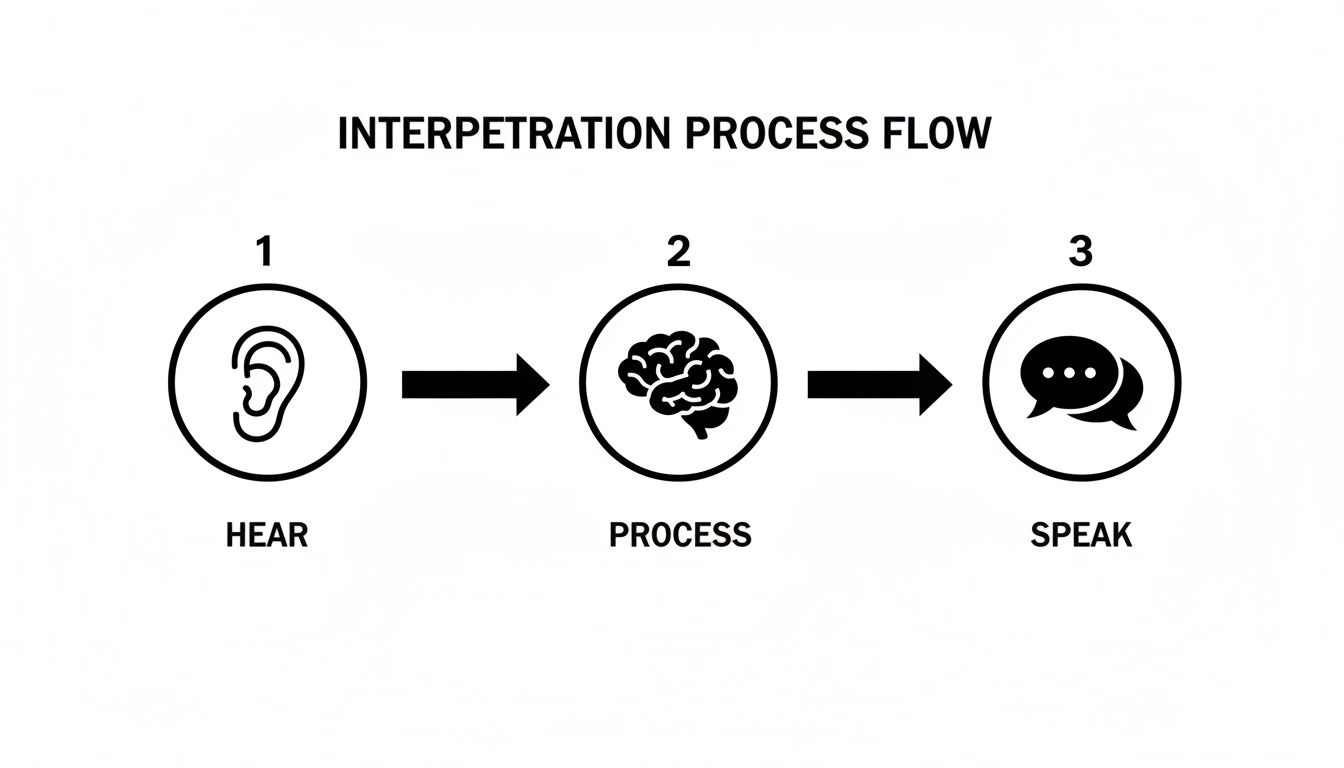
As you can see, it’s not a simple word-for-word swap. It’s a fluid cycle of hearing, deep cognitive processing, and articulate speaking.
The Art of Décalage
To pull this off, interpreters use a technique called décalage. This is the split-second delay between when they hear the original language and when they speak the translated version. Think of it as a video stream buffering just enough data to play smoothly; the interpreter "buffers" a few words to get the full context before committing to a translation.
This brief pause is everything. It allows the interpreter to:
- Grasp the complete thought or idiom.
- Restructure the sentence to sound natural in the target language.
- Avoid literal translations that would mangle the speaker's meaning.
Mastering décalage is what separates a good interpreter from a great one, ensuring the final output is both accurate and eloquent. It's a delicate balance. If the delay is too short, the translation might sound robotic. Too long, and they risk falling behind.
The cognitive load is so immense that interpreters almost never work alone. For any assignment longer than 30 minutes, they operate in teams of two, swapping every 20-30 minutes to stave off mental fatigue and keep their performance razor-sharp.
The Team Effort and Tech Hand-Off
While one interpreter is actively translating, their partner isn't just taking a break. The "off-air" interpreter is still locked in, actively listening, looking up unfamiliar terms, and ready to jump in to assist or take over without missing a beat. This teamwork is non-negotiable for maintaining quality during long events.
From their microphone, the translated audio is fired off to a central console. A technician then beams it wirelessly to the audience members, who wear headsets and can select the channel for their preferred language. It’s this intricate dance between human skill and specialized technology that makes real-time, cross-language communication possible on a massive scale.
Simultaneous vs Consecutive Interpretation
If you're facing a language barrier, it's crucial to know your options. While simultaneous interpretation is fantastic for fast-paced events, another common method is consecutive interpretation. Picking the right one isn't about which is "better"—it's about matching the method to the moment to solve your specific communication problem.
Think of it like this:
- Simultaneous interpretation is like a live news broadcast with a real-time voiceover. The goal is to keep information flowing to a large audience without pauses. It's ideal for international conferences, webinars, and UN-style assemblies where stopping would kill the momentum.
- Consecutive interpretation is more like a turn-by-turn conversation. The speaker says a few sentences and then pauses, giving the interpreter room to step in and deliver the translation. It’s slower and more deliberate, with the focus on meticulous accuracy.
Actionable Advice: When to Choose Each Method
Your setting and goal are everything here. For smaller, more intimate settings where every word must be captured with absolute precision, consecutive is often the perfect fit.
Choose consecutive interpretation for situations like:
- Medical Appointments: Ensure a doctor and patient are on the exact same page about a diagnosis, leaving zero room for misunderstanding.
- Legal Depositions: Create a crystal-clear, sequential record of questions and answers where accuracy is legally critical.
- One-on-One Business Meetings: Allow for thoughtful, detailed discussions during high-stakes negotiations.
In these scenarios, the pauses are a feature, not a bug. They give everyone time to process what’s being said and ensure complete agreement before moving on.
Simultaneous vs Consecutive at a Glance
To make the choice even clearer, this table gives you specific, actionable advice on the fundamental differences between simultaneous and consecutive interpretation.
| Feature | Simultaneous Interpretation | Consecutive Interpretation |
|---|---|---|
| Timing | Real-time, with only a few seconds of lag. | Listen first, then speak; happens during natural pauses. |
| Flow | Continuous and uninterrupted, like a constant stream. | Stop-and-start, just like a turn-based conversation. |
| Equipment | Needs special gear: booths, headsets, and microphones. | Often just a notepad and pen, sometimes nothing at all. |
| Best For | Large conferences, live broadcasts, and big multilingual events. | Medical consultations, legal proceedings, and small meetings. |
Getting this core difference right is the first step toward planning any successful multilingual event. It ensures the service you pick solves the communication problem your situation demands.
The Technology Powering Flawless Communication
Great interpretation isn't just about linguistic talent—it's backed by a specific technological ecosystem. If you're planning an event where language is a barrier, understanding these tools is essential. They all work together to create a seamless audio experience for everyone.
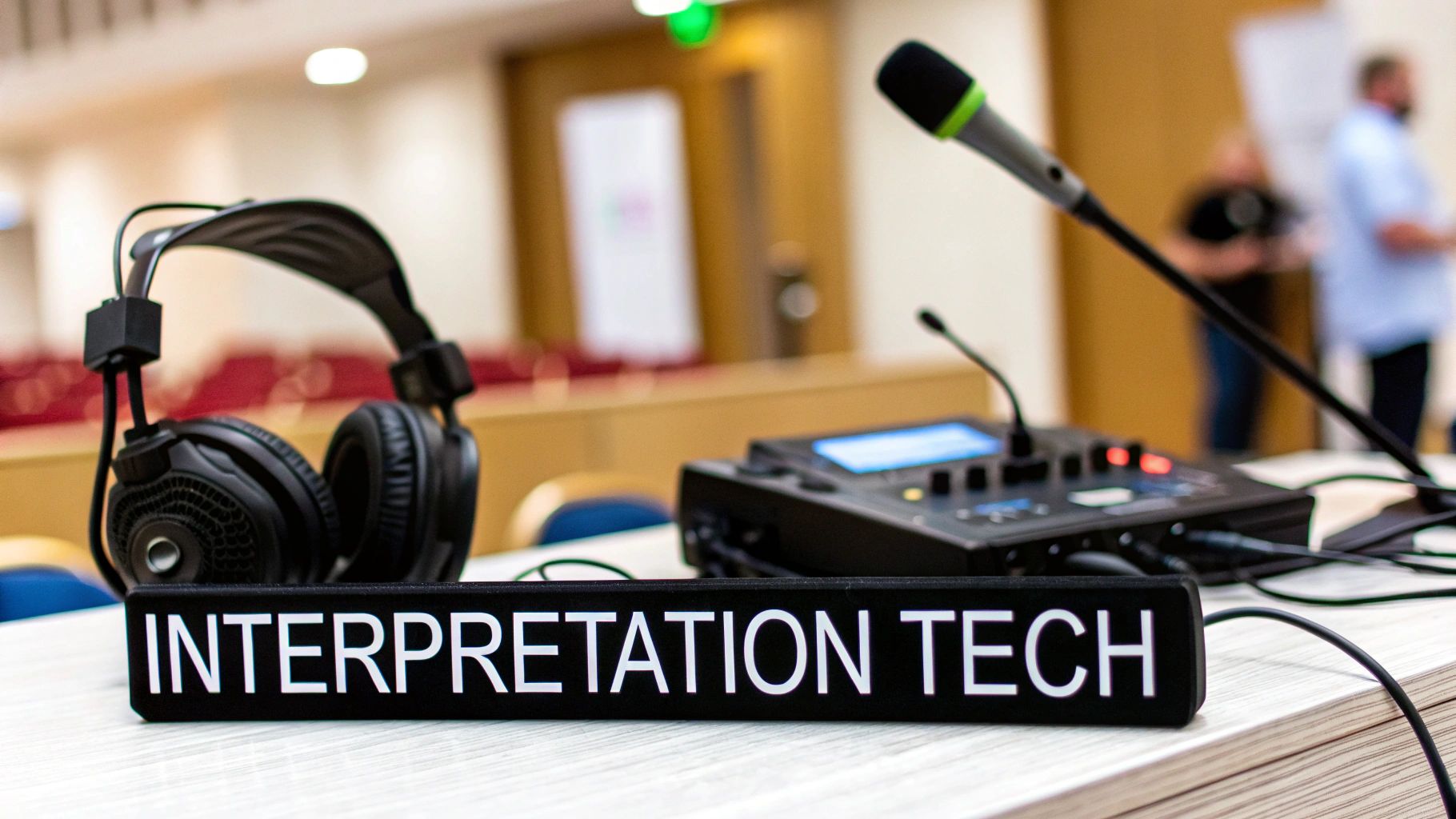
This setup is far more than a pile of gadgets. It’s a carefully designed system where every component plays a non-negotiable role in delivering clear, precise communication. Here’s a breakdown of what you need.
The Interpreter's Command Center
The first thing you'll probably notice is the soundproof booth. This is the interpreter's isolated workspace, a quiet bubble designed to block out every distracting noise. Inside this sanctuary, the interpreter can find the intense focus their job demands.
Inside the booth, these critical tools are always at hand:
- Interpreter Console: The control panel where interpreters switch between audio feeds, fine-tune volume, and communicate with their booth partner.
- High-Fidelity Headsets: Professional-grade headsets that deliver crystal-clear audio, ensuring the interpreter catches every word and nuance.
- Noise-Canceling Microphone: A microphone engineered to pick up only the interpreter's voice, transmitting a clean, crisp translation.
This controlled environment is essential for maintaining the high quality and accuracy professional simultaneous interpretation is known for.
The International Organization for Standardization (ISO) has specific standards for booth dimensions and sound insulation, showing how critical the physical setup is to the quality of the interpretation.
Delivering the Message to the Audience
Once the interpreter speaks, the technology gets that message to your audience. A transmitter sends the audio signal to individual receivers held by attendees. Each person gets a small receiver and headset, allowing them to tune into the channel for their preferred language.
This system ensures a diverse, multilingual audience can follow a presentation in real time, with each person hearing the message in their own language. Modern tech has also started making these capabilities more accessible. For instance, a live voice translation app can bring similar real-time features right to your smartphone, perfect for smaller, less formal gatherings.
How AI Is Making Instant Translation Accessible
For a long time, simultaneous interpretation was a tool for the elite—something you’d only see at the UN or high-stakes diplomatic meetings. It was powerful but out of reach for most people facing everyday language barriers.
Now, artificial intelligence is changing that. It’s putting the power of a real-time interpreter right into your pocket, making instant translation a reality for everyone, everywhere.
This isn’t about replacing highly skilled human interpreters. It's about bringing a similar capability to your daily life. Modern apps now use sophisticated algorithms to deliver live voice translation, and you don’t need any of the clunky, expensive hardware.
This shift is a lot like the one that happened after the Nuremberg Trials. While the idea for simultaneous interpretation was born in the 1920s, its widespread use after the trials slashed meeting times by a massive 60-75%. AI is creating that same kind of leap, but this time for you. You can read more about the history of simultaneous interpretation to see how big these technological jumps have been.
Bringing Interpretation to the Masses
AI-powered translation apps are tearing down the walls for travelers, expats, and anyone who needs to connect across languages without high costs or hassle.
Imagine trying to order food in another country, asking for directions, or having a spontaneous chat. These apps let you have fluid, back-and-forth conversations without awkward pauses.
Here’s the simple, three-step process they use:
- Catch what you say with advanced speech recognition.
- Translate the actual meaning, not just a word-for-word jumble.
- Speak the translation in a natural-sounding voice.
It smooths out the entire process, making it feel less like a transaction and more like a real conversation. We dive deeper into the tech behind this in our guide on what is machine translation.
Your Personal Interpreter on Your Phone
The most exciting part is how this turns your smartphone into a complete, portable translation system. All you need is your phone and a simple pair of earbuds. This means you can finally solve those on-the-spot language problems without needing to hire a professional or carry a phrasebook.
Try Translate AI for On-the-Go Conversations
Take the Translate AI app, for example. It lets two people have a conversation where each person hears the translation in their own language, almost in real-time. With support for over 80 languages, it’s a practical tool for just about any situation you could run into while traveling or working abroad. It’s no longer a futuristic dream—it’s an everyday tool.
Your Personal Interpreter for Everyday Conversations
Professional simultaneous interpretation is fantastic for big, formal events, but what about the rest of life? What about those day-to-day moments where you just need to understand and be understood? This is where technology has completely changed the game, turning your smartphone into a pocket-sized interpreter.
If you've ever struggled to negotiate a price in a market, ask for directions in a new city, or chat with a new neighbor, you know the frustration of a language barrier. AI-powered apps are built for exactly these spontaneous conversations, delivering seamless, two-way translations right to your earbuds. It makes real-world interactions feel natural and easy.
How AI Delivers Instant Understanding
This isn't just about clunky, word-for-word translation anymore. Modern AI apps provide context-aware translations that capture the real meaning. With support for over 80 languages and natural-sounding voices, the experience is miles away from the robotic exchanges of the past.
The whole point is to make it intuitive. You shouldn't have to fiddle with complicated settings when you're just trying to talk to someone.
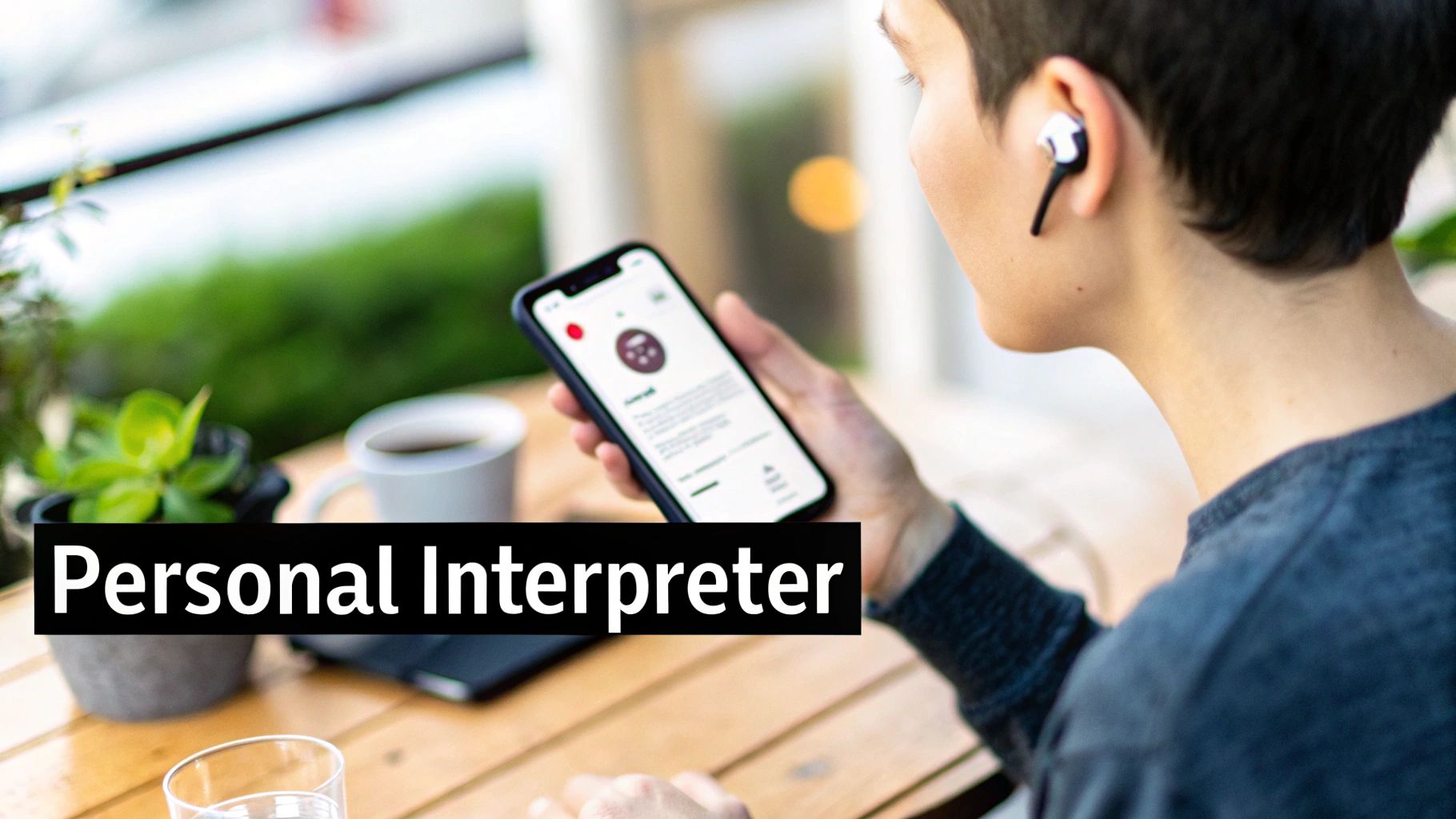
As you can see, the design is clean and simple. You just pick your languages and start speaking. This kind of accessibility is a massive deal for anyone trying to break down a language barrier on the spot. It's not just about translating words; it's about enabling genuine communication.
By putting this power in your hands, AI makes instant translation accessible for everyday situations that were previously hindered by language differences. It provides an immediate and practical solution for real-world interactions.
It's incredible how far this technology has come. We've moved from needing complex setups to having effortless translation in our pockets. If you're curious about the mechanics, check out our guide on how to translate conversation in real time. The focus now is on making sure you can understand and be understood, no matter where you are.
Your Top Questions About Interpretation, Answered
After diving into the world of simultaneous interpretation, you probably have a few practical questions. Let's get straight to the point with clear answers on cost, whether AI is taking over, and what it really takes to be a human interpreter.
How Much Does Professional Simultaneous Interpretation Cost?
Let's be upfront: professional simultaneous interpretation is a premium service. You're paying for an incredible level of human skill and focus. Typically, you can expect to pay anywhere from $500 to over $1,500 per day for a standard two-interpreter team handling one language pair.
Keep in mind, that price doesn't usually cover the hardware. Renting soundproof booths, headsets, and transmitters will be a separate cost. This makes it a perfect fit for high-stakes events like international conferences, but not a practical solution for daily business calls or your next vacation.
Can AI Actually Replace Human Interpreters?
While AI translation is a game-changer for most everyday conversations, it's not a complete substitute for human interpreters in every situation. Not yet, anyway.
Think of it this way: for incredibly sensitive or legally binding scenarios—like diplomatic summits, live court proceedings, or critical medical consultations—you still need the nuance, cultural awareness, and adaptability of a professional human interpreter. They can read the room in a way an algorithm can't.
AI's real magic is making instant translation accessible and affordable for the millions of other moments where a professional interpreter was never a realistic option.
So, it's less about replacement and more about expanding access. AI democratizes communication for the masses, while human experts continue to handle mission-critical assignments.
What Does It Take to Become a Simultaneous Interpreter?
Becoming a simultaneous interpreter is about more than just being bilingual. It’s an elite skill that demands a unique combination of talent and years of intense training.
Here’s an actionable checklist of what’s required:
- Total Fluency: Native-level mastery of at least two languages, including cultural quirks and slang.
- Ironclad Concentration: The ability to maintain laser focus for long stretches under serious pressure.
- Extreme Multitasking: They are literally listening, analyzing, translating, and speaking—all at the same time.
- Superhuman Short-Term Memory: They hold a speaker's thought in their head just long enough to reformulate it perfectly in another language.
Most top-tier interpreters have advanced degrees in conference interpretation and have spent years honing their craft. It's a demanding profession that ensures flawless communication when the stakes are highest.
Actionable Advice: How Do I Choose the Right Tool?
Picking between a human interpreter and an AI solution comes down to the job at hand. For a UN-style global conference, professional interpreters are non-negotiable. But for finding your way around a new city or having a spontaneous chat with a business partner overseas, a smart AI tool is the perfect fit.
For Everyday Communication, Try Translate AI
The Translate AI app was built for exactly those real-world moments. It puts a powerful, reliable interpreter right in your pocket, making it perfect for travel, casual meetings, and everyday conversations where you just need to connect. It makes seamless communication something everyone can have.
Ready to break down language barriers in your daily life? With Translate AI, you can have natural, real-time conversations in over 80 languages, directly through your earbuds. Download Translate AI today and start speaking the world's languages.