

Your Guide to Using a Voice Translator from English to Chinese
Ever found yourself in a bustling Beijing market, pointing awkwardly at a menu, or in a crucial Shanghai business meeting, struggling to connect? You're not alone. The language barrier between English and Chinese can feel like a massive wall, leading to missed opportunities and frustrating silences.
This guide is designed to solve that exact problem. Its goal is to give you specific, actionable advice on how to use a voice translator English to Chinese to have clear, confident conversations. Whether you're a traveler, a business professional, or a language learner, we'll show you how to turn your phone into a powerful communication tool.
Why Real-Time Voice Translation Is No Longer a "Nice-to-Have"
The need for instant, reliable communication is exploding. The market for the speech-to-speech technology that powers these real-time dialogues is projected to surge to USD 1.25 billion by 2031. That growth reflects a massive demand from travelers, professionals, and expats who need to turn awkward gaps into fluid conversations. You can read the full research on the speech-to-speech translation market for more details.
This guide will show you how to turn your smartphone into a powerful communication bridge. Our goal is to equip you with the practical steps needed for clear, real-time conversations. We will cover:
- How the tech works in simple, no-jargon terms.
- Practical scenarios where a voice translator is essential.
- Actionable tips to ensure your translations are accurate.
A voice translator is more than just software. It’s a key to unlocking authentic experiences, building stronger relationships, and navigating the world with confidence.
By the end of this guide, you will know exactly how to use these tools effectively to break down one of the world's most significant language barriers.
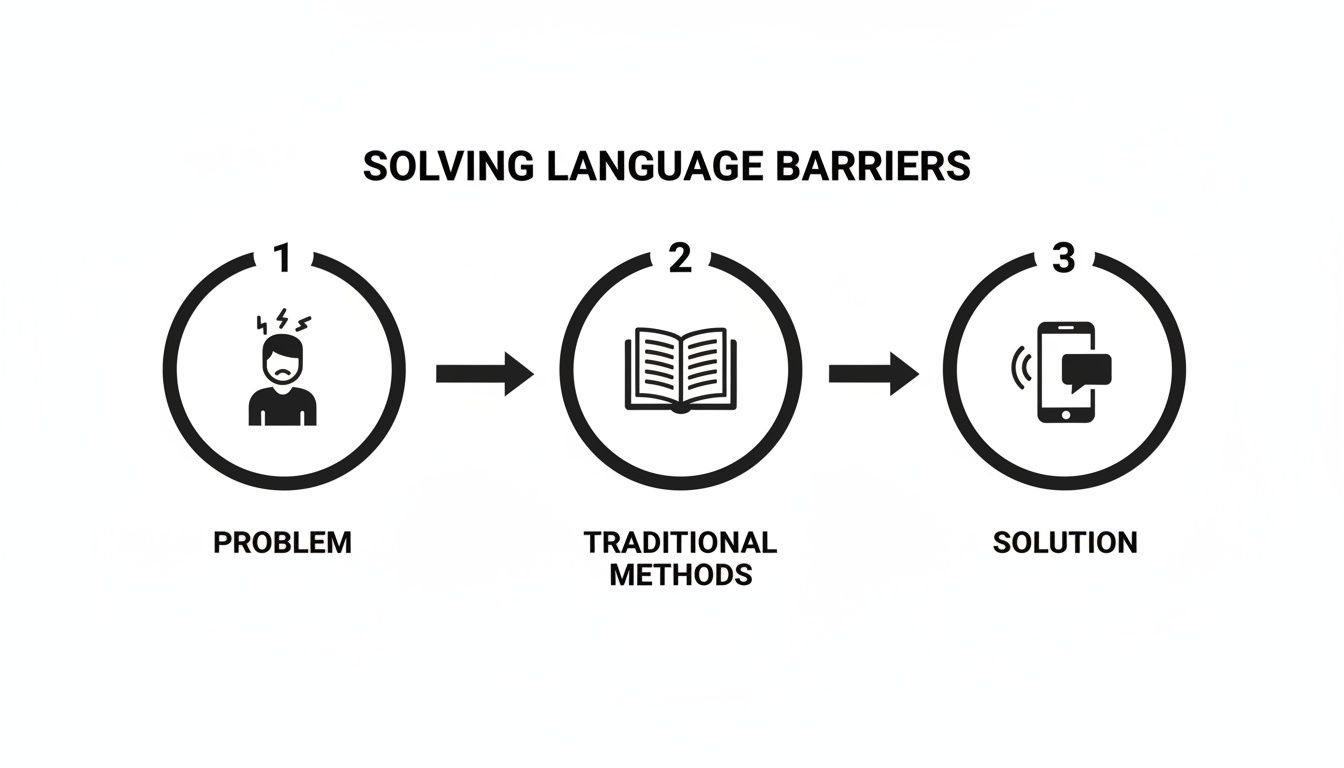
How Voice Translators Solve Common Communication Hurdles
Before diving into the technology, let's look at the specific problems these apps solve. For decades, travelers relied on phrasebooks, gestures, or expensive human interpreters. Modern tools offer a much more direct path to understanding.
Here’s how a voice translator provides a practical solution to common challenges:
| Communication Challenge | Traditional Method | Voice Translator Solution |
|---|---|---|
| Ordering food in a restaurant | Pointing at menus, using a phrasebook, or hoping for an English version. | Speak your order into the app; it plays the translation for the waiter. Use the camera to translate the menu instantly. |
| Asking for directions | Using gestures, showing a written address, or finding someone who speaks English. | Ask your question naturally; the app speaks the translated question and translates the response back to you. |
| Haggling at a market | Using a calculator, learning a few key phrases, or overpaying. | Have a real-time negotiation by speaking into your phone, making the process faster and clearer. |
| Small talk in a business meeting | Relying on a human interpreter, leading to stilted conversation. | Break the ice with direct conversation, building rapport before the formal meeting begins. |
| Handling an emergency | Frantically searching a phrasebook for "hospital" or "help," causing dangerous delays. | Immediately speak your needs to communicate with first responders or locals quickly and accurately. |
The shift is from slow, awkward methods to immediate, conversational ones. This technology doesn't just translate words; it enables fluid interaction.
How Real-Time Voice Translation Actually Works
Ever wonder what’s happening inside a voice translator for English to Chinese? It feels like magic, but it’s a sophisticated four-part process powered by artificial intelligence, all happening in a split second.
Think of it as a digital relay race. Each part has a specific job and passes the message along at lightning speed. Let's break down the steps.
Step 1: Automatic Speech Recognition (ASR)
The first step is listening. When you speak English into your device, Automatic Speech Recognition (ASR) technology converts the soundwaves of your voice into written text.
- What it does: It acts like a world-class stenographer, transcribing your speech with incredible speed.
- How it works: Modern ASR is trained on thousands of hours of audio to handle different accents, speaking speeds, and background noise.
Step 2: Neural Machine Translation (NMT)
Once your English words are text, they’re passed to the brain of the operation: the Neural Machine Translation (NMT) engine. This is where the actual translation happens.
- What it does: Instead of a word-for-word swap, NMT analyzes the entire sentence to understand grammar, context, and nuance.
- Why it's better: It knows the difference between "book a flight" and "read a book," finding the most accurate and culturally fitting equivalent in Chinese. You can learn more in our article on how machine translation works.
This technology is a massive and growing market. The machine translation sector is expected to be worth USD 668.3 million in 2025 and is projected to soar past $1 billion by 2032, with much of that growth fueled by China's global trade.
Step 3: Text-to-Speech Synthesis (TTS)
With the accurate Chinese text ready, a Text-to-Speech (TTS) engine gives the translated words a voice.
- What it does: It converts the translated text back into spoken audio.
- The result: Today’s TTS systems use AI to generate natural-sounding speech with human-like intonation, making the conversation feel much more comfortable.
The infographic below illustrates this entire journey.
These three steps—ASR, NMT, and TTS—work in harmony to make real-time conversation a reality.
Actionable Steps: Using a Voice Translator App
Theory is great, but what matters is how it works face-to-face. A solid voice translator English to Chinese app takes that complex technology and makes it simple to use.
The goal is an effortless experience. You don’t need to be a tech expert—you just need to connect. The process is just a few quick taps.
Your First English to Chinese Conversation: A 3-Step Guide
Ready to try it? Here’s how to start a real-time dialogue in seconds:
- Select Your Languages: Open the app and set your languages to English and Chinese (Mandarin). This tells the AI which way the conversation will flow.
- Start Speaking: Tap the microphone icon and speak clearly. The app begins translating on the fly.
- Enable Speaker Mode: For a natural, hands-free chat, turn on speaker mode. This lets both people hear the translations spoken aloud, creating a genuine back-and-forth flow without passing the phone around.
To learn more, check out our guide on how a live voice translation app can transform your interactions.
The Right Tool for the Job: Translate AI
To put these steps into action, you need a reliable app. Translate AI is designed for exactly these scenarios, offering a seamless and intuitive interface for real-time voice translation. It bundles powerful technology into an easy-to-use tool for travelers and professionals. You can find it on the App Store here: download Translate AI.
Putting Your Translator to Work in the Real World
A voice translator is a key that unlocks authentic experiences. Let's look at specific situations where a voice translator from English to Chinese becomes your most valuable partner.
Whether you're a tourist, a professional, or a student, these tools bridge the communication gap when it matters most.
For the Adventurous Traveler
Imagine wandering through Chengdu, drawn in by the aroma of street food. Instead of just pointing, you can have a conversation.
- Order with Confidence: Ask the vendor, "What's your most popular dish?" or "Is this very spicy?" in English, and they'll hear it in Mandarin.
- Navigate Like a Local: When lost in Shanghai's metro, asking "Which exit is closest to the Bund?" becomes stress-free.
- Haggle at the Market: Bargaining is part of the experience. A real-time translator makes the back-and-forth negotiation feel fluid and natural.
The technology empowers you to be an active participant in your travels.
For the Global Business Professional
In international business, clear communication is everything. A voice translator can be a powerful tool for building stronger relationships with Chinese partners.
The demand for this tech is massive. In 2021, China had 423,547 language service providers and 5.38 million language professionals, but finding specialized Chinese-to-foreign expertise can still be tough. AI-driven voice translation is filling that gap. You can learn more about the translation industry's size and scope.
Consider these business scenarios:
- Breaking the Ice: Use your translator for small talk about weather or culture before a meeting. This builds rapport and sets a positive tone.
- Clarifying Details: Instantly translate a phrase like, "Can you confirm the payment terms for this shipment?" to ensure both sides are aligned and avoid misunderstandings.
- Conducting Site Visits: While touring a factory, ask questions directly to on-site staff without needing a human interpreter for every detail.
For the Dedicated Language Learner
Learning Mandarin is a serious undertaking, and practice is essential. A voice translator can act as an interactive practice partner.
- Pronunciation Practice: Speak a phrase in Chinese and listen to the AI-generated voice repeat it. This provides instant feedback on your tones and pronunciation.
- Building Conversational Confidence: Start low-stakes conversations with native speakers. If you get stuck on a word, the translator helps you find it, keeping the conversation flowing.
Tips for Achieving Crystal-Clear Translations
Even the best voice translator English to Chinese app needs clear input to deliver accurate results. If you mumble or use broken phrases, the AI will struggle to understand you.
A few simple adjustments to how you speak can make a massive difference. The goal is to give the AI the clearest signal possible.

Speak Clearly and Simply
The single most important action you can take is to speak clearly at a moderate pace.
- Enunciate Your Words: Pronounce each word distinctly.
- Maintain a Steady Pace: Avoid speaking too fast. Aim for a calm, measured rhythm.
- Pause Between Sentences: Natural pauses act like punctuation, signaling where one idea ends and the next begins.
- Avoid Slang and Idioms: English is packed with phrases like "it's raining cats and dogs" that don't translate directly. Stick to straightforward language.
The principle is to reduce ambiguity. The more directly you state your meaning, the less guesswork the machine translation has to do, leading to a more precise output.
Use complete, grammatically sound sentences that express one clear thought at a time.
Manage Your Environment
Context and background noise play a huge role in translation quality.
- Provide Context: Instead of just saying "Book," which can be a noun or a verb, say "I want to book a table for two." This extra information guides the AI to the correct translation.
- Minimize Background Noise: Traffic, loud music, or a bustling crowd can scramble the microphone's ability to pick up your voice. Find a quieter spot before you speak.
To learn more about mastering conversations, read our guide on how to translate a conversation in real time.
Dos and Don'ts for Accurate Voice Translation
Here’s a quick reference guide to improve your translation experience.
| Best Practice (Do) | Common Mistake (Don't) |
|---|---|
| Speak clearly and at a moderate pace. | Don't mumble or speak too quickly. |
| Use simple, direct language. | Don't use slang, idioms, or jargon. |
| Speak in complete sentences. | Don't use sentence fragments or single words. |
| Minimize background noise. | Don't try to translate in a loud, crowded area. |
| Provide context when needed. | Don't use ambiguous words without clarification. |
Following these simple rules will dramatically improve your results.
A Word on Privacy and Security with Translation Apps
When you use a voice translator for an English to Chinese conversation, you’re trusting an app with your words—from travel plans to sensitive business details. This raises important questions: How is my data handled? Is it secure?
Understanding these factors is key to using these tools with confidence. A recent survey found that 79% of users worry about how companies use their data, which puts the spotlight on app developers to be transparent.
On-Device vs. Cloud-Based Processing
One of the biggest differences affecting privacy is where the translation happens.
-
On-Device Processing: Everything happens right on your smartphone. Your conversations never leave your device, offering the highest level of privacy. This is ideal for confidential information. The trade-off is that you often need to download large language files.
-
Cloud-Based Processing: This is more common. Your voice data is sent to powerful servers for analysis, resulting in more accurate and nuanced translations. With this method, it's crucial to understand the company's data policies.
When an app sends your data to the cloud, strong encryption is non-negotiable. Always check that the app uses end-to-end encryption to shield your conversations.
What to Look for in a Privacy Policy
A clear privacy policy is a sign of a trustworthy app. A reputable voice translator English to Chinese should be upfront about how it handles your information.
Look for answers to these questions:
- Is my conversation data stored? See if the app keeps a record of your translations.
- Is my data anonymized? Anonymization strips out anything that could identify you from your data.
- Is my data shared with third parties? The policy should state whether your information is sold or shared with advertisers.
- How is my data secured? Look for mentions of security measures like SSL/TLS encryption.
Making a conscious choice based on these points will let you communicate freely and securely.
Got Questions? We’ve Got Answers.
Here are some straight answers to common questions about using a voice translator from English to Chinese.
Just How Accurate Are These Voice Translators for Chinese?
Modern AI translators are incredibly good, especially for major languages like English and Mandarin. The best apps, which use Neural Machine Translation (NMT), can achieve accuracy rates well over 90% for everyday conversations.
However, accuracy depends on:
- Audio Quality: Clear speech with minimal background noise gives the best results.
- Language Complexity: Simple, direct sentences work best. Slang or technical jargon can be challenging.
- Context: The more conversation the AI has, the better it gets at picking the right word.
For most travel, business, or casual chats, the accuracy is more than sufficient for clear communication.
Can I Use a Translator if I Don't Have Internet?
Absolutely. Many top translation apps offer an offline mode, which is a lifesaver for travelers. The trick is to download the language packs you need—in this case, English and Chinese—to your phone before you go offline.
Keep in mind that while offline translation is convenient, it may not be as sharp as the online version. Cloud-based AI models are more powerful and constantly updated.
Our Take: Offline mode is perfect for essentials like asking for directions or ordering from a menu. For a critical business meeting, a solid internet connection will provide the highest quality translation.
What's the Difference Between Mandarin and Cantonese?
This is a critical distinction. While they share the same written characters, Mandarin and Cantonese are completely different spoken languages.
- Mandarin (普通话, Pǔtōnghuà): This is the official language of mainland China, Taiwan, and Singapore. It's the default for most translators.
- Cantonese (广东话, Guǎngdōnghuà): This is spoken mainly in Hong Kong, Macau, and the Guangdong province.
Before you start a conversation, always check your app’s settings to ensure you've selected the right language for your location.
Do I Need to Buy Special Hardware?
Not anymore. A few years ago, you might have seen people with clunky translator devices. Today, the most powerful tools are apps on your smartphone.
A good translation app works perfectly with your phone's built-in microphone. For more privacy, you can use standard earbuds or headphones, including AirPods. This lets you hear the translation directly in your ear, making the exchange feel more natural. No extra purchases needed.
Using Your Own Earbuds with Translate AI
For a conversation that just flows, an app like Translate AI is built to work with the hardware you already have. You can speak normally, and the translation is delivered right to your earbuds, creating a smooth, back-and-forth dialogue. You can see how simple it is and download Translate AI from the App Store.
Ready to break down the language barrier for good? Translate AI turns your iPhone into a real-time translator that fits in your pocket. Download Translate AI today and start having seamless conversations in over 80 languages.