

Your Essential Guide to a Real Time Voice Translation App
Ever found yourself in a new country, trying to ask for directions or order from a local menu, only to be met with a blank stare? That moment of awkward silence, the fumbling for a phrasebook, the frustrating feeling that a simple language gap is preventing a real connection. We've all been there.
Language barriers are more than just an inconvenience; they're moments of missed opportunity and genuine frustration. This guide is your roadmap to a powerful solution that fits right in your pocket. Our goal is simple: to show you how a real-time voice translation app can instantly tear down those walls, turning moments of confusion into confident, meaningful conversations.
End Awkward Silences and Connect Instantly
Imagine having a personal interpreter on call 24/7. That’s the whole idea here. Instead of clunky, word-for-word translations that kill the conversation, modern apps are all about creating natural, flowing dialogue. The technology is moving so fast that it's completely changing how we talk to each other across the globe.
And the market shows it. The real-time voice translation software market is expected to jump from around $2.5 billion in 2025 to several billion by 2033, growing at a steady clip of 18% each year. This boom is all about the massive demand for easy communication, with mobile apps leading the way, grabbing over 60% of all downloads in the category. You can learn more about the voice translation market's growth trajectory and what's driving it.
This isn't just about translating words; it's about confidently connecting with people anywhere. It’s the key to turning confusing exchanges into meaningful interactions.
What This Guide Will Cover
We’re going to break down how these apps work, what features actually matter, and how you can use them to your advantage. Our goal is to get you communicating freely and effectively, no matter where you are. You will learn about:
- The AI Behind the Magic: We'll unpack the core technologies that make instant translation happen.
- Essential App Features: Find out the must-have functions that separate a great app from a frustrating one.
- Real-World Scenarios: See how a voice translator solves everyday problems for travelers and professionals.
- Step-by-Step Instructions: Get a practical walkthrough for your very first translated conversation.
By the time you're done, you'll see exactly how a real-time voice translation app can tear down communication barriers, turning moments of confusion into confident connections.
How AI Powers Your Personal Interpreter
Ever wondered what’s actually happening inside your phone when you speak into a real-time voice translation app? It’s not magic, but it’s pretty close. Think of it as a tiny, hyper-efficient digital interpreter running a precise three-step sequence to bridge any language gap in seconds.
This whole process is designed to move us from awkward, disjointed exchanges to smooth, natural conversations.
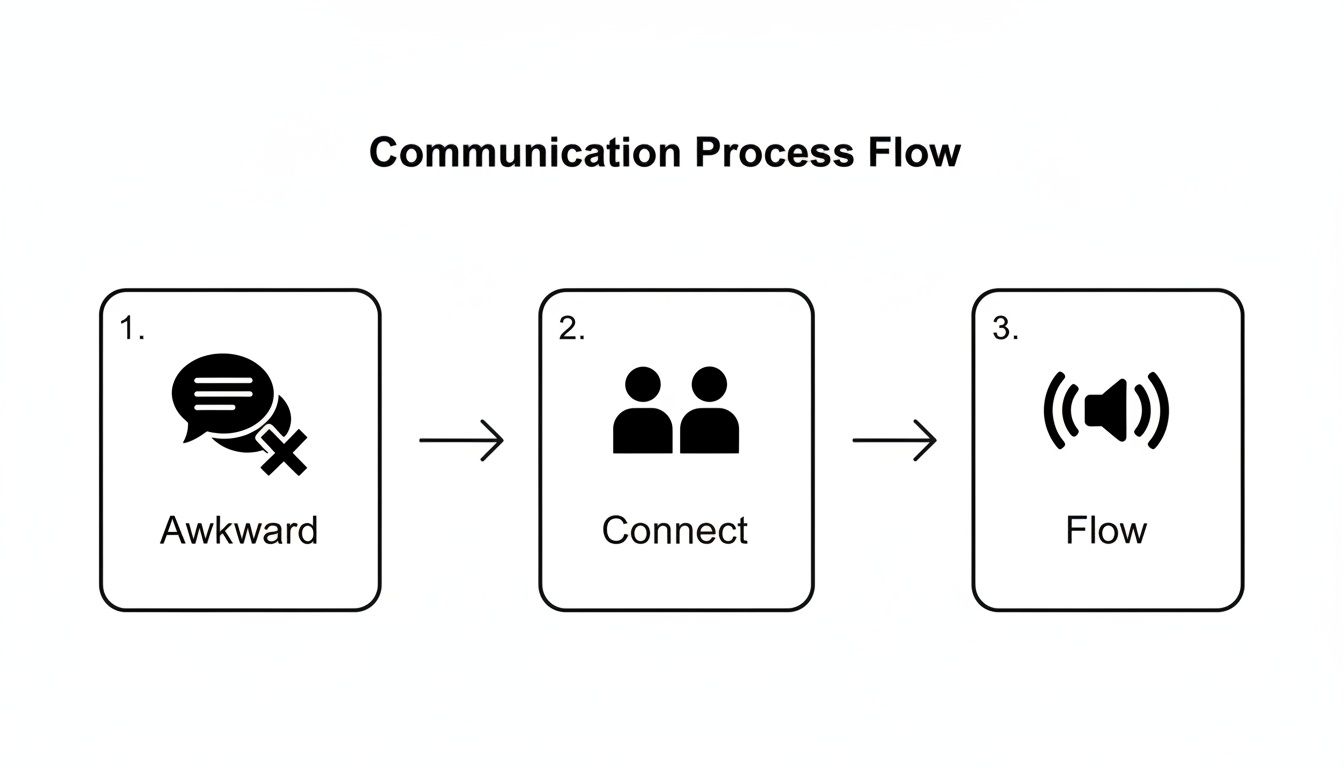
The real goal isn't just to swap words around; it's to create a genuine conversational flow, just like the diagram shows. It all starts with the AI needing to "hear" you correctly.
The Ears of the Operation: Automatic Speech Recognition
The very first step is for the app to capture what you're saying. This is handled by a technology called Automatic Speech Recognition (ASR), which basically acts as the digital ears of your interpreter.
ASR’s job is to grab the soundwaves of your voice and convert them into written text. These systems are trained on massive libraries of audio data to get good at understanding different accents, speaking speeds, and even the normal pauses in human speech. The better the ASR, the more accurate the starting point for the translation will be.
The Brain of the System: Neural Machine Translation
Once your speech becomes text, it’s handed off to the app's "brain"—the Neural Machine Translation (NMT) engine. This is where the real interpretive work happens, and it’s a huge leap forward from older, clunkier translation methods.
Instead of just translating word-by-word, NMT looks at the entire sentence for context. It figures out grammar, idioms, and how words relate to each other to produce the most natural-sounding meaning on the other side.
This context-aware approach is exactly why modern apps can handle complex sentences and deliver translations that sound human, not robotic. It's the difference between a literal, often confusing translation and one that actually captures what the speaker intended to say.
This core technology is always getting smarter. You can learn more about how AI is advancing language translation and what's driving these improvements.
The Voice of Your Interpreter: Text-to-Speech
The final step is to give that translated text a voice. The NMT engine's output is sent to a Text-to-Speech (TTS) system, which converts the written words back into spoken audio in the target language.
Today’s TTS systems are incredibly sophisticated. They don't just produce a flat, robotic voice; they can generate speech with a natural tone, intonation, and rhythm. This makes the conversation feel much more personal and engaging for everyone involved.
This whole three-part dance—hearing with ASR, understanding with NMT, and speaking with TTS—happens almost instantly. It’s this coordinated AI effort that puts a powerful and effective personal interpreter right in the palm of your hand.
Must-Have Features in a Modern Translation App
Let's be honest: sorting through the countless real time voice translation apps can feel like a chore. With so many choices, how do you find one that actually helps in a real conversation instead of just making things more awkward? The difference between a smooth chat and a frustrating, broken exchange usually comes down to a few core features.
Knowing what to look for will help you pick an app that genuinely breaks down barriers, whether you're traveling, closing a business deal, or just connecting with someone new. This isn't about flashy gimmicks; it's about reliable tech that just works when you need it to.
Seamless Two-Way Dialogue
The single most important job of a voice translator is to make a conversation flow naturally. Older tools often felt like using a walkie-talkie—you speak, wait for the translation, then they speak, and you wait again. That stop-and-start rhythm completely kills the vibe of a normal discussion.
A modern app has to support simultaneous (or close to it) translation where both people can speak without those painful pauses. It should feel less like you're operating a gadget and more like you have a human interpreter in your ear. The technology should fade into the background, letting the actual conversation shine.
The goal is to forget you're even using an app. A great translator fosters a back-and-forth dialogue that feels human, not robotic, enabling genuine connection rather than just information exchange.
Extensive and Accurate Language Support
A translation app is only as good as its language library. Sure, every app has Spanish, French, and Mandarin covered. But for serious global travelers and international businesses, a top-tier app needs to cast a much wider net.
Here's what that looks like in practice:
- A Wide Range of Languages: Look for an app that supports over 80 languages. This gives you confidence that you’re covered whether you're in a bustling European capital or a remote village in Southeast Asia.
- High Accuracy Across Dialects: It’s not just about the number of languages, but the quality. The AI needs to be smart enough to understand regional dialects and even a bit of slang to provide translations that make sense in context.
With that kind of comprehensive support, you can rely on one app for all your trips, which is a huge confidence booster.
An Intuitive and Simple Interface
Power is useless if you can't access it easily. When you're in the middle of a conversation, the last thing you want is to be fumbling through confusing menus and settings. A great real time voice translation app needs a clean, simple interface that gets out of your way.
You should be able to pick your languages and start a conversation in just a couple of taps. The whole experience should be built for speed and simplicity, with almost no learning curve. The less you have to think about the app, the more you can focus on the person right in front of you.
Compatibility with Standard Earbuds
A common myth is that you need to buy expensive, specialized hardware to get real-time voice translation. For a long time, this was a huge barrier for most people. Thankfully, the best apps today are designed to work with the tech you already have in your pocket.
Compatibility with standard Bluetooth earbuds, including AirPods, is a must-have feature. This makes the technology incredibly accessible and affordable. You can just connect your favorite pair of wireless earphones and start talking, no need to carry around another single-purpose gadget. That convenience is a game-changer when you're on the move.
A Reliable Option: Translate AI
Finding an app that ticks all these boxes is key, and Translate AI was built around these very principles. It supports over 80 languages, so you're ready for conversations almost anywhere in the world. Its interface is designed for effortless two-way dialogues that feel natural, and most importantly, it works with any standard earbuds you already own. You can learn more about how Translate AI can turn your earbuds into a powerful translator and give it a try yourself.
Key Features of a Top-Tier Voice Translation App
This quick comparison breaks down the essential features versus the nice-to-have options to help you choose the right app for your needs.
| Feature | Why It's Essential | What to Look For |
|---|---|---|
| Two-Way Voice Conversation | This is the core function. It allows for natural, back-and-forth dialogue instead of a clunky, one-way process. | An interface that supports simultaneous speaking and listening, with minimal lag and button-pressing. |
| Broad Language Support | Your app should work wherever you go. Limited language options make an app useless for multi-country trips or diverse business environments. | Support for 80+ languages, including multiple dialects and regional variations for higher accuracy. |
| Standard Earbud Compatibility | Makes the technology accessible and affordable. You shouldn't have to buy a $300 gadget just to use a translation app. | Explicit support for any Bluetooth earbuds, especially popular models like Apple AirPods and Samsung Galaxy Buds. |
| Simple User Interface | In a real-world conversation, speed matters. A complicated app creates awkward pauses and frustration, defeating the whole purpose. | A clean design where you can start a translation in two or three taps. The focus should be on ease of use, not clutter. |
| Offline Mode (Nice-to-Have) | While not strictly essential with today's eSIMs, offline packs are great for areas with spotty internet, like on a plane or in a remote area. | The ability to download specific language packs for use without a data connection. |
| Camera Translation (Nice-to-Have) | Super useful for translating signs, menus, and other written text instantly. A great bonus for travelers. | A feature that uses your phone's camera to translate text in real-time or from a photo. |
Ultimately, you want an app that feels like a reliable tool, not a science experiment. The features listed above are what separate the truly useful apps from the rest of the pack.
Putting Voice Translation to Work in the Real World
The true power of a real time voice translation app isn’t in its technical specs; it’s in how it transforms real human moments. It’s the difference between fumbling for a phrasebook in a crowded market and confidently negotiating for a souvenir. It’s about turning a stressful business meeting into a productive collaboration.
So, let's move beyond the theory and look at practical, everyday scenarios where this technology truly shines. These are the moments where the right app removes the friction of language barriers, letting you focus on the experience itself.
For the Fearless Traveler
Imagine you’re wandering through the vibrant, winding alleys of a Marrakech souk. The air is thick with the scent of spices and leather, and a vendor is showing you a beautifully crafted lantern. Instead of just pointing and hoping for the best, you simply tap your app.
You ask, "How much for this beautiful piece?" and your question is instantly relayed in Darija. The vendor smiles and replies in his native tongue, and you hear the price clearly in your earbuds. That simple exchange turns a potentially confusing transaction into a genuine, memorable interaction. It allows you to haggle, laugh, and connect on a human level.
This isn't just about shopping; it's about empowerment. A good translation app lets you:
- Order food confidently from a local, family-run restaurant in Seoul.
- Ask for directions from a stranger in Tokyo without feeling lost.
- Chat with your taxi driver in Lisbon and get insider tips on the best local spots.
The app becomes an invisible bridge, letting you dive deeper into the culture and experience your destination like a local, not just a tourist. For a more in-depth look, check out our guide on how real-time language translator earbuds are changing travel.
For the Global Professional
Now, picture a different scene: you're on a critical video call with a potential client in Brazil. Your team has put weeks into this proposal, but a language barrier could derail everything. With a real time voice translation app, that risk just evaporates.
As your colleague presents in English, the client hears a clear, accurate translation in Portuguese. When they ask a nuanced question, you understand it instantly, allowing you to provide a thoughtful and precise answer. This seamless flow builds trust and shows a level of preparedness that sets you apart. The conversation is about business strategy, not about struggling with language.
The impact here is huge. A recent survey found that 68% of remote workers feel much more productive with these tools, enabling smooth global collaborations. That translates to real wins, with one Fortune 500 firm reporting a 25% sales spike directly linked to using voice tools for international outreach. As companies increasingly prioritize multilingual operations, the AI language translation market has surged from $1.88 billion to $2.34 billion. You can find more insights on the growth of the voice translation software market and its business impact.
In business, clarity is currency. A voice translation app ensures your message lands exactly as intended, every time, fostering stronger partnerships and driving growth.
For the Expat Navigating Daily Life
Finally, think about the challenges of moving to a new country. Simple daily tasks—like setting up a bank account, visiting a doctor, or talking to your child's teacher—can become major sources of stress when you don't speak the local language.
A voice translation app becomes an essential tool for just getting things done. It provides the confidence to handle appointments, run errands, and integrate into your new community. It helps turn a foreign city into a new home, one clear conversation at a time.
Your Go-To Tool: Translate AI
In all these scenarios, having a reliable and simple app is what matters most. Translate AI is designed for these real-world moments. It supports over 80 languages, making it a perfect companion for travelers, and its intuitive interface ensures that business professionals can launch a translated conversation in seconds.
Most importantly, it works with the earbuds you already own. You can discover how Translate AI works on the App Store and see how it fits into your life, whether you're closing a deal or just ordering coffee.
A Practical Walkthrough for Your First Conversation
You get the theory, and you’ve seen how a real time voice translation app can break down communication walls. Now it's time to actually use it. This is your guide to that first translated conversation, making sure it goes off without a hitch from the very first tap. The goal here is to get you from understanding the app to confidently using it in the real world.
We'll cover everything from the quick initial setup to the small habits that make for a clear, natural dialogue.
The Five-Minute Setup
Before you jump into a conversation, a few simple setup steps will pave the way for a much smoother experience. Think of it as your pre-flight check.
- Choose Your Languages: Open the app and select your native language and the one you want to translate. Most apps make this obvious on the main screen.
- Pair Your Earbuds: For the best experience, connect your Bluetooth earbuds. This lets you hear translations clearly and privately.
- Check Your Microphone Access: The first time you use the app, it will ask for permission to use your phone's microphone. You must approve this for it to work.
- Confirm Your Internet Connection: Because the heavy AI processing happens in the cloud, a stable Wi-Fi or cellular data connection is essential for instant, accurate translations.
With those four steps done, you're officially ready to start talking.
Best Practices for a Smooth Dialogue
A successful translated conversation isn’t just about the tech—it's also about how you use it. Following a few simple rules of the road will make a huge difference in the clarity and flow of your chat, making it feel way more natural for both you and the other person.
The key is to help the AI understand you perfectly. By speaking clearly and taking turns, you give the translation engine the best possible input, which results in a much higher-quality output.
Keep these tips in your back pocket as you speak:
- Speak Clearly and Naturally: There's no need to shout or talk painfully slow. Just use your normal conversational pace and try to enunciate.
- One Person at a Time: To get the cleanest results, avoid talking over each other. Let one person finish their thought before responding.
- Use Shorter, Simpler Sentences: Today's AI is good with complex sentences, but breaking down long ideas reduces the chance of misinterpretation.
- Minimize Background Noise: If you can, have your conversation somewhere relatively quiet. If you can't, speak a little closer to your phone's mic.
Making these small adjustments will make every chat with your real time voice translation app more effective and a lot less stressful. For a deeper dive into handling different situations, check out our guide on how to translate a conversation in real time with total confidence.
Our Recommendation: Translate AI
To put all this into practice, you need an app that's both powerful and dead simple to use. Translate AI was designed with exactly that in mind. Its interface is clean and intuitive, letting you pick from over 80 languages and dive into a conversation in seconds.
Most importantly, it's built to work flawlessly with any standard Bluetooth earbuds you already own, including AirPods. There’s no special hardware to buy. Just pair your favorite earphones, tap the screen, and start talking. See for yourself how easy it is to get started by checking out Translate AI on the App Store.
Meet Translate AI: Your Pocket Interpreter
Alright, we’ve walked through all the tech and features that separate a decent translation app from a great one. Now, let’s see what it looks like when all those pieces come together. Translate AI is built to be a powerful pocket interpreter that just works, making global communication feel natural, not like you're wrestling with technology.
The app supports over 80 languages, giving you the confidence to strike up a conversation pretty much anywhere on the planet. Its real strength is in facilitating genuine two-way dialogues. Your interactions flow like a real chat, not a clunky, turn-based exchange where you're just waiting for a robot to finish talking. That focus on natural conversation is what really makes a difference.
Simplicity You Can Hold in Your Hand
The whole experience is designed to be dead simple. You just pick your languages, tap the screen, and start talking. There are no confusing menus to dig through, which is huge when you’re in the middle of a real-world chat and don't have time to be fumbling with your phone.
Here’s a look at the clean interface that gets a conversation going in seconds.
As you can see, the design is all about clarity. It gets the technology out of the way so you can focus on the person in front of you, not the screen.
One of the biggest wins here is its universal compatibility. Translate AI works seamlessly with any standard earbuds you already own, including AirPods. This is a big deal. It means you don’t have to shell out for expensive, specialized hardware to get powerful translation. You just use the gear you already have.
For travelers navigating new cities, professionals collaborating with international colleagues, and expats managing daily life, having a reliable tool is key. Translate AI provides the accurate, context-aware translations needed to handle any scenario with confidence.
Whether you're trying to order from a menu in Tokyo or closing a deal with a partner in Berlin, the app is a reliable bridge. The AI is tuned to pick up on the nuances of conversation, delivering translations that capture what the speaker actually means.
If you’re looking for a real time voice translation app that nails the essentials—broad language support, a simple interface, and compatibility with your existing tech—this is a fantastic choice. You can see how it works for yourself and start your first conversation by checking out Translate AI on the App Store.
Got Questions? We’ve Got Answers
Even with all the cool possibilities, you probably have a few practical questions about how a real time voice translation app actually works in the real world. Totally normal. We've pulled together the most common ones we hear to give you clear, simple answers.
Let's clear things up so you can start your first conversation with confidence.
Do I Need to Buy Special Translator Earbuds?
Nope, not at all. The best apps today are designed to work perfectly with the standard Bluetooth earbuds or earphones you already own, including popular ones like AirPods.
This makes the whole thing incredibly easy to get started with. There’s no need to shell out for an expensive, single-purpose translation gadget you have to remember to pack. Just pair your favorite earbuds to your phone, and you’re good to go.
Just How Accurate Is This Stuff?
Thanks to some huge leaps in AI, especially something called Neural Machine Translation (NMT), today's top apps are surprisingly accurate. They do way more than just swap words; they actually understand the full context of a sentence to give you a translation that makes sense.
Of course, no AI is perfect—it might stumble on hyper-local slang or struggle in a really loud bar—but the accuracy is more than good enough for clear, effective conversations in almost any travel, business, or social setting. These tools are built for how people actually talk.
The secret is context. Modern AI doesn't just hear words; it understands what you mean. This leads to translations that feel natural and human, letting you have a genuine back-and-forth instead of an awkward, robotic exchange.
Will It Work if I Don’t Have an Internet Connection?
For the best, most natural-sounding translations, you’ll need a stable internet connection (either Wi-Fi or your phone's data). The heavy lifting—all that complex AI processing that makes the conversation feel instant—happens on powerful servers in the cloud, not on your phone.
Some apps might offer a basic offline mode for pre-downloaded phrases, but the real magic of a live, flowing conversation depends on being online. That connection is what lets the AI do its best work.
Can We Both Talk at the Same Time?
For the clearest translation, it works best if one person speaks at a time. Think of it like a walkie-talkie. The app needs a moment to catch a complete thought before it can accurately translate it and play it for the other person.
Most apps guide you into this rhythm naturally with a simple tap-to-talk button. This creates a turn-based flow that keeps the AI from getting jumbled by overlapping voices. Following this one simple rule makes the whole dialogue way smoother and more accurate for both of you.
Ready to break down language barriers with a tool that just works? Translate AI supports over 80 languages, has a dead-simple interface, and works with the earbuds already in your pocket.
Experience seamless conversation by trying Translate AI on the App Store