

Your Guide to AI-Powered Language Translation for Seamless Global Chat
Ever landed in a new country and felt that immediate wall go up? You're trying to order coffee, ask for directions, or just share a laugh, but all you have are awkward gestures and a phrasebook that feels a century old. It’s that frustrating moment of being surrounded by people but feeling completely alone.
What if you could tear down that wall? This guide is your roadmap to doing just that. We'll show you how to turn your smartphone and the earbuds you already own into a personal, real-time interpreter. This isn’t science fiction anymore. It’s the reality of AI-powered language translation, and it’s changing how we connect with the world.
Our goal is simple: to give you specific, actionable steps to move beyond just getting by and start having genuine conversations, anywhere. By the end of this guide, you’ll know how the technology works, what to look for in a tool, and how to use it to feel confident and understood on your next trip or international call.
Why Everyone's Talking About Instant Translation
The world feels smaller, but the language gaps are still huge. That's why the demand for instant, reliable translation has absolutely exploded. The numbers don't lie: the market for AI-powered language translation shot up from $1.8 billion in 2023 and is on track to hit a staggering $13.5 billion by 2033.
That’s a growth rate of 22.3% every single year, which tells you one thing—people are hungry for tools that help them connect. You can read more about these market trends and their impact to see just how massive this shift is.
What’s fueling this fire? It boils down to a few key things:
- Global Business is the Norm: Teams are spread across continents, and you can't build great things together if you can't understand each other. Seamless communication is no longer a luxury; it's a necessity.
- Travel is Back and Easier: More people are exploring the world for work and fun, and they need practical, on-the-go tools to navigate new cultures without feeling lost.
- We're All Connected Online: The internet brought us all together, but language is still the final gatekeeper. True global connection means being able to understand anyone, anywhere.
Your Pocket-Sized Interpreter
For globetrotters and international professionals, this technology is no longer just a cool concept. Apps are the real-world solution, offering smooth voice translation in dozens of languages without needing any clunky, specialized hardware.
The big idea here is simple: make the world smaller by making it more understandable. This technology lets you have real, meaningful conversations, breaking free from the limits of pointing and smiling.
All you need is an app and your favorite earbuds, like AirPods, and you can start talking. This guide will walk you through exactly how the magic happens, what it’s good for, and how you can get started. By the time you're done reading, you’ll be ready to turn your phone into the most powerful travel companion you’ve ever had.
A Tool for the Modern Traveler: Translate AI
For those seeking a practical, powerful solution, an app like Translate AI is designed to be your pocket-sized interpreter. It offers smooth voice translation in over 80 languages and works seamlessly with your existing earbuds, making it an ideal choice for both travelers and professionals who need clear communication on the go. You can find it on the App Store here.
How AI Translates Your Voice in Real Time
Ever wonder what’s happening in that tiny moment between you speaking into your phone and someone else hearing a perfect translation? It’s not magic. It’s more like a high-speed, four-part relay race happening inside the AI, where each component hands off its work to the next to create a nearly instant bridge between languages.
The whole process is a beautifully simple flow from speaking to understanding.
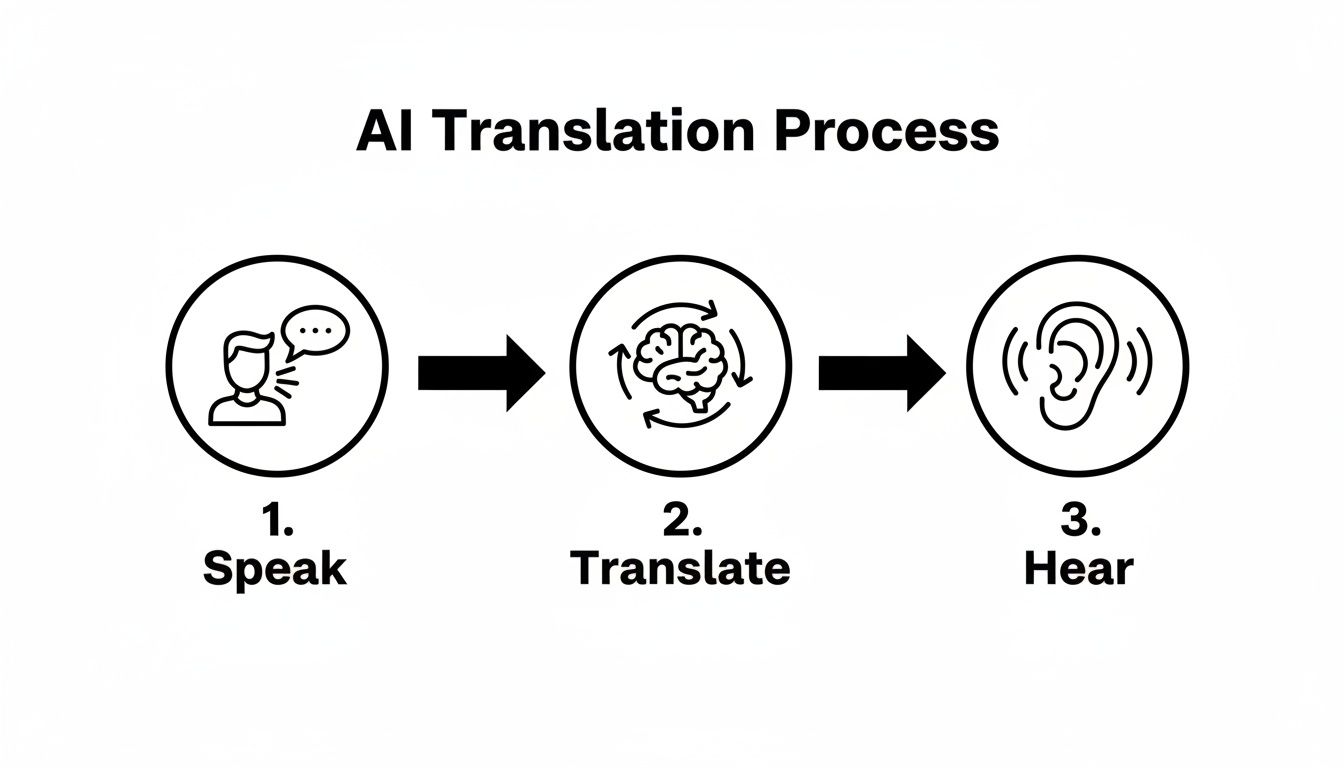
This elegant system is exactly what makes modern AI powered language translation feel so fluid and natural in a real conversation. Let's break down each runner in that relay race.
Step 1: Automatic Speech Recognition (The Digital Ear)
The journey kicks off with Automatic Speech Recognition (ASR). Think of this as the system's digital ear. Its only job is to listen intently to the sound waves of your voice and turn them into written text.
Imagine ASR as the world's fastest stenographer. It isn't trying to understand what you mean; it’s just transcribing what it hears with incredible speed. This first step is critical—the quality of the final translation hangs entirely on how accurately your words are captured right at the start.
Step 2: Neural Machine Translation (The Brain)
Once your speech is in text form, it gets passed to the brain of the operation: Neural Machine Translation (NMT). This is where the real translation work happens, but it’s a world away from a simple word-for-word swap.
NMT models have been trained on billions of sentences from books, articles, and websites across the internet. This massive library of information teaches them to see the subtle patterns, grammar, and relationships between words in different languages.
Instead of just swapping out words, NMT translates meaning. It looks at the whole sentence to figure out the context, which is how it produces translations that sound natural and human, not clunky and robotic.
If you want to go deeper on this, you can learn more about how machine translation works in our detailed guide. This core component is what truly separates modern tools from the awkward translators of the past.
Step 3: Text-to-Speech Synthesis (The Voice)
After the NMT model has crafted the perfect translation in text, it’s time to give it a voice. This is the job of Text-to-Speech (TTS) synthesis.
TTS technology takes that translated text and converts it into natural-sounding audio. Today's TTS systems are incredibly sophisticated, able to mimic human intonation, pitch, and rhythm. The goal is to avoid that dreaded robotic monotone and produce speech that is clear, expressive, and easy for the other person to understand.
This step is what keeps the conversation flowing, because hearing a natural voice is far more engaging than just reading text off a screen.
Step 4: Context Handling Algorithms (The Manager)
Finally, there’s an overarching layer of intelligence managing the whole process: context-handling algorithms. These algorithms work behind the scenes to make sure the translation actually makes sense within the specific conversation you're having.
This is what helps the AI tell the difference between words with multiple meanings. For example, it can figure out if "bank" refers to a river bank or a financial institution based on the other words you used. It’s the final check that prevents embarrassing or confusing mistranslations.
Bringing It All Together With Translate AI
An app like Translate AI seamlessly integrates these four components to deliver a smooth, real-time conversational experience. When you speak, the app’s ASR captures your voice, its NMT engine translates the meaning, and its TTS system vocalizes the result—all in a fraction of a second. This rapid, coordinated effort is what empowers you to have a genuine, back-and-forth dialogue with someone in another language, making global communication feel truly effortless.
Getting Translations That Sound Natural
A good translation does more than just swap words. It has to catch the little things—the tone, the cultural context, the real meaning behind what someone is saying. This is where modern AI powered language translation has made a huge leap, moving past clunky, robotic text to something that feels genuinely human.
The magic behind this is a technology called Neural Machine Translation (NMT). Instead of looking at words one by one, NMT models are smart enough to analyze the whole sentence at once. They’re trained on gigantic piles of text—billions of sentences from books, articles, and websites—which teaches them the patterns and grammar that make a language actually flow.
Think of it like learning a language by living in a country versus just memorizing a dictionary. The AI learns context, figures out how words relate to each other, and spits out translations that aren't just correct, but feel right for the conversation.
From “Good Enough” to Genuinely Fluent
The difference this makes is staggering. Neural machine translation has totally changed the game for accuracy, making the kind of natural, back-and-forth conversations in live voice apps a reality. While performance always depends on the specific languages you’re using, modern AI systems now hit 90-95% fluency for common pairs like English-Spanish or Mandarin-English.
That’s a massive jump from the 70% accuracy we saw with older systems, and it means far fewer awkward mistakes.
This level of precision is what makes smooth, real-time chats possible. It’s the difference between a conversation that feels like a series of clumsy stops and starts, and one where you can actually forget about the tech and just focus on the person you're talking to.
Tackling Translation’s Toughest Challenges
Of course, language is messy, and no system is perfect. It's full of tricky exceptions that can trip up even the smartest AI. Developers are always pushing to solve these tough problems to make AI powered language translation even more dependable.
Some of the biggest hurdles include:
- Idioms and Slang: Phrases like "break a leg" or "bite the bullet" have meanings that are anything but literal. NMT models have to learn these expressions from context to avoid silly, nonsensical translations.
- Technical Jargon: Fields like medicine, engineering, or law have their own special vocabularies. To get these right, AI models need specific training on this kind of terminology.
- Cultural Specifics: Language and culture are welded together. A common idea in one language might not even have a direct equivalent in another, forcing the AI to find the closest, most appropriate way to express the meaning.
The real goal is to teach the AI not just to translate words, but to interpret meaning. This takes constant learning and fine-tuning, making sure the technology can handle the rich, messy reality of how people actually talk.
Bridging the Gap for Every Language
Another huge area of focus is expanding high-quality translation to more languages and dialects. The quality of a translation is often tied directly to how much data the AI has to learn from for that specific language pair.
For example, there's a mountain of digital text available for English-to-Spanish translations, which helps the AI learn with incredible precision. But for a language pair like Hindi-to-Swahili, there’s way less data out there, making it much harder to achieve the same level of fluency.
That’s why building up these datasets for less common languages and regional dialects is so important. As developers expand these resources, the accuracy and natural feel of AI translations will get better for speakers all over the world, making global communication a more inclusive reality. If you want to see this in action, check out our guide on how to translate a conversation in real time.
How Translate AI Delivers a Natural Sound
This focus on accuracy and naturalness is exactly what drives tools like Translate AI. The app uses powerful NMT models to make sure your conversations don't just make sense, but actually sound right. It’s designed to keep up with the fast pace of real-life dialogue, picking up on the small details that make communication feel authentic. By zeroing in on context and conversational flow, Translate AI helps close the gap between what you say and what your listener truly understands. It turns what could be a frustrating language barrier into a genuine human connection.
Putting AI Translation to Work in the Real World
All the theory is great, but the real test of AI powered language translation is how it holds up when you're actually standing on a busy street corner trying to ask for directions. This tech is no longer some futuristic novelty; it's a practical tool that solves real communication problems every single day.
Whether you're a globetrotter, a business pro, an expat finding your footing, or a student trying to learn, AI translation offers a solid answer to the age-old language barrier. Let's look at where it's making a genuine difference.

For the International Traveler
Picture yourself navigating the chaotic souks of Marrakech. Instead of fumbling with a dusty phrasebook, you ask a vendor about a handmade rug in English and hear their reply in your ear, instantly. Or imagine you're in rural Japan, confidently asking an elderly local for the best path to a hidden temple.
This is where AI translation truly shines. Here’s what you can do with it:
- Order food without pointing at a menu.
- Ask for directions and understand the reply.
- Haggle at a market with confidence.
- Connect with locals beyond simple greetings.
It transforms moments of potential stress into opportunities for connection, making your travels more immersive and a whole lot less intimidating.
For the Business Professional
In a global marketplace, clear communication isn't just nice to have—it's everything. AI translation tools are becoming indispensable for anyone collaborating with international teams or negotiating with clients overseas.
Just think about these scenarios:
- Smoother Negotiations: A real estate developer in Dubai can have a fluid conversation with an investor from Germany, making sure every last detail is understood without needing a costly human interpreter.
- Global Teamwork: A software team spread across Brazil, India, and the United States can hold a brainstorming session where everyone contributes in their native tongue. Better ideas, stronger collaboration.
- Client Relationships: A sales rep can build real rapport with a potential customer in Korea by speaking their language, creating a connection that feels more personal and effective.
By cutting out delays and misunderstandings, AI powered language translation helps businesses move faster and more efficiently across borders.
The real value isn't just in translating words, but in enabling relationships. When communication is seamless, trust and understanding can flourish, which is the foundation of any successful business partnership.
For the Expat and Language Learner
For someone building a new life abroad, an AI translator becomes a daily sidekick. It helps with the essential stuff—scheduling a doctor's appointment, getting through a parent-teacher meeting, or just making new friends at the local café. It lowers the barrier to entry, making the move to a new culture feel much less isolating.
Language learners get a huge leg up, too. Using a real-time translation app creates an immersive practice environment. You can test your skills in real-world conversations, get immediate feedback, and build speaking confidence way faster than with textbooks alone. The technology basically acts as a patient, always-available conversation partner.
The sheer scale of this is massive. Every day, over 500 million people use Google Translate, and more than 70% of European language professionals now use machine translation in their workflows. This just shows how deeply this tech has woven itself into modern communication. You can discover more insights on translation accuracy statistics to see the full picture.
How Translate AI Powers Your Conversations
To handle all these different needs, an app has to be fast, reliable, and dead simple to use. An application like Translate AI is built specifically for these real-world situations, handling two-way chats in languages from Hindi to Arabic without those awkward, conversation-killing delays. Imagine landing in Tokyo, popping in your earbuds, and just… chatting fluently in Japanese. By focusing on natural-sounding voice output and understanding context, Translate AI turns your phone into a powerful tool for genuine human connection, no matter where your journey takes you.
Choosing the Right AI Translation Tool for You
With a flood of options on the market, picking the best AI-powered language translation tool can feel overwhelming. You need a reliable partner for your travels or business meetings, not just another app cluttering your phone. The key is to look past the marketing hype and focus on the features that actually deliver a smooth, natural conversation.
Your goal is simple: find a tool that makes you forget you're even using a translator. It should feel less like a gadget and more like a natural extension of your voice, bridging the language gap without creating awkward pauses or clunky interactions. To do that, you need to know exactly what to look for.
Feature Checklist for Your AI Translator App
When you’re trying to decide on an app, it's easy to get lost in feature lists. What really matters depends on how you plan to use it. A frequent business traveler has different priorities than a backpacker exploring a new city. This table breaks down the most important features and why they matter for different users.
| Feature | Why It Matters for Travelers | Why It Matters for Business Users |
|---|---|---|
| Real-Time, Two-Way Dialogue | Essential for natural chats, like ordering food, asking for directions, or haggling at a market. Keeps the conversation flowing without awkward pauses. | Non-negotiable for meetings, negotiations, and client interactions. Ensures clear, immediate understanding on both sides, which is critical for building relationships. |
| Low Latency | Makes conversations feel human. High latency (delay) can kill the vibe of a friendly chat and create frustrating misunderstandings. | A delay of even a second can disrupt the flow of a professional discussion. Low latency is key for maintaining momentum and conveying confidence. |
| Wide Language Support | Crucial for multi-country trips or exploring off-the-beaten-path destinations. You need an app that covers the languages you'll actually encounter. | Gives you the flexibility to communicate with international partners, clients, and suppliers from around the globe without needing multiple tools. |
| Earbud Compatibility | Lets you have discreet conversations without holding your phone up. Perfect for noisy environments and keeping your hands free to handle luggage or maps. | Allows for private, hands-free conversations in public spaces like airports, trade shows, or client sites. It looks more professional and is less intrusive. |
| Strong Privacy Policy | Protects your personal conversations and location data. You don't want your travel chats stored or analyzed without your consent. | Absolutely vital. Business discussions often involve confidential information, from financials to strategy. The app must guarantee that your conversations are not stored. |
| Intuitive Interface | You need to be able to start translating in seconds, not fumble with settings. A simple, clean design is best when you're on the move. | Efficiency is paramount. A user-friendly interface means less time spent on tech setup and more time focused on the business at hand. |
By weighing these features against your specific needs, you can cut through the noise and find an app that will genuinely make your international communications easier, whether you're closing a deal or just trying to find the best local coffee shop.
Core Features That Truly Matter
When you're evaluating an app, some features are non-negotiable. An intuitive interface is a big one; you don’t want to be fumbling with complicated settings when you’re trying to have a quick chat. The app should be ready to go in just a few taps.
Similarly, think about the hardware you already own. A top-tier app should work seamlessly with standard equipment like AirPods or other wireless earbuds. You shouldn't have to buy expensive, proprietary hardware—your existing tech is more than enough.
Here are the essentials to prioritize:
- Real-Time, Two-Way Dialogue: The app has to handle a natural back-and-forth conversation. It should translate what you say instantly for your partner, and translate their response back to you with almost no delay.
- Minimal Latency: Latency is just a technical term for that frustrating pause between speaking and hearing the translation. The lower it is, the more natural the conversation feels.
- Wide Language Support: Check that the app supports the languages you actually need. A tool with over 80 languages gives you the flexibility to communicate confidently almost anywhere in the world.
Prioritizing Your Privacy and Security
Whether for business or personal travel, your conversations can contain sensitive information. It’s absolutely vital to know how a translation app handles your data. Does it store your conversations? Who has access to them?
Always choose a tool with a clear, transparent privacy policy. Reputable apps are built to process your conversations without storing them long-term, ensuring your discussions remain confidential.
This isn't just a minor detail; it’s a critical factor for building trust, especially when the conversations really matter. Your privacy should never be an afterthought.
Experience True Conversational Flow with Translate AI
Finding an app that balances all these needs—speed, accuracy, ease of use, and security—is what makes all the difference. A great live voice translation app can fundamentally change how you experience your travels or conduct business abroad. Translate AI was designed with these exact priorities in mind. It delivers real-time, two-way conversations with exceptionally low latency, making your chats feel fluid and natural. The app supports a vast range of languages and works perfectly with the earbuds you already use, so you can start talking right away. To see how these features come together in a powerful yet simple tool, check out Translate AI on the App Store and get ready for your next global conversation.
How to Start Your First Conversation with Translate AI
Ready to jump in and see what AI-powered language translation can do? It's way easier than you might think. With the right tool, you can go from downloading an app to having a real conversation in just a couple of minutes. Here’s a quick walkthrough to get you started with Translate AI.
Setting Up the App
First things first, let's get the app on your phone. We designed the process to be as fast as possible so you can skip the frustrating setup and get right to talking.
- Download and Install: Find the Translate AI - Live Translator app on the App Store and give it a tap. Installation only takes a moment.
- Grant Permissions: Once it's installed, open it up. The app will ask for microphone access—this is essential so it can hear your voice for translation.
- Select Your Languages: Tap the language selectors to pick your native language and the one you want to translate to. With over 80 languages to choose from, a whole world of conversation is waiting.
This screenshot shows just how clean and simple the interface is for picking your languages.
The whole design is built for speed. You just pick your language pair and you're ready to go.
Having a Natural Conversation
Translate AI is made for easy, back-and-forth dialogue. Once your languages are set, just tap the big microphone icon and start speaking like you normally would. The app works its magic instantly, translating your words and speaking them aloud for the other person.
When they reply in their language, you'll hear the translation clearly in your own. It's a seamless exchange that keeps the conversation moving without any weird pauses or delays.
Pro Tip: For the best experience, especially in a noisy café or a busy street, pop in your earbuds. The app works perfectly with any standard earbuds, including AirPods, giving you crystal-clear, hands-free conversations.
This simple setup turns your phone into a seriously powerful communication tool. It makes a genuine connection possible, no matter what language you speak.
Got Questions About AI Translation? We've Got Answers
If you're diving into the world of AI-powered language translation, you're going to have questions. It's totally normal. This tech is moving fast, and figuring out what it can really do is the first step to using it well. Let's tackle some of the most common ones.
Think of this as your practical guide to setting the right expectations. Whether you're traveling, closing a deal, or just trying to connect with someone new, knowing the answers will help you make the most of these amazing tools.
So, How Accurate Is This Stuff, Really?
Modern AI translation, especially systems running on Neural Machine Translation (NMT), is surprisingly good for major languages. For common pairs like English and Spanish, French and Chinese, you're looking at 90-95% accuracy in a normal conversation. That's more than enough to get your point across clearly.
But "accuracy" isn't one simple number. It's more of a moving target that depends on a few things:
- Language Weirdness: Some languages have incredibly complex grammar or dozens of dialects. Those can be tougher for an AI to nail every single time.
- Context is King: Trying to translate super-technical stuff like a legal contract or a medical report? Or maybe some niche internet slang? That's where AI can still get tripped up.
- The Data Diet: The best translations happen between languages that have massive amounts of text online for the AI to learn from. The more data, the smarter the translation.
Bottom line? For your average travel and business chats, today's AI translators are absolutely reliable. You can communicate clearly and effectively without much trouble.
Should I Worry About My Data? Is It Safe?
That's a great question, especially when you're talking about personal or business conversations. The good news is that reputable translation apps are built with privacy as a top priority.
The real key is to pick a service that's upfront about its privacy policy. If you're discussing sensitive business matters, you'll want an app that makes it crystal clear it doesn't store your conversation data long-term or uses end-to-end encryption to protect it.
Many of the best systems are designed to process your speech for translation without ever saving the content of your personal chats. Just take a minute to glance at an app's privacy policy to make sure you're comfortable with how they handle things.
Will AI Translators Make Human Translators Obsolete?
Nope. AI is an incredible tool for smashing through communication barriers in live, on-the-spot conversations, but it's not here to replace professional human translators. They handle two very different, though sometimes overlapping, jobs.
Here’s an easy way to think about it:
- AI Translators Crush It At: Real-time, on-the-go conversations where speed is everything. They're perfect for navigating a new city, handling informal meetings, and everyday interactions.
- Human Translators Are Essential For: High-stakes content that demands deep cultural nuance, creativity, and absolute precision. We're talking legal documents, marketing campaigns that need to resonate, official paperwork, and literature.
AI helps us connect in an instant. Human experts make sure the most important, nuanced messages are translated perfectly. They're two different tools in the same toolbox, and they often work best together.
How Translate AI Tackles These Common Concerns
A well-built app should address these issues from the get-go. We designed Translate AI with accuracy, security, and ease-of-use baked right in, so you can count on it when you need it. Our app leans on advanced NMT models to give you high-accuracy translations that actually understand conversational context, making your chats feel natural, not robotic. And when it comes to privacy, we're serious. We process your translations securely without holding on to sensitive conversation data, giving you the confidence to communicate freely whether you're ordering coffee or talking business with a new partner.
Ready to see for yourself how smooth, secure, and accurate a conversation can be? Download Translate AI and turn your smartphone into your own personal interpreter.
Get started with Translate AI on the App Store and start breaking down language barriers today.