

Your Ultimate Guide to a Portable Language Translator Device
Staring at a train schedule in a language you can't read. Trying to explain a food allergy to a waiter who just smiles and nods. Feeling that sinking feeling of being utterly lost in translation. If you're a traveler, you know this feeling all too well. It’s the invisible wall that pops up, turning an exciting adventure into a stressful ordeal.
The real problem isn’t just about translating words; it's about missing out on genuine human connection. You hesitate to explore a side street, you order the "safe" thing on the menu, and you miss the chance to share a laugh with a local. For business travelers, the stakes are even higher—a missed nuance in a negotiation can cost you a deal.
This guide is here to solve that exact problem. Our goal is to give you clear, actionable advice to help you choose the right tool—whether it's a dedicated device or a powerful app—to break down those barriers and connect with the world confidently.
How a Portable Language Translator Device Works
Ever wondered what’s happening inside that little gadget when you speak into it? It’s not magic, though it certainly feels like it. The device acts as a lightning-fast interpreter, using a sophisticated three-step process powered by artificial intelligence to make conversations flow.
The goal isn’t just to swap words; it’s about capturing the meaning and intent behind what you're saying so the conversation feels natural, not robotic. The entire process happens in the blink of an eye.
The flowchart below shows how these devices turn moments of communication anxiety into genuine human connection.
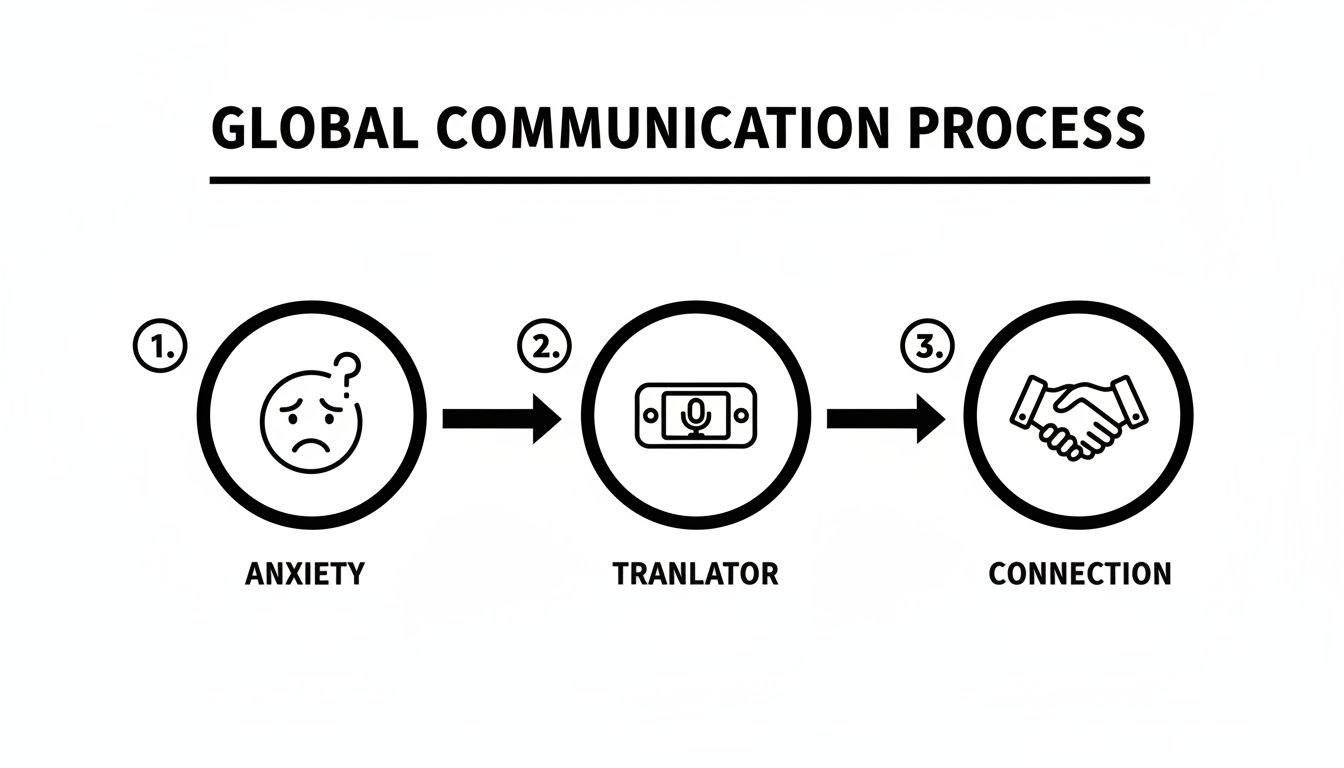
This visual journey nails the core value of a portable translator: it’s the bridge from confusion to clarity. Now, let’s get into the nuts and bolts of how that bridge gets built.
The 3 Core Steps of Instant Translation
At the heart of every modern translator is a sequence of AI-powered actions. Here’s a simple breakdown of how your voice becomes a seamless translation:
-
Automatic Speech Recognition (ASR) — The Listener: This is the device’s "ear." When you speak, ASR technology converts the sound waves of your voice into digital text. It’s trained to understand different accents, pronunciations, and even filler words.
-
Neural Machine Translation (NMT) — The Brain: Once your speech is text, the NMT engine takes over. Instead of translating word-for-word, NMT analyzes the entire sentence to grasp its context and nuance. It then finds the most accurate and natural-sounding way to say it in the target language.
-
Text-to-Speech (TTS) — The Speaker: After the NMT crafts the perfect translation, the TTS engine converts that text back into clear, audible speech for your conversation partner to understand.
This sophisticated process is why the market for these devices is exploding. The consumer market for portable language translators is growing at over 15% CAGR and is expected to blow past USD 1.8 billion by 2032.
Online vs. Offline: A Critical Choice for Travelers
Understanding the difference between online and offline modes is crucial for any traveler.
- Online (Cloud-Based) Translation: When connected to Wi-Fi or a mobile network, your device taps into powerful cloud servers. This gives you the highest possible accuracy—often over 95%—perfect for important business meetings or detailed conversations.
- Offline Translation: What about when you’re on a plane or hiking in a remote area? This is where offline mode is a lifesaver. Many devices let you download language packs directly onto the hardware, providing essential functionality when you're off the grid.
The powerhouse driving all of this is machine translation, a field that has seen mind-blowing advancements.
Must-Have Features in a Portable Language Translator Device
Shopping for a portable language translator device can be overwhelming. To cut through the noise, focus on these five specific features that make a real difference in the real world.
1. Translation Accuracy and Speed
A conversation is all about flow. If there's a long, awkward pause, the magic is lost.
- Actionable Advice: Look for devices with a translation speed of less than one second. For accuracy, target a rate of 95% or higher (when online). This ensures the translation captures context, not just words.
2. Battery Life
Imagine your device dying right when you need to ask for directions back to your hotel.
- Actionable Advice: Choose a device with a battery that lasts at least 8-10 hours of continuous use. This will get you through a full day of exploring without hunting for a power outlet.
3. Offline Capabilities
You can't always count on having Wi-Fi. An offline mode is your safety net.
- Actionable Advice: Before you buy, confirm the device has an offline mode and check which languages are available for download. Ensure it covers your destination.
4. Durability and Design
Travel gadgets get knocked around. A flimsy device won't last long.
- Actionable Advice: Look for a rugged design that can handle being tossed in a backpack. A simple, one-button interface is also better for quick, on-the-go conversations.
5. Language and Dialect Support
A device boasting 100+ languages is useless if it doesn't cover the specific dialect of the region you’re visiting.
- Actionable Advice: Check the device’s language list for regional dialects. For example, ensure it has European Portuguese, not just Brazilian, if you're heading to Lisbon.
Handheld translators with these features command over 70% of the market share in 2024. With global tourism arrivals hitting 1.3 billion, the need for reliable tools is greater than ever. You can explore more data on the language translator market to understand these trends.
The App-Based Alternative: Translate AI
If you'd rather not carry another gadget, a powerful app on your smartphone can be a fantastic solution.
- Actionable Advice: Consider an app like Translate AI. It provides high-accuracy translations and works with the earbuds you already own, giving you a discreet, hands-free translator without the extra hardware.
Real-World Scenarios Where a Translator Shines

Tech specs are one thing, but where a portable language translator device truly proves its worth is in the real world. Here are specific, actionable ways a translator can transform your trip from stressful to seamless.
For Daily Navigation
- Problem: You're trying to buy a train ticket from a machine with no English option.
- Actionable Solution: Use your device's camera translation feature to scan the screen. Or, approach a staff member and ask, "Which ticket do I need to get to Shibuya?" The device translates instantly, getting you on your way.
For Dining Out with Confidence
- Problem: You have a nut allergy and need to ensure your meal is safe.
- Actionable Solution: Instead of pointing and hoping, use your translator to clearly state, "I have a severe nut allergy. Is this dish cooked with nuts or peanut oil?" This specific communication removes the guesswork and keeps you safe.
For Shopping and Bargaining
- Problem: You're at a market in Marrakesh and want to haggle for a better price on a rug.
- Actionable Solution: Use the device for a back-and-forth conversation. You can ask about the material, make a counteroffer, and understand the vendor's response, making the experience more engaging and effective.
The global market for portable translators was valued at USD 985.6 million in 2024, fueled by travelers who need these practical solutions. Discover more insights on the booming translator market. For discreet business settings, many professionals also learn more about real-time language translator earbuds in our dedicated article.
The App-Based Alternative: Translate AI
For travelers who prefer to pack light, an app can handle these same scenarios effectively.
- Actionable Solution: Download Translate AI before your trip. When you need to ask for directions or order food, just open the app, select the conversation mode, and speak into your phone. It delivers two-way translations directly through your phone and earbuds.
Choosing: Dedicated Device vs. Smartphone App
Should you buy a separate gadget or just use an app? The right choice depends on your specific needs. This section gives you actionable advice to help you decide.
The Case for a Dedicated Translator Device
A standalone device is purpose-built for one job and excels at it.
- You should choose a dedicated device if:
- You'll be in noisy places. They have superior noise-canceling microphones.
- You need to preserve your phone's battery for maps and emergencies.
- You'll be traveling in areas with zero cell service and need a reliable offline mode.
The Case for a Smartphone App
You can’t beat the convenience of using the supercomputer already in your pocket.
- You should choose a smartphone app if:
- You are a minimalist traveler and want to avoid carrying extra gear.
- Your trip is shorter or your translation needs are more casual.
- You are on a budget and prefer a free or low-cost solution.
Head-to-Head Comparison
Use this simple table to make your choice:
| Factor | Dedicated Hardware Translator | Smartphone Translation App |
|---|---|---|
| Microphone Quality | Excellent; for clarity in loud environments. | Good; can struggle with background noise. |
| Battery Impact | None; has its own battery, saving your phone. | High; can drain your phone's battery quickly. |
| Convenience | Requires carrying another device. | Excellent; on the device you already carry. |
| Cost | Significant upfront investment. | Free or low-cost subscription. |
| Offline Use | Generally more reliable and extensive. | Varies by app; often a limited feature. |
The App-Based Alternative: Translate AI
An app can give you the best of both worlds—high performance without the extra hardware.
- Actionable Advice: If you want the power of a dedicated device but the convenience of an app, try Translate AI. It uses your phone's processor for fast, accurate translations and pairs with your earbuds for clear, hands-free conversations, making it a powerful choice for any traveler.
A Powerful App-Based Translator Alternative
While dedicated hardware is great, sometimes the smartest tool is the one you already own. A modern translator app can turn your smartphone into a powerful communication device without the extra cost or luggage space.
Top-tier apps deliver high-quality, real-time translations that rival standalone devices, making them a practical choice for everyone from casual tourists to seasoned globetrotters.
Turn Your Phone into a Pro Translator
A high-quality app like Translate AI bridges the gap between convenience and performance. It supports over 80 languages and offers seamless, two-way conversations that feel natural and fluid.
Its standout feature is its ability to work with any earbuds you already own. This creates a discreet, hands-free conversation system perfect for any environment. You speak, and your partner hears the translation instantly, creating a smooth and private dialogue.
By turning your smartphone and earbuds into a complete translation system, Translate AI offers the power of a dedicated device without the extra hardware.
Who Is an App-Based Translator For?
An app-based solution is perfect for the same person who would consider a portable language translator device: travelers, business professionals, and anyone needing to break down language barriers. The only difference is a preference for software over hardware.
If you value packing light and getting the most out of the gadgets you already own, an app is a compelling choice. To see how it stacks up, check out our guide on the best live translation app and decide if it’s the right fit for your next adventure.
Your Top Questions About Translator Devices Answered
We've covered the tech and features, but you probably still have some practical questions. Here are clear, actionable answers to the most common concerns.
How accurate are they in a real, noisy conversation?
High-quality translators can hit 95% accuracy or higher with a good internet connection.
- Actionable Advice: In a noisy environment like a market, stand closer to the person you're speaking with and speak clearly into the device's microphone. This will help the noise-canceling technology isolate your voice and improve accuracy.
Can I really use them without an internet connection?
Yes, and you should. This is a critical feature for any serious traveler.
- Actionable Advice: Before you leave home, connect your device to Wi-Fi and download the offline language packs for your destination. Test it once before you pack to ensure it's working properly.
What's the real difference between a $50 and a $300 translator?
You get what you pay for. The extra cost typically buys you:
- Better Microphones: Superior noise-canceling mics for accuracy in loud places.
- Faster Processing: Near-instant translations that keep conversations flowing.
- Durability & Battery Life: A tougher build and a battery that lasts all day.
- Software Updates: Ongoing improvements to translation quality and features.
- Actionable Advice: If clear communication is critical for business or you travel frequently, investing in a premium device is worth it. For a casual vacation, a mid-range device or a quality app will suffice.
Are translator apps good enough for business meetings?
For casual business chats, a great app is discreet and convenient.
- Actionable Advice: For a quick, informal meeting, an app is fine. For a high-stakes negotiation, a dedicated device with superior microphones is the more professional and reliable choice. For a formal boardroom setting, a human interpreter remains the gold standard.
The App-Based Alternative: Translate AI
An app can provide a powerful solution that addresses many of these concerns.
- Actionable Advice: Translate AI uses your smartphone's advanced microphones and works with your earbuds for clear, private conversations. This gives you a robust, convenient tool perfect for travelers and professionals without the need for extra hardware.
Ready to break down language barriers with the device you already own? Translate AI turns your smartphone into a powerful, real-time translator. Download it today from the App Store and start your next global conversation with confidence.