

Multilingual Communication Services Explained
You're at a hotel desk, trying to find out whether your booking includes a late arrival. The receptionist points to a policy, you point to your reservation, and both of you smile without being sure you agree. A translation tool might help, but first you need to know whether you're asking a simple question or accepting a charge you haven't understood.
Why a Shared Language Cannot Be Assumed
Multilingual communication services are organized ways to move meaning between languages through speech, writing, or both. They include human interpreting, professional document translation, language-aware customer support, and live AI conversation tools.
For travelers, cross-border teams, expats, educators, and public-service users, the practical question isn't which service advertises the most languages. It's which service can handle the consequences of a misunderstanding.
Think of language support as a bridge with a weight limit. Asking whether breakfast is available puts little weight on it. Giving informed consent or accepting a contractual obligation requires a different level of support, with a qualified person checking the meaning.
Practical rule: Choose language support by what someone could lose if the message is wrong, not by how fluent the output sounds.
The gap is bigger than vocabulary
UNESCO's World Atlas of Languages documents 8,324 spoken or signed languages, with approximately 7,000 still in use, about 1,400 legally recognized, roughly 1,500 at risk of losing their users, and approximately 1,000 represented online; UNESCO also reports that about 40% of people worldwide lack access to education in a language they speak and understand fluently, reaching 90% in some low- and middle-income countries.
That means you can't assume someone understands an institutional language because they live, work, or study where it's used. Nor can you assume a language with limited digital resources will work as well in an app as a widely represented one.
These everyday situations show where the gap becomes visible.
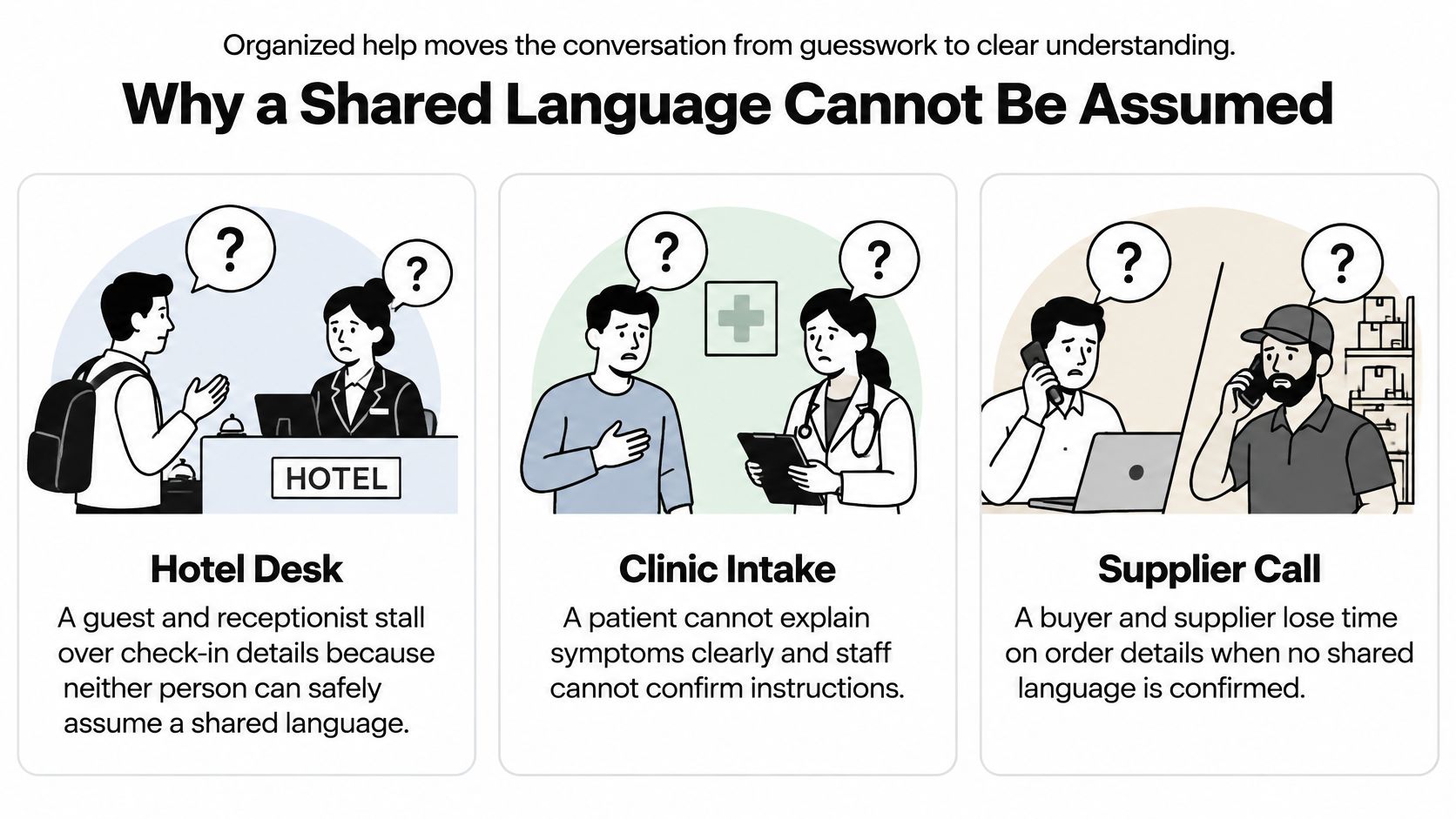
Start with the person's preferred language
At the hotel, ask which language the receptionist prefers before explaining the reservation. At work, establish the language for the discussion rather than relying on whoever speaks first.
For a business receiving Spanish-speaking callers, Mercateer Spanish call answering is a useful resource when considering a dedicated answering workflow rather than asking customers to use an English-only desk. Separately, cross-cultural communication deserves attention because politeness, directness, and agreement don't always travel neatly between cultures.
Your aim is straightforward: match the situation to a service, understand how spoken meaning travels, and recognize when an app is only an aid. Start by identifying the job you need done.
Six Service Types and the Job Each One Does
Multilingual communication services by job
| Service | Best for | Speed | Who checks the meaning | If it is wrong |
|---|---|---|---|---|
| Written translation | Contracts, websites, medical records | Hours to days | Reviser or subject expert | High if published or signed |
| Consecutive interpreting | Clinics, interviews, small meetings | Live, with pauses | The interpreter | High in care and employment |
| Simultaneous interpreting | Conferences and live events | Near real time | Booth interpreters | High for an official record |
| Video remote interpreting | On-demand qualified access | Connects in minutes when available | Licensed interpreter where applicable, otherwise appropriately qualified interpreter | High, with a human present |
| AI live voice translation | Travel, logistics, informal work chat | Usually a few seconds in suitable conditions | The speakers must verify | Low to medium if details are confirmed |
| Multilingual IVR and chat | Support lines and self-service | Instant menu or bot reply | Script owner plus escalation | Medium until a person takes over |
Pick the row by what goes wrong if the meaning is off. The speeds are planning expectations, not promises of availability or performance.
Written records and live human interpretation
Written translation suits material people must inspect, approve, publish, or sign. Give the translator the intended audience, relevant terminology, and the authoritative version of the document. A translated contract needs review, not merely readable sentences.
Consecutive interpreting makes room for that review during a conversation. You speak a short segment, pause, and let the interpreter convey it. It fits interviews and small meetings where participants need opportunities to clarify.
Simultaneous interpreting serves events where the audience needs to follow a speaker continuously. Organizers should provide presentations, names, and specialist vocabulary beforehand. A polished stage presentation doesn't remove the need for preparation behind it.
Video remote interpreting brings a qualified person into the conversation without requiring everyone to share a room. Availability, credentials, privacy, and a workable connection matter. For visual communication, the camera must show the relevant participants clearly; audio alone may not meet the need.
A clinic separating administrative support from language access can examine resources such as MedicalVirtual's Medical Virtual Assistants. The important procurement question is which role someone is qualified to perform, not whether they can handle general office tasks. For remote delivery considerations, this guide to video translation services helps distinguish the format from the underlying language task.
Live AI and automated support
AI live voice translation fits an immediate, informal exchange when typing is awkward and arranging an interpreter would be disproportionate. The speakers remain responsible for checking the details.
Multilingual IVR and chat handle recurring support needs through menus, scripts, or conversational systems. Give the customer a clear route to a person when their problem falls outside the supported workflow.
Serious operations don't have to choose between people and technology. The European Commission's translation figures show DG Translation working across 24 official EU languages, producing approximately 2,499,000 pages in 2025, handling 64% in-house and outsourcing 36%, with law-making accounting for 57%; its eTranslation service processed more than 890 million pages in 2025, against 19 million in 2017, roughly 47 times as many.
That combination illustrates different delivery models serving different workloads. It doesn't establish that machine output and reviewed professional translation are interchangeable.
A large language list isn't the same as usable accuracy. Circle the row that fits your next conversation, including who will check it.
How a Spoken Turn Becomes a Translation
A live exchange works like a relay, not a dictionary lookup. Each stage receives something from the previous stage, so an early mistake can reach the listener in a perfectly clear voice.
The basic outward journey looks like this.
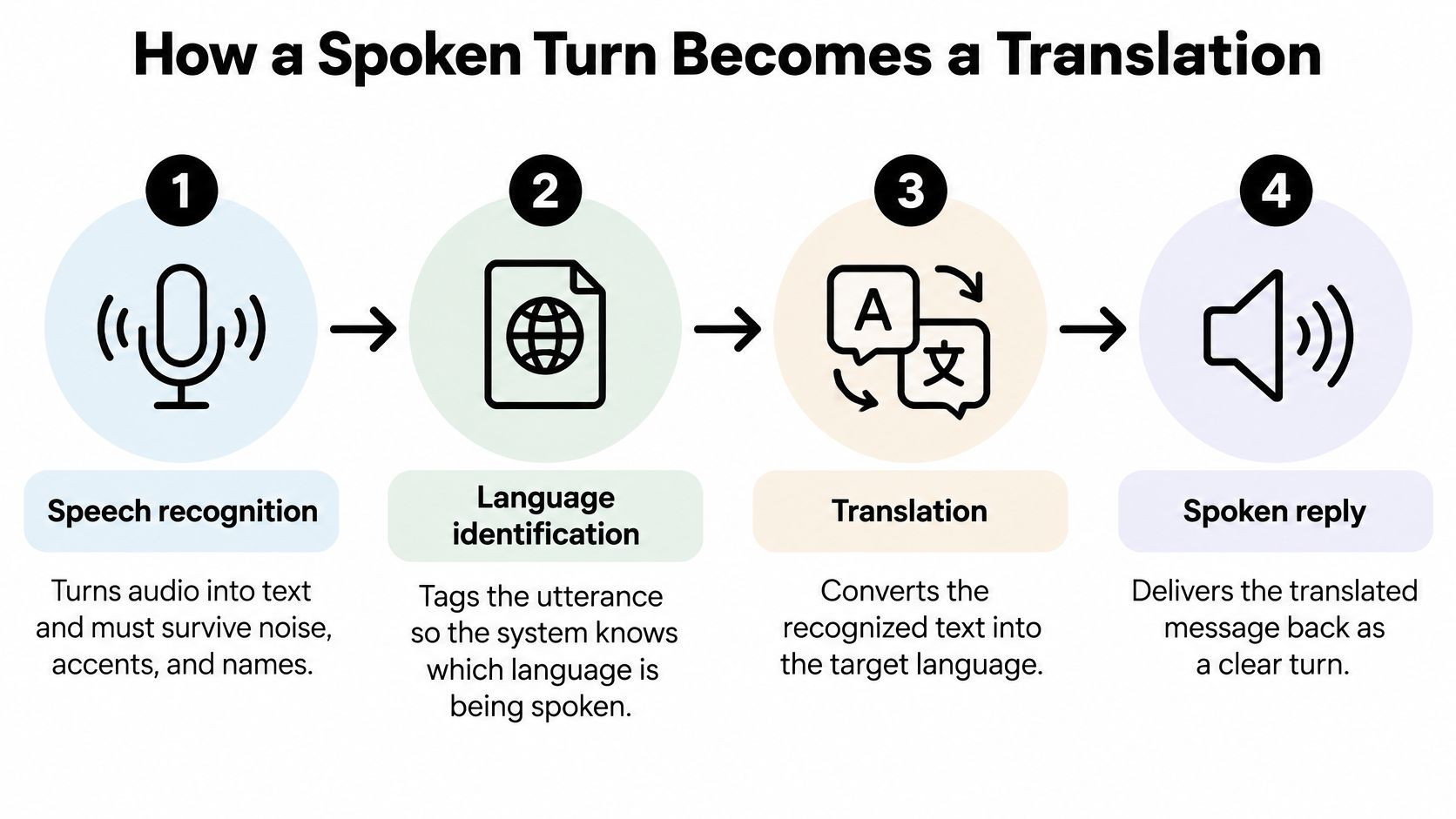
- Speech recognition turns your audio into text. Background music, an unfamiliar surname, or an accent can affect what it captures.
- Language identification labels the utterance. It needs to account for a speaker changing languages during the conversation.
- Translation uses the recognized text, source language, target language, and available context.
- Speech synthesis and display deliver spoken output and a readable transcript.
- The reply reverses the journey. The other person answers, and their meaning travels back through the same stages.
Put a luggage label on each segment
The W3C's language-tag guidance identifies BCP 47 language tags as foundational metadata, supporting language, script, and regional information, including zh-Hans for Simplified Chinese and zh-Hant for Traditional Chinese.
Think of these tags as luggage labels attached to each segment, not just the whole conversation. They help systems select suitable speech models, voices, fonts, and localization resources.
For implementation, preserve the source tag, target tag, relevant script information, and confidence scores. Define a fallback for cases when dialect identification is uncertain rather than treating a guess as confirmed.
Direction needs its own field
Language identity and text direction aren't interchangeable. W3C guidance on localizable string metadata recommends carrying a value, language tag, and separate direction field using ltr, rtl, or auto.
Arabic and Hebrew run right to left, while embedded numbers, URLs, and Latin names run left to right. Store direction per segment and use bidirectional isolation around inserted fragments, so punctuation and names don't appear in the wrong place.
For business documents involving Hebrew, RNC Group translation guidance offers a relevant companion when considering the written deliverable.
This video provides another way to follow the spoken workflow.
Even when every technical stage works, intelligibility isn't equivalence. Someone may understand the general point while missing politeness, an idiom, or a legal distinction.
Use one speaker at a time, with deliberate handoffs in speaker or earbud mode. Before relying on the setup, run a short test in a noisy room using a name, a number, a date, and a mixed-language sentence.
Travel Meetings and Everyday Errands
UN Tourism estimated that 1.4 billion international tourists traveled in 2024, an 11% increase over 2023 and approximately 99% of the pre-pandemic level. For an individual traveler, the practical challenge is less impressive but more immediate: understanding the answer after you've asked the question.
A phrasebook can help you request a ticket. It can't necessarily help you follow the explanation about a different station entrance.
At the station
Say you're asking for the next train and its platform. Save the station name, intended departure time, and destination address in writing before you approach the desk.
Use live speech for the follow-up: whether you need to change trains, where the entrance is, or which stop serves your hotel. Then show the written destination and ask the staff member to confirm it.
This is the kind of exchange where pointing to a map and checking a detail can work together.

During a cross-border standup
Your colleague chats comfortably before the meeting but hesitates when the team discusses delivery conditions. Conversational ease doesn't tell you whether they understood a qualification or an indirect refusal.
State the purpose first. Define specialist terms in plain language, pause after decisions, and ask each participant to restate the action, owner, and date.
- Action: Specify the deliverable, not just the topic discussed.
- Owner: Name the person responsible rather than saying the team will handle it.
- Date: Write the deadline clearly, avoiding an ambiguous numeric date format.
That confirmation gives everyone something concrete to correct without making language ability the focus.
At a school office or landlord visit
You're trying to arrange an ordinary appointment or clarify a maintenance visit. Ask the other person's preferred language before launching into the explanation; English won't suit every neighbor or local desk.
Break the exchange into layers: establish the language, explain the essential point in short segments, then ask the listener to restate what will happen. Put the appointment, amount, or deadline in writing.
A nod can mean someone is listening. Ask for the next step in their own words before treating it as agreement.
Keep these examples to routine logistics. Medical decisions, binding agreements, and emergencies need a different level of language support.
Choose the episode closest to your next week: a journey, a meeting, or an errand. Prepare the written anchor before you arrive, rather than reaching for it after the conversation has stalled.
When Live AI Is an Aid Not an Interpreter
The person who most needs a translation may be the least able to spot its errors. A confident voice won't tell you that the system missed a negative or confused a medication name.
A public-service translation study reports that, in a UK study of 2,520 public-service professionals, at least 33% had used machine translation at work, including health, social care, legal, emergency, and policing settings; it also reports professional language workers' concerns about errors or inaccuracies at 76.12%, data privacy and safety at nearly 70%, and lack of verifiability at approximately 55%.
The overlapping risks are privacy violations, inaccuracy, bias or discrimination, and unclear liability. For your own service policy, use the following conservative boundaries, rather than treating them as a statement of universal legal requirements.
When to keep a human in the conversation
| Setting | Live AI role | Qualified human | Minimum check |
|---|---|---|---|
| Menus, directions, small talk | Main aid | Not required for routine exchanges | Repeat place names and times |
| Preliminary team discussion | Turn-taking aid | Optional note review | Each person restates action, owner, and date |
| Employment, contracts, money | Prep only | Required before anyone signs | Read numbers and names aloud and in writing |
| Healthcare, emergencies, policing, consent | Bridge only until an interpreter arrives | Required | Confirm drug names, doses, and yes or no |
| Noisy, accented, or mixed-language talk | Test first | Required if meaning stays uncertain | One speaker at a time and show the text |
Coverage doesn't prove usable communication
A supported language label doesn't tell you how a service handles your partner's accent, an indirect answer, or an unfamiliar name. Test the conversation you need, not just a greeting.
The CIUTI roadmap for translation and interpreting users reports that 80.17% of respondents expressed concern about negative effects of AI on translation output quality. That finding isn't an accuracy score for a particular app, but it supports asking harder questions than whether a language appears in a menu.
If meaning remains uncertain after you reduce noise and simplify the wording, stop trying to talk your way through the uncertainty. Bring in a qualified interpreter.
Make verification a habit
For consequential details, use a deliberate check:
- Names and numbers: Read names, doses, prices, and dates aloud and show them in writing. Ask the other person to identify any mismatch.
- Consent: Confirm the actual decision and what the person understands will happen. A translated yes doesn't, by itself, establish informed consent.
- Audio handling: Ask whether audio stays on the device, is retained in the cloud, or is shared with third parties.
- Professional review: Have a qualified person resolve clinical, legal, or financial distinctions before anyone relies on them.
In an emergency, seek emergency assistance immediately and request language support. Don't delay urgent help while testing an app.
Live translation is a communication aid with a check step, not an automatic stand-in for a professional interpreter.
Mark your next conversation low, medium, or high stakes. If someone could lose rights, money, safety, or control over a medical decision, treat the language arrangement as part of the decision itself.
Security, Privacy and Best Practices for Teams
A team needs more than permission to use a translation app. Staff need an agreed process for what they may send, what they may retain, and who takes over when the conversation becomes consequential.
Set the handling rules before the call
- Map where audio goes. Establish whether processing happens on-device or in the cloud, the retention period, third-party sharing, and the deletion process. Record unanswered questions instead of assuming a favorable policy.
- Obtain consent for recording or storage. Explain what you intend to keep in the listener's language before capturing it. Distinguish live processing from retaining a recording.
- Preserve usable metadata. Keep transcripts with their language tags and direction values, and restrict access to staff who need the record.
- Minimize identifying details. Keep names, identification numbers, and medical information out of shared chat logs unless the record requires them.
Use a secure communication app checklist when assessing the surrounding workflow. A translation feature doesn't remove the need to evaluate account access, storage, and sharing.
Give uncertainty an owner
- Label high-stakes AI output as a draft. Require qualified review before staff rely on it for a consequential decision.
- Write the escalation path. Name the responsible role, set a response target, and provide a handoff script explaining that a qualified interpreter is being contacted. Don't promise a connection time your team can't deliver.
- Keep an approval trail. Record who reviewed the translation, which version they approved, and its intended use. This supports accountability without pretending a log settles legal liability.
- Schedule quarterly quality reviews. Check authorized records for mistranslated names, numbers, and consent wording. Track the corrective action while avoiding unnecessary copies of sensitive conversations.
A usable policy should tell a new staff member what to do during an awkward pause. Give them a named escalation contact and permission to stop a conversation they can't safely understand.
Evaluate a Service and Choose Your Path
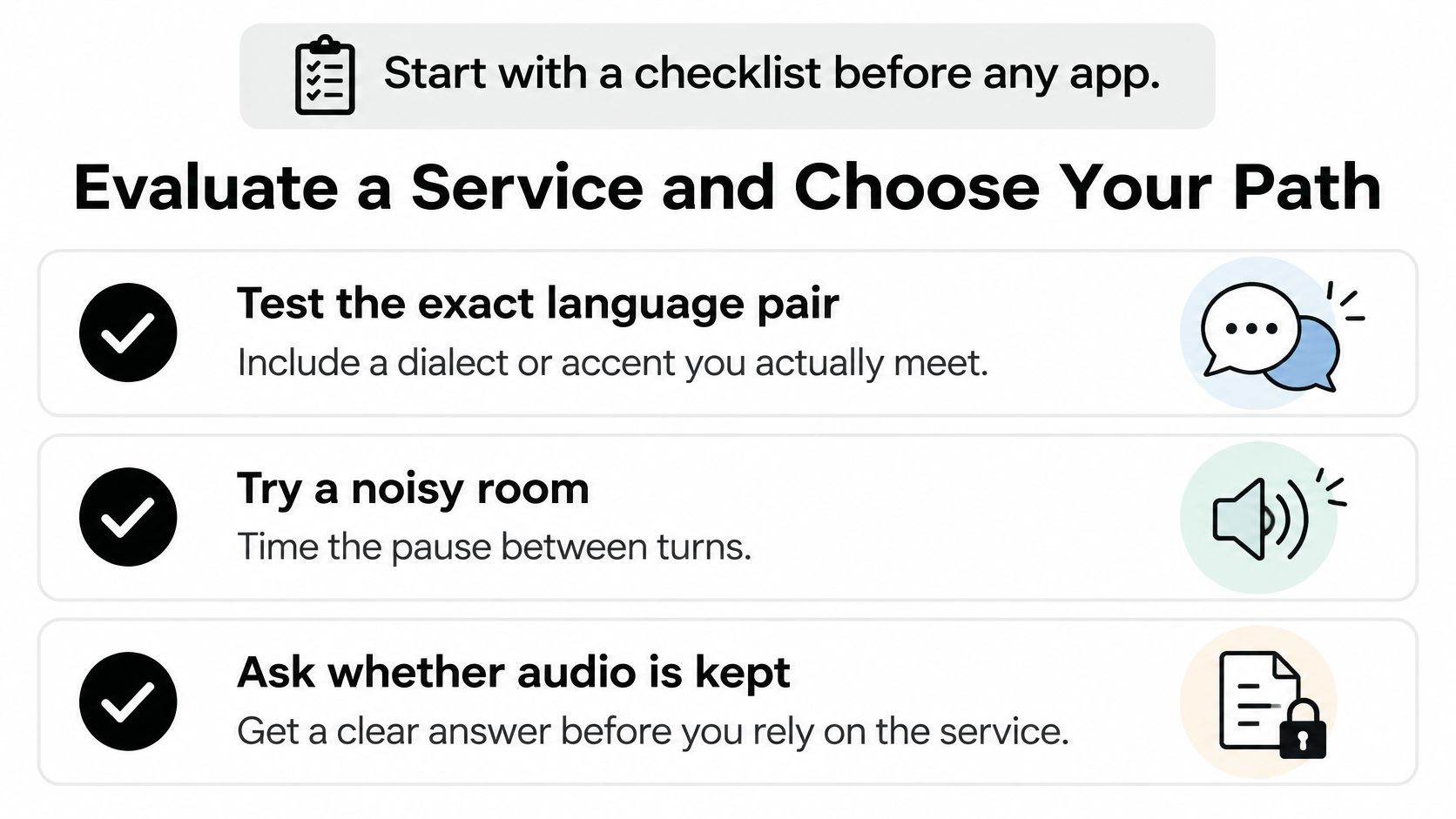
Start with a checklist before any app. You're choosing a working arrangement between people, not buying a language count.
- Test the exact language pair. Include the dialect or accent you encounter, plus a realistic question and follow-up.
- Try a noisy room. Time the pause between turns and check whether either speaker starts talking before the translation finishes.
- Resolve audio handling. Get clear answers about retention, device processing, and third-party sharing before entering sensitive information.
- Confirm human fallback. Identify who can join or review every high-stakes conversation you expect to handle.
- Check your equipment. Test the earbuds and phone you'll carry rather than relying on a demonstration setup.
Keep the evaluation focused on the conditions you'll face.
A successful test includes the reply, not just your opening sentence. Ask your partner whether the output preserved the question, the tone, and the detail they needed to answer.
Using Translate AI for the live row
Our app offers instant voice translations in over 80 languages, including English, Spanish, French, German, Chinese, Japanese, Korean, Arabic, and Hindi. It translates both ways: you speak in your language, and your partner hears it in theirs.
We designed it for travel, work, and everyday chats, not as a substitute for reviewing signed documents. It's compatible with most AirPods and earbuds, so you can test your existing equipment rather than start with a dedicated headset.
You can find Translate AI on the App Store. Getting started follows a simple sequence:
- Select your native language and your partner's language from the app's list.
- Tap the microphone and speak naturally. Keep the opening message focused so your partner has a clear turn to answer.
- Read and hear the translation, then enable speaker mode for hands-free chats when that suits the setting.
Run the name-number-date test on your chosen pair before depending on it. The useful question is whether both people can complete the exchange and correct an error, not whether the first sentence sounds impressive.
Choose the path that fits the consequence
For low stakes, where a wrong detail would be inconvenient rather than harmful, choose the live-voice row. Keep the necessary details in writing and open the app from the subsection above.
For high stakes, where someone signs, consents, doses a medicine, or relies on words during an emergency, arrange a qualified interpreter or translator. Keep an app as a temporary bridge, not the authority for the decision.
Before your next exchange, name who checks the meaning, how fast you need it, and what you'll repeat back. If any answer is blank, complete the arrangement before you rely on it.
Translate AI offers two-way voice translation for travel, work, and everyday conversations, helping you speak and hear a reply across languages. Visit Translate AI, choose the language pair you'll need next, and test a short exchange before you head to the desk, meeting, or station.