

Cross Cultural Communication: A Practical Guide
Cross-cultural communication means sharing intent across different norms, not swapping words, whether you're navigating roughly 7,000 living languages or a conversation in a shared language. Use the context table and six repair scripts below to check what someone means before you act.
You're at a hotel counter after a late flight. The receptionist confirms your booking, you nod, and only later do you discover that you've understood different arrival arrangements. The useful question isn't whether the sentence sounded fluent. It's whether both people can describe the same next step.
What Cross-Cultural Communication Is For
At a clinic desk, a patient hears that a follow-up is possible and assumes the appointment is booked. The receptionist means the patient still needs to call. Neither person has necessarily misunderstood the vocabulary, but they've left with different care decisions.
Cross-cultural communication gets intent, status, and certainty across, alongside the literal message. Are you asking, suggesting, or instructing? Can the person answering authorize the decision? Does their response mean agreement, acknowledgment, or a need to consult someone else?
The infographic captures those everyday gaps.

An everyday skill, not a diplomatic specialty
The United Nations migration overview estimates 304 million international migrants in 2024, compared with 154 million in 1990, representing 3.7% and 2.9% of the world's population respectively; women accounted for 48% of international migrants in 2024. Those are people arranging housing, taking transport, finding schools, and explaining symptoms, not only attending international conferences.
Language access also shapes who can participate confidently. UNESCO's multilingualism overview reports that at least half the global population uses two or more languages or dialects in daily life, while only 351 languages serve as media of instruction against roughly 7,000 languages still in use.
A traveler may speak confidently about food but struggle with a rental condition. An expat may understand a manager's instructions yet miss whether questioning them publicly is welcome.
The practical goal: Leave with a context map, six repair lines, and a way to judge whether a fluent translation is safe to act on.
Make expectations visible
In remote work, shared working hours don't automatically mean shared expectations about feedback or authority. GENTY recruitment's discussion of the cultural advantages of nearshore developers offers a useful starting point for those team conversations, provided you ask individuals how they prefer to work rather than treating regional descriptions as guarantees.
Before speaking, identify where your listener is likely to find meaning: in the wording, the relationship, or the situation.
High-Context and Low-Context Moves
Where meaning sits and the safer move
| Setting | Where meaning sits | Easy misread | Safer move |
|---|---|---|---|
| United States, Germany, United Kingdom | Explicit wording | Soft answers sound evasive | State the ask, deadline, and level of certainty |
| Japan and Korea | Status, politeness, shared background | A direct request sounds rude; an indirect no sounds like yes | Offer a private way to correct you and write the decision |
| Mixed team meeting | Both styles in one room | Silence or yes means heard, not agreed | Summarize the decision and invite correction in writing |
| Travel counter or clinic | Local script plus time pressure | Matching words hide a different outcome | Mirror formality, then repeat the result and the time |
Pick the row closest to your next conversation, but use it as a hypothesis, not a personality test. A colleague may be direct with teammates and restrained with a senior customer.
The communication analysis on context and conversational settings describes the United States, Germany, and the United Kingdom as commonly cited lower-context environments, where people place more meaning in explicit language. It contrasts these with higher-context environments such as Japan and Korea, where shared background, status, politeness, and nonverbal behavior carry more of the message.
Match the move, not the passport
In a lower-context exchange, a detailed answer can be considerate rather than cold. State what you need, when you need it, and whether it's a proposal or a requirement. Don't make your listener extract a deadline from a long explanation of your circumstances.
In a higher-context exchange, the same efficiency can feel abrupt if you skip acknowledgment of the relationship or the other person's authority. Offer room for correction without demanding a public confrontation. A private message asking about obstacles may produce a clearer answer than asking someone to disagree in front of their supervisor.
- Mixed meeting: Give people a written route to correct the summary, including those who didn't speak.
- Busy counter: Separate the service being offered from the outcome you expect. Reserving a room isn't necessarily confirming immediate access.
- Unclear authority: Ask who can approve the arrangement before treating a helpful explanation as authorization.
Don't mistake a communication channel for a cultural norm
Some differences concern access, not willingness to engage. iScribe Live Speech to Text's guide to deaf and hearing cultures is useful for thinking beyond spoken-language assumptions and considering visual attention, turn-taking, and communication preferences.
Roles, place, time, and audience can change the conversational script more than vocabulary does. A crowded reception desk isn't the place to demand a detailed explanation of a sensitive refusal.
Carry this habit into the exchange: name your certainty, from exploring to proposed to decided. Your listener shouldn't have to infer whether you're brainstorming or committing them to action.
Signals That Do Not Translate
Before choosing your words, watch how the other person manages attention and distance. You're looking for a comfortable way to participate, not trying to diagnose someone's culture from their posture.
Observe, mirror, then ask
Use these signals as prompts to adjust, never as proof of someone's intentions.
- Silence: A pause may allow thought or show respect rather than indicate agreement. Try waiting three seconds before filling it, as a practical listening exercise, not a universal cultural rule.
- Eye contact: A steady gaze can feel attentive to one person and challenging to another, particularly across differences in seniority. Ease off a fixed stare and follow the level of eye contact your partner seems comfortable using.
- Space and touch: Start a step farther back than feels necessary. Let the other person initiate a handshake, hug, or other contact instead of assuming friendliness makes touch welcome.
- Gestures: Don't rely on a beckoning finger, pointing, or a thumbs-up to carry an important instruction. Use an open hand to indicate a direction and say what you mean.
- Address and titles: Ask how the person prefers to be addressed. In a formal introduction, use the title and family name they provide until they invite something less formal.
- Time: Even arriving early can create an unintended obligation for a host. For example, if you plan to arrive five minutes early, check whether you should wait outside or enter.
Mirror formality without performing it
You don't need to copy every gesture or imitate an accent. Match the general level of formality, leave room for the other person to respond, and ask when the convention matters.
For a concrete travel example, the guide to how to greet people in Japan can help you prepare for an introduction without treating every encounter as identical.
Observe a turn, mirror the level you see, then ask what's comfortable.
The words can be right while your body sends a different message. Treat that mismatch as something to clarify, not a reason to judge either person.
When Correct Words Still Mislead
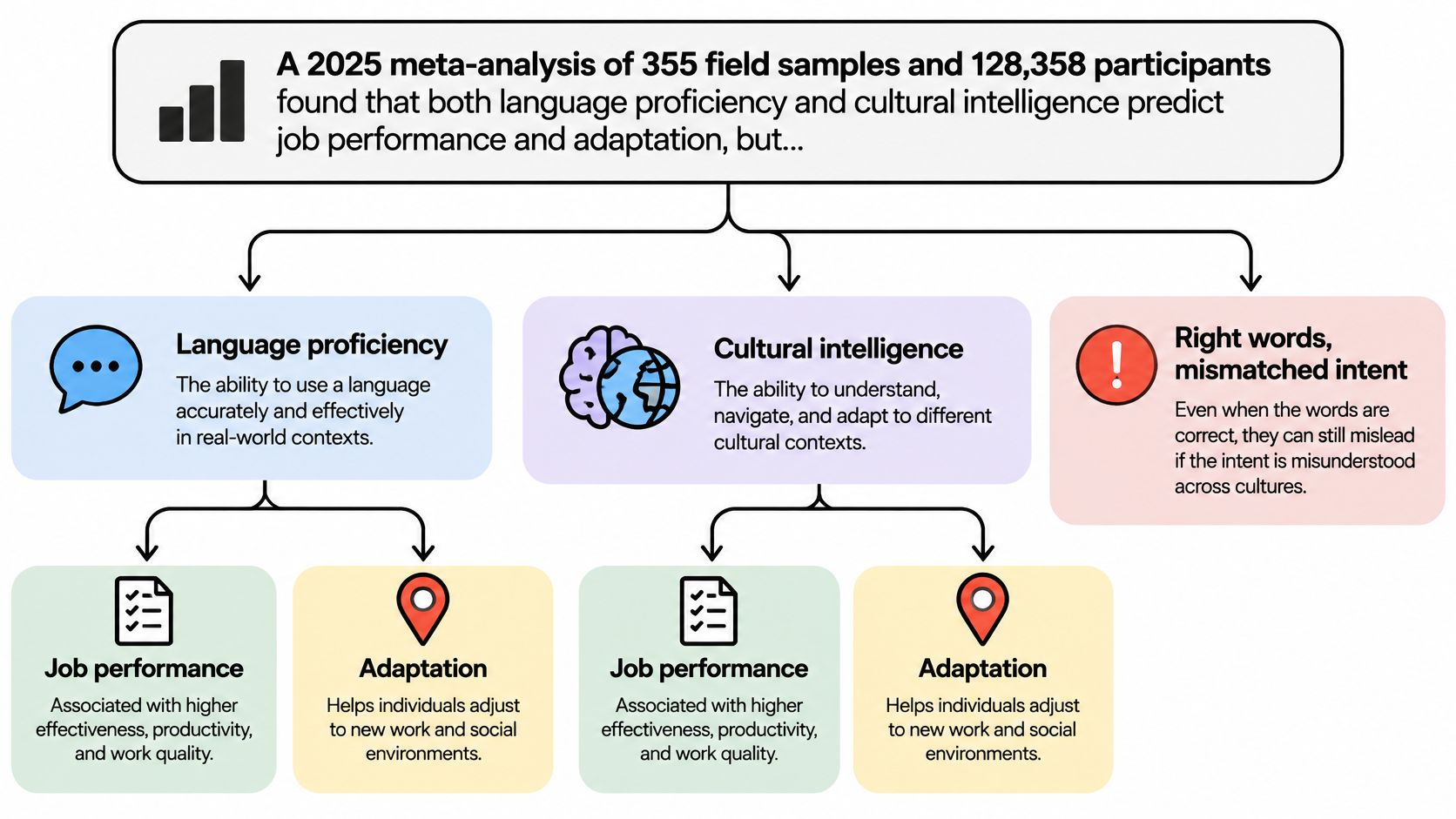
A 2025 meta-analysis published in Applied Psychology, covering 355 field samples and 128,358 participants, found that both language proficiency and cultural intelligence, or CQ, positively predict job performance and cultural adaptation. Language proficiency had stronger effects in lower-context cultures, while CQ became significantly more influential in higher-context cultures.
The distinction is between knowing what a sentence says and recognizing what someone is doing by saying it. This diagram separates the complementary skills.
A perfect sentence can be the wrong move
Say you tell a colleague that you need a document by Friday. In an office that expects explicit requests, that's useful clarity. In a relationship where you're expected to acknowledge workload or seniority first, it can sound like an order you aren't entitled to give.
Now reverse the problem. Your colleague replies that Friday could be difficult. You hear a scheduling challenge and expect them to try; they believe they've politely declined.
Neither interpretation requires a dictionary error. The missing information concerns authority, obligation, and whether the deadline is negotiable.
The video offers another way to consider communication across cultural expectations.
Watch for meaning that gets thinned out
Humor, metaphor, honorifics, emotional tone, useful ambiguity, and appropriate directness can disappear even when the basic proposition survives. The LSE Confucius Institute for Business London magazine's discussion of AI-mediated communication describes risks including semantic thinning and loss of contextual and emotional meaning. That's thinning, not merely a typo.
For audience-facing material, transcreation in translation addresses the related challenge of carrying purpose and effect across languages rather than preserving wording alone.
In a live conversation, add a confirmation before committing resources: Should I treat that as agreement, a decline, or something you still need to consider? This gives the other person usable choices without accusing them of being unclear.
Language proficiency and CQ complement each other. Collecting vocabulary helps, but reading the relationship tells you when the fluent sentence still needs a question.
Scripts for Six Everyday Frictions
Six frictions and a safer line
| Moment | What goes wrong | Safer line or action |
|---|---|---|
| Negotiating | A hard bargain sounds disrespectful or a soft answer sounds like a deal | Ask what is possible, pause, and repeat the figure |
| Apologizing | Silence looks careless; over-apology looks unsure | Name the issue, the fix, and the time |
| Refusing | A flat no costs face; a vague yes creates a false commitment | Decline the specific request and offer a real boundary |
| Small talk | Early questions about money, age, or family feel intrusive | Stay with place, food, and schedule until invited further |
| Talking about money | Tips, deposits, and totals get guessed | Say the amount twice and show it in writing |
| Giving feedback | Public critique shames; vague praise hides the change | Praise the work, then one private, specific change |
Keep the relationship and clarify the action
Negotiating. At a market stall or supplier meeting, ask: Is there flexibility in the price, or another option within my budget? Then pause rather than adding pressure. As the listener, distinguish an offer from a possibility: Is that the price you can confirm, or do you need approval?
Apologizing. Replace silence or a long self-attack with a repair: I sent the wrong file. I'll send the corrected version before our meeting. The listener's useful response is: Thanks. Should I discard the earlier version? That settles what happens next instead of requiring the apologizing person to keep proving remorse.
Refusing. Decline the request without rejecting the person: I can't do Friday; Monday works for me. Only offer an alternative you can honor. If you receive a softened refusal, ask: Should I take Friday off the schedule? Don't reward politeness by continuing to negotiate an unavailable option.
Make sensitive subjects easier to answer
Small talk. Start with something the person can discuss without disclosing private information: Have you tried the café near the station? Questions about salary, age, or family can wait until they open that door. If you're asked something you'd rather not answer, redirect warmly: I keep that private, but I'd love your recommendation for lunch.
Talking about money. At a hotel desk, ask: Is this the deposit or the full total? Please show me the amount and currency. Repeat the displayed amount and ask the other person to confirm it. On the receiving side, clarify what's included rather than assuming the customer understands local tipping or deposit practices.
Giving feedback. Recognize the contribution in the meeting, then ask privately: Could we review the handover? I need the next version to include the delivery date. The listener can respond: Is that the change you need before approval? Specificity avoids both public embarrassment and praise that conceals an unresolved problem.
For teams preparing cross-border prospecting conversations, Hire SDRs is a relevant resource to consider alongside an internal agreement on refusals, follow-ups, and what counts as a commitment. Hiring support doesn't replace teaching those expectations.
Save before you go: Keep a refusal line and a money-confirmation line in your phone, ready to adapt rather than recite mechanically.
Practice the listener's half as deliberately as the speaker's. These techniques for improving conversation skills are especially useful when you need to slow down, ask a follow-up, and resist finishing someone else's meaning for them.
Signs a Translation Is Not Safe to Trust
Language availability isn't proof of equal accuracy. A system can produce smooth sentences while mishandling a less-supported language pair. The De Gruyter Brill paper on language technology and underrepresented languages identifies risks from sparse, outdated, or inconsistent training material, including inaccurate or culturally insensitive output.
A language appearing on a menu doesn't establish that a translation is suitable for a clinic, visa desk, contract, or school meeting. The person speaking the dominant language may feel confident because the output reads naturally, while their partner has no reliable way to inspect what was conveyed.
Warning signs you can check
You don't need to understand every target-language word to notice structural trouble.
- Names and figures change: Compare the written output with the original spelling, appointment time, amount, and currency.
- Rephrasing changes the outcome: If a simpler version produces a different deadline or reverses who must act, stop.
- Formality surprises your partner: An unexpected reaction may signal an unsuitable title, relationship term, or level of directness.
- Important distinctions disappear: Ask explicitly about gender, kinship, and honorifics when those distinctions affect the message.
- Substitutions go unexplained: Don't accept a familiar-looking replacement for a place, medicine, organization, or document name without checking.
An absence of visible problems isn't certification of accuracy. It only means you haven't found an obvious reason to reject the output.
Use a stronger check as the consequences rise
Start with short sentences and repeat key facts separately. Ask the other person to explain the intended action in their own words, or request a back-translation to expose possible mismatches.
Back-translation is a diagnostic aid, not independent proof. A system may reproduce its own misunderstanding convincingly. Follow important details with a written record that both people can review.
For medical consent, legal rights, immigration decisions, and safety instructions, arrange a qualified human interpreter rather than relying on an unverified automated exchange. Don't ask a companion to carry responsibility for specialized meaning just because they speak both languages.
Before acting, ask: If I couldn't check this myself, what would make me trust it? If your answer is only that it sounded fluent, you need another check.
Run the Repair Routine and Set Up Your Tool
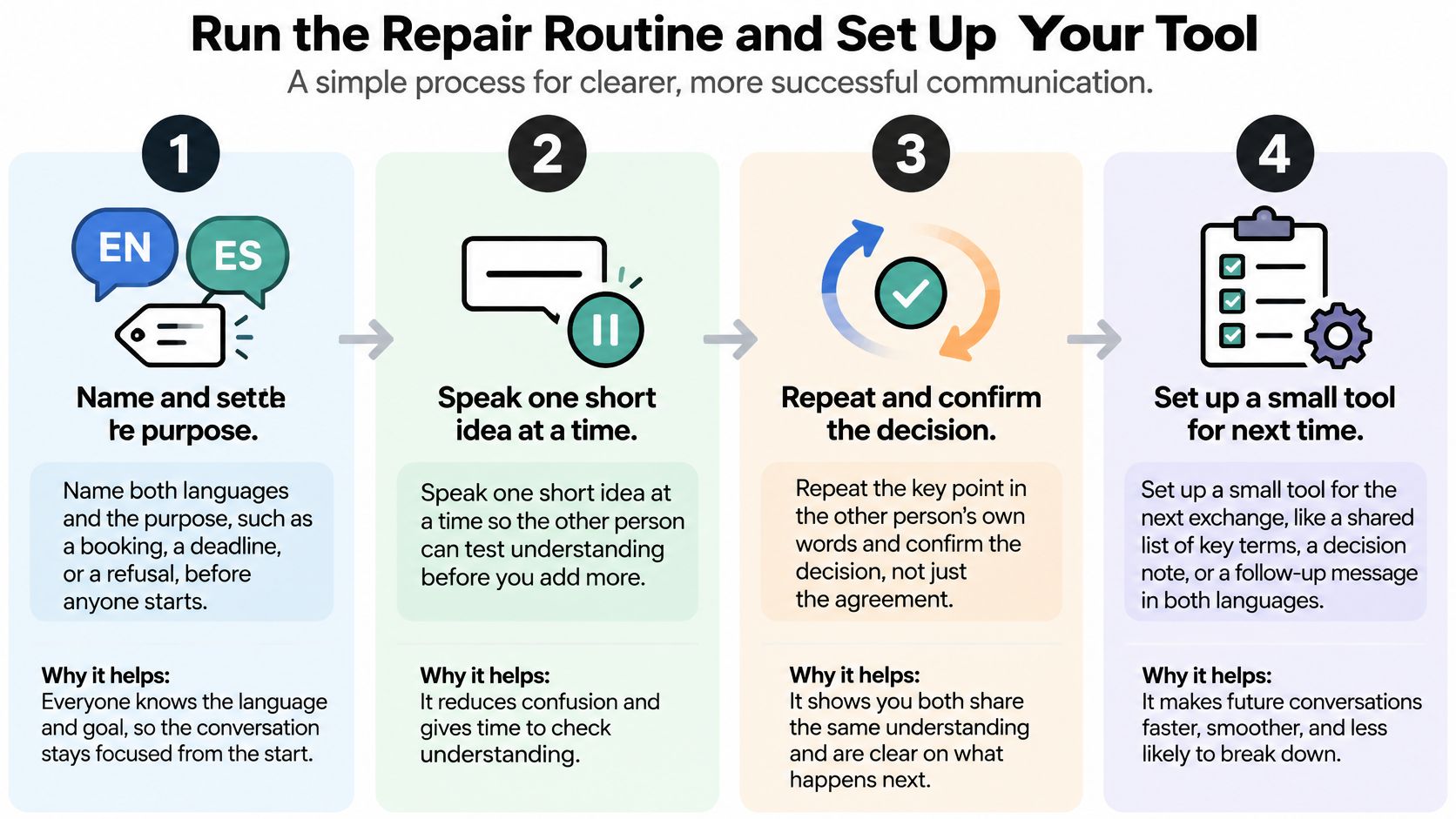
Use a routine that gives either person permission to interrupt. The aim isn't a polished performance. It's an exchange in which a mistake can be caught before it becomes a booking, payment, missed deadline, or unsafe instruction.
Make the conversation checkable
-
Name the languages and purpose. Establish what each person speaks comfortably and whether you're arranging a booking, discussing a deadline, or declining a request. This helps prevent an exploratory conversation from being mistaken for a final agreement.
-
Give each turn a manageable job. Say a short idea, then pause. Don't combine your explanation, exception, question, and preferred answer into a speech the other person can't easily interrupt.
-
Make critical details visible. Show names, times, amounts, and reference details in writing as well as saying them. If spelling matters, let the person who owns the name or document supply it.
-
Ask a confirmation that permits disagreement. Try: Did that mean yes, no, or not yet? Avoid asking only whether everything is clear, which makes a polite acknowledgment too easy.
-
Repair the specific fault. If a number, title, or request feels wrong, rephrase the troublesome part. Repeating it louder doesn't explain it better, and adding more detail can conceal the original problem.
-
Record responsibility and timing. Write what was decided, who will act, and when. Read the summary back and let the other person correct it before you leave or end the call.
Keep the note narrow enough to verify. A useful booking note names the service, arrival arrangement, payment obligation, and any remaining action, rather than merely recording that everyone agreed.
This visual provides a compact reminder to keep beside your conversation notes.
Set up Translate AI for the exchange
Our Translate AI app offers instant voice translation in over 80 languages and uses AI to recognize context. It translates both ways: you speak in your language, and your partner hears it in theirs.
Select your native language and your partner's language before starting. You can use ordinary earbuds, read and hear the translation immediately after speaking, or enable speaker mode for hands-free chats.
Use the spoken output to support turn-taking and the displayed line to inspect details. Still perform the confirmation and decision-recording steps yourself; context recognition doesn't remove the need for either person to challenge an interpretation.
For consent, contracts, immigration matters, and safety-critical instructions, stop and arrange a qualified interpreter. A convenient conversation tool shouldn't become the sole basis for a consequential decision neither person can verify.
Before your next exchange, prepare the names and terms you expect to use and open a note for the outcome. The success test is simple: both people can state the same decision and the same time, without relying on a nod to fill in what's missing.
Translate AI offers two-way, context-aware voice translation for travel, work, and everyday conversations. Visit Translate AI to prepare for your next exchange, then use a confirmation question and a shared written decision to make sure you've understood each other.