

A Guide on How to Greet People in Japan Confidently
Are you traveling to Japan and worried about saying the wrong thing or bowing incorrectly? Greeting someone in Japan is more than just saying hello—it's a small ritual, a blend of words and bows that sets the tone for everything that follows. Getting this cultural handshake right is surprisingly easy, and it makes a fantastic first impression.
This guide will give you specific, actionable advice to greet people in Japan with confidence. By the end, you'll know exactly what to say, when to say it, and how to bow respectfully in any situation.
Your First Impression in Japan
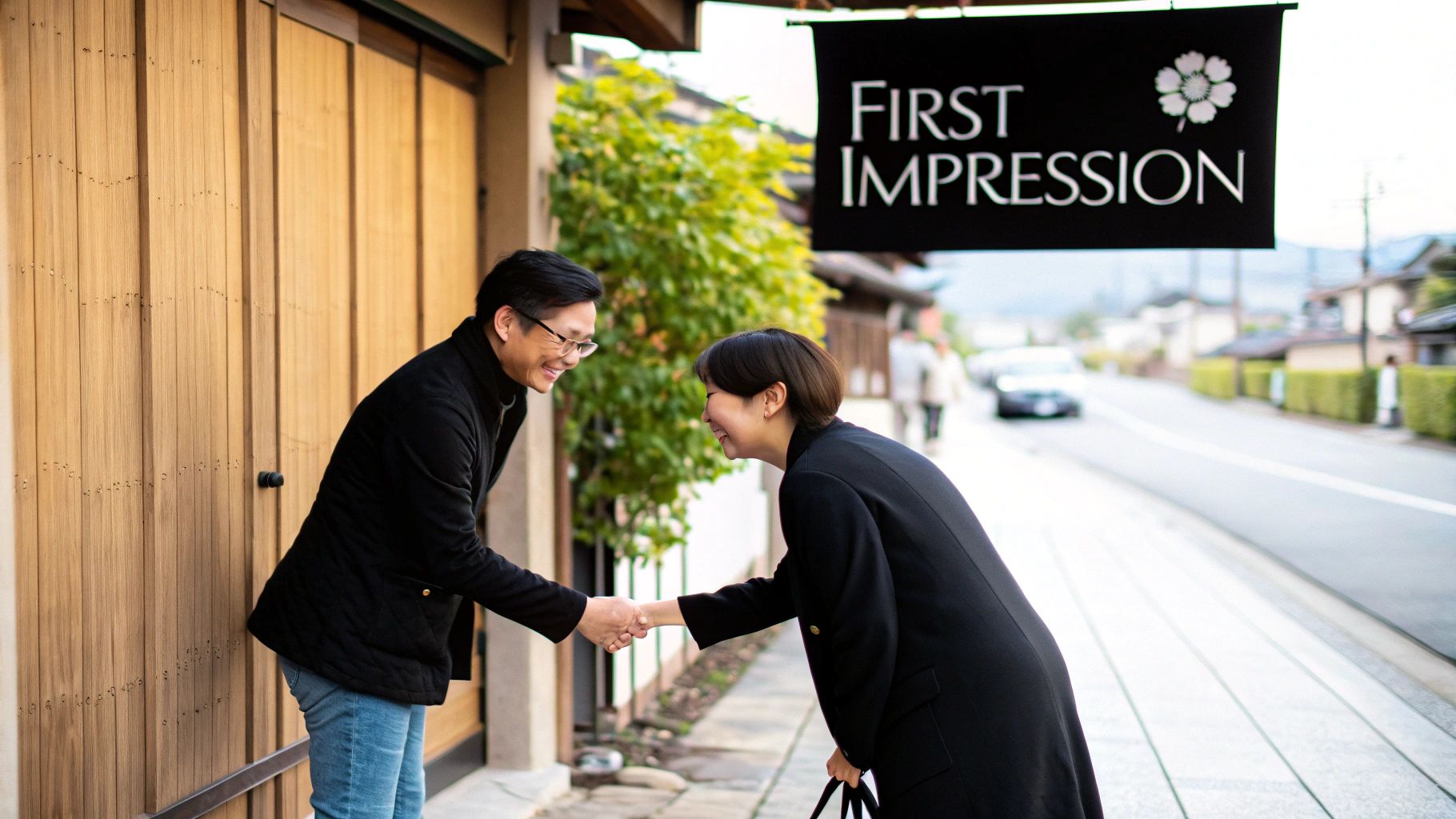
When you first meet someone in Japan, your greeting is the first thing they'll notice. It’s an immediate signal of your awareness and respect for their culture. Don’t stress about achieving perfect, native-level execution. It’s really the genuine effort that counts.
Unlike in many Western cultures where a firm handshake is the go-to, the bow is the primary non-verbal greeting in Japan. Pairing a simple bow with the right phrase creates a powerful, positive connection. For most visitors, this combination can feel a little unfamiliar at first, but it’s a fundamental part of daily life you'll see everywhere from convenience stores to corporate boardrooms.
Why Greetings Matter So Much
In Japanese society, greetings are the bedrock of smooth social interactions. They’re rooted in a deep cultural respect for harmony (wa, 和) and politeness. A proper greeting isn’t just a formality; it’s a way to communicate your intentions and acknowledge the other person's presence and status. It shows you've taken the time to understand and appreciate local customs.
By learning even the most basic greeting, you shift from being just another tourist to a thoughtful visitor. This small gesture can open doors to more meaningful and positive interactions with locals.
The key is understanding the context. Are you meeting a friend for ramen, thanking a shopkeeper, or introducing yourself to a business partner? The situation dictates how formal your words and your bow should be. Don't worry—it's easier than you think. And for those looking for more general advice before their trip, our guide on traveling to Japan offers some great tips.
This guide will break down exactly what you need to say and do, helping you build the confidence to greet anyone in Japan with grace. We’ll start with the most foundational phrases and actions you can use right away.
Essential Japanese Greetings for Every Situation
If you only know one Japanese greeting, it's probably "Konnichiwa." And that's a great start! But to really connect with people in Japan, you'll want to move beyond the basics. Using the right phrase at the right time is a simple way to show respect and cultural awareness, and it makes every interaction feel smoother.
Let’s get you armed with a handful of essential phrases that fit every part of the day and every kind of situation.
Time-Specific Greetings for Daily Use
One of the first things you'll notice is that Japanese greetings are often tied to the time of day. Using the morning greeting in the evening isn't a huge mistake, but getting it right shows you've made an effort to understand the culture.
- Ohayou gozaimasu (おはようございます): This is your go-to for "Good morning." You'll hear it from the moment you wake up until around 11 AM. If you're with close friends or family, you can shorten it to a more casual Ohayou (おはよう).
- Konnichiwa (こんにちは): The classic "Hello" or "Good afternoon." It’s typically used from late morning until dusk, roughly from 11 AM to 5 PM. This is a wonderfully versatile phrase that works perfectly in most neutral or semi-formal situations.
- Konbanwa (こんばんは): Once the sun goes down, switch to "Good evening." This is the standard polite greeting for any encounter at night.
A quick inside tip: In a Japanese workplace, it's common to say 'Ohayo gozaimasu' the first time you see a colleague that day, even if it's 3 PM! It acts more like a "hello for the first time today" in that specific context. While some studies suggest traditional greetings are changing among younger generations, for visitors, sticking to these time-of-day rules is absolutely the way to go. You can read more on this in a study on Japanese communication trends.
Beyond Hello: Crucial Everyday Phrases
Greeting someone properly in Japan is about more than just the first "hello." A few other phrases for introductions, apologies, and thanks are just as critical for daily life.
When you're meeting someone for the very first time, the phrase you need is Hajimemashite (はじめまして). It translates roughly to "Nice to meet you" and is the cornerstone of any introduction, almost always followed by your name and a bow.
Next up is the incredibly useful Sumimasen (すみません). Think of this as your multi-tool for polite interaction. It means "Excuse me" or "I'm sorry," and you can use it to get a waiter's attention, apologize for bumping into someone on the train, or even as a way to say "thank you" when someone does you a small favor.
Mastering phrases like 'Sumimasen' and 'Arigatou gozaimasu' can be more impactful than knowing a dozen complex sentences. They are the social glue of daily Japanese life and show deep respect.
Finally, showing gratitude with Arigatou gozaimasu (ありがとうございます) is fundamental. For a more casual "thanks" with friends, you can simply say Arigatou (ありがとう).
Quick Guide to Common Japanese Greetings
This handy table breaks down the essential phrases, how to pronounce them, and the perfect time to use each one.
| Situation | Japanese Phrase (Kanji/Kana) | Romaji Pronunciation | When to Use |
|---|---|---|---|
| Morning Greeting | おはようございます | Ohayou gozaimasu | From waking up until around 11 AM. Use "Ohayou" for friends/family. |
| Afternoon Greeting | こんにちは | Konnichiwa | From around 11 AM to 5 PM. A general, all-purpose "hello." |
| Evening Greeting | こんばんは | Konbanwa | After sunset. Your standard "good evening." |
| First Introduction | はじめまして | Hajimemashite | When meeting someone for the absolute first time. |
| Getting Attention / Apologizing | すみません | Sumimasen | To get someone's attention, apologize for a minor inconvenience, or say "excuse me." |
| Expressing Thanks | ありがとうございます | Arigatou gozaimasu | A polite way to say "thank you." Use "Arigatou" in casual settings. |
Having these six phrases down will cover a huge range of your daily interactions in Japan.
Putting It All Together With Confidence
No one expects you to have perfect pronunciation, but a clear and sincere attempt goes a long way and is always appreciated. These greetings are the foundational blocks for polite and friendly conversation.
Getting these right will open the door to more positive and memorable experiences during your travels. To build on these basics, check out our guide on how to improve your conversation skills, which has tips that apply to any language you're learning.
The Art of Bowing with Respect
Words are only half the story in a Japanese greeting. The other half is the bow, or ojigi (お辞儀). This silent gesture is a huge part of Japanese communication, capable of showing respect, gratitude, or an apology without saying a thing. It might feel a little intimidating at first, but once you get the hang of the basics, it starts to feel completely natural.
The most critical part? Your posture. A proper, respectful bow comes from the waist, not the neck. Keep your back and neck in a straight line as you hinge at your hips. A common mistake is just dipping your head or rounding your spine, which can look a bit sloppy. A clean hinge shows sincerity.
Three Main Types of Bows
Not all bows are created equal. The depth of your bow says a lot about the situation and your relationship with the other person. Getting familiar with the three main types will have you covered for just about any encounter in Japan.
- Eshaku (会釈) - The Casual Bow: Think of this as a slight nod from the waist, about a 15-degree angle. It’s perfect for casual situations, like acknowledging a coworker you pass in the hall or thanking a cashier at the convenience store.
- Keirei (敬礼) - The Standard Respectful Bow: This is a deeper, 30-degree bow, and it’s your go-to for most polite, everyday situations. You'd use a keirei when meeting someone for the first time, greeting a client, or offering a formal thank you. It’s your all-purpose bow for showing genuine respect.
- Saikeirei (最敬礼) - The Deepest Bow of Respect: This is a very deep bow of 45 degrees or more. It’s reserved for moments of profound gratitude, a sincere apology, or when greeting someone of very high status, like a company president. You won't use this one often, but it's important to recognize its weight.
This simple chart shows how greetings change throughout the day, and your bow should adapt right along with them to match the formality.
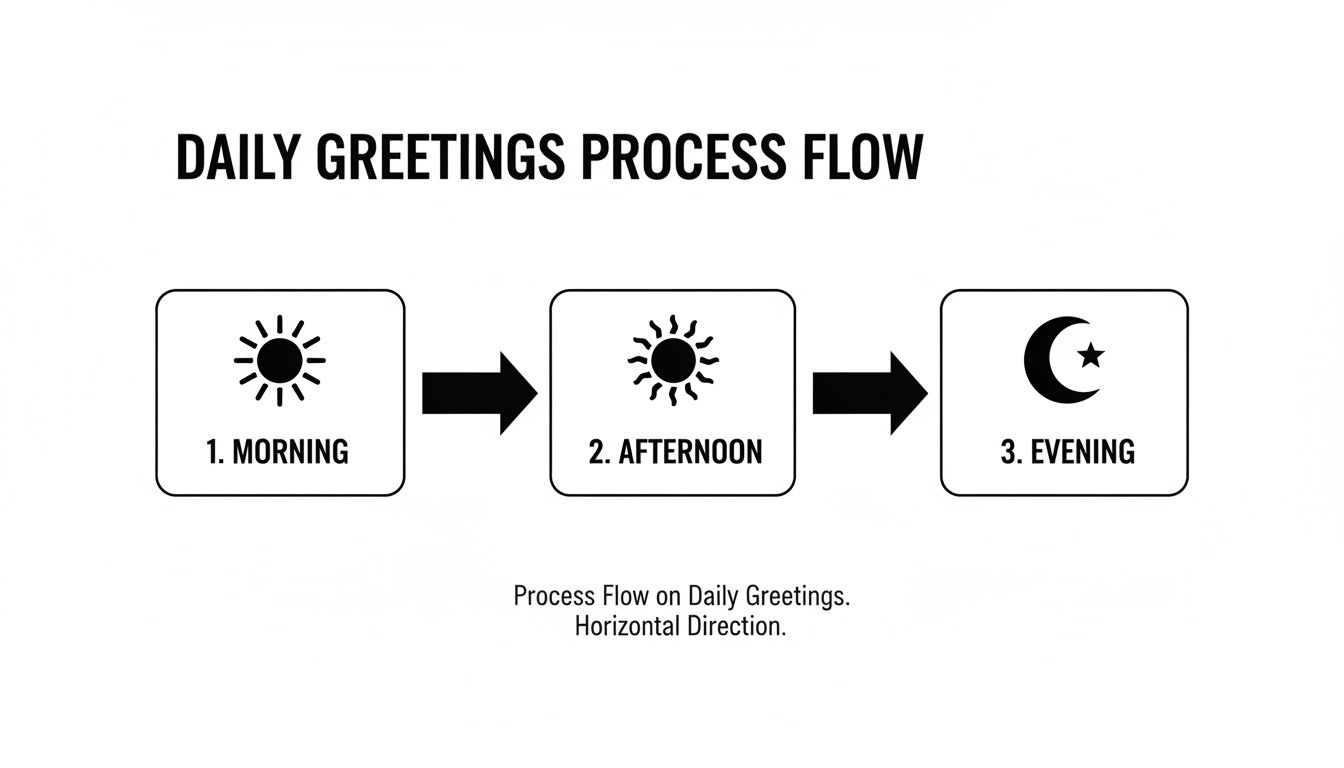
As the verbal greeting changes, so does the non-verbal. It’s all about context.
Mastering the Right Posture
Good posture is what separates a confident bow from an awkward one. As you bow, your eyes should follow the movement, naturally looking down at the floor in front of you. Trying to maintain eye contact during a bow is generally considered a bit strange, so let your gaze drop.
Here are the key posture points:
- Hinge at the hips: Bend from your waist, keeping your back and neck straight.
- Let your gaze drop: Look at the floor in front of you, not at the person.
- Hand placement: Men should keep hands at their sides. Women can either keep them at their sides or clasped in front.
The angle of the bow is a powerful signal, with deeper bows reserved for more formal situations—a cultural cornerstone you can learn more about in the context of Japanese business greetings.
Remember this: the person of lower status (or the person initiating the greeting) bows first and holds it slightly longer. As a visitor, a great rule of thumb is to simply mirror the bow you receive, but maybe hold it for just a beat longer to show a little extra respect.
Don't stress about getting it perfect every single time. Your effort to show respect through bowing will be noticed and genuinely appreciated. It’s the sincerity behind the gesture that truly counts.
Navigating Greetings in Professional Settings

While a casual "konnichiwa" works on the street, the professional world in Japan plays by a much more structured rulebook. A proper business greeting isn't just a nicety; it’s a critical first impression that builds immediate trust and shows you take the relationship seriously.
The entire process is a well-defined ritual. It’s a dance of verbal introductions, precise bows, and the careful exchange of business cards, or meishi (名刺). Every single move is done with care, signaling your respect for the person you're meeting. Learning the steps shows you’re a considerate professional, not just a tourist.
The Formal Introduction Ritual
When you meet a business counterpart for the first time, this sequence is your first test of cultural fluency. It kicks off with a bow—a standard 30-degree keirei is perfect here—followed by your introduction. State your company name first, then your full name.
For example, you’d say, "ABC Corporation no Smith desu. Hajimemashite." (I'm Smith from ABC Corporation. It's a pleasure to meet you.)
Right after that comes the business card exchange. This is arguably the most important part of the entire greeting. In Japan, a meishi is seen as an extension of a person's identity, so it must be handled with the utmost respect.
Here’s how to do it right:
- Offer with Two Hands: Always present your card with both hands, holding it by the top corners so your counterpart can easily read your name.
- Receive with Two Hands: Accept their card the same way. Take a moment to actually read their name and title.
- Acknowledge and Place: Acknowledge their name with something like, "Tanaka-san, arigatou gozaimasu" (Thank you, Mr. Tanaka). During the meeting, place the card on the table in front of you. Never stuff it in your pocket or, worse, write on it in front of them.
Using Polite Language and Titles
In a Japanese professional setting, using polite language, known as teineigo (丁寧語), is non-negotiable. This is the default mode of speech that shows respect and is expected in all business communication.
You should also always address people by their last name followed by the honorific suffix -san (さん). Calling someone by their first name is way too familiar and would be seen as disrespectful in a business context.
The key takeaway here is that every action in a Japanese business greeting is deliberate. Rushing the process or treating a business card like a disposable piece of paper can be interpreted as a deep lack of respect for the person and their company.
Bridge Communication Gaps with Translate AI
Even with the best preparation, you might forget a phrase or find yourself struggling to explain a complex idea. This is where an app like Translate AI can become your personal interpreter.
Imagine you're meeting a potential partner. You could speak your introduction in English, and the app will give you a natural, polite Japanese translation on the spot.
It's also a fantastic tool for practicing key phrases like 'Yoroshiku onegaishimasu' to nail the pronunciation. By helping you have smoother, more professional conversations, it can be a real asset for successful cross-cultural business communication.
Common Greeting Mistakes to Avoid
Even if you’ve memorized all the right phrases, knowing what not to do is just as important for making a great first impression in Japan. Many friendly Western habits can come across as overly familiar or even a bit disrespectful.
The good news? A little awareness goes a long way. Let's walk through the common tripwires so you can sidestep them with ease.
The Big One: Unsolicited Physical Contact
This is probably the biggest mistake visitors make. In Japan, personal space is taken seriously, and gestures like a friendly hug, a pat on the back, or touching someone's arm are generally off-limits unless you know someone very well.
Think of it as a "hands-off" default. Unless your Japanese counterpart initiates a handshake, it's best to keep your hands to yourself.
Speaking of handshakes, while some Japanese professionals who deal with Westerners will offer one, you should never be the one to initiate it. If one is offered, keep your grip light and brief—a firm, bone-crushing handshake can feel aggressive. The bow is always the default.
Missteps in Bowing and Eye Contact
The bow itself has its own set of nuances that can trip people up. One of the most frequent mistakes is maintaining direct eye contact while bowing. This can feel confrontational or signal mistrust.
Instead, let your gaze naturally fall toward the floor in front of you as you bend at the waist. It’s a simple adjustment that shows you understand the etiquette.
The most common mistakes are often rooted in friendly Western habits. Avoiding unprompted physical contact and remembering to lower your gaze during a bow are two simple adjustments that show immense cultural respect.
Getting the Language Formality Right
Finally, be mindful of your language. Tossing out an overly casual phrase like "Yaho!" (a very informal "hey") with a shopkeeper or someone you've just met is a definite no-no. It would be like yelling "'Sup!" at a bank teller.
Until you've built a much closer relationship, stick to polite, all-purpose greetings like Konnichiwa or Hajimemashite.
Get it Right with Translate AI
Worried you might pick the wrong level of formality on the spot? An app like Translate AI can be a real lifesaver. It provides contextually appropriate translations, helping you find the right words for any situation so your greetings always land respectfully.
Still Have Questions About Japanese Greetings?
Even after you've learned the basics, real-life situations can throw you a curveball. Here are some quick answers to the questions that pop up most often for travelers in Japan.
What if someone offers a handshake instead of a bow?
Go for it! In international business settings, it’s quite common for your Japanese counterpart to offer a handshake to make you feel more comfortable. Just remember, the grip is usually lighter and gentler than what you might be used to in the West.
A great way to show extra respect is to accept the handshake and give a slight nod of your head at the same time. It’s a nice hybrid gesture that blends both cultures.
How should I greet staff in shops or restaurants?
When you walk into almost any shop or restaurant, you’ll be met with a bright, cheerful "Irasshaimase!" (いらっしゃいませ!), which means "Welcome!"
You don’t actually need to say it back. The best response is a simple, friendly smile and a small nod to show you’ve heard them. As you’re leaving, a thoughtful touch is to say "Arigatou gozaimashita" (ありがとうございました) at a shop, or "Gochisousama deshita" (ごちそうさまでした) at a restaurant, which means "It was a delicious feast."
Is it a big deal if my bow isn't perfect?
Not at all. Japanese people are incredibly gracious and understanding when it comes to foreigners. They know you're learning, and what truly matters is that you're making a sincere effort to respect their customs.
Your genuine attempt will always be appreciated far more than the technical perfection of your bow. It's the effort to connect that truly counts.
Do I really need to bow when I'm on the phone?
It might sound strange, but you'll see many Japanese people do this, especially in business calls. It’s a deeply ingrained habit that's less about the other person seeing you and more about putting yourself in a respectful frame of mind.
While the person on the other end can't see the bow, the physical act often helps the speaker maintain a more polite and formal tone of voice.
Even with all the practice in the world, having a little help in your pocket can make all the difference. For those real-time moments when you need a quick translation or want to perfect your pronunciation on the go, Translate AI is the perfect companion.
It gives you clear, accurate translations so you can communicate confidently, whether you're ordering dinner or meeting new friends.
Download Translate AI from the App Store and make every interaction a success.