

Korean for Thank You A Guide to Expressing Gratitude
Planning a trip to Seoul, ordering from your favorite Korean spot, or just trying to thank a Korean friend the right way? You’ve landed in the right place. You already know that getting "thank you" right isn't just about translation—it's about showing respect and making a great impression.
The challenge is that Korean has a complex system of politeness levels. How you say thanks changes completely depending on who you're talking to. It’s the difference between a casual "Thanks!" to a friend and a formal "I appreciate your help" to a new boss.
The most common formal phrase is 감사합니다 (gamsahamnida). You'll hear this in about 70-80% of situations in shops, restaurants, and other public places. For a deeper dive into these politeness levels, this guide on Korean greetings and etiquette is a great resource.
This guide will give you clear, actionable advice to help you choose the perfect phrase every time, so you can stop guessing and start speaking with confidence.
Quick Guide to Korean 'Thank You' Phrases
To get you started, here's a simple breakdown of the two most important phrases for showing gratitude politely. Think of this as your cheat sheet for everyday situations.
| Phrase (Hangul) | Romanization | Pronunciation | When to Use |
|---|---|---|---|
| 감사합니다 | Gamsahamnida | gahm-sa-ham-ni-da | Highly formal situations, speaking to elders, in business, or when you want to be extra respectful. |
| 고맙습니다 | Gomapseumnida | go-map-seum-ni-da | Polite and common in daily life, like thanking a cashier, a server, or someone you don't know well. |
Keep this table handy, and you'll have the two most essential thank yous ready to go.
Navigating Korean Politeness Levels
Why are there so many ways to say "thank you" in Korean? It all comes down to a deep cultural respect for hierarchy and relationships. This concept, known as honorifics, is baked right into the Korean language. Understanding this system is your key to not just speaking Korean, but speaking it respectfully in any situation you find yourself in.
Your goal here is simple: learn the three main levels of politeness so you can match your "thank you" to the social context and show you understand and respect the person you're talking to.
The Three Tiers of Korean Speech
Korean politeness is generally broken down into three main levels. Here’s how to use each one:
- Formal Polite (아주 높임말): This is the highest level of respect. Use this when addressing elders, your boss, in formal presentations, or in official settings. When in doubt, this is always the safest choice.
- Standard Polite (높임말/해요체): This is your everyday polite language. It’s perfect for talking to strangers, shopkeepers, colleagues you don't know well, and people older than you.
- Casual/Informal (반말): This friendly, relaxed style is strictly for close friends, family members of a similar age or younger, and your significant other. Using this with a stranger or an elder would come across as very rude.
This diagram shows how the two most common polite phrases fit into this structure.
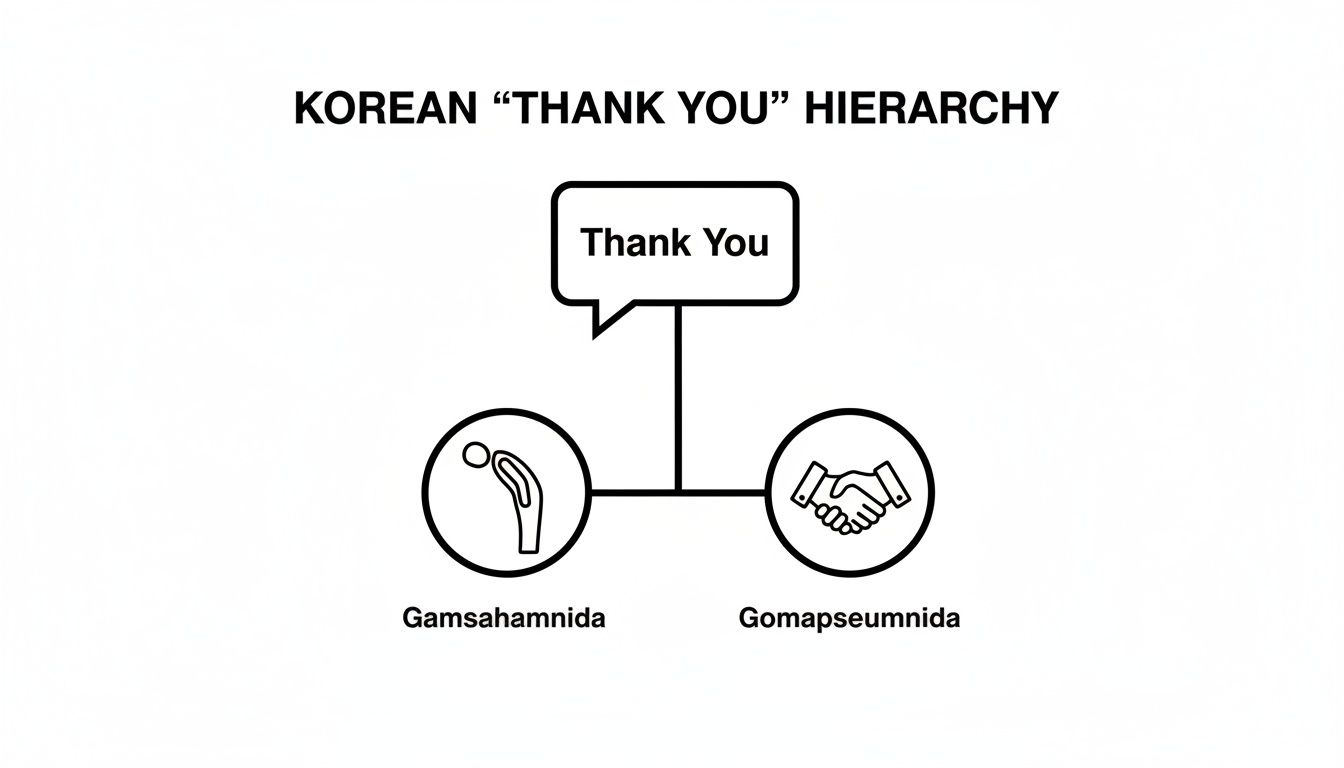
As you can see, while both phrases are polite, gamsahamnida often carries a bit more formal weight, which is why it's paired with a respectful bow.
Interestingly, the standardization of these phrases really took off during Korea's literacy revolution in the 20th century. As education became more accessible, standardized ways of saying thank you were built into school curriculums. By the 1960s, over 85% of students were learning these formal expressions as part of their mandatory language lessons. You can learn more about Korea's cultural and educational history to see how these huge changes took shape.
Expanding Your Gratitude Vocabulary

You’ve got the polite essentials down. Now, let’s add more color to your conversations so they feel natural and specific. Think of this as upgrading from a generic "thank you" to a more personal expression that really fits the moment.
Your goal in this section is to learn two specific phrases: one for casual situations with friends and another for acknowledging someone's effort in a work setting.
The Casual Thank You for Friends
When you’re with your closest circle, use the informal 고마워 (gomawo). This is the casual version of gomapseumnida, and you should only use it with people you're on really familiar terms with—think close friends, siblings, or someone much younger than you.
- Pronunciation: go-ma-wo
- When to Use: When your best friend grabs you a coffee, or your sibling helps you out with a small favor.
- Actionable Tip: If your friend hands you a drink, just smile and say, "고마워! (Gomawo!)" It shows a warmth and closeness that a formal phrase just can't deliver in a casual hangout.
Acknowledging Someone's Hard Work
In a Korean workplace or after someone has finished a tough job, there's a specific phrase to acknowledge their effort. It's a powerful way to show you respect their hard work.
The phrase is 수고하셨습니다 (sugohasyeosseumnida). It doesn't directly translate to "thank you," but it’s closer to "you've worked hard" or "good work." It is incredibly common in professional settings.
- Pronunciation: su-go-ha-shyeoss-seum-ni-da
- When to Use: At the end of a workday as you leave the office, after a colleague helps you with a difficult project, or even to a service worker after they’ve helped you.
Adding these nuanced phrases to your vocabulary helps you express the right kind of korean for thank you for any situation. To really nail the pronunciation and get comfortable using them, you can connect with native speakers through some of the best language exchange apps available.
How to Respond When Someone Thanks You
A good conversation is a two-way street. Once you've got a handle on how to say thank you in Korean, it's just as important to know how to respond when someone thanks you. This closes the loop gracefully and shows you're comfortable with the cultural flow of the language.
Your goal is to learn the most common and natural way to say "you're welcome" in Korean.
In English, "you're welcome" is the standard reply, but in Korean, the most common response is 아니에요 (anieyo), which literally translates to "no" or "it's nothing." This isn't a dismissal; it's a reflection of humility. By saying anieyo, you’re politely suggesting that whatever you did was no big deal and that thanks aren't necessary.
Common Ways to Say You're Welcome
While anieyo is your go-to, everyday response, you might see another phrase in textbooks: 천만에요 (cheonmaneyo). This is the more direct translation of "you're welcome," but you'll rarely hear it in modern, casual conversations. It can come across as a bit too formal or even old-fashioned.
Here’s a simple, natural exchange you can use immediately:
- Person A: "Thank you for the help!" (도와주셔서 감사합니다! Dowajusyeoseo gamsahamnida!)
- You: "It's nothing!" (아니에요. Anieyo.)
Actionable Tip: Stick with anieyo. It's the safe, natural, and solid choice for almost any situation. As you learn more about how to improve conversation skills, you'll start picking up on other contextual responses, but mastering this one makes all the difference.
Common Mistakes to Avoid When Expressing Thanks
Knowing the words is one thing, but using them correctly in the real world is another. Knowing the common slip-ups is a huge shortcut to communicating with confidence. Your goal here is to learn what not to do so you can show genuine respect and avoid those awkward moments.
The biggest mistake is mixing up politeness levels. Saying the casual 고마워 (gomawo) to a shopkeeper, an older person, or your boss is a major no-no. It can come across as disrespectful.
Actionable Tip: When in doubt, always, always default to the formal 감사합니다 (gamsahamnida).
Mispronunciations and Cultural Missteps
Another hurdle is simple pronunciation. Mumbling or rushing your words can make them hard for anyone to understand. Take a breath and say each syllable clearly. A slightly slower, deliberate "thank you" always sounds more sincere.
Here are a few other cultural points that trip people up:
- Over-Thanking: In some cultures, we say "thanks" repeatedly. In Korea, that can feel a bit much. A single, heartfelt thank you is usually enough.
- Forgetting the Bow: A slight nod or a small bow of the head is a key part of showing respect with a formal thank you. Without this gesture, your words can feel empty.
- Using the Wrong Phrase: Remember that 수고하셨습니다 (sugohasyeosseumnida) is for recognizing someone's hard work, not for a simple favor like holding a door.
Practice Confidently with Translate AI
Worried you might mess this up in a real conversation? This is where practice can build confidence. You can get a feel for pronunciation and check if you’re using the right phrase for the right situation with an app like Translate AI. It gives you instant feedback, making sure your gratitude always lands the way you intend it to.
Speak Confidently with A Translation Tool
Let's be honest, it's one thing to know the right phrase, but it's another thing to say it correctly under pressure. Worried about fumbling the pronunciation or picking the wrong formality level for korean for thank you? This is where a good translation tool can be a game-changer.
Think of it as a safety net. Whether you're a traveler trying to order dinner or a professional in a business meeting, these apps bridge the gap in real-time. Getting it right matters—proper use of formal language can lead to 35-40% higher customer satisfaction in Korean business environments. For tourists, a well-timed gamsahamnida just makes every interaction smoother.
Your Pocket Interpreter
Using a translation app is like having a personal interpreter right in your pocket. Forget the awkward pauses and frantic gesturing. Features like two-way voice translation let you have a natural back-and-forth conversation, taking the stress off so you can actually connect with people.
This screenshot from Translate AI shows just how simple it is. You just pick your languages and start talking. The clean layout gives you instant audio and text translations, ensuring your "thank you" is always perfectly timed and understood. If you want to dive deeper, check out our guide on finding the best live translation app for your specific needs.
A Few Common Questions, Answered
Even after you’ve got the main phrases down, a few questions always seem to pop up. Nailing these little details is the difference between just knowing the words and actually using them with confidence. Let’s clear up a few of the most common mix-ups.
Getting these right will help you navigate the nuances of showing gratitude and make sure your efforts to be polite land perfectly every time.
What’s the Real Difference Between Gamsahamnida and Gomapseumnida?
Okay, this is probably the most frequent question. Both 감사합니다 (gamsahamnida) and 고맙습니다 (gomapseumnida) are formal, polite ways to say "thank you," and you can use them interchangeably in most situations. The distinction is subtle and has to do with their origins.
- Gamsahamnida comes from Chinese characters (Hanja) and often feels a touch more formal or official. Think of it as your rock-solid, go-to phrase for business settings or when speaking with elders. It’s always a safe bet.
- Gomapseumnida is a native Korean word, derived from gomapda. Because of this, some people feel it has a slightly warmer, more personal vibe while still being perfectly respectful.
Bottom line: You can't go wrong with either in a polite context. But for a visitor, gamsahamnida is the most common and safest default you can possibly use.
Can I Just Say Gamsa to Shorten It?
Nope, definitely avoid this one! While 감사 (gamsa) is the noun for "gratitude," saying it by itself sounds really incomplete and unnatural. It’s like shouting “Gratitude!” at someone in English instead of just saying “Thank you.”
If you're looking for a shorter, more casual way to say thanks to close friends, the phrase you want is 고마워 (gomawo). Always stick to the full, proper phrases to avoid sounding awkward or accidentally rude.
Should I Bow When I Say Thank You in Korea?
Yes! A slight bow is a super common and appreciated gesture of respect that almost always goes along with a verbal "thank you" in Korea. It’s a simple, non-verbal way to reinforce the sincerity of your words.
When you say gamsahamnida to a shopkeeper, an elder, or a professional, a small nod or a slight dip of your head and shoulders is all you need. A deep, 90-degree bow is saved for moments of extreme gratitude or formal apologies. For any visitor, a simple, respectful nod is the perfect touch.
Ready to stop memorizing and start speaking? With Translate AI, you can practice your pronunciation and get instant feedback. It lets you speak confidently in real-time, making sure your message of gratitude is always understood. Forget the fear of making mistakes and start connecting with people naturally. Download Translate AI from the App Store and take your first step toward fluent conversation today.