

How to Prepare for International Travel: A Stress-Free Guide
Feeling that mix of excitement and panic as you stare at a newly booked international flight? You know a life-changing adventure is waiting, but between you and that first gelato in Rome is a mountain of tasks: passports, visas, money, packing, and a dozen other things you're worried you'll forget. It's overwhelming. The secret to a smooth trip isn't a frantic scramble the week before you leave. It's a clear, step-by-step plan that tackles the right tasks at the right time.
This guide is designed to be that plan. Our goal is to walk you through a simple countdown, breaking down exactly what you need to do and when. By the end, you'll have a clear checklist to get you from "trip booked" to "ready for takeoff" without the last-minute stress.
Your Pre-Travel Countdown: The Long-Lead Essentials
The pure excitement of booking an international trip can easily push the boring-but-critical tasks to the back of your mind. But a truly smooth journey doesn't start at the airport—it starts anywhere from two to six months before you even think about leaving.
This is your golden window to tackle the big stuff: passports, visas, and essential health prep. Getting these done early means you aren't scrambling to deal with bureaucratic delays or surprise requirements when it's too late.
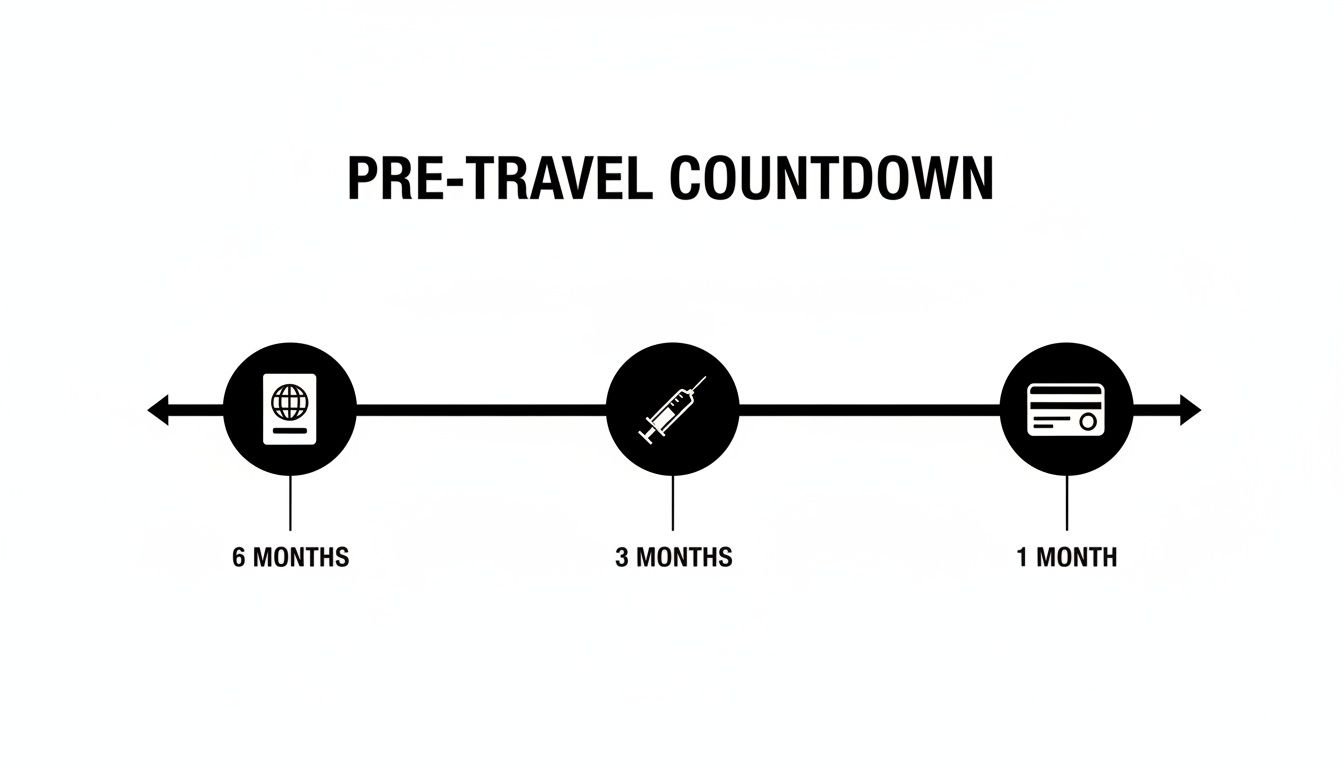
Advance planning has never been more important. With travel roaring back, experts predict nearly 2 billion international trips in 2025, which is even higher than pre-pandemic numbers. That means busier airports, stricter rules, and less room for error. Being prepared is no longer just a good idea; it's what separates a great trip from a stressful one.
To make this manageable, we've broken down the key tasks into a simple timeline. Think of it as a step-by-step checklist to get you from "trip booked" to "ready for takeoff" without the last-minute panic.
International Travel Preparation Timeline
| Timeframe Before Departure | Key Tasks to Complete |
|---|---|
| 6 Months Out | Passport & Visas: Check your passport's expiration date (the "six-month validity rule" is real!). Apply for renewals or new passports now. Research and apply for any required visas for your destination. |
| 3-4 Months Out | Health & Insurance: Schedule a visit with your doctor or a travel clinic to discuss necessary vaccinations or medications. Some shots require multiple doses. Research and purchase comprehensive travel insurance. |
| 1-2 Months Out | Finances & Bookings: Notify your banks of your travel dates to avoid fraud alerts. Book major accommodations, rental cars, and key tours or activities. Start setting aside foreign currency if needed. |
| 2-4 Weeks Out | Connectivity & Packing: Research phone plan options (eSIM, roaming, local SIM). Download offline maps and translation apps. Create a packing list and begin gathering items you don't use daily. Arrange for pet or house sitters. |
| 1 Week Out | Final Preparations: Confirm flights and accommodations. Share your itinerary with a friend or family member. Start packing your main luggage. Pay any upcoming bills that will be due while you're away. |
| 1-2 Days Out | Last-Minute Checks: Pack your carry-on, including all essential documents, medications, and electronics. Charge all your devices. Check in for your flight online. Reconfirm your airport transportation. Double-check your packing list. |
Following this timeline spaces out the work and ensures the most time-consuming steps are handled well in advance.
Secure Your Passport and Visas Early
Your passport is the single most important document you'll carry. The very first thing you should do—ideally six months before your trip—is grab it and check the expiration date.
Many countries have a "six-month validity rule," meaning your passport must be valid for at least six months after the date you plan to leave their country. If it's cutting it close, you could be denied boarding at the gate.
If you need a new one, start the renewal process immediately. Standard processing can take months, and paying for expedited service is an expensive, stressful fix for something that could have been handled early.
Once your passport is sorted, dig into the visa requirements for your destination. Some countries are visa-free for tourists, while others demand a complicated application submitted weeks or months in advance. The official government or embassy website for your destination is always the most reliable source for this information.
Consult Your Doctor and Insurance Provider
Around three or four months out, make an appointment with your doctor or a travel clinic. This is your chance to discuss any required or recommended vaccinations for where you're going. Don't leave this to the last minute, as some immunizations require a series of shots spaced weeks apart.
This is also the perfect time to get your travel insurance locked in. Your regular health plan probably offers little to no coverage once you leave the country, and an unexpected medical emergency overseas can be financially crippling.
Here's a quick checklist for a solid travel insurance policy:
- Emergency Medical Coverage: This is non-negotiable. It should cover hospital stays, doctor visits, and, crucially, medical evacuation back home.
- Trip Cancellation & Interruption: This protects the money you've spent on flights and hotels if something unexpected forces you to cancel or cut your trip short.
- Baggage Loss or Delay: Provides reimbursement if the airline loses your bag or it's stolen. It's a lifesaver when you have to buy a whole new wardrobe on the road.
Prepare for Communication and Connectivity
In a world where we rely on our phones for everything from maps to boarding passes, figuring out your communication plan is a key part of travel prep.
While we’ll get deeper into the tech side of things later, it's smart to start researching your options now. At the same time, think about how you'll handle language barriers. A good translation app can turn a moment of potential confusion into a genuine connection with a local. To get a head start, check out our guide on the 9 best translation apps for travel in 2025. Taking a few minutes to download and test one or two will pay off big time when you land.
Managing Money and Tech Across Borders
Nothing torpedoes a trip faster than a declined credit card or a phone with zero signal. Getting your finances and tech sorted out before you leave is one of the most critical steps to avoiding those classic, frustrating travel headaches. This section will give you specific, actionable steps to handle your money and stay connected without coming home to a shocking bill.
Imagine this: you've just landed after a 12-hour flight, you're exhausted, and you hop in a taxi. When you arrive at your hotel, your card is declined. It's been flagged for suspicious activity and frozen. A single, five-minute call to your bank a week before you leave can prevent this entire scenario.
Smart Financial Strategies for Traveling Abroad
Your approach to money overseas should be a mix of plastic and paper. Relying on just one is a recipe for disaster. Having a couple of cards and some local cash means you're ready for anything, whether it's a fancy restaurant or a cash-only street food stall.
About a week or two before you fly out, call your bank and credit card companies. Let them know your travel dates and every country you'll be visiting. This "travel notification" keeps their fraud detection systems from shutting you down when they see a charge from halfway across the world.
Here’s a quick script you can use:
"Hi, I'm calling to set up a travel notice on my account. I’ll be traveling to [Country/Countries] from [Start Date] to [End Date]. Could you please make sure my debit and credit cards will work there?"
It’s a tiny task that saves you from massive stress. While you have them on the line, ask if they have partner banks abroad—using their ATMs can sometimes help you dodge hefty withdrawal fees.
Choosing the Right Cards and Cash Strategy
Not all credit cards are created equal for international travel. Many will quietly tack on a foreign transaction fee, usually around 3%, to every single purchase you make. That might not sound like much, but it can easily add up to a hundred dollars or more on a long trip.
Before you go, check your card's terms. Better yet, get a card that specifically advertises no foreign transaction fees. These are almost always marketed as travel rewards cards and are an absolute must-have for frequent flyers.
As for cash, skip the currency exchange kiosks at the airport. They almost always have the worst rates. A much smarter move is to withdraw local currency from a legitimate bank ATM once you arrive. You’ll get a far better exchange rate. It's a good idea to have a small amount of cash for immediate needs—like that taxi or a bottle of water—but use your fee-free card for bigger purchases.
Staying Connected Without High Roaming Charges
Your smartphone is your map, translator, camera, and lifeline. But using it abroad can get confusing and incredibly expensive if you don't have a plan. You've basically got three choices for staying online:
- International Roaming Plan: This is the easiest option but often the priciest. You pay your home carrier a daily fee to use your plan abroad. It’s convenient for a weekend trip, but the cost can skyrocket on a longer journey.
- Local SIM Card: When you land, you can buy a physical SIM card from a local provider. This is a super cost-effective route if you use a lot of data. The only catches are you'll have a new phone number, and your phone must be unlocked to accept a foreign SIM.
- eSIM (Embedded SIM): The modern, digital way to do it. You can buy and install a data plan for your destination right from your phone before you even leave home. eSIMs are often cheaper than roaming and way more convenient than physically swapping tiny plastic cards.
For a deeper dive, check out our guide on how to get internet access while traveling abroad, which really breaks down the pros and cons of each.
Prepare Your Digital Toolkit Before You Go
Getting connected is half the battle. The other half is loading your phone with the right apps to make your trip smoother. First up, download offline maps for your destination in Google Maps or a similar app. This lets you navigate perfectly without using a single byte of data.
Next, think about the language barrier. A phrasebook is fine, but today's tools can make communication feel almost seamless.
Use an App for Real-Time Conversation
For fluid, real-time conversations, an app like Translate AI is an absolute game-changer. It supports over 80 languages and is built for natural, two-way dialogue, so you’re not awkwardly passing your phone back and forth. You just speak, and the app gives an instant audio translation. It makes everything from ordering coffee to asking a local for their favorite restaurant feel completely effortless.
Overcoming Language Barriers with Confidence
Feeling lost in translation can sour a trip fast. But with a little prep, it can actually become one of the most rewarding parts of your adventure. We’re not talking about dusting off an old, impractical phrasebook here. Let's focus on modern tools that make real, human connection feel easy and natural.
The goal isn't just to get by—it's to connect. Imagine confidently ordering coffee at a bustling Parisian cafe, haggling for a souvenir in a Marrakech souk, or just sharing a laugh with a local in Tokyo. This is all totally possible, but it starts with setting up your digital toolkit before you even lock your front door.
Set Up Your Phone for Success
Your smartphone is your single best asset for bridging language gaps, but don't wait until you've landed and are fighting with spotty airport Wi-Fi to get organized. A few simple steps now will have you ready to communicate from the moment your plane touches down.
Here’s how to get your phone ready for seamless communication:
- Download Offline Languages: This is non-negotiable. Most major translation apps let you download entire language packs. That means you can get instant text translations even if you're on a subway, hiking a remote trail, or in a place with zero cell service.
- Familiarize Yourself with the App: Seriously, spend 15 minutes just playing with it. Learn how to switch languages on the fly, use the camera to translate menus and signs, and activate the conversation mode. Knowing where these features are before you need them makes a world of difference.
- Check Your Data Plan: While offline packs are your safety net, live conversation features will need data. Confirm your connectivity plan—whether it's an eSIM, a local SIM, or roaming—so you don't get hit with surprise charges when using those real-time features.
A little bit of prep work transforms your phone from a potential source of stress into your most powerful tool for connection. The confidence you'll gain from knowing you can handle any conversation is priceless.
Beyond basic text, the real magic is in live conversation. For a deeper look at how new tech is changing the way we talk abroad, check out our article on real-time language translator earbuds and the incredible experiences they can create.
Communicate Like a Local with Translate AI
For fluid, back-and-forth conversations, an app like Translate AI is a total game-changer. It supports over 80 languages, letting you have natural dialogues without awkwardly passing your phone back and forth. You just speak, and the app delivers an instant audio translation for the other person to hear.
This makes interactions feel less transactional and more human. It even works with the earbuds you already own, like AirPods, so you can use it discreetly in a busy market or train station where holding up a phone feels clunky.
Before you go, download the app from the App Store and get comfortable with its features. This one step can replace a ton of travel anxiety with genuine excitement to connect with the people and culture you're about to experience. You'll land ready not just to see a new place, but to truly engage with it.
Packing Strategically for Any Destination
Great packing isn't about what you bring; it’s about what you can do with what you bring. Forget those generic, one-size-fits-all checklists that leave you with a suitcase full of "just in case" items you never actually touch. A strategic approach is what keeps you feeling prepared and mobile without being weighed down.
The whole goal is to pack with purpose. Let’s walk through how to choose the right luggage for your specific trip, build a versatile travel wardrobe, and get your essential tech and personal items organized.
Choose Your Luggage Wisely
The first decision isn't what to pack, but what you’re going to pack it in. The right bag can make navigating airports, train stations, and cobblestone streets feel effortless. The wrong one? A constant source of frustration.
Your choice really comes down to your travel style and itinerary:
- Carry-On Only: If your trip is a week or less and involves hopping between cities or flying budget airlines, going carry-on only is a total game-changer. You’ll breeze past the baggage claim carousel, eliminate any risk of lost luggage, and stay far more mobile.
- Checked Bag: For longer trips (think two weeks or more), cold-weather destinations that require bulky clothing, or if you need to bring specialty gear, a checked bag is often unavoidable. Just be sure to pack a spare change of clothes and all your essential medications in your carry-on in case it gets delayed.
My personal rule of thumb: If I can possibly make it work with a carry-on, I always will. The freedom it gives you is almost always worth the challenge of packing light.
Build a Versatile Wardrobe
The secret to a small bag that offers endless outfit combinations is building a capsule wardrobe. This just means choosing a few core, neutral-colored items and adding pops of color with accessories or a couple of statement pieces.
Think in terms of layers and mix-and-match potential. Every single top should work with almost every bottom. Before an item makes the cut, ask yourself: "Can I wear this in at least three different ways?" If the answer is no, it probably doesn't deserve a spot in your suitcase.
Let’s say you’re planning a 10-day trip to Italy in the spring. Your wardrobe foundation might look something like this:
- Bottoms: One pair of dark jeans, one pair of comfortable black pants, and a versatile skirt or pair of shorts.
- Tops: A few neutral t-shirts (black, white, grey), a button-down shirt that can be worn alone or open over a tee, and one nice blouse or sweater for evenings.
- Outerwear: A light jacket (like a classic trench coat or denim jacket) and a packable rain shell.
- Shoes: This is a big one—limit yourself to three pairs. Comfortable walking shoes are non-negotiable, then add a pair of stylish flats or sandals, and one dressier option if you really need it.
This simple collection can create dozens of distinct outfits perfect for sightseeing, museum visits, and nice dinners out, all while taking up minimal space.
Organize Your Tech and Personal Essentials
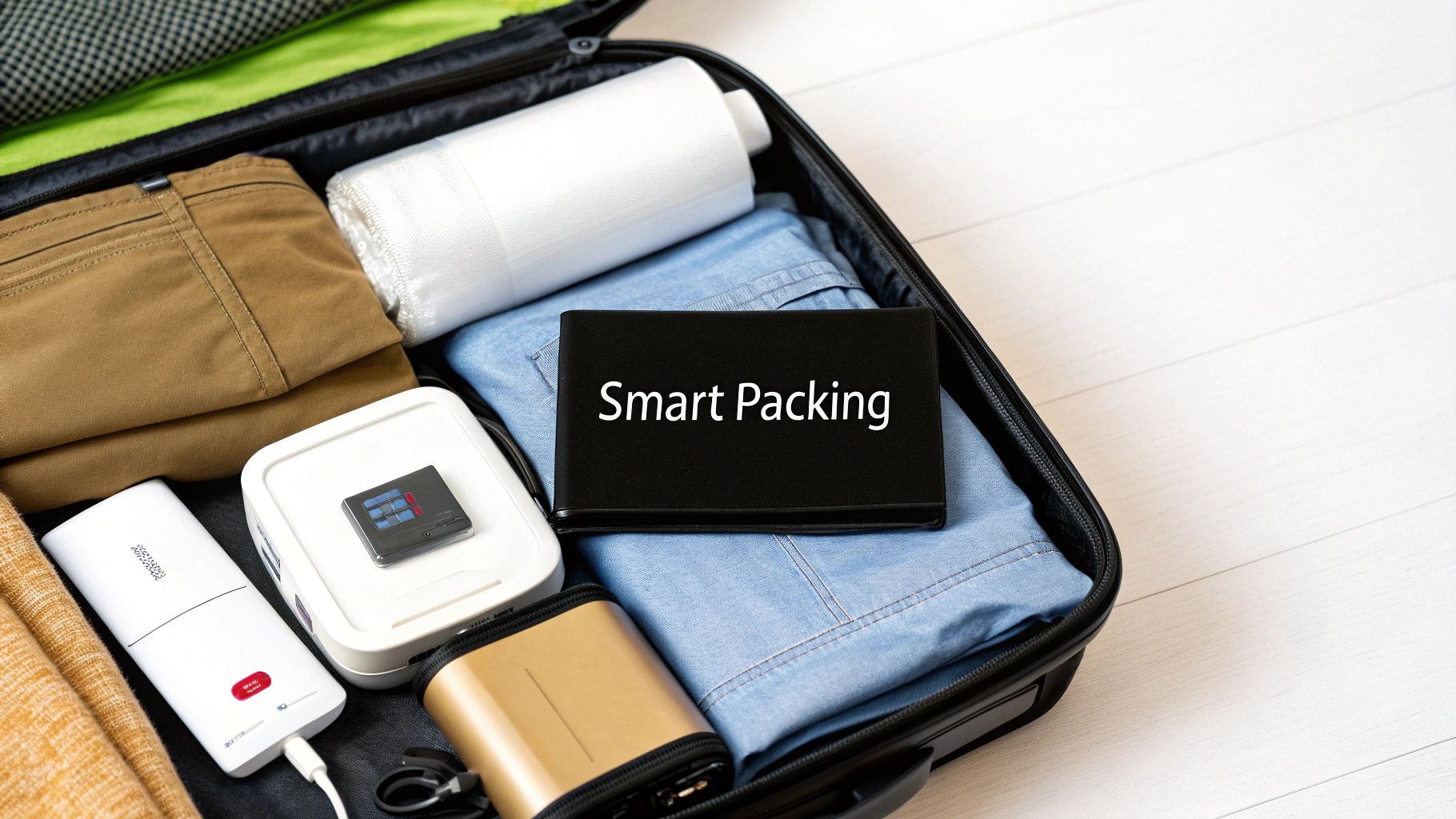
A well-organized bag is a stress-free bag. Two of the most critical components here are your tech pouch and your personal first-aid kit. These should always go in your carry-on, never in a checked bag.
Think of your tech pouch as your command center. Keeping all your cables, chargers, and adapters in one small, dedicated bag will save you from that frantic digging for a charging cord when your phone hits 2%.
Here’s what I consider a non-negotiable tech kit:
- Universal Power Adapter: A single adapter that works in multiple countries is one of the best travel investments you can possibly make.
- Portable Power Bank: Absolutely essential for long travel days when you're draining your battery with maps, photos, and translation apps.
- All Your Cords: Don't forget the chargers for your phone, camera, e-reader, and anything else you're bringing.
- Headphones: And if they're Bluetooth, an adapter for the in-flight entertainment system is a fantastic little gadget to have.
In that same vein, create a compact, personalized first-aid kit. While you can buy basics abroad, having your preferred remedies for a headache, an upset stomach, or a minor cut means you can handle small issues immediately without tracking down a foreign pharmacy. Include any personal prescriptions, pain relievers, motion sickness medication, and a handful of bandages. This small bit of prep provides a huge amount of peace of mind on the road.
Staying Safe and Respectful Abroad
Real travel confidence isn’t just about having the right stuff in your suitcase; it’s about feeling secure and aware in a place you’ve never been. This section focuses on developing smart safety habits and a genuine respect for the new culture you're about to experience. Getting this right will turn you from a tourist into a welcome guest, opening the door to much more authentic interactions.
Protect Your Person and Your Possessions
Before you even lock your front door, create a digital “go-bag.” Scan your passport, visa, driver's license, and both sides of your credit cards. Save these files to a secure cloud service like Google Drive or Dropbox. Also, stash a couple of physical photocopies in a bag separate from the originals. If you ever lose your wallet, this one step will be an absolute lifesaver.
Make sure a trusted friend or family member back home has a copy of your detailed itinerary. This isn’t just a general "I'm in Italy for two weeks" note. It should include flight numbers, hotel names and addresses, and a rough idea of your plans. Think of it as a simple safety net—someone always knows where you're supposed to be.
For crowded cities and busy public transit, consider an anti-theft bag. Many come with slash-proof materials, locking zippers, and RFID-blocking pockets that shield your cards from scanners. It’s a small investment for a lot of peace of mind, letting you focus on the sights instead of constantly checking your pockets.
A classic mistake is keeping all your money and cards in one wallet. Split them up. Carry just enough cash for the day in your pocket or an easy-to-reach spot. Your main stash of cash and a backup credit card should live somewhere else, like a hotel safe or a hidden pocket.
Understand Local Norms and Scams
A little bit of pre-trip research can save you from a world of headaches. Spend an hour scrolling through travel blogs or your government's official travel advisories to learn about common tourist scams at your destination.
For example, in Paris, the "gold ring" scam is a classic. In Rome, overly friendly strangers offering "help" at an ATM are a major red flag. Knowing what to look for ahead of time lets you spot these situations from a mile away and just walk on by.
This isn't just about avoiding scams, though. It’s about understanding the local rhythm—knowing which neighborhoods are best avoided after dark, or how to properly hail a taxi versus using a rideshare app. This isn't about being paranoid; it's about being informed. It’s what lets you move through a new city with confidence.
Embrace Cultural Etiquette and Language
Respect is the most valuable thing you can pack, and it doesn't take up any space. Learning the local customs is a fundamental part of travel that shows you see yourself as a guest. This small effort can open doors to amazing, genuine conversations.
I'd focus on three key areas:
- Greetings and Basic Phrases: Learning "hello," "please," "thank you," and "excuse me" in the local language is huge. It's a universal sign of respect that locals almost always appreciate.
- Dress Code: Do a quick search on appropriate clothing, especially if you plan on visiting temples, churches, or mosques. In many parts of the world, this means covering your shoulders and knees. A lightweight scarf is a perfect, easy-to-pack solution.
- Tipping and Etiquette: Tipping rules are all over the map. In the U.S., it's expected. In Japan, it can be seen as an insult. A quick Google search will tell you the local standard for restaurants, taxis, and guides so you can avoid any awkward moments.
Use Technology to Bridge Cultural Gaps
While learning a few key phrases goes a long way, technology can fill in the gaps for more complex conversations. Modern tools can help you do everything from reading a dinner menu to asking for directions, turning moments of potential confusion into opportunities to connect.
An app like Translate AI can make these interactions feel surprisingly natural. Instead of fumbling with a phrasebook, you can have a real, fluid conversation. You just speak into your phone, and the app gives an instant audio translation for the other person to hear. A good move is to download it from the App Store before you leave and get familiar with it. That way, you’ll land ready to connect from day one.
Your Final 48-Hour Departure Checklist
The last two days before an international trip are a special kind of chaos—a mix of pure excitement and that frantic, buzzing energy that says "this is really happening." A solid last-minute checklist is your best friend here. It helps you channel that energy so you can walk out the door feeling cool, calm, and completely ready for takeoff.
This isn't about scrambling; it's about executing the final few critical steps with confidence. It’s what separates a frantic, sweaty rush to the airport from a smooth, confident departure.
Confirm and Download Everything
First up, let’s get digital. Log in to your airline and hotel booking sites one last time. You're just confirming flight times, terminal numbers, and check-in details. It’s a simple peace-of-mind check, because things can and do change.
While you're at it, check in for your flight online. This little step can save you a ton of time at the airport and usually lets you confirm your seat choice. Once you have your digital boarding pass, take a screenshot and save it to your phone's photo album. Now it's accessible even if you lose your connection.
Next, prepare for the long flight. In-flight entertainment can be hit-or-miss, so it's always smart to bring your own.
- Offline Maps: Open your map app of choice and download the entire city map for your destination. This is a game-changer, letting you navigate like a local the second you land, no data required.
- Entertainment: Grab a few movies, a season of a show, a handful of podcast episodes, and maybe an audiobook. Options are your friend.
- Music and Playlists: Curate a few playlists for different moods—something for takeoff, something for relaxing, and definitely something to get you pumped when you land.
A well-stocked phone is your travel day MVP. Taking 30 minutes to download content is your insurance against spotty plane Wi-Fi or a broken seat-back screen.
Charge and Organize Your Carry-On
Your carry-on bag is your travel lifeline. The night before you fly, lay out everything that needs to go inside and plug in every single electronic device. Your phone, power bank, headphones, and laptop should all hit 100% before you go to bed.
Do one last, meticulous check of what's in that bag. It should contain anything you absolutely cannot afford to lose if—worst-case scenario—your checked luggage takes a little detour.
Your carry-on essentials must include:
- All Documents: Passport, visas, driver's license, and any printed booking confirmations.
- Essential Medications: Always keep prescription meds with you, plus a small first-aid kit with the basics.
- Valuables: Jewelry, your camera, and any other expensive electronics.
- A Change of Clothes: A fresh shirt, underwear, and socks can make you feel human again after a 12-hour flight.
- Chargers and Adapters: Keep your power bank and universal adapter in your carry-on, never in your checked bag.
Final Prep for a Smooth Airport Experience
With your bags packed and devices charged, it's time to map out your travel day. Schedule your ride to the airport in advance, whether it's a taxi, a rideshare, or a shuttle service. Always build in extra time. It’s far better to be an hour early, grabbing a coffee, than five minutes late and sprinting through the terminal.
Prepare for Instant Communication
Finally, set up your tech for instant communication when you land. If you haven't already, now is the time to download a good translation app. A tool like Translate AI can be a lifesaver, especially for navigating those first few disorienting hours in a new country. You can grab it from the App Store and have it ready to go. This one simple step ensures you can ask for directions or talk to your taxi driver the moment you step off the plane, making that transition from traveler to explorer completely seamless.
Common Questions About International Travel Prep
Even the most seasoned travelers have questions that pop up. Let's get straight to the point and answer a few of the most common things people ask when figuring out how to get ready for a trip abroad.
How Far in Advance Should I Start Planning?
For most international trips, I’ve found the sweet spot for serious planning is 3-6 months out.
This gives you plenty of breathing room to handle passports and visas without paying insane rush fees, find much better deals on flights and hotels, and schedule any pre-travel doctor visits. Honestly, planning ahead is the single best way to cut down on stress and save a surprising amount of money.
What Is the Smartest Way to Handle Money Overseas?
A mixed approach is always the smartest bet.
Use a credit card with no foreign transaction fees for bigger purchases like hotels, car rentals, and nice dinners. For smaller, cash-only things like street food or local market finds, your best move is to withdraw local currency from a trusted bank's ATM right after you land.
Whatever you do, avoid the currency exchange kiosks at the airport. Their rates are notoriously terrible. It's also a great habit to keep a small backup stash of cash tucked away somewhere separate from your main wallet, just in case.
Is Travel Insurance Really Worth It?
Yes, 100%. It’s not an "if," it's a "must."
Think of it as a non-negotiable part of your trip budget. Travel insurance is your safety net for all the unexpected stuff—trip cancellations, lost baggage, or, most importantly, a medical emergency. Healthcare costs in other countries can be astronomical, and your home insurance policy likely won't cover a penny of it.
When you're ready to bridge language gaps with confidence, Translate AI makes communication effortless. Download the app from the App Store to have real-time, two-way conversations in over 80 languages.