

Your Guide to Choosing the Best Handheld Translator Device
Ever stood in a bustling foreign market, fumbling with a phrasebook, trying to ask for a price? Or sat in a crucial business meeting, worried that subtle nuances are getting lost in translation? That feeling of being disconnected, of not being able to communicate clearly, is a common frustration for travelers and professionals alike. This guide is designed to help you solve that problem.
Our goal is to walk you through everything you need to know about handheld translator devices, so you can choose the right tool to turn confusing moments into clear, confident conversations.
Turning Confusion into Conversation
At its core, a handheld translator device is a pocket-sized gadget built to do one thing really well: translate languages for you in real time. Think of it as having a personal interpreter on call, ready to smooth out communication bumps wherever you end up.
The demand for tools like this is exploding. Thanks to a huge rebound in global travel and some serious leaps in technology, the market for translation devices is growing fast. Valued at USD 1.65 billion in 2024, it's expected to jump to an incredible USD 4.02 billion by 2034. That tells you just how much people need to communicate clearly in a connected world. You can see the full market breakdown on Precedence Research.
Who Are These Devices Actually For?
If you've ever felt the anxiety of a language barrier, these devices are for you. They have practical uses for all sorts of people:
- International Travelers: Finally, you can order food, figure out public transport, and chat with locals without flipping through a dusty phrasebook.
- Business Professionals: Make sure nothing gets misinterpreted during international negotiations, client meetings, or big conferences.
- Expats and Immigrants: Take the stress out of daily errands like doctor's appointments or grocery shopping in a new country.
- Language Learners: Get instant feedback and practice your pronunciation by having actual conversations with a digital partner.
Ultimately, a handheld translator device is about empowerment. It strips away the anxiety of not being understood, letting you focus on the actual human connection. It's about more than just swapping words; it’s about building trust and having a genuine conversation, no matter where you are.
How These Pocket Interpreters Actually Work
Ever wondered what kind of sorcery is happening inside a handheld translator when you speak into it? It’s not magic, but it is some seriously fast technology that crams a digital interpreter into your pocket. The whole journey—from your spoken words to a clear, translated sentence—flashes by in just a few seconds.
At its core, the device has one powerful goal: grab your voice, figure out what you mean, and then say it out loud in another language. This all happens through a slick, multi-step process fueled by artificial intelligence.
First up, a set of advanced microphones jumps into action. These aren’t your average mics; they’re built with noise-canceling technology to cut through background chatter, street noise, and wind. This gives the device a clean audio file to work with, which is the first and most critical step for getting an accurate translation.
This diagram shows how the device turns a moment of confusion into a clear connection.
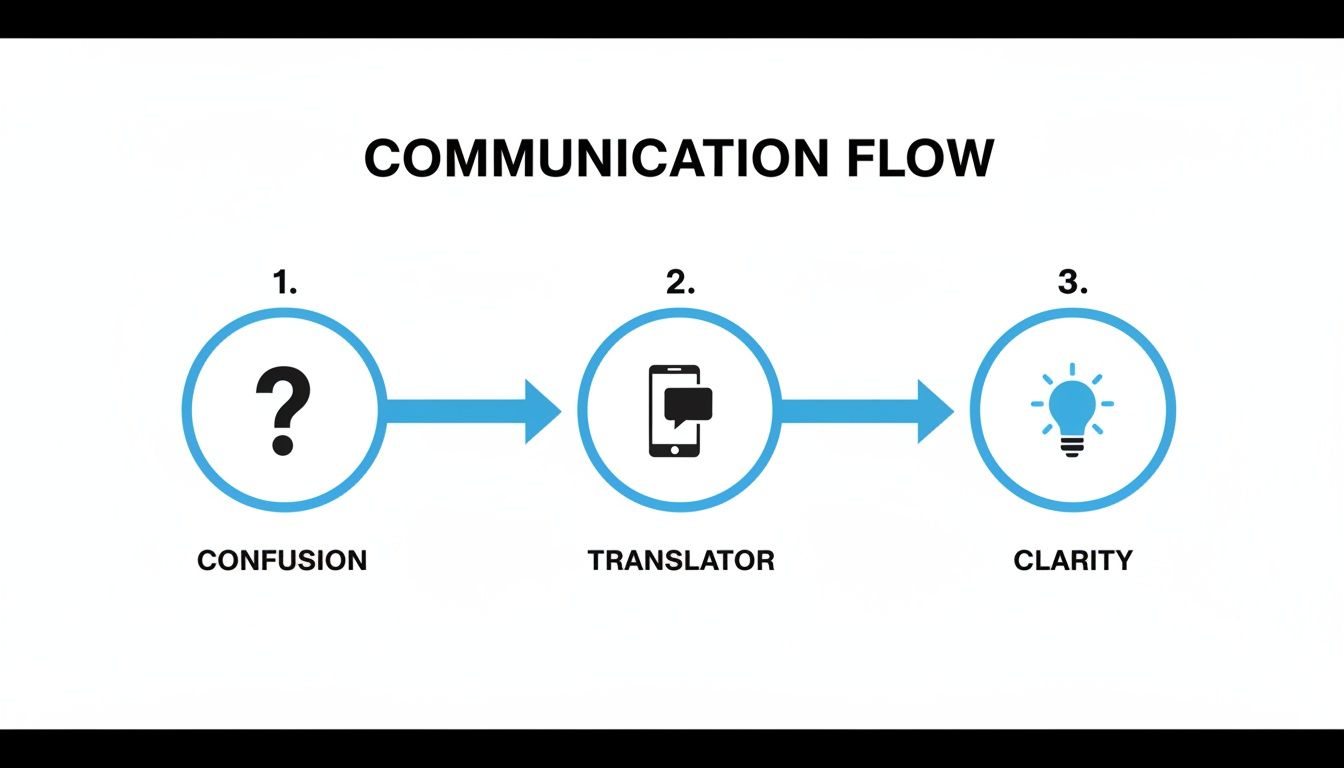
As you can see, the translator acts as that essential bridge, smoothing over a communication barrier and creating real understanding.
From Sound to Text to Meaning
Once your voice is captured cleanly, a speech-to-text (STT) engine kicks in. This AI component listens to the recording and transcribes your spoken words into digital text. Think of it as a stenographer typing at lightning speed.
With your sentence now in text form, the device shoots it over to a powerful translation engine. This is where the real heavy lifting happens.
This engine doesn't just swap words one-for-one. It analyzes grammar, context, and common phrasing to grasp the intent behind your sentence, resulting in a much more natural and accurate translation.
This process is the secret sauce behind all modern translation tools. If you want to go a bit deeper, you can learn more about machine translation and see just how far the technology has come.
The Final Step: Speaking a New Language
Finally, once the engine has cooked up the best translation, a text-to-speech (TTS) system turns that translated text back into audible speech. Today’s TTS systems are incredibly good, producing voices that sound natural and human, not like a 90s robot.
The translated phrase is then played through the device's speaker, completing the loop. This entire sequence—capturing, transcribing, translating, and speaking—is what makes these little gadgets such indispensable tools for anyone trying to connect across cultures.
What About Translation Apps?
It's worth noting that this same high-tech process isn't just for dedicated hardware. Many of these steps are replicated inside powerful smartphone apps.
An app like Translate AI, for example, uses your phone’s own high-quality microphone and processing power to deliver similar, top-notch results. It follows the exact same sequence of capturing your voice, turning it to text, translating the meaning, and speaking it aloud to keep the conversation flowing. You can download Translate AI on the App Store.
How to Choose the Right Handheld Translator Device
Not all translators are created equal. Picking the right one is all about matching its features to your actual needs. The perfect translator for a casual tourist grabbing coffee in Rome is probably overkill—or underpowered—for a business professional trying to close a deal in Tokyo.
This section provides actionable advice to help you select a device that solves your specific communication challenges.
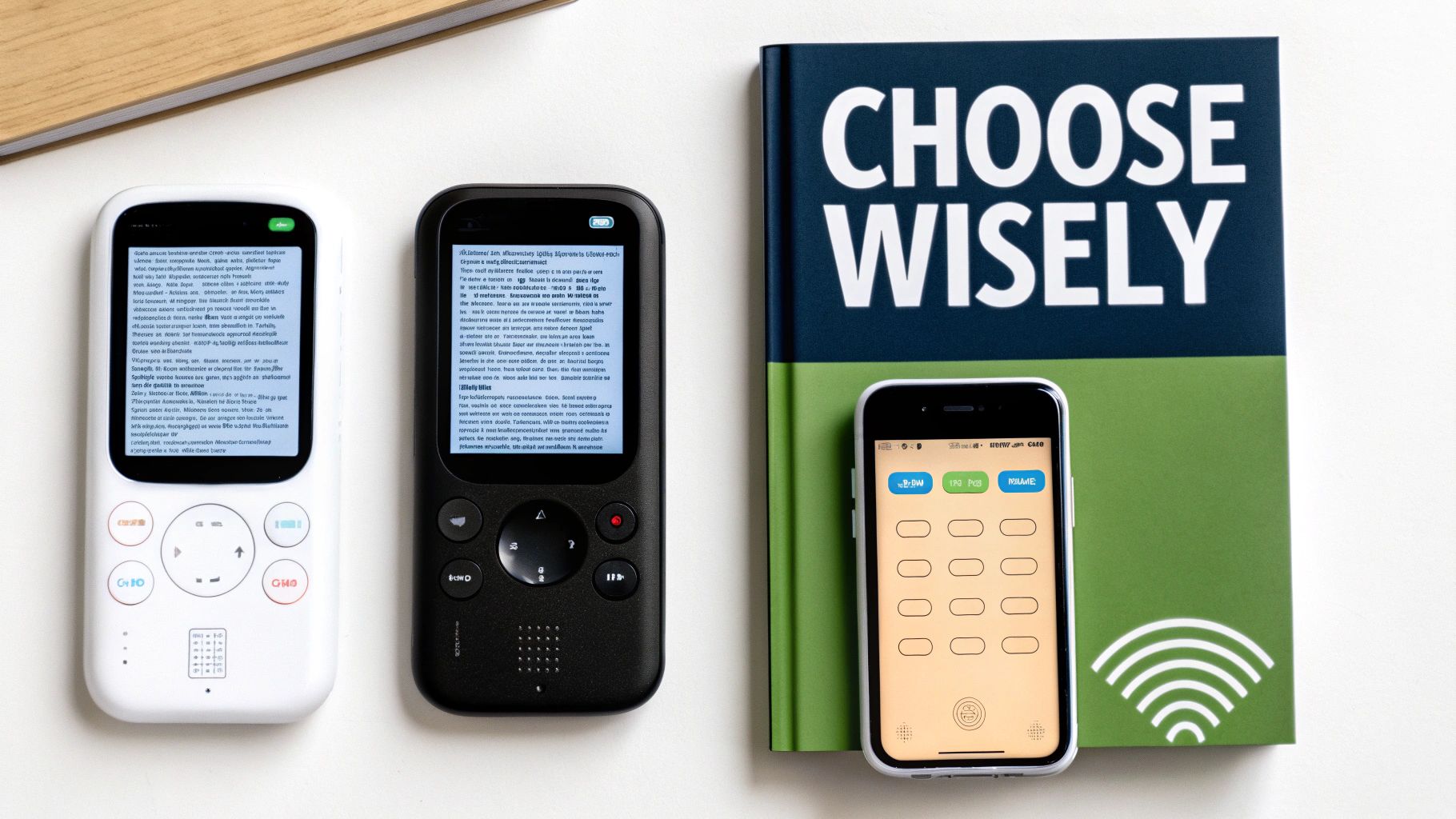
Before you buy, you've got to look past the flashy marketing and focus on what will actually help you communicate. From the number of languages it supports to how long the battery lasts, every little detail matters.
Actionable Checklist: Key Features to Look For
Here’s a quick-glance checklist to help you cut through the noise and figure out what’s truly important when you're comparing different models.
- Language Support: Does it cover the specific countries you're visiting? A device with 100+ languages is useless if the one you need isn't well-supported.
- Translation Accuracy: Does it use multiple AI engines? This avoids awkward word-for-word translations and captures the real meaning.
- Offline Functionality: Can you download language packs for your destinations? You can't rely on Wi-Fi or cellular data everywhere.
- Battery Life: Does it offer all-day battery life (8+ hours)? A dead translator is just a paperweight.
- Microphone Quality: Does it have dual noise-canceling microphones? This is crucial for busy, real-world settings like markets or restaurants.
- Two-Way Conversation: Does it have a dedicated mode for back-and-forth dialogue? This makes it feel like a real conversation.
- User Interface: Is the screen large and clear with simple buttons? You don't want to be fumbling through complex menus in a hurry.
If a device nails these key features, you're on the right track to finding a reliable travel companion.
Non-Negotiable Features for Any Traveler
When you're looking at different handheld translators, some features are just non-negotiable. These are the fundamentals that make a device a dependable tool instead of a novelty gadget.
First up is language support. Does it actually cover the languages for your planned destinations? A device boasting 100+ languages sounds great, but it’s worthless if the specific dialect you need isn't accurately supported.
Next, think about translation accuracy. Look for devices that use multiple AI translation engines. This is a huge deal. It allows the device to pick the best engine for a specific language pair, leading to more natural, context-aware translations that don’t sound like they were pieced together by a robot.
Here are a few other essentials:
- Offline Functionality: This is a lifesaver. An offline mode lets you translate a handful of core languages without Wi-Fi or a data connection, which is absolutely critical when you're on a plane, in a remote village, or just trying to avoid insane roaming charges.
- Battery Life: A dead translator is no translator at all. You really want a device that offers all-day battery life from a single charge. It needs to keep up with a full day of sightseeing or back-to-back meetings without you having to hunt for an outlet.
- Two-Way Conversation Mode: This is the magic feature. It allows two people to speak and hear translations in real-time, turning a clunky, stop-and-start exchange into a fluid conversation. This is what truly brings communication to life.
Beyond the Basics: What to Look For
Once you have the essentials covered, a few other things can make your experience a whole lot better. The user interface is a big one. A device with a large, clear touchscreen and simple, intuitive buttons is far easier to use in a hurry than one that forces you to navigate a complex menu system.
Microphone quality is also a huge factor, especially if you plan on using the translator in a noisy market or a busy restaurant. Look for models with dual noise-canceling microphones. These are designed to isolate your voice from all the background chatter, which leads to much, much higher accuracy.
The ability to have fluid, back-and-forth talks is what makes a translator truly useful. In fact, two-way translation features now dominate the market with over a 65% share, a number expected to grow as they become essential for business and daily life abroad. As a dedicated gadget, a handheld translator device often provides superior audio and longer battery life compared to other options. You can discover more insights on these market trends here.
If you want to go a bit deeper into how all this tech works in the real world, you might find our guide on what makes a great real-time language translation device useful.
A Note on App-Based Alternatives like Translate AI
While a dedicated piece of hardware is powerful, don't count out the apps that can turn the smartphone you already own into a translator. An app like Translate AI can offer fantastic accuracy and a massive library of languages without you needing to carry another gadget. By using your phone's powerful processor and high-quality microphone, apps provide a super convenient—and surprisingly effective—alternative. You can even connect your own earbuds for more private conversations. Check out Translate AI on the App Store to learn more.
When a Translator Becomes Your Best Travel Companion
Tech specs are one thing, but they don't capture the real magic of a handheld translator. Let's move beyond feature lists and look at how these gadgets actually solve problems for people out in the world, turning stressful moments into genuine connections.
Picture this: you’re trying to navigate the Tokyo subway for the first time. The signs are a blur, the announcements are confusing, and you’re about to miss your train. Instead of panicking, you pull out your translator, ask a station attendant for directions, and get a clear, instant answer in English. That’s the power of having the right tool in your pocket.
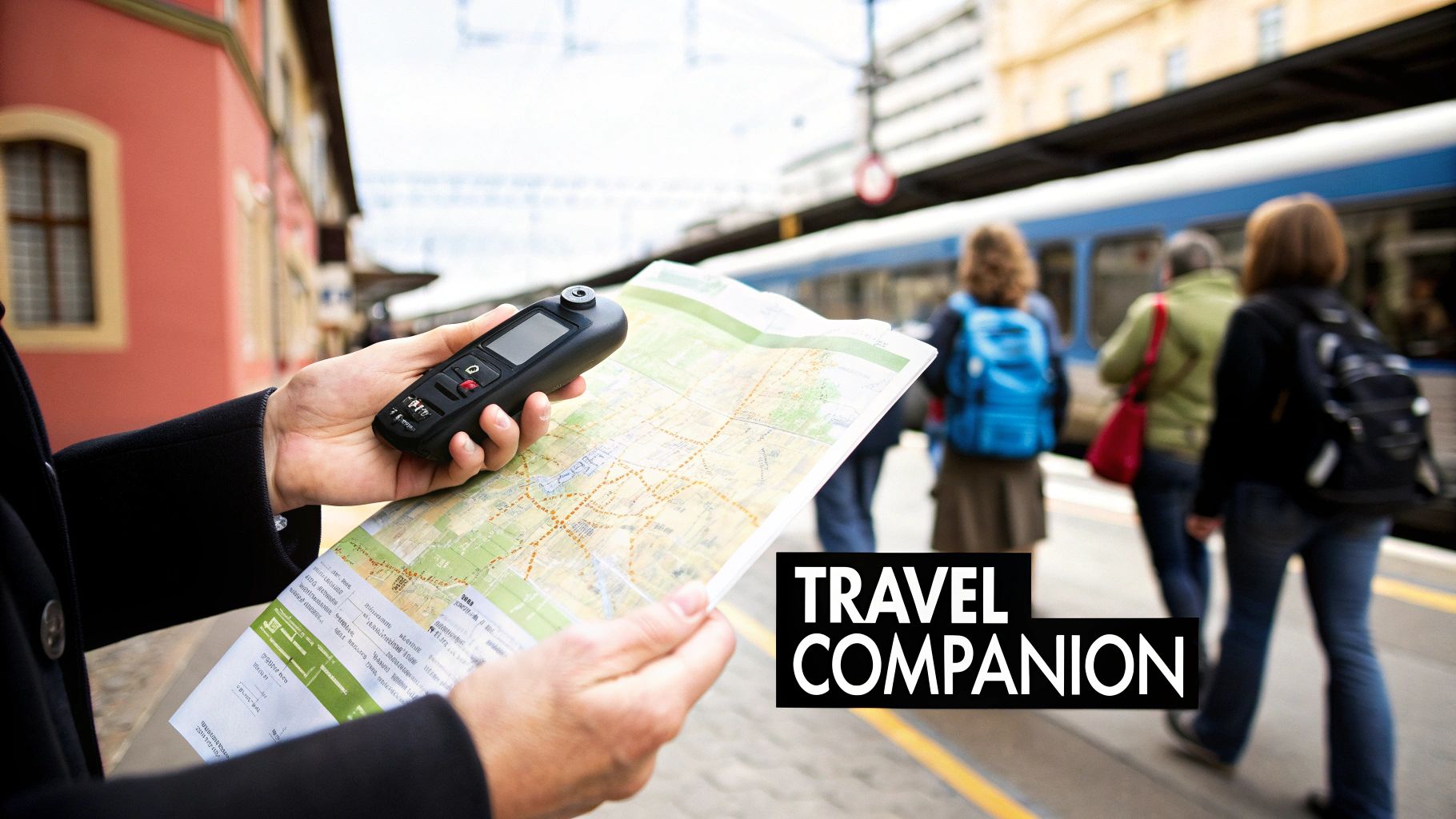
This isn’t just a nice-to-have; it’s a game-changer for how we experience the world. With the massive resurgence in global tourism, these devices have become essential for the 1.5 billion+ international travelers exploring new places each year. This huge demand is fueling market growth, with consumer interest alone climbing 15% annually as travel bounces back to pre-pandemic levels. You can explore more data on these market trends if you want to dig deeper.
Real Stories from Real Travelers
Let's look at a few more practical scenarios where a handheld translator becomes an essential companion.
- The Business Professional in Berlin: A consultant is in a high-stakes negotiation, but their German counterpart doesn't speak fluent English. Using a high-accuracy translator, they nail down complex contract details without ambiguity. Every point is understood, trust is built, and the deal is closed—all without a single misunderstanding.
- The Expat in Seoul: An expat needs to book a doctor's appointment but feels intimidated by the language barrier. With a translator's two-way conversation feature, they call the clinic, explain their symptoms, and schedule a time slot effortlessly. What used to be a source of major anxiety becomes a simple task.
These examples show that the true value of a handheld translator isn't just about converting words. It’s about empowering you to handle everyday situations with confidence and independence.
By removing the communication barrier, these devices do more than just translate; they build trust. Whether it's a patient feeling understood by their nurse or a traveler getting help from a stranger, clear communication fosters a sense of safety and connection.
Your Smartphone is a Powerful Alternative, Too
While dedicated devices are great, you don't always need to carry extra hardware to get these benefits. The smartphone you already own can be an equally powerful communication tool.
For travelers who prefer a more minimal setup, a modern translation app offers a compelling alternative. Apps like Translate AI use your phone’s advanced processor and high-quality microphone to deliver incredibly accurate, real-time translations. Pair it with your favorite earbuds, and you’ve created a discreet and effective two-way communication system that fits right in your pocket.
Dedicated Devices vs Translation Apps: Which is Right for You?
When you’re trying to break down a language barrier, you'll run into a fundamental choice: should you buy a dedicated handheld translator device, or just use a translation app on your smartphone? It’s the classic debate between specialized hardware and the pure convenience of software, and the right answer really boils down to how you'll be using it.
A standalone translator is a bit like a professional photographer's camera. Sure, your phone can take great pictures, but a dedicated camera is built from the ground up for one job, and it does it exceptionally well. These devices often pack in superior, noise-canceling microphones that can pick up your voice clearly in a chaotic train station or a packed restaurant—places where a standard phone mic might struggle.
Then there's the battery life. A handheld translator is engineered to last all day without killing your phone, which is a massive plus when you’re relying on that same phone for maps, tickets, and emergency calls while traveling.
The Power of Convenience
On the flip side, the argument for translation apps is beautifully simple: you already own the hardware. Your smartphone is a powerful little computer with a great screen and a decent microphone, so using an app means one less gadget to buy, charge, and stuff into your bag. For the minimalist traveler, that’s a huge win.
A dedicated device offers reliability through its specialized design. However, a powerful app provides unmatched flexibility, constantly receiving updates with the latest AI improvements without requiring a new hardware purchase.
The best choice often comes down to the situation. Are you a business professional heading into a critical meeting where every word matters? The top-tier microphones on a dedicated device are probably the safer bet. Or are you a casual tourist who just needs a little help ordering dinner and asking for directions? An app on your phone is more than capable—and a lot easier on your wallet.
A Modern, App-Based Solution with Translate AI
For many people, the balance of power, convenience, and cost makes a high-quality app the smarter choice. Instead of carrying another piece of tech, you can just use the supercomputer that’s already in your pocket. This is where an app can really shine.
An app like Translate AI is built to turn your phone into a powerful two-way communication tool, using its processor to deliver fast, accurate translations without any extra hardware. This approach is not only convenient but also ensures you always have the latest translation tech right at your fingertips. If you're curious about how apps stack up, you might want to check out our guide on choosing the best real-time translator app for your needs. You can also download Translate AI on the App Store to try it for yourself.
A Smarter Alternative in Your Pocket
While dedicated hardware has its place, what if the most powerful handheld translator was the one you already own?
For anyone who values convenience and modern tech, a translation app can deliver all the power of a standalone gadget without the extra cost or the hassle of carrying another device. This is where your smartphone steps up and becomes a top-tier communication tool.
By tapping into the advanced processor and high-quality microphone already in your phone, you can get incredibly accurate translations on demand. It just makes sense. You skip having to buy, charge, and pack another piece of equipment for your travels.
Unlock Your Phone’s Potential with Translate AI
An app like Translate AI is built specifically to turn your smartphone into a powerful two-way translator. It’s a modern solution for travelers and professionals alike, delivering AI-driven translations in over 80 languages.
The screenshot below gives you a feel for the app's clean and straightforward interface.
As you can see, the design is all about simplicity. You can pick your languages and kick off a conversation with just a few taps.
Instead of investing in new hardware, you can use the device you rely on every day. With a pair of standard earbuds, your phone transforms into a discreet and effective tool for real-time, back-and-forth conversations.
This offers a really cost-effective and flexible way to get top-tier translation performance. You can discover how Translate AI works and see if it’s the right fit for what you need.
Common Questions About Handheld Translator Devices
As you get closer to a decision, a few final questions always seem to pop up. Is it really as accurate as they say? What happens if I don't have Wi-Fi? Is a dedicated gadget actually better than an app?
Getting straight answers to these is key to choosing the right tool. Let's tackle the most common ones.
How Accurate Are These Things, Really?
Modern translation tools have come an incredibly long way. For common language pairs, like English to Spanish, the best devices and apps can hit over 95% accuracy in everyday chats. This isn't just word-for-word translation anymore; the AI is smart enough to understand the context of a sentence.
But let's be realistic—it's not perfect. Accuracy can take a hit when you throw these curveballs at it:
- Heavy regional slang or idioms
- Very thick, unfamiliar accents
- Super technical or specialized jargon
The top-tier systems are getting much better at handling this, using advanced AI that can grasp nuance. That's why the quality has taken such a massive leap forward recently.
Do I Need an Internet Connection for It to Work?
This is a deal-breaker for any traveler. Many handheld translators do offer a limited offline mode, which is an absolute lifesaver when you're on a plane, hiking in a remote area, or just dodging expensive roaming fees. This feature usually only supports a handful of the most popular languages.
For the highest accuracy and the full list of languages, most translators do need an internet connection. This lets them tap into powerful, cloud-based AI engines that are constantly being updated. Always, always double-check a device's offline capabilities before you buy.
Is an App Like Translate AI Better Than a Dedicated Device?
Honestly, "better" comes down to what you need and how you travel. A dedicated device is built for one job. It often has superior noise-canceling microphones for chaotic markets and a battery that won’t leave your phone dead when you need it for navigation. It's a simple, rugged tool.
On the other hand, a quality app gives you incredible convenience. You don't have to carry (or pay for) another gadget, and it’s constantly getting smarter with the latest AI updates.
For a lot of modern travelers and professionals, using the powerful smartphone they already have in their pocket is simply the more practical and cost-effective move.
The Translate AI Advantage
An app like Translate AI is designed to leverage the tech you already own. It offers a convenient, powerful, and always-improving alternative to traditional hardware, turning the device you never leave home without into your personal interpreter. You can learn more about Translate AI on the App Store to see if it’s the right fit for your next trip.
Ready to break down language barriers with the device you already own? Translate AI turns your smartphone into a powerful, real-time translator. Download the app today and start your next conversation with confidence.