

How to Choose a Real Time Language Translation Device
Ever felt that awkward silence when a conversation hits a language wall? You're on a trip, trying to ask for directions or order food, but the words just won't connect. You start fumbling with hand gestures or falling back on broken phrases, and the real connection you were hoping for just... disappears. It’s a frustratingly common experience for travelers, expats, and international business professionals alike.
This guide is designed to help you solve that exact problem. Our goal is to walk you through everything you need to know about a real-time language translation device, so you can choose the right tool to communicate clearly and confidently, no matter where you are.
Break the Sound Barrier in Conversation
A real time language translation device is your personal interpreter, fitting right in your pocket. These gadgets are designed to make interactions feel natural again. They're more than just fancy dictionaries; they empower you to share your actual thoughts, ideas, and personality without getting lost in translation.
Whether you're trying to haggle in a crowded market in Marrakech or presenting to international colleagues in Berlin, these tools are made to keep the conversation flowing.
Moving Beyond Words to True Connection
The whole point isn't just to swap words from one language for another. It's about preserving the meaning and feeling behind what you're saying, so you can build a genuine human connection. The best devices work to get rid of those clunky, unnatural pauses that kill the vibe of a good chat.
This focus on smooth communication has created huge demand. The global market for these devices is exploding, projected to jump from USD 2.5 billion in 2024 to an incredible USD 10 billion by 2032. This growth is being driven by international travelers and business pros who now depend on these tools. You can explore more data on this market trend to see just how fast things are moving.
A translation device should do more than just translate; it should make you feel confident and understood, no matter where you are or who you're talking to.
Ultimately, our goal is to help you go from feeling anxious and lost in foreign conversations to feeling empowered and engaged. With the right tool, you can finally focus on the person in front of you, not the language barrier between you.
How AI Makes Instant Translation Possible
Ever wonder what’s happening under the hood of a real-time language translator the moment you speak into it? The secret is a super-fast, three-step process powered by artificial intelligence. Understanding this will help you know what to look for in a quality device.
This entire sequence happens in less than a second, turning what could be an awkward silence into a flowing conversation.
-
Automatic Speech Recognition (ASR): This is the device’s digital ear. Its job is to listen to your voice and instantly transcribe it into text. The accuracy of this first step is critical—if the device mishears "let's eat" as "let's meet," the whole translation will be off.
-
Neural Machine Translation (NMT): Next, that text gets handed to the brains of the operation. Old-school software used to just swap words, which is why early translations sounded so robotic. NMT is smarter. It analyzes the entire sentence to understand context and grammar, much like a human interpreter. If you want to dive deeper into how this core tech works, check out our guide on what is machine translation.
-
Text-to-Speech (TTS): Once the NMT engine creates the translation, the final step is to give it a voice. A good TTS system is the difference between a jarring, robotic voice and a clear, natural-sounding one, making sure the message is delivered with the right tone.
From Text Back to Natural Speech
This is a simple way to visualize how these technologies tear down communication walls.
The flow from "Barrier" to "Translate" to "Connect" is exactly what a good device does—it turns a point of friction into a moment of genuine human interaction.
These three pieces—ASR, NMT, and TTS—have to work together perfectly to make a conversation feel fluid. The speed and accuracy of this whole AI-powered process are what separate a powerful translation tool from a basic app. The goal is to get rid of those awkward pauses and create an experience that feels less like using tech and more like just having a chat.
Must-Have Features in a Translation Solution
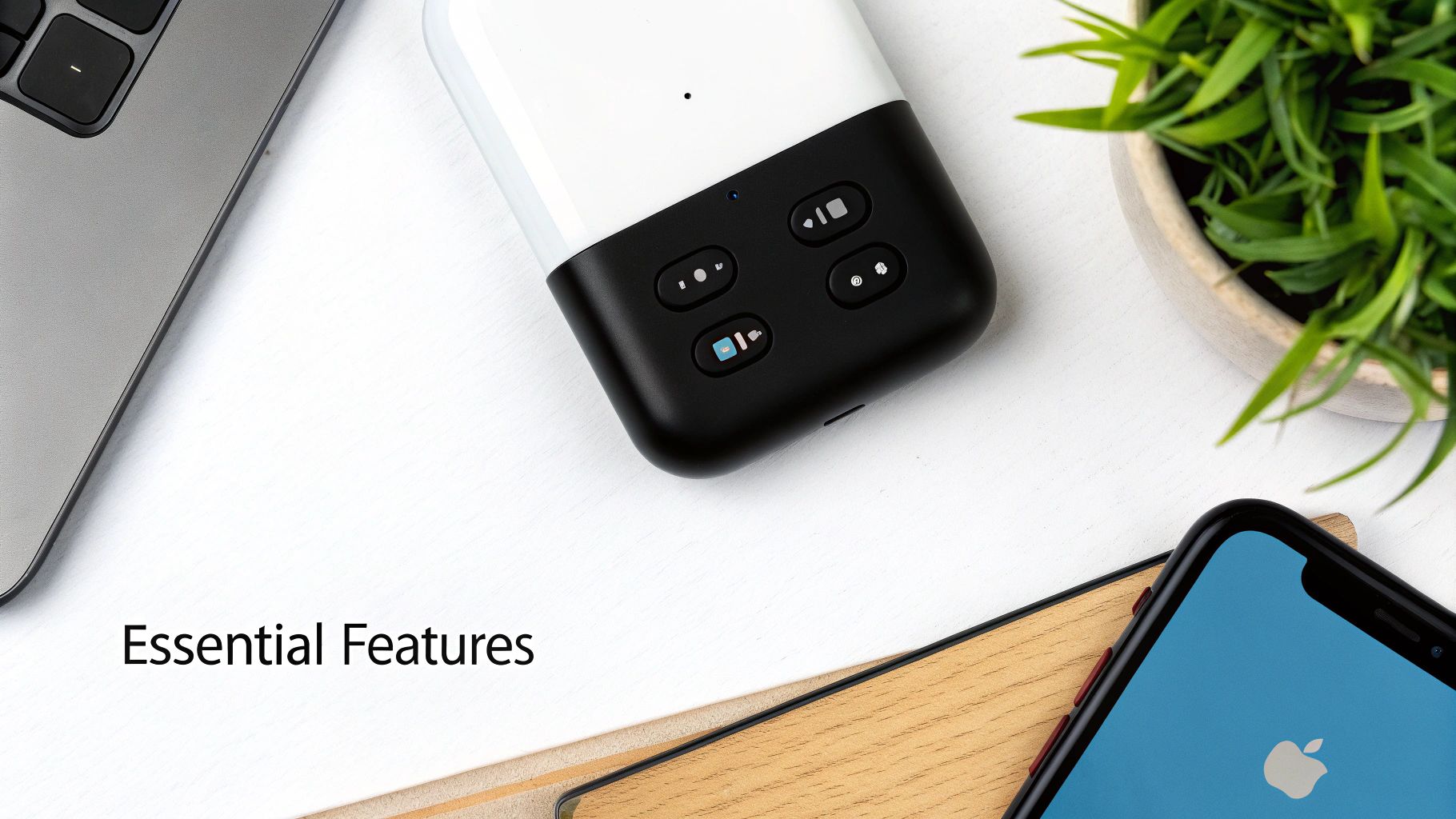
Shopping for a translation tool can feel overwhelming. To cut through the noise, let's focus on the specific, actionable features that matter in a real-world conversation. Your goal is to find a tool that works when you're standing in a Tokyo train station, not just in a quiet room.
At the top of the list are translation accuracy and speed. A translator that gets the meaning wrong is worse than no translator at all. Look for solutions that consistently hit 95% accuracy or higher. Just as important is speed (low latency), which means no awkward, conversation-killing pauses.
Core Functionality for Any Scenario
Here are the essential features that make a translator a reliable travel partner instead of a frustrating gadget:
- Offline Capability: What happens when you're on a plane or deep in a subway with zero signal? An offline mode is a lifesaver. It lets you download language packs ahead of time, guaranteeing your device works anywhere.
- Two-Way Conversation Mode: This is essential for a natural back-and-forth. A good two-way mode lets both people speak while the device translates in both directions without having to pass a phone back and forth.
- Long Battery Life: A translator is useless if it's dead. Look for a device or an app that won’t drain your power halfway through the day, so you can explore with confidence from morning till night.
A translation solution should be a reliable partner in your pocket, always ready to bridge a communication gap. Features like offline mode and a solid battery are what provide that dependability when you're far from home.
To help you zero in on what's most important, here’s a quick breakdown of how different features serve different needs.
Essential Features of a Modern Translation Device
| Feature | Why It Matters for Travelers | Why It Matters for Business Professionals |
|---|---|---|
| High Accuracy (>95%) | Prevents misunderstandings when ordering food, asking for directions, or dealing with hotel staff. It’s the difference between getting to the museum and ending up at the train station. | Critical for negotiating deals, discussing technical specs, and building trust. A small error can have big financial or relational consequences. |
| Low Latency (<1 sec) | Keeps conversations feeling natural and fluid. Avoids long, awkward silences that can make simple interactions feel strained. | Maintains professionalism and conversational momentum in meetings. A fast response shows you’re engaged and respects the other person's time. |
| Offline Mode | A true lifesaver in areas with spotty Wi-Fi or no cellular data, like rural areas, subways, or during flights. Ensures you're never left without a translator. | Provides reliability in conference centers with overloaded Wi-Fi or during international travel where roaming data can be unreliable. Guarantees you can communicate in any business setting. |
| Long Battery Life | Lasts through a full day of sightseeing, from your morning coffee to your late-night dinner, without you having to hunt for a power outlet. | Powers through back-to-back meetings, client dinners, and travel days without dying. A dead device mid-negotiation looks unprofessional. |
| Two-Way Conversation | Makes chatting with locals feel like a real dialogue. You can have a back-and-forth without fumbling with settings or passing a device around. | Facilitates smooth, interactive discussions. Allows for a natural flow of ideas where both parties can speak freely and be understood in real time. |
Ultimately, the right features depend on how you'll use the tool. A casual tourist and a globetrotting executive have different priorities, but the core principles of accuracy, speed, and reliability are universal. For a deeper look at the hardware itself, you can learn more about various voice translation devices and their features in our detailed guide.
Your Smartphone as a Powerful Translator
While dedicated hardware has its place, don't overlook the power you already have in your pocket. Modern translation apps can be just as effective, especially when they cleverly use your phone's built-in tech. An app like Translate AI can turn your smartphone and any pair of earbuds into a powerful, discreet translation tool. This setup is perfect for busy public squares and quiet professional meetings alike, making your phone one of the most versatile translators you can own.
Dedicated Devices vs. Translation Apps
When choosing a real-time translator, your first big choice is between dedicated hardware and a translation app on your smartphone. The right call depends on your specific needs and priorities. This section will help you decide which is better for you.
Dedicated hardware is built for one job: translation. That focus often means they have superior, noise-canceling microphones to pick up your voice in a chaotic train station. They also tend to have much better battery life and rugged designs that can handle the bumps of travel better than a delicate smartphone.
The Power and Convenience of Apps
On the other hand, translation apps offer incredible convenience by using the computer you already carry. There's no extra gadget to charge or pack, which is a massive plus for traveling light. Apps are also constantly updated with new languages and features, so your tool gets better over time. You can check out our top picks for the best real-time translator app to see what's out there.
This convenience is starting to shift the market. While physical devices still make up over 70% of the market, app-based solutions are growing much faster. This trend makes sense for the hands-free needs of modern professionals and travelers. You can discover more insights about these market shifts to see how user preferences are changing.
Your smartphone is already a powerful communication hub. A high-quality translation app simply unlocks its potential as an expert interpreter, giving you a top-tier tool without the extra hardware.
The Smart Alternative: Translate AI on Your Phone
For anyone who wants top-notch performance without another device, an app like Translate AI offers the best of both worlds. It transforms your smartphone into a premium translation device for natural, two-way conversations in over 80 languages. By pairing the app with your existing earbuds, you get a discreet, hands-free experience. Getting started is simple: just download the app, pick your languages, and start talking.
Real-World Scenarios Where Translators Shine

The real magic of a language translator isn’t in the tech specs. It's in the human moments it creates—the times it turns confusion into connection. Let’s look at how these tools solve specific, real-life problems.
- For the Traveler: Imagine you're in a Thai street market. You find the perfect souvenir, but the vendor doesn't speak English. Instead of pointing awkwardly, you speak into your device. In clear Thai, it asks, "How much for this beautiful scarf?" The vendor’s face lights up, and a friendly negotiation begins.
- For the Business Professional: You're on a video call with international partners. A critical detail is getting lost in translation. A good translator ensures everyone understands the exact meaning, heading off expensive mistakes and building trust. When communication is easy, teams work better together.
- For the Expat: Think about an expat trying to open a bank account in their new home. A stressful process becomes manageable. They can ask specific questions and get instant, clear answers, handling a vital task with confidence.
These aren't just hypotheticals. The demand for these tools is exploding, mostly driven by tourism and international business. The market is expected to jump from USD 1.65 billion in 2025 to USD 4.02 billion by 2034. You can read the full research on this market expansion to see the data for yourself.
The best translation tool fades into the background, allowing you to focus on the person in front of you. Its job is to make technology invisible and human connection the priority.
Whether you're haggling in a market, closing a deal, or just setting up a new life, a real-time translator turns challenging moments into successful ones. It helps you do more than just get by—it empowers you to truly connect.
Empowering Your Conversations with Translate AI
For anyone who'd rather use what they already have, an app like Translate AI delivers the same powerful translation right on your smartphone. It turns the phone and earbuds you already own into a discreet, effective translator that's perfect for all the situations we just talked about.
How to Choose the Right Translator for You
Picking the right language translator comes down to one simple question: what will you do with it? This section provides actionable advice to help you match a tool to your real-world needs.
Are you constantly flying for business meetings? Your top priority should be perfect audio quality and a rock-solid two-way conversation mode. In fact, this feature already makes up over 65% of the market in 2024 because it is critical for clear, instant negotiations. You can learn more about these global business trends to see why seamless exchanges matter so much.
Matching Your Profile to the Perfect Tool
If you're a casual tourist, your priorities are different. You'll care more about convenience, portability, and price. To find what's best for you, ask yourself these three key questions:
- Who are you? A business pro, a tourist, an expat, or a student?
- Where will you use it? In quiet conference rooms, bustling street markets, or remote areas without Wi-Fi?
- What's your budget? Are you ready for a premium one-time purchase, or would a flexible app make more sense?
Answering these will help you choose between dedicated hardware and a powerful app. For many people, a versatile app hits the perfect sweet spot.
The Flexible Solution: Translate AI
For travelers, students, and professionals who value convenience but still want serious power, an app like Translate AI turns the smartphone you already carry into a top-tier translation device. It uses the powerful hardware you already own, which makes it a smart, cost-effective solution. It's the perfect choice for anyone who wants high-quality translation without the hassle of carrying—and charging—another gadget.
Got Questions? We’ve Got Answers.
Diving into translation tech can feel a bit overwhelming. This section provides clear, straightforward answers to the most common questions about accuracy, internet needs, and the "device vs. app" debate.
How Accurate Are These Things, Really?
Modern translators, both devices and top-tier apps, can hit accuracy rates well over 94% for common languages. This is more than enough for clear conversations when traveling or in business. Thick accents or very noisy environments can sometimes cause a hiccup, but the technology has become impressively reliable.
Do I Need to Be Online for It to Work?
Not always. While an internet connection gives you the best performance, many top options have a solid offline mode. This lets you download language packs to your device or phone before you travel. This feature is a lifesaver on planes, subways, or in remote areas with spotty service. Always check that the languages you need are available for offline use.
A reliable offline mode is your safety net. It means you can communicate no matter where you end up or how bad the local Wi-Fi is.
Is a Dedicated Device Better Than a Translation App?
It depends entirely on your needs. A dedicated device often has better microphones and battery life, which is great for heavy use. On the other hand, a good app is incredibly convenient and cost-effective, using the powerful smartphone you already own. For most people, a premium app offers a fantastic, flexible solution without needing another gadget.
The Smart Alternative: Translate AI on Your Phone
If convenience and quality are what you’re after, the Translate AI app is a brilliant choice. It effectively turns the smartphone you already have into a top-tier translator, making it a perfect fit for the modern traveler or professional.
Ready to break down language barriers with the device already in your pocket? Translate AI turns your smartphone into a powerful communication tool. Download Translate AI from the App Store and start having confident conversations today.