

Earliest Convenience Meaning: How Soon to Reply in 2026
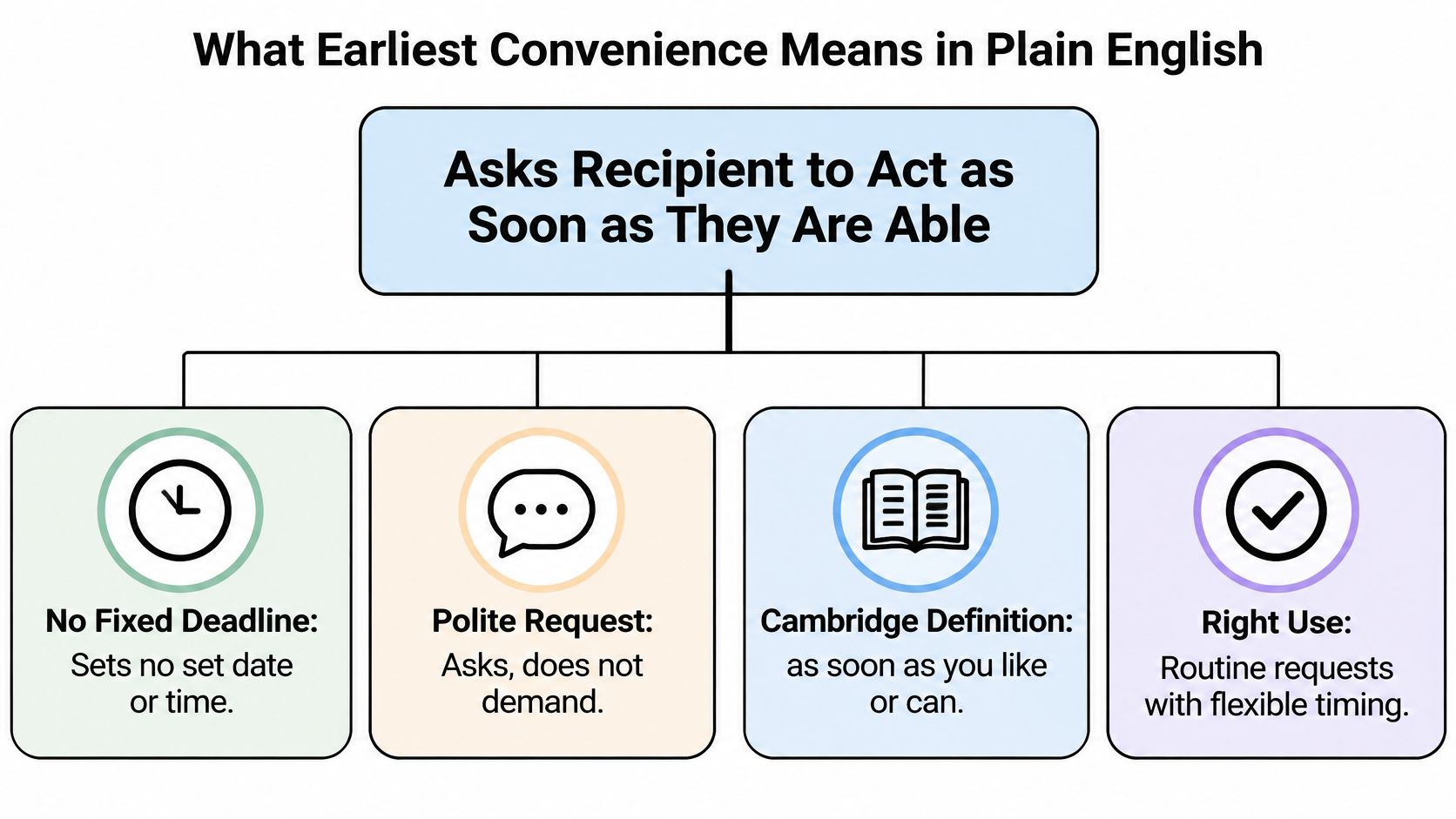
‘At your earliest convenience' means as soon as the recipient is able, with no fixed deadline, so it signals priority without setting a time.
You've just received that line from a client, a hotel, or a colleague abroad. Do you need to stop what you're doing, reply before lunch, or put the task on tomorrow's list? The useful skill is knowing when you can choose the timing and when you should ask for a deadline.
What Earliest Convenience Means in Plain English
A client asks you to send a document “at your earliest convenience.” The phrase leaves the timing decision with you: the sender wants you to act promptly, but hasn't set a specific deadline. Your job is to judge what is reasonable, or ask when the task needs to be done.
It works like an invitation to choose a suitable time, rather than a fixed appointment. The wording still calls for a reasonable effort, so it should not be read as permission to put the request aside indefinitely.
How the Words Work Together
- Earliest asks you to avoid unnecessary delay.
- Your convenience leaves room for your workload, availability, and circumstances.
The Cambridge Dictionary entry is for “early,” not the full expression. The useful distinction is in the phrase itself: it asks for prompt action while leaving the exact timing open.
Here, convenience means a suitable opportunity, not merely personal comfort. You are being asked to find a workable time, not to wait until the task feels enjoyable.
The diagram shows the difference between a polite request and a fixed deadline.
Why Readers Hear Different Messages
The Free Dictionary's convenience entry includes senses such as “whenever one wishes” and “as soon as one can.” In a business request, the second sense often fits the sender's intention: make room for the task and act when you can. A recipient may hear the first sense and assume the timing is entirely optional.
The word's history offers another clue. Grammarphobia's historical account explains that convenience meant agreement when it entered English in the early 1400s, while meanings connected with opportunity and comfort developed later. In this expression, suitability is the useful idea.
Practical rule: Use the phrase when the recipient may choose the timing. If you need a result by a particular moment, name that deadline.
The wording is polite because it recognizes that the recipient has other commitments. It does not ensure that both people have the same timing in mind.
A plain-English version you can reuse is: “Please reply as soon as you are able. If you need more time, let me know.”
How Soon a Reply Is Expected in Practice
For routine business email, a useful baseline is a reply within one business day, according to Mailbird's communication standards guidance; customer-facing messages often carry expectations of one to four hours, while high-priority issues may warrant acknowledgment within an hour. These are contextual expectations, not deadlines created by the phrase itself.
The same guidance notes business-response benchmarks around 12 hours. An average still won't tell you whether a stranded traveler or a colleague collecting optional feedback can wait.
Reasonable Response Windows by Situation
Treat these windows as working targets, not universal rules. The replacement wording illustrates how a sender or responder can make the next step checkable.
| Situation | Reasonable response window | Replacement wording |
|---|---|---|
| Routine internal request | Within 1 business day | Please review by Thursday, 12:00 |
| Customer or sales inquiry | Within 1 to 4 hours | We will confirm within 4 hours |
| High-priority or urgent issue | Acknowledge within 1 hour | We have received this and will update you by 15:00 |
| Complex task with several parts | Same-day progress update, full reply by an agreed date | Starting now; full answer by Monday |
| Travel disruption or document deadline | Same day, with a specific time | Please send by 18:00 UTC today |
The routine, customer, and urgent windows reflect the guidance linked above. The complex-task and travel rows are practical coordination targets that should be agreed with the people involved.
Separate Acknowledgment From Completion
You don't need to finish a complicated task before responding. For a non-urgent request, acknowledge receipt the same day and say when you can provide the result.
For example, tell a colleague that you've received the contract and will return comments after legal review. That's more useful than remaining silent while deciding what earliest means.
- For a customer or sales lead: Confirm that someone is handling the inquiry, even if the answer needs checking.
- For a complex task: Identify the missing input and give a progress-update point.
- For travel disruption: Check the actual booking or document cutoff rather than relying on polite wording.
Waiting until a convenient moment can look unprofessional when someone else can't proceed without you. It can also cause unnecessary follow-ups because the sender doesn't know whether you've read the message.
For meeting-related requests, combine the timing commitment with clear attendance and preparation expectations. These virtual meeting etiquette tips help make that coordination easier.
Teams working across time zones benefit from tiered expectations: rapid acknowledgment for urgent issues, a stated business-day target for routine work, and progress updates for longer assignments.
Example Emails and Spoken Lines That Use It
| Weak timing | Clearer timing |
|---|---|
| Please send the invoice at your earliest convenience. | Please send the invoice at your earliest convenience, preferably by 18:00 UTC today. |
The second sentence preserves the courtesy while adding a measurable target. However, preferably still allows negotiation. If that's a firm cutoff, remove the qualifier and ask for the invoice by the stated time.
A final read before sending should focus on what the recipient needs to do, not just whether the email sounds polished.

Email Wording You Can Adapt
Scribbr's usage guide explains that the expression belongs mainly in formal correspondence and can be unsuitable when a task requires completion by a specific date or time. Use it when flexibility is genuine, not as decoration around an unstated deadline.
For a room booking, try this:
Please confirm by Friday, 17:00 UTC, so we can book the room.
The reason helps the recipient understand what their reply enables. It also makes the request feel purposeful rather than arbitrary.
A formal closing might read:
Thank you for your help with this at your earliest convenience.
That line is courteous, but it's less direct than naming the requested action. Keep the action clear earlier in the letter, especially if the recipient must send, approve, or sign something.
Natural Alternatives in Conversation
Out loud, the full expression can sound stiff. A colleague will often respond more naturally to a short question matched to the situation.
- A flexible request: When you get a moment, could you check this?
- A callback today: Whenever you're free today, could you call me back?
- Before a scheduled call: Could you look at this before the 2 p.m. call?
- A service-desk scheduling request: Whenever it suits you this week, let me know which date works.
The meeting example names the event that makes the answer urgent. The service-desk example deliberately leaves room for the customer to choose.
For more practice with natural questions and clarification, use these conversation-skills techniques.
You can also use the video as a prompt for comparing formal wording with everyday speech.
When the matter is urgent, name the day, time, or relevant event. A serious tone won't reliably tell another person how soon you need an answer.
Writing Deadlines Across Time Zones
A usable international deadline needs a shared reference point. Write it so the recipient doesn't have to guess which office clock you mean.
Make the Deadline Checkable
-
Name the zone. Before: Please send it by six. After: Please send it by 18:00 UTC. If you add a city's local time, check the conversion for the actual date because daylight-saving rules can change the offset.
-
Use a clear clock format. Before: Update me at three. After: Update me at 15:00 UTC. A 24-hour format avoids a.m./p.m. confusion.
-
Spell out the month. Before: Please reply by 05/06. After: Please reply by Thursday 12 June. Numeric dates can reverse the month and day for readers in different regions; check that the weekday matches your intended date.
-
Replace office shorthand. Before: Please send this by COB. After: Please send this by 17:00 UTC on Thursday 12 June. EOD and COB don't identify a shared closing time.
-
Ask when the zone is unknown. Before: Tomorrow afternoon works. After: What time zone should I use for the deadline? Confirm the converted deadline in your next message.
Check the Conversion Before Sending
For a date-specific comparison, use the BubblyPhone time zone conversion tool from BubblyPhone.
A deadline written only in the sender's zone can be misread by several hours. Include the recipient's converted time where useful, and replace relative wording such as tomorrow with an explicit date.
Common Mistakes and Cross-Cultural Pitfalls
The most damaging mistake is using a flexible courtesy phrase for an urgent task, then treating the recipient's silence as agreement. If a missed response will disrupt a booking or approval, ask for confirmation that the deadline is achievable.
A literal translation can cause a different problem. A reader may associate convenience with comfort and interpret the request as something to handle only when nothing else needs attention.
Mistakes and Their Fixes
- Hiding urgency: State the required action and cutoff, then ask the recipient to flag any difficulty meeting it.
- Giving a customer no timeline: Say when they'll receive an acknowledgment or an answer.
- Repeating the phrase in every follow-up: Ask whether the recipient can meet a proposed completion date instead.
- Treating it as casual permission to delay: Check whether another person is waiting on your response before postponing it.
Lancaster University's discussion of convenience traces the word's meanings through suitability and opportunity. That distinction helps explain why the expression asks for the earliest suitable opening, rather than demanding immediate action.
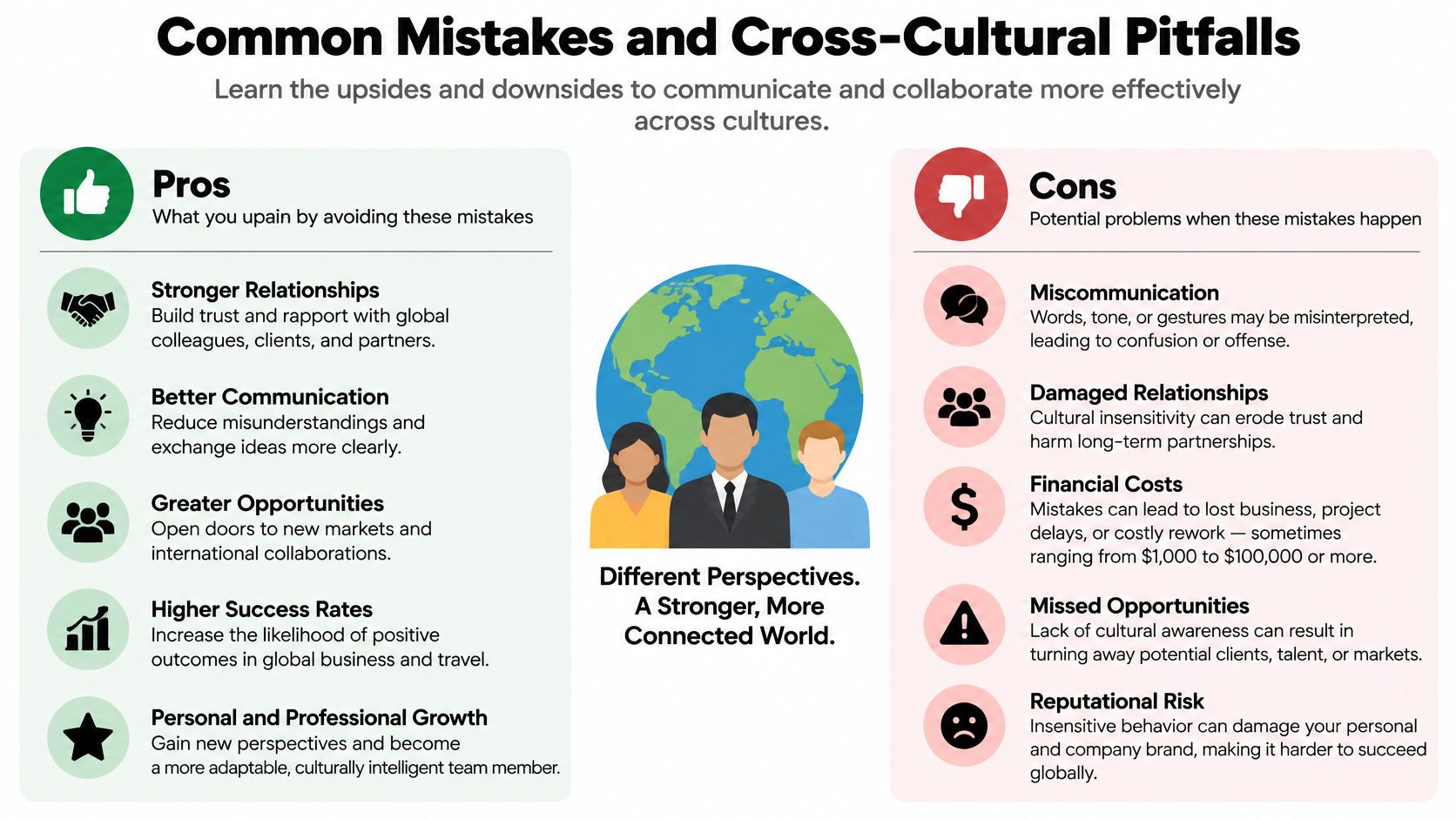
The contrast below is useful when reviewing messages for an international audience.
Workplace Norms Matter More Than Assumptions
A sender accustomed to explicit deadlines may use the expression to indicate that there's no firm deadline at all. If a quick confirmation is actually needed, a clearer replacement is: Could you confirm by tomorrow?
A recipient from a workplace that favors direct, dated requests may find the phrase evasive. For cross-border coordination, a replacement such as Please send by 3 p.m. UTC gives them a concrete action point.
Neither reaction tells you how an entire nationality communicates. Ask about team expectations and use these cross-cultural business communication practices to establish shared habits.
Clarifying the Phrase Across Languages
Alongside asking the speaker to rephrase or using a written translation, Translate AI is an option for live voice translation and two-way dialogue. The publisher describes support for more than 80 languages and compatibility with most earbuds or AirPods; check the current App Store listing for available features and device requirements, or visit its website.
An app can help clarify what someone means during a conversation. The written fix remains a stated deadline that both people can confirm.
Choose Polite Wording and Run the Four-Question Check
| Phrase | Best use | Urgency signal | Sets a deadline |
|---|---|---|---|
| At your earliest convenience | Formal requests where timing is flexible | Medium | No |
| When you have a moment, no rush | Colleagues, friends and low-stakes asks | Low | No |
| I would appreciate your reply this week | Professional requests with a loose window | Medium | Yes, loose |
| Whenever suits you before Monday | Client follow-ups with a soft deadline | Medium | Yes, loose |
| Could you confirm by tomorrow? | Peers or clients who need a quick answer | High | Yes, tomorrow |
| Please reply by 5 p.m. Friday | Scheduling, approvals and deadlines | High | Yes, exact |
| Please send by 3 p.m. UTC | Teams and vendors across time zones | High | Yes, exact with zone |
These urgency signals describe how the wording is likely to sound, not a formal classification. Even a sentence with an exact clock time needs the correct date and shared time zone when the context doesn't supply them.
Check the Stakes Before Choosing the Phrase
-
Can the recipient reasonably choose the timing?
If yes, at your earliest convenience is appropriate in a formal relationship. When you have a moment, no rush sounds warmer for a low-stakes request between colleagues.
Only say no rush when you mean it. Don't use relaxed wording and then follow up as though you'd established an urgent deadline.
-
Would missing the time cost money, a meeting, or a booking?
If yes, give an exact day, time, and zone. Add a short reason so the recipient understands the consequence: the room needs booking, the application needs filing, or the supplier needs approval.
If the cutoff is firm, don't weaken it with whenever convenient or preferably. Ask the recipient to tell you promptly if they can't meet it.
-
Is the recipient a customer or in another time zone?
State an acknowledgment window and a completion date. These are different promises: one confirms that someone has accepted the work, while the other says when the result will arrive.
If completion relies on another person, name the next update rather than promising an answer you can't control. Keep the customer informed without making them chase you.
-
Might the reader use English as a second language?
Prefer a measurable request over an idiom. Name the document, decision, or action, then attach its timing.
For a spoken agreement, ask the other person to confirm the deadline in their own words. Follow up in writing so neither person has to rely on memory.
Match the Wording to the Work
Use Could you confirm by tomorrow? when a peer or client needs to give a quick answer. Use I would appreciate your reply this week when there's a loose window but no immediate cutoff.
Choose urgency according to what the task requires, not how impatient you feel while writing.
A concise model email keeps the action, deadline, and reason together:
Hi Anna,
Could you send the signed contract by 15:00 UTC on Thursday so we can file it before the audit? Please let me know if that timing won't work.
Thank you.
Before sending, check whether Anna can choose the timing, what happens if the deadline is missed, whether the zone is clear, and whether the wording is easy to understand. If any answer is uncertain, revise the request rather than adding another courtesy phrase.
Translate AI offers live voice translation for conversations with colleagues, service staff, and other people who speak a different language. Visit Translate AI to explore an option for clarifying requests in conversation, then put the agreed action and deadline in writing.