

Finding the Best Portable Translator for Seamless Travel
Picture this: you're trying to order coffee in Tokyo, make sense of a train schedule in Paris, or simply ask for directions, but a language barrier turns a simple task into a stressful roadblock. That feeling of being unable to connect is frustrating and can hold you back from truly experiencing a new place. For business travelers, a misunderstood phrase can derail a negotiation.
The goal of this guide is to cut through the noise and help you find the best portable translator for your specific needs. We'll give you actionable advice to choose the right tool, whether it's a rugged device for an off-grid adventure or a slick app for a city break, so you can turn frustrating moments into smooth, confident conversations.
Why the Right Translator Is Your Most Important Travel Gadget

We’ve all felt that moment of panic. Fumbling with a phrasebook, getting blank stares, or feeling completely isolated because you can't communicate. This is the core problem every traveler faces. A language barrier doesn't just make logistics difficult; it prevents you from connecting with people and culture on a deeper level.
For anyone traveling for work, the stakes are even higher. A single misunderstood phrase in a negotiation or a technical term lost in translation can have real consequences. That feeling of not being able to communicate clearly can completely undermine the reason for your trip. A great portable translator solves this problem, empowering you to speak confidently in any situation.
Actionable Step 1: Identify Your Primary Translation Need
Before you look at any products, ask yourself: what is the main problem I need to solve? The market is packed with options, but your first big decision comes down to three main types.
- Dedicated Hardware: Purpose-built gadgets for toughness and long battery life, often with their own internet. Best for off-grid reliability.
- Smartphone Apps: Convenient and powerful, using the device you already carry. Best for city travel, business, and daily life.
- Hybrid Solutions: Specialized earbuds or smart glasses that work with your phone for a different user experience.
To help you figure out what’s right for you, we'll compare these options based on what actually matters when you’re on the ground.
Choosing a translator isn't just about the tech specs; it's about anticipating your environment. Will you be in a remote village with zero Wi-Fi, or in a fast-paced business meeting where you need to be discreet? Your answer points you to the right tool.
Core Criteria for Comparison
To make sense of the options, we need to look at the key things that make or break a translation experience. Understanding these criteria will help you zero in on the perfect fit for your next trip.
| Feature | Dedicated Hardware | Standard Free Apps | Advanced AI Apps |
|---|---|---|---|
| Accuracy | Generally High | Moderate to High | Very High (Context-Aware) |
| Offline Mode | Strong, Built-in | Limited/Basic | Varies (Often Subscription) |
| Convenience | Carry Separate Device | Excellent (On Your Phone) | Excellent (On Your Phone) |
| Battery Impact | Self-Contained | Drains Phone Battery | Drains Phone Battery |
| Cost | High Upfront Cost | Free (with Ads/Limits) | Subscription/One-Time Fee |
Hardware vs. Apps: Which Portable Translator Is Right for You?
When you’re looking for a portable translator, your first big choice is between a dedicated piece of hardware and a powerful app on your phone. There’s no single “best” answer here. Each approach is built for a different kind of traveler, and the right one really depends on where you're going and what you’ll be doing.
Think of dedicated hardware as the rugged, single-purpose tool for the job. These are handheld devices from brands like Vasco or Pocketalk that are built for one thing: translation. They’re often more durable than a smartphone and have batteries that last for days, so you’re not draining your phone’s power just to ask for directions.
Their biggest selling point is reliability, especially when you’re off the grid. Many of the top models come with their own built-in global SIM card, giving you free internet for translation in 150+ countries. That’s a game-changer for anyone venturing far from reliable Wi-Fi.
The Case for Dedicated Hardware
So, who are these devices really for? They shine in situations where convenience and rock-solid reliability are everything. Imagine you're haggling in a crowded market where your phone’s data plan is nonexistent. A dedicated translator with its own connection is ready to go instantly.
Here’s where they truly stand out:
- Offline Reliability: This is their superpower. They are designed to work well without an internet connection, making them essential for trips to rural areas, long flights, or countries with spotty mobile coverage.
- Saves Your Phone’s Battery: Using a separate gadget for translation means your phone’s battery is preserved for what it does best—navigation, taking photos, and making emergency calls.
- Durability and Simplicity: These things are often built to take a beating, surviving the bumps and drops that come with travel. Their focused design also makes them incredibly simple. Anyone, from your kids to your grandparents, can pick one up and use it immediately.
But this specialization comes at a price. These devices are an investment, often setting you back a few hundred dollars. They’re also one more thing to pack, charge, and keep an eye on.
The Power of Smartphone Apps
On the other side, you have smartphone translation apps. This is the minimalist’s choice—turning the powerful device already in your pocket into a translator. There's no extra hardware to buy and no added weight in your bag. The convenience is unbeatable.
Apps also benefit from a constant stream of updates, so their translation engines and features are always getting better. For a business professional in a meeting, discreetly using an app with earbuds is far less awkward than passing a clunky device back and forth. That seamless integration is a huge plus.
A key advantage of apps is their ability to integrate with your existing tech. Pairing an advanced app with your earbuds creates a hands-free, private translation experience that feels natural and immediate, something most standalone hardware can't replicate.
App Spotlight: Translate AI
For anyone leaning towards the app-based route, tools like Translate AI show just how powerful this approach can be. It essentially turns your iPhone and earbuds into a real-time, two-way conversational translator, completely removing the need for expensive, single-use hardware. This makes it an incredibly cost-effective yet potent choice for almost any situation. You can see a full breakdown of how different app options compare in our guide to the best translation apps for travel in our 2025 guide.
Ultimately, choosing between hardware and an app comes down to your personal travel style. If you’re heading off the beaten path and need a bulletproof tool you can count on, a dedicated device is a smart investment. But for most modern travelers, business people, and expats, the convenience, power, and value of a great smartphone app make it the more versatile choice.
The Ultimate Feature Showdown for Translators
Picking between a dedicated device and an app is just step one. To really find the best portable translator, you have to dig into the features that make or break its performance in the real world. A list of 100 supported languages sounds great, but it’s useless if the translation is slow, clumsy, or dies when you need it most.
This feature-by-feature breakdown will help you cut through the marketing noise and evaluate your options like a pro. We'll look at what actually matters for smooth, confident conversations, from AI-powered accuracy to the life-saving grace of an offline mode.
This chart gives you a quick look at where the market stands, showing how users are split between dedicated hardware and app-based solutions.
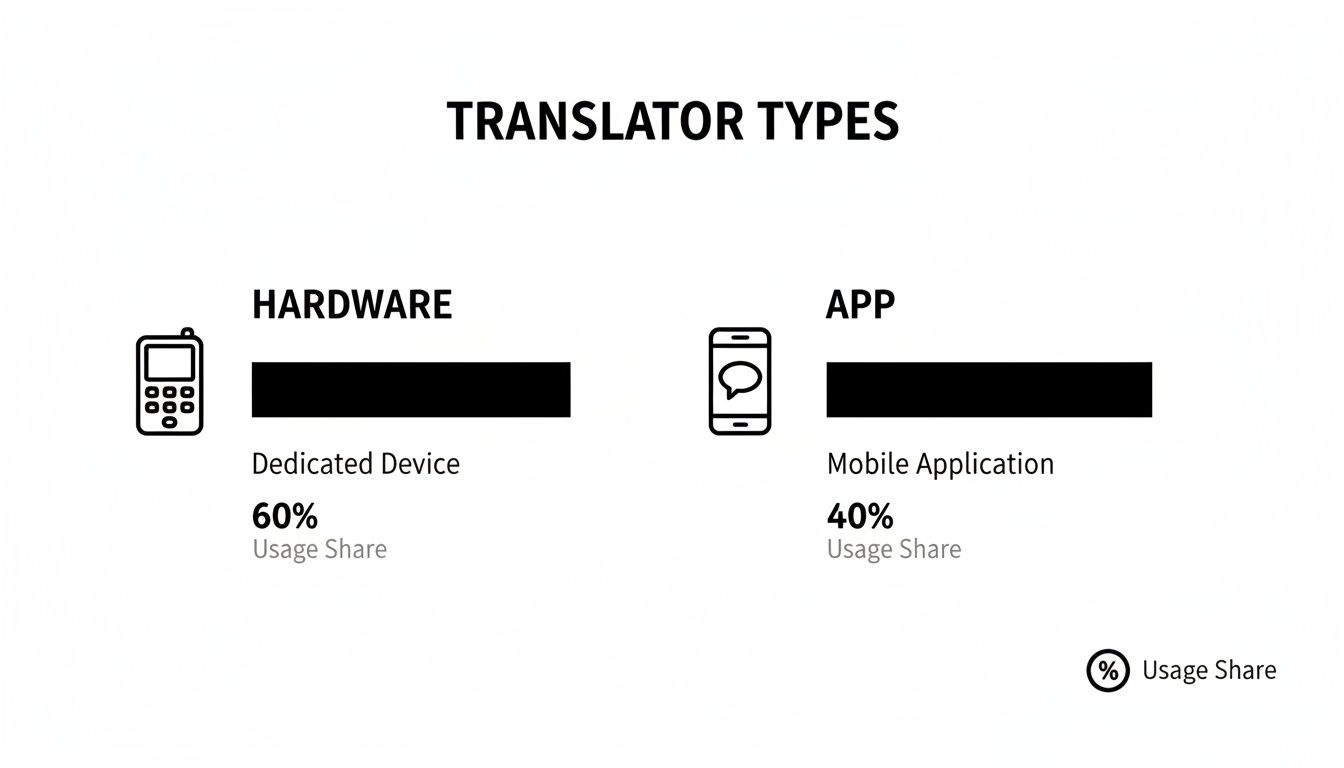
While hardware still holds a 60% majority, the 40% share for apps shows that both approaches are incredibly popular, each for different reasons.
Accuracy and Contextual AI
The single most important job of any translator is to get it right. Early tools were infamous for word-for-word translations that missed idioms, context, and cultural nuance, often leading to hilarious—or just plain confusing—results.
Today's solutions are worlds apart. The best portable translator options use sophisticated AI that analyzes the entire sentence to understand the bigger picture. This allows them to deliver translations that sound natural and fit the situation, whether you’re in a formal business meeting or a casual café.
A key differentiator in accuracy is the use of multiple translation engines. Premium devices and advanced apps don't rely on a single source; they intelligently select the best engine for a specific language pair—like using one that excels at German-to-English and another for Japanese-to-Spanish—for superior results.
Latency for Two-Way Conversations
Accuracy doesn't mean much if you have to wait five seconds for it. Latency—the delay between speaking and hearing the translation—is critical for a natural conversation. High latency creates awkward pauses that kill the flow and make everyone feel impatient.
The goal is near-instant, real-time translation that feels like a genuine back-and-forth. This is where advanced AI apps often shine, especially when you pair them with earbuds. You can speak naturally while your partner hears the translation almost immediately, and vice versa. That low-latency experience is what turns a clunky tech demo into a real human conversation. You can learn more about how this tech works in our guide to real-time language translator earbuds.
The Necessity of Offline Mode
Picture this: you're on a plane, deep in a national park, or navigating a subway system far underground. These are all common travel spots where you won't have a reliable internet connection. Without a solid offline mode, your fancy translator becomes a useless brick.
This feature lets you download language packs directly to your device, ensuring you can still get crucial translations when you're disconnected. While offline translations can sometimes be a bit less accurate than their online versions, their value in a pinch is undeniable. It’s a safety net every serious traveler should have.
Battery Life and Power Management
A dead translator is no translator at all. This is a simple, practical reality that directly impacts usability. Dedicated hardware typically has a clear edge here, with batteries designed to last for days on a single charge. That frees you up to explore without constantly worrying about finding an outlet.
Smartphone apps, on the other hand, have to share power with everything else your phone is doing. Running a translation app, especially one using the mic and speaker, can drain your battery fast. If you're relying on an app, carrying a portable power bank is pretty much non-negotiable.
Feature Comparison At a Glance
So, how do these different options stack up when you put them side-by-side? Here’s a quick-reference table to help you see the key differences at a glance.
Feature Comparison Hardware vs Free Apps vs Advanced AI Apps
This comparative analysis of key features across different types of portable translators can help you identify the best solution for your needs.
| Feature | Dedicated Hardware | Standard Free Apps | Advanced AI App |
|---|---|---|---|
| Accuracy (Contextual AI) | High; often uses premium, multiple engines. | Moderate to High; typically relies on a single free-tier engine. | Very High; leverages advanced AI for nuanced, context-aware results. |
| Low Latency (Two-Way) | Good; designed for face-to-face exchanges. | Variable; can have noticeable delays. | Excellent; optimized for real-time, natural conversation flow. |
| Offline Mode | Strong; often a core feature with extensive language support. | Limited; basic functionality or requires a premium subscription. | Good; typically offered as a premium feature with downloadable packs. |
| Battery Impact | Excellent; has its own long-lasting, self-contained battery. | Poor; significantly drains your smartphone's battery. | Fair; optimized but still impacts phone battery life. |
| Privacy & Security | Variable; check manufacturer's data handling policies. | Poor; user data is often used for advertising. | Strong; premium apps prioritize user privacy and data security. |
As you can see, there isn't one "perfect" choice—it all comes down to what you value most. A dedicated device offers reliability and battery life, while an advanced app can deliver superior speed and AI-powered accuracy, provided you can keep your phone charged. Free apps are great for occasional use, but they come with significant trade-offs in performance, features, and privacy.
Unlock Your Smartphone with Translate AI
For most people, the best portable translator is the one they already have in their pocket. Your smartphone, loaded with a powerful app, can often outperform dedicated hardware in speed, accuracy, and sheer convenience. This is where an app like Translate AI comes in, turning the tech you already own into a world-class communication tool.
Instead of buying and carrying another gadget, this approach leverages your iPhone and earbuds to create a surprisingly seamless, real-time translation system. Its real strength is helping conversations flow naturally, avoiding the awkward pauses that kill the vibe with other solutions. Interactions feel more human and less like a tech demo.
Natural Conversations in Over 80 Languages
Translate AI supports fluid, two-way conversations across more than 80 languages. It uses your phone’s microphone and your earbuds to create a private, efficient communication channel. You speak in your native language, and the other person hears the translation almost instantly through the phone's speaker or a shared earbud.
This setup is incredibly useful in a few key situations:
- Business Meetings: Hold negotiations or discussions without awkwardly passing a device back and forth.
- Noisy Environments: Get direct audio piped to your earbuds so you never miss a word in a bustling market or train station.
- Personal Connections: Share an earbud for a private chat, which feels much more direct and personal.
The real magic of an app-based system is its integration. You're using the hardware you already carry—your phone and earbuds—to get a high-performance translator without the extra cost or bulk of another device.
The app's interface is designed to be dead simple, letting you pick your languages and start talking with just a few taps.
The clean design gets you translating immediately, without a steep learning curve.
Advanced AI for Context-Aware Accuracy
Good translation is about more than just swapping words. Translate AI uses an advanced AI engine that understands context, local idioms, and nuance. This means you get translations that aren't just correct but also sound natural and culturally appropriate—which is critical for any real communication.
Whether you're trying to follow complex directions or navigate a sensitive business conversation, that contextual awareness makes all the difference. To make sure your app works flawlessly on your trip, check out our guide on how to get internet access while traveling abroad.
How to Choose the Right Translator for Your Journey
The "best" portable translator isn't a single device or app. It's the one that fits seamlessly into your life. A tool that's perfect for a backpacker hitting remote trails will be completely wrong for a professional closing a deal in a boardroom.
Forget scrolling through endless feature lists. The right choice comes down to your personal context. Let's break down the best options for four common scenarios to help you figure out what really matters for your next trip.
For the Globe-Trotting Traveler
You live out of a suitcase, equally at home on the bustling streets of Bangkok as you are on a mountain trail with zero bars of service. Your translator needs to be as tough and self-sufficient as you are.
For you, it's all about durability, long battery life, and—most importantly—a killer offline mode. Being able to translate a menu or ask for directions without Wi-Fi isn't just a nice-to-have; it's non-negotiable.
- Your Must-Haves:
- Robust Offline Capabilities: Look for translators with extensive downloadable language packs.
- All-Day Battery Life: You need a device that can keep up with a full day of exploring on a single charge.
- Durable Build: Your gear has to survive the occasional drop, bump, or splash.
A dedicated hardware device like the Vasco V4 is often the clear winner here. Its self-contained battery and built-in data (for when you do get a signal) offer a level of reliability your phone just can't match while it's busy running maps, taking photos, and draining its own battery.
For the International Business Professional
Your work sends you across borders where every word counts. Whether you're presenting to a new client, negotiating a contract, or networking at a conference, your translator has to be fast, discreet, and incredibly accurate, even with technical jargon.
You need a solution that keeps the conversation flowing naturally. Real-time, two-way dialogue is critical; any lag or awkward fumbling with a device can kill the professional vibe. Having a private conversation without passing a gadget back and forth is a massive plus.
In the business world, accuracy and subtlety are everything. A tool that delivers discreet, hands-free translation through earbuds maintains the natural flow of conversation and projects confidence—something that's invaluable in high-stakes meetings.
This is where advanced apps, paired with high-quality earbuds, often shine. They offer a private listening experience and use powerful AI that understands context and industry-specific language. In fact, two-way translation tech now dominates the portable translator market with over 65% market share in 2024, proving just how essential that fluid, back-and-forth conversation is for professionals. You can discover more insights about this trend and its market impact.
For the Expat Navigating Daily Life
You've moved to a new country and are building a life from scratch. Your translation needs are constant and practical—from deciphering mail and setting up a bank account to just chatting with your new neighbors. Your ideal tool has to be quick, simple, and always within arm's reach.
For everyday life, convenience is king. You need a translator you can whip out and use in seconds. Photo translation is also a game-changer for reading product labels, official documents, and street signs.
- Key Needs for Expats:
- Ease of Use: A dead-simple interface is a must for frequent, on-the-fly translations.
- Camera Translation: The ability to instantly translate text on menus, forms, and signs is a lifesaver.
- Accessibility: A solution that's always with you, like a smartphone app, is perfect.
A powerful smartphone app is often the best fit for an expat. It's already in your pocket, and its camera feature can turn confusing daily tasks into simple ones. Having a quick spoken conversation without needing extra gear makes the process of settling into a new culture feel a whole lot smoother.
For the Ambitious Language Learner
You’re not just trying to get by; you're actively trying to learn. Your goal is to practice speaking, nail down your pronunciation, and build real conversational confidence. For you, the best translator is one that moonlights as a learning partner.
Look for features that actually support your studies. Seeing both the original text and the translation side-by-side helps you connect words and phrases. Some apps even let you slow down the audio, which is fantastic for catching the subtle sounds of a new language. You need a tool that encourages you to speak and gives you immediate feedback.
The Role of Translate AI in Your Journey
For language learners, business pros, and expats alike, an app like Translate AI offers a serious edge. Its real-time, two-way dialogue feature is an amazing platform for practicing conversation. By speaking and hearing a natural-sounding translation instantly, you're not just passively translating—you're actively engaging with the language, which is one of the fastest ways to learn.
Tips for a Flawless Translation Experience
Picking the right translator is only half the battle. To really communicate smoothly, you have to know how to use it. A few small tweaks to how you speak and prepare can make a huge difference in accuracy, turning what could be an awkward exchange into a confident conversation.
Think of these tips as the basic rules of the road. They’ll help you get the most out of any translation tool, whether it’s a dedicated device or an app on your phone.
Mastering Your Speaking Style
How you talk directly impacts the quality of the translation. Even the smartest AI needs clear input to give you accurate output. The goal is simple: be understood by the machine so you can be understood by the person you're talking to.
Follow these simple guidelines for much better results:
- Speak Clearly and Moderately: Don't mumble or rush. Use a natural, conversational pace to give the translator time to process what you’re saying.
- Use Shorter Sentences: Break down complex thoughts into simpler, shorter sentences. This dramatically cuts down the chances of the AI getting your meaning wrong.
- Minimize Background Noise: If you can, step into a quieter spot for important conversations. Loud street traffic or a bustling cafe can make it tough for the microphone to pick up your voice cleanly.
Think of your translator as a very literal listener. It doesn't guess your intent from context the way a human does. By speaking clearly and simply, you provide clean data, which results in a much more accurate translation.
Setting Up Your Device or App for Success
A little prep work goes a long way. Before you even head out, spend a few minutes getting your translator configured and ready to go. This can prevent a lot of frustrating technical hiccups when you're in the middle of a conversation.
First, download any language packs you need for offline use. This is a lifesaver in places with spotty internet. Next, pop into your phone's settings and double-check the microphone permissions to make sure your app can actually hear you.
Quick Setup for Translate AI Users
If you're using an app like Translate AI, take an extra second to connect and test your earbuds. Doing this ensures the audio flows exactly where it needs to, creating that smooth, two-way dialogue the app is known for. This tiny check prevents you from fumbling with your tech during a real interaction.
Common Questions About Portable Translators
Picking the right translator often boils down to a few final questions. Are dedicated devices still worth it in a world of powerful apps? Is a paid app really better than a free one? Let's clear up the most common queries we hear from travelers and professionals alike.
Think of this as the last step before you decide—straightforward answers to help you choose a tool that actually works when you need it most.
Is a Paid App Really More Accurate Than a Free One?
Yes, there's often a noticeable jump in quality. Free translation apps are fantastic for quick, simple lookups, but they usually lean on a single, one-size-fits-all translation engine. This can lead to clunky or out-of-context translations, especially with longer sentences or local slang.
Paid apps and premium devices, on the other hand, typically invest in more sophisticated AI and often tap into multiple translation engines at once. They can intelligently pick the best engine for a specific language pair, giving you translations that sound more natural and context-aware. This is a game-changer for business meetings or any conversation where getting the details right is non-negotiable.
Are Dedicated Hardware Translators Still Relevant?
Absolutely, and for certain kinds of travelers, they're still the best tool for the job. While smartphone apps are incredibly convenient, dedicated hardware wins on reliability and endurance. These devices are built for one purpose, so they boast long-lasting batteries that won’t drain your phone and rugged designs that can take a few bumps on the road.
Their biggest edge, though, is often their superior offline capability. In fact, offline mode is a critical feature in the portable translator market because it guarantees you'll have service in places with spotty internet—a must-have for the 23% of global travelers who explore remote destinations. You can dive into the full research on the portable translator market to see the data for yourself.
How Can I Maximize My Translator's Battery Life?
If you’re relying on a smartphone app, good battery hygiene is key. Start by dimming your screen brightness and closing any background apps you don't need. Whenever you can, pop in some earbuds for audio output—they use a lot less power than your phone’s built-in speaker.
A simple but powerful trick is to download your language packs for offline use before you even leave home. This not only prepares you for dead zones but also cuts down on the battery drain from a constant data connection.
And for total peace of mind, a fully charged portable power bank is your best friend. It’s the ultimate safety net, ensuring both your phone and your communication lifeline stay on all day long.
Ready to turn your smartphone into a powerful, real-time communication tool? With Translate AI, you can have natural, two-way conversations in over 80 languages without buying extra hardware. Download the app today and start speaking the world's languages with confidence.