

Your Guide to a Flawless Arabic to English Voice Translator
Feeling the pressure of an upcoming trip to Dubai or a business meeting in Riyadh? You know the language barrier is a real hurdle. That awkward moment when you need to ask for directions, order food, or close a deal can be stressful. An effective Arabic to English voice translator isn't a futuristic gadget anymore; it’s the practical tool you need to turn confusion into clear, confident conversation.
This guide will show you exactly how to choose and use a voice translator app so you can communicate naturally and effectively, no matter the situation.
Why You Need Instant Voice Translation
Picture this: you've just landed in Dubai for a crucial business meeting, or you're trying to haggle for a souvenir in the buzzing markets of Marrakech. In those moments, the language barrier feels like an invisible wall, leading to confusion, awkwardness, and missed opportunities. You're trying to connect, but the words just aren't there.
This is where a solid Arabic to English voice translator becomes more than just a cool app—it’s your essential tool for getting things done.
We're long past the days of clunky, robotic translators that spit out stiff, often hilariously wrong phrases. Today’s technology delivers fluid, AI-powered conversations that actually pick up on nuance and intent. For international travelers, that means ordering food, asking for directions, or chatting with locals with a new sense of confidence. For business professionals, it means you can build real rapport and handle negotiations without needing a human interpreter on standby.
This simple graphic nails the journey from confusion to clarity.
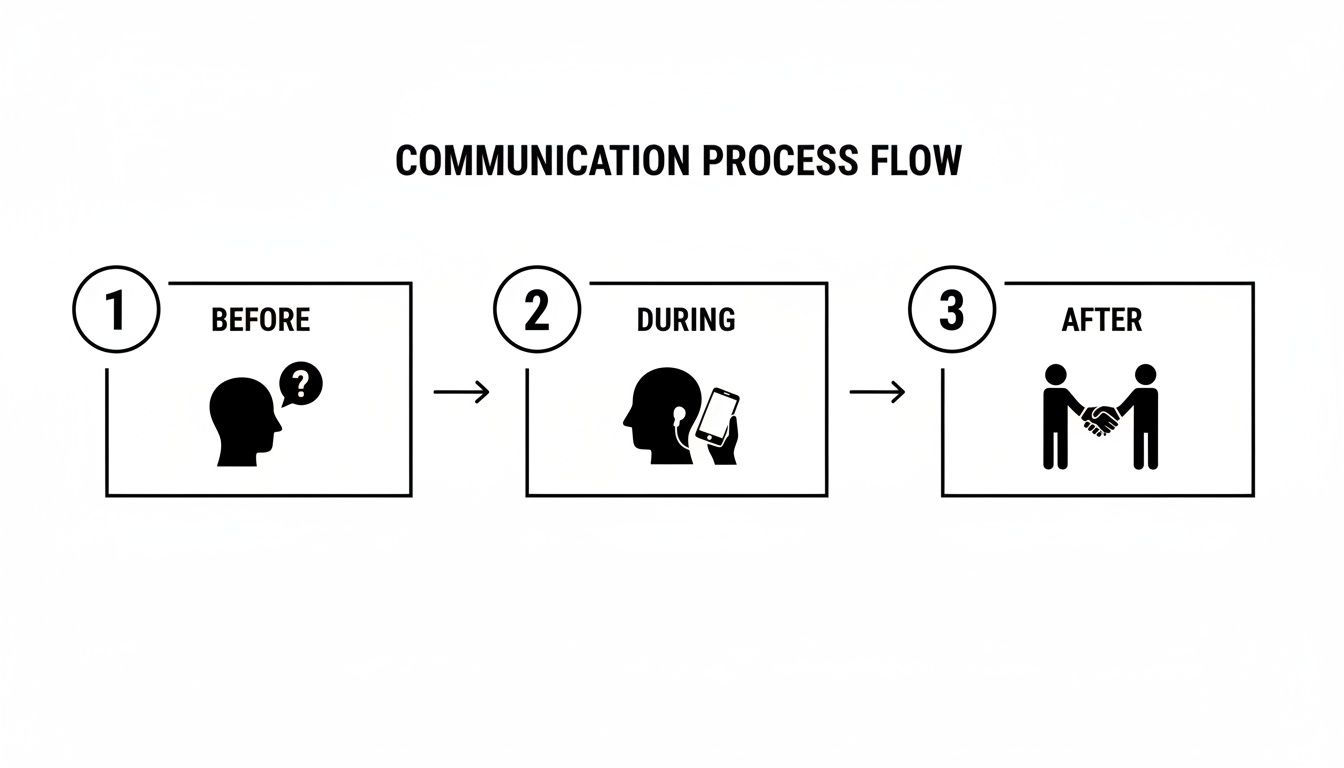
It shows how a voice translator turns a moment of uncertainty ("Before") into a productive conversation ("During"), which leads to a successful connection ("After").
The Growing Need for Seamless Dialogue
The demand for this kind of technology is exploding. The speech-to-speech translation market, which powers these real-time apps, has seen massive growth, thanks to the return of global travel and business.
Valued at USD 0.56 billion in 2024, the market is on track to hit USD 1.01 billion by 2030. That boom is all about AI getting better at enabling smooth, two-way dialogues that are perfect for travelers and expats.
This shift points to something bigger: we don't just want to translate words anymore; we want to connect with people. An instant voice translator makes genuine human interaction possible, breaking down cultural barriers one conversation at a time.
Practical Benefits in Everyday Scenarios
The real magic of an Arabic to English voice translator is how it helps in everyday situations. It empowers you to handle tasks that would otherwise be a massive headache, like discussing a rental agreement with a landlord in Riyadh or understanding a doctor’s advice in Cairo.
Of course, for these tools to work their best, you need a stable internet connection. That's why it's always a good idea to figure out how to get internet access while traveling abroad before you go.
Ultimately, this technology gives you independence and makes your experience in an Arabic-speaking country that much richer.
How to Have Your First Translated Conversation in Minutes
Ready to give it a try? Starting your first translated conversation might feel a little strange, but modern apps make it incredibly straightforward. This section will walk you through the exact steps to go from downloading an app to having a real-time chat in just a few minutes, without getting bogged down in menus.
Think about those real-world moments. You're a tourist in Cairo, dying for a traditional coffee but don't know the words. Or maybe you're an expat in Riyadh trying to sort out a maintenance issue with your landlord. This is exactly where a good Arabic to English voice translator steps in, turning a potentially awkward moment into a simple exchange.
Step 1: Get Set Up in Under a Minute
The initial setup is designed to be fast. You don't need to be a tech whiz to get this right.
- Find and Install the App: First, you need the right tool. Search for a voice translation app on your phone's app store.
- Pick Your Languages: When you open it, you’ll see a language selection screen. Set your input to Arabic and your output to English. Most apps make this obvious, often with flag icons.
- Choose Your Mode: How do you want to listen? For a private chat, use your earbuds. For a group or public interaction, the speaker is the way to go. This is usually a single tap to switch between them.
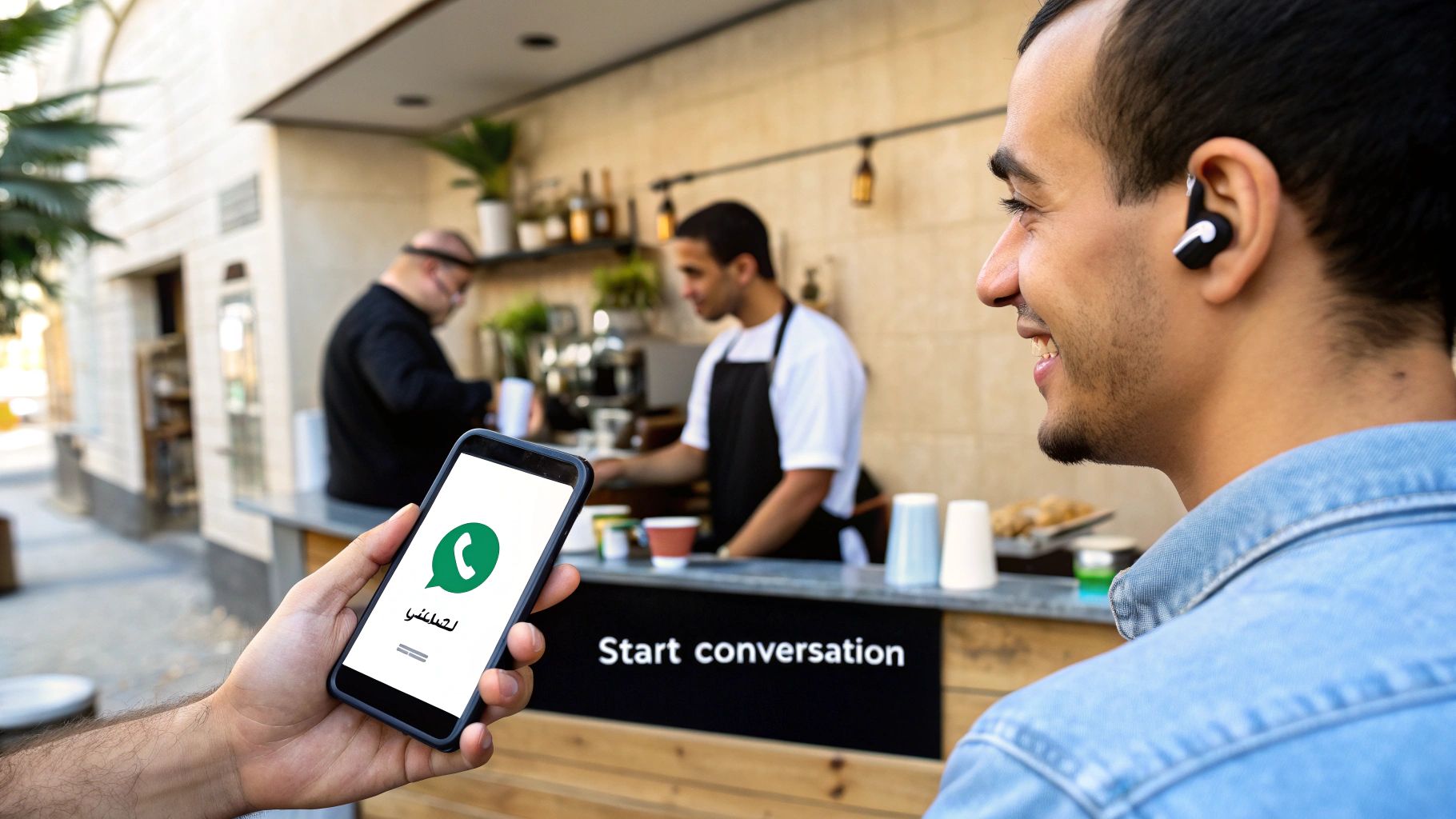
The interface is intentionally simple. That big microphone button and clear language indicators are there so you can jump right into your conversation without any confusion.
Step 2: Start Talking with Confidence
With your languages locked in, you're ready to go.
Just tap the main microphone icon—it will usually light up or pulse to let you know it's listening. Speak your phrase clearly and at a normal, conversational pace. Something like, "Hello, I would like to order one coffee, please."
The app gets to work, and in a second or two, you’ll hear the Arabic translation spoken out loud. You'll also see the translated text pop up on the screen, which is perfect for showing the other person to make sure everything is clear.
When they reply in Arabic, the magic happens in reverse. The app listens, translates, and speaks the English audio back to you, creating a back-and-forth dialogue that feels much more natural than fumbling with a keyboard.
Recommended App: Translate AI for a Smoother Chat
For a really solid experience, especially with the nuances of different Arabic dialects, an app like Translate AI is built for this. It’s designed specifically for these real-time, two-way conversations that work just as well with your earbuds as with your phone’s speaker.
- Earbuds Mode: Perfect for private or professional conversations. Pop in your earbuds, and you'll hear the translation directly, which is a lifesaver in noisy markets or important business meetings.
- Speaker Mode: When you’re having a more open chat, like ordering from a street vendor, speaker mode lets everyone hear both the original phrase and its translation clearly.
You can learn more and download Translate AI from the App Store to get your first conversation going in moments. With the right app, you'll be communicating with confidence.
How to Choose the Right App for Arabic Translation
When you need an Arabic to English voice translator, you’ll quickly find that not all apps are created equal. Arabic is a tricky language for machines—with its many dialects, context, and unique rhythm, it needs a tool that’s smarter than a basic word-swapping program. Using a clunky app can lead to stiff, robotic conversations that cause more confusion than they solve.
The goal of this section is to give you a clear checklist of what to look for, so you can pick an app that enables natural, flowing conversations. For a bigger-picture look at what separates the good apps from the great, check out this breakdown of the best translation apps for travel.
Key Features for Natural Arabic Dialogue
So what actually makes a voice translator useful in the real world? It boils down to a few key features that let you have a smooth, back-and-forth conversation without awkward pauses or special gadgets. The best apps make the experience seamless.
Here’s your actionable checklist:
- True Two-Way Dialogue: The app must be able to listen and translate for both people at the same time. This creates a natural conversational rhythm, unlike apps that make you keep tapping buttons to switch who’s talking.
- Standard Earbud Compatibility: You shouldn’t have to buy expensive, proprietary hardware. A great translator will work with the Bluetooth earbuds you already own, like AirPods, making it practical for everyday use.
- Context-Aware AI: The AI needs to be smart enough to tell the difference between formal and casual speech and even pick up on regional dialects. This is crucial for avoiding literal translations that miss the intended meaning.
When an app has these features, it becomes a genuinely helpful tool for stress-free travel and more effective business meetings. You end up focusing on the person you're talking to, not the tech in your hand.
The ultimate test of a voice translator is whether you forget you're even using one. It should feel like a natural part of the conversation, helping you connect with someone instead of getting in the way.
Meet Translate AI: Your Pocket Translator
Translate AI was built around these exact ideas. It has a simple, clean interface designed for real-world chats, so you can start a conversation in seconds without digging through complicated settings.
If you need a reliable Arabic to English voice translator that just works when you're on the go, this is it. You can download Translate AI for iOS and see for yourself.
Actionable Tips for Clearer Translated Conversations
Getting an accurate translation from your Arabic to English voice translator is about more than just hitting a button. How you speak, where you are, and even the words you choose can make a world of difference. Think of the AI as a focused listener—give it a clear signal, and you’ll get a clear translation back. This section provides specific, actionable advice to help you get smooth, natural translations every time.
Speak So the AI Can Understand You
The first trick is to slightly adjust how you talk. You don't need to sound like a robot, but being deliberate is key.
- Pace Yourself: Speak at a natural but slightly slower pace. Rushing your words is a surefire way to make the AI miss syllables or jumble your phrases.
- Articulate Clearly: Mumbling is the enemy of a good translation. Make an effort to enunciate each word so it’s distinct from the next.
- Pause Between Sentences: This is a big one. Give the AI a split second to process what you just said. A brief pause after each complete thought helps the translator catch up and deliver a much more accurate response.
It’s like leaving an important voicemail—you’d instinctively speak more clearly to make sure they get the message. The same idea applies here.
How to Handle Dialects and Noisy Places
Arabic is a language packed with rich regional dialects. While modern AI is getting surprisingly good at recognizing these variations, you can give it a helping hand. For important conversations, try sticking to more standard vocabulary and avoid heavy slang.
Background noise is another major hurdle. A bustling souk or a loud café can easily confuse the microphone.
Actionable Tip: Whenever you can, find a slightly quieter spot to talk or simply hold your phone's microphone a bit closer to your mouth. This simple move can dramatically boost the accuracy of your Arabic to English voice translator.
For a quick-reference guide, here are the key dos and don'ts.
Best Practices for Optimal Translation Accuracy
| Do This for Best Results | Avoid This for Clearer Translations |
|---|---|
| Speak clearly and enunciate. | Mumbling or speaking too quickly. |
| Pause briefly between sentences. | Talking in one long, continuous stream. |
| Find a quiet environment. | Trying to translate in a loud, crowded space. |
| Use standard vocabulary for important talks. | Relying on heavy slang or specific dialects. |
| Hold the mic close to your mouth. | Holding the phone far away or covering the mic. |
Following these simple guidelines will help the AI understand you perfectly, leading to smoother conversations.
The Incredible AI Driving Modern Translation
The technology behind these apps is advancing at a breathtaking pace. The AI-driven language translation market was valued at a massive USD 1.8 billion in 2023 and is on track to hit USD 13.5 billion by 2033. This explosion is powered by AI that can now understand context and dialects with 95%+ accuracy rates under ideal conditions—a game-changer for businesses in regions like the GCC. You can dive deeper into these findings on the AI translation market.
Your Go-To App for Effortless Conversations
If you want a tool that’s built to handle these real-world challenges, give Translate AI a try. Its powerful AI is designed to adapt to different speaking styles and less-than-perfect environments. Whether you're using earbuds for a private chat or the speaker in a group, it delivers the clear, reliable translations you need to connect. You can download Translate AI from the App Store and start having smoother conversations today.
Where an Arabic Translator Truly Comes to Life
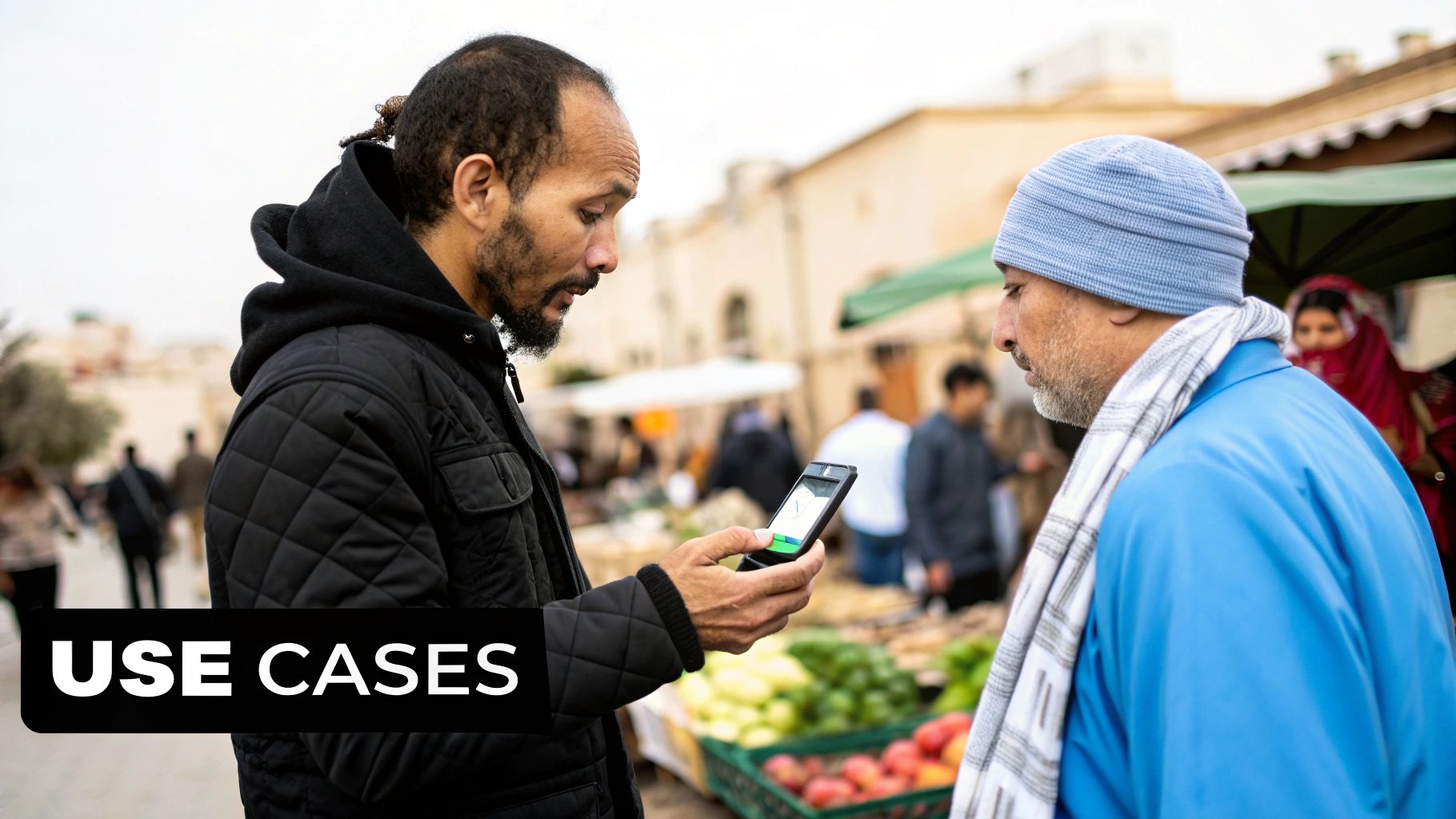
The theory is great, but the real magic of an Arabic to English voice translator happens in the moments that matter. This is where the tech stops being a neat gadget and becomes an essential tool for real human connection. Let's walk through a few situations where it can make all the difference.
Navigating a Business Meeting in Dubai
Picture this: you're in Dubai, sitting across from a potential client. The stakes are high. A good voice translator lets you discuss project specs, negotiate terms, and build rapport without the awkward pauses of a human interpreter.
You can speak naturally, and your counterpart hears a clear, professional translation almost instantly. It creates a direct line of communication, which helps build trust and shows you came prepared. This kind of direct engagement is a huge deal in business hubs across the Gulf Cooperation Council (GCC) region, where demand for this technology is surging. The proof is in the numbers: businesses report 50% better engagement from Arabic-localized content, and conversion rates have climbed 62% for ads in Saudi Arabia compared to English-only versions.
Haggling at a Souk in Jordan
Now, let's switch gears. You're wandering through a vibrant souk in Amman. You spot the perfect souvenir, but you know haggling is part of the experience. A translator turns what could be an intimidating process into a fun, authentic interaction.
You can ask about the craftsmanship, discuss the price, and enjoy a bit of friendly back-and-forth.
- You could say: "This is beautiful. What is the best price you can offer?"
- The app translates, and the vendor replies in Arabic.
- You hear back: "For you, a special price. This is handmade with local materials."
Suddenly, it's more than just a purchase—it's a genuine cultural exchange, all made possible because you can communicate clearly.
Using an Arabic to English voice translator in these moments isn't just about understanding words—it's about participating in the local culture with confidence and respect.
Practicing Your Arabic Language Skills
If you're trying to learn Arabic, a voice translator is an incredible practice partner. It gives you a low-pressure way to have conversations with native speakers, check your pronunciation, and pick up new vocabulary. You can use it to practice anything from ordering coffee to asking for directions.
The immediate feedback is priceless. You say a phrase, hear the correct Arabic, and then listen to the native speaker's reply. This kind of real-time practice reinforces what you've learned in a way that no textbook ever could. Many learners find that using discreet real-time language translator earbuds makes these practice sessions feel even more natural.
Your Go-To Tool for Real Conversations
In every one of these situations, a reliable app is what makes or breaks the experience. You need a tool that can handle the specific flow and vocabulary of each setting, from formal business terms to the casual chatter of a marketplace.
Translate AI was designed for exactly these moments. Its AI understands context, helping your conversations feel fluid and natural. Whether you're trying to close a deal or just buy a souvenir, it delivers the accurate translations you need to connect with confidence.
Got Questions About Voice Translators? We've Got Answers.
When you're counting on tech to bridge a language gap, it's smart to have questions. Getting straight answers helps you use your Arabic to English voice translator with confidence. Let's dig into what people usually ask.
Just How Good Are These Translators With Arabic, Really?
Modern AI translators have gotten seriously good—we're talking 95% accuracy or higher in ideal conditions. Today’s apps are smart enough to pick up on different dialects and the nuances of conversation that used to confuse machines.
The secret is the advanced AI that looks at the whole context of what you're saying. This means the app can tell the difference between a formal business meeting and a casual chat, giving you a translation that sounds natural. For the best results, though, remember to speak clearly and find a spot without too much background noise.
Do I Need to Be Online for This to Work?
Some advanced apps do have an offline mode, which can be a lifesaver when you're in a place with weak or expensive data. It's a great backup for simple things like asking for directions.
However, the most accurate, context-aware translations happen when you have an internet connection. Being online lets the app tap into powerful, cloud-based AI models that deliver the best possible quality. If the conversation is important, you’ll want to be connected.
Actionable Tip: If you know you'll be offline, see if your app lets you download an Arabic and English language pack beforehand. But for a real-time, nuanced conversation, a stable connection is your best friend.
Will I Need to Buy Special Earbuds or Hardware?
Nope, and that’s one of the best parts. Modern voice translation apps are designed to work with the gear you already have.
You don't need to buy expensive, specialized devices. A good app is built to use:
- Your phone's built-in microphone and speaker for open, public settings.
- Any standard Bluetooth earbuds you already own, like AirPods, for conversations that need more privacy.
This makes it incredibly easy to start a translated conversation anywhere, without having to lug around extra gadgets. It's powerful translation tech that fits right in your pocket.
For a seamless experience that works with your existing earbuds and delivers high-accuracy translations, Translate AI is designed to make every conversation feel natural. You can download Translate AI from the App Store and start communicating with confidence today.