

Which Countries Speak English in Europe: A 2026 Guide
Does a country “speak English” if you can order dinner easily but can't explain a prescription, understand a tenancy agreement, or follow a family conversation?
That's the gap behind the question of which countries speak English in Europe. You land in a new city, need a train ticket or a dinner reservation, and want to know whether English will carry you through. The useful answer isn't just a country ranking. It's knowing where English is the default, where it's a reliable shared language, and where you should have a backup ready.
English has unusually broad reach. A European Commission language summary reports that 47% of Europeans speak English, making it Europe's most widely used foreign language. That doesn't mean every person, service, or situation will be accessible in English.
Practical rule: Plan around the conversation you need to have, not just the country you're visiting.
Malta, Ireland, and the United Kingdom belong in a different category from destinations where English works well as an additional language. In the latter group, a hotel check-in and a discussion about medical symptoms require different preparation. Use the country notes below to decide when to start in English, what to say if communication stalls, and when live translation is worth opening.
1. Malta
English is an official language in Malta, making it a straightforward choice for travelers who want an English-speaking Mediterranean destination. The European Union's language overview confirms Malta's official-language position, rather than merely classifying it as somewhere visitors often understand English.

For a Valletta sightseeing day, start by asking for an English-language tour, menu, or explanation. If you're visiting St. John's Co-Cathedral, check the available guide options before booking rather than assuming every admission package includes the same language support.
Where a backup still helps
Official status doesn't establish an individual's preferred language. A taxi driver, host, or older acquaintance may feel more comfortable discussing a complicated request in Maltese.
- Fallback phrase: “Could we speak English, please?” is a sensible first request. “Could you say that more slowly?” helps when speed, rather than language, is the problem.
- Translation trigger: Use Translate AI when someone prefers Maltese and you need to explain a destination change, accessibility requirement, or detailed arrangement.
- Booking habit: Confirm the guide's language when reserving a tour, especially if the explanation matters more to you than reaching the attraction itself.
Keep your address, reservation details, and transport arrangements accessible. This guide to preparing for international travel can help you organize the practical details before departure.
2. Ireland
In Ireland, English is the practical starting point for daily travel. Your more likely challenge is following a fast conversation or unfamiliar expression, not finding a shared language.

Don't confuse difficulty understanding an accent with needing translation. At a Dublin café, on a telephone call, or while asking for directions, a slower repeat may solve the problem more cleanly than introducing an app.
A useful fallback is “Could you repeat that a little more slowly, please?” For a place name, ask the person to write it down. Seeing the spelling can be more useful than hearing the same unfamiliar name again.
Respect Irish without treating it as a travel barrier
Learning “dia duit,” meaning hello, is a thoughtful way to acknowledge Irish. If you want more than a memorized greeting, you can start learning Irish before your trip.
Keep the distinction between curiosity and necessity clear. You can take an interest in Irish without assuming you'll need it to order lunch or arrange accommodation.
Use Translate AI when the conversation is genuinely multilingual, such as meeting a host's relatives or working with colleagues who prefer another language. Don't expect translation software to be the best remedy for every unfamiliar English accent. Start with repetition, a shorter question, and written confirmation of important details.
3. United Kingdom
The United Kingdom is Europe's largest predominantly English-speaking country. For an English-speaking visitor, the practical preparation is less about translating everyday requests and more about understanding regional speech, checking arrangements, and avoiding assumptions.
You can plan a London business meeting, ask about a hotel booking, or discuss a restaurant reservation in English. That doesn't mean every speaker will use the vocabulary or pronunciation you're used to.
Clarify meaning before reaching for an app
Your fallback phrase is “What does that mean in this context?” It works better than pretending to understand a regional expression and discovering later that you misunderstood the directions.
For travel instructions, repeat back the destination and the action you need to take. For work, ask someone to put an unfamiliar term in writing.
An unfamiliar accent isn't automatically a language barrier. Ask for a slower explanation before switching tools.
Translate AI becomes useful when a conversation includes people who don't share English, rather than people who merely speak different varieties of it. A multilingual meeting in London is a better reason to use live translation than an unfamiliar phrase at a railway station.
Before departure, check the entry requirements that apply to your nationality and travel purpose. Don't assume that arrangements for another European destination also apply to the UK.
For an additional perspective on English-speaking travel in Europe:
4. Netherlands
An English conversation in Amsterdam can feel so effortless that it's tempting to stop thinking about language altogether. That's a reasonable approach to a casual exchange, but a poor approach to paperwork.
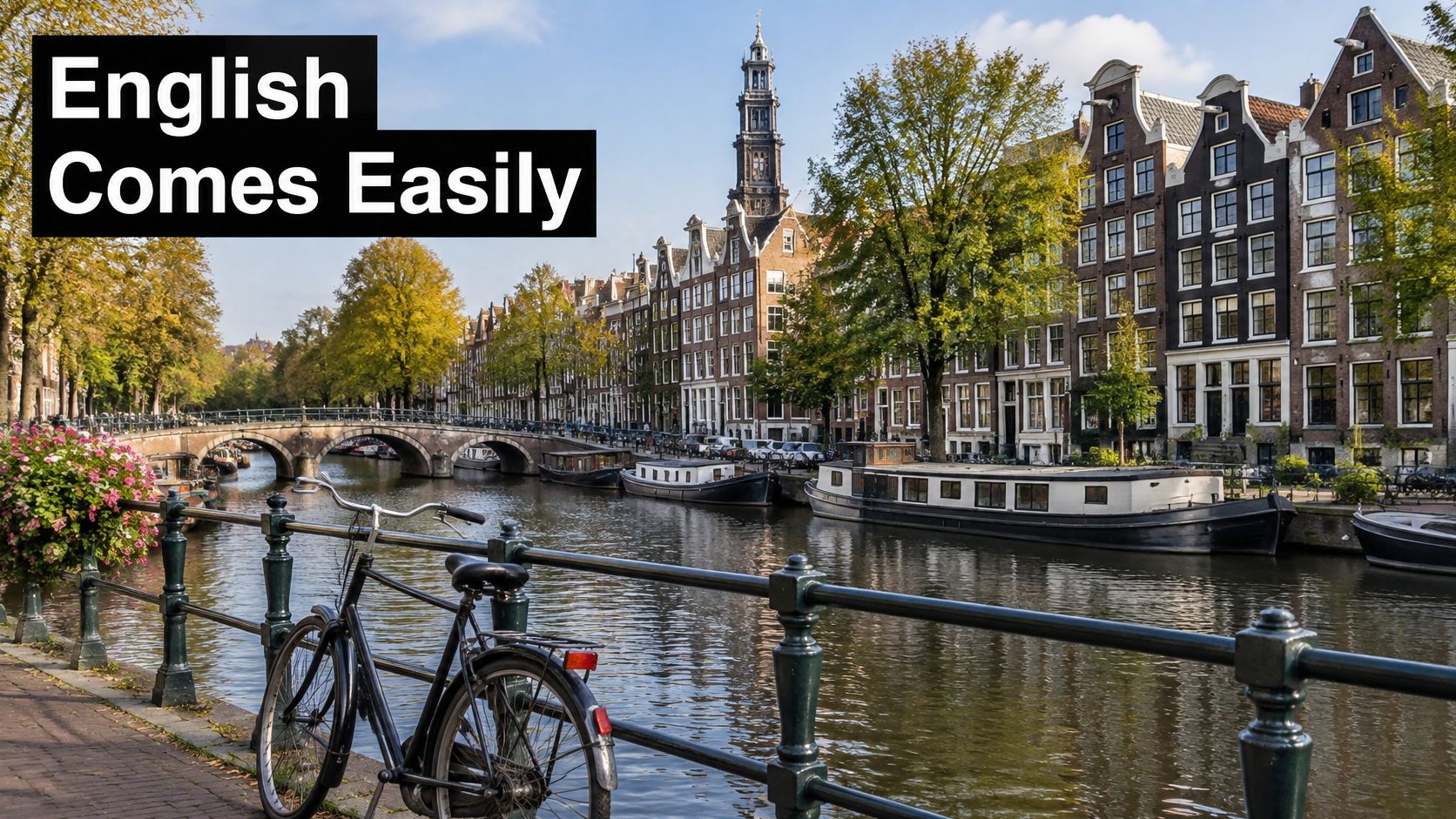
Treat English as your opening language for a visitor-facing conversation. Before a rental appointment, employment discussion, or administrative visit, confirm separately whether both the conversation and the documents can be handled in English.
Those are different questions. A helpful English-speaking representative doesn't make a Dutch document understandable.
Keep casual convenience separate from formal understanding
- Fallback phrase: “Spreekt u Engels?” means “Do you speak English?” It's a polite way to establish the shared language without demanding a switch.
- Where English runs out: Watch for documents, conversations between local participants, and technical explanations where the speaker prefers Dutch.
- Translation trigger: Use Translate AI when someone wants to explain something in Dutch and you need a back-and-forth conversation, not just a translated word.
For example, you might discuss an apartment viewing in English but need help asking about a Dutch maintenance notice. Translate the specific question, then confirm the answer rather than attempting to process the entire document conversationally.
Choose your tool before that situation arises. This guide to choosing a translation app for travel is a useful starting point for comparing your needs.
5. Sweden
Start in English for most visitor-facing exchanges in Stockholm, Gothenburg, and Malmö. Sweden teaches English from early school years, so exposure is broad. Treat that as a strong starting point, while remembering that schooling does not guarantee the same ease in a hurried pharmacy queue or a detailed housing call.

For hotels, museums, transit desks, and routine purchases, English usually works. For relocation tasks, ask in advance which language the appointment and paperwork will use. A friendly answer at check-in does not prove a contract, referral, or municipal letter will be clear in English.
Switch early when the subject turns precise
Your fallback phrase is “Kan vi prata engelska?”, meaning “Can we speak English?” Add “tack” for thank you, and learn how to say thank you in Swedish before you arrive.
English runs out fastest in Swedish group conversation, jokes, nuanced complaints, and handwritten notes. Use Translate AI when a Swede can explain more precisely in Swedish and you need the exact meaning, such as a landlord's repair condition or a clinic instruction. Keep the phone for the decisive exchange, not every aside.
6. Denmark
Denmark is a sensible destination for travelers who want to start conversations in English. However, confidence varies between individuals, and even confident speakers may prefer Danish for detailed or personal subjects.
The European Commission's language survey recorded 44% self-assessed “very good” English ability in Denmark. Treat that as a survey result, not a guarantee about the next person you meet.
Ask clearly, then adapt
In Copenhagen, begin with a brief request rather than a long explanation. At a restaurant, “Could you help me check the ingredients?” gives the person a clearer task than an extended account of your travel history and dietary preferences.
- Fallback phrase: “Taler du engelsk?” means “Do you speak English?” “Hej” and “tak,” meaning hello and thank you, are useful courtesies.
- Where English runs out: A Danish-speaking group may return to Danish, or someone may prefer it when explaining a complicated issue.
- Translation trigger: Open Translate AI when a willing participant can explain themselves more accurately in Danish than in English.
For a workplace visit, confirm the meeting language beforehand. If the formal discussion is in English but the supporting notes are in Danish, ask for the relevant points to be explained before making a decision.
Don't use translation just because you packed the app. If everyone understands the conversation comfortably, keep talking.
7. Norway
For Norway, prepare around the setting and the consequences of a misunderstanding, not a blanket assumption about English. A routine question on an Oslo visit and a detailed discussion with a rural host call for different levels of preparation.
If you're booking a fjord excursion, confirm the guiding language with the operator. Ask the same question about safety explanations and any instructions you'll need to follow independently.
Confirm the details that affect your day
Your fallback phrase is “Snakker du engelsk?”, meaning “Do you speak English?” If you don't understand the answer to a practical question, ask the person to write down the place name or show it on your booking.
A useful distinction is between missing background commentary and missing instructions. You can ask about a sightseeing detail later, but you should resolve uncertainty about a meeting point before leaving.
Before you move on: Repeat back the location, departure details, and any action you're expected to take.
Use Translate AI when your host or another local prefers Norwegian and the exchange needs more than pointing or a short English question. Explaining a changed arrival plan or discussing a problem with accommodation are sensible uses.
For safety-critical matters, stop until you understand. An app can help you ask questions, but it shouldn't replace the operator's responsibility to communicate essential instructions clearly.
8. Finland
Plan to try English, while keeping a local-language option ready. In Finland, that's a more useful travel strategy than either assuming effortless communication everywhere or trying to learn enough Finnish for every possible situation.
For a Helsinki hotel arrival, send a complicated request in advance. That gives staff time to clarify it and gives you a written record to refer to if the spoken conversation becomes difficult.
Separate a quick request from a detailed explanation
“Do you speak English?” is a practical opening. “Puhutko englantia?” is the Finnish version, while “kiitos” means thank you.
Use short, direct sentences if the other person seems uncertain. Don't make the same request harder by adding idioms, jokes, and several questions at once.
- Where English runs out: Prepare for an individual who prefers Finnish, particularly when the subject becomes detailed or unfamiliar.
- Translation trigger: Use Translate AI for a conversation with a Finnish-speaking host, shopkeeper, or acquaintance when neither of you can comfortably explain the issue.
- Useful preparation: Save your accommodation address and the wording of any important request so you don't have to reconstruct everything aloud.
For example, a simple check-in may need no help, while explaining a broken appliance to a host may require specific vocabulary. Translate the problem in short parts and let the other person respond before continuing.
The aim is shared understanding, not an impressive uninterrupted speech.
9. Cyprus
Cyprus belongs in the English-useful, local-backup-ready category. Start by confirming whether the person can help in English, especially when arranging something more involved than a routine purchase.
For a Limassol accommodation booking, ask about the room and arrival arrangements in English, then keep the written confirmation. For a taxi or excursion, confirm the destination, price, and what's included before committing.
Prepare for Greek or Turkish preferences
A friendly Greek greeting is “yia sas,” meaning hello. Your functional fallback can remain the simple English question, “Can we speak English, please?”
Don't assume that a memorized greeting tells you which language the person wants to use for the rest of the exchange. Ask, listen, and choose the translation language together if necessary.
Use Translate AI when a Greek- or Turkish-speaking person prefers to explain something in their own language. A village market purchase may be easy with a short exchange, but asking about ingredients, a repair, or a changed booking can require more precision.
For those conversations, avoid translating a long paragraph at once. State the issue, allow the person to answer, and confirm the practical outcome.
A successful English interaction at your hotel doesn't establish what will work with every other person you meet. Keep the backup available without assuming you'll need it constantly.
10. Luxembourg
In Luxembourg, separate the language of the meeting from the language of everything around it. An international business conversation may be arranged in English while related correspondence or informal exchanges use another language.
That distinction matters for both short business visits and relocation. Before an appointment, ask what language the discussion will use and whether you can receive the relevant documents in a language you understand.
Agree on a shared language early
“Moien,” meaning hello, is a useful Luxembourgish greeting. For the substantive conversation, use the fallback “Which language would you prefer?”, followed by a clear statement that you're comfortable in English.
- Where English runs out: Be ready for Luxembourgish, French, or German preferences in a multilingual setting.
- Translation trigger: Use Translate AI when participants don't share a comfortable language and need to exchange questions, rather than merely review prepared notes.
- Meeting habit: Confirm decisions in writing, especially when people have switched languages during the discussion.
For example, an English-language project meeting might be followed by a French explanation of a practical arrangement. Ask for that detail to be restated or translated before everyone leaves.
Don't mistake polite nodding for agreement, either from yourself or someone else. A short clarification is more useful than maintaining the appearance of a fluent meeting.
How the 10 European Countries Compare for English Speakers
Use the table as a planning aid: “default” means English can carry normal travel, while “English-plus-backup” means a greeting, a document check, or a translation app can still matter.
| Country | English tier | What English usually covers | Backup that helps |
|---|---|---|---|
| Malta | Default English | Signs, menus, service counters, everyday errands | A Maltese greeting is polite; English is normally enough |
| Ireland | Default English | Almost all daily travel, study, and work talk | Fast speech and local placenames may need a repeat |
| United Kingdom | Default English | Routine travel, study, and work | Regional accents and recognized regional languages can slow first contact |
| Netherlands | Reliable shared language | Cities, universities, and much business life | Dutch helps for offices, housing papers, and older speakers; ask “Spreekt u Engels?” |
| Sweden | English-plus-backup | Urban tourism and many workplaces | Ask “Talar du engelska?”; use an app for forms, care visits, or smaller towns |
| Denmark | English-plus-backup | Common in cities and tourism, but confidence and preference vary by person | Ask “Taler du engelsk?”; switch tactics if someone prefers Danish |
| Norway | English-plus-backup | Tourism routes, hotels, and many business settings | “Snakker du engelsk?” plus translation for timetables, rentals, or remote stops |
| Finland | English-plus-backup | Helsinki, universities, and international work circles | “Puhutko englantia?”; an app helps with Finnish or Swedish paperwork |
| Cyprus | English-plus-backup | Resorts, higher education, and many services | Greek is the usual backup, Turkish in some areas; try “Milate anglika?” |
| Luxembourg | English-plus-backup | Finance and EU-facing work | Confirm the language of meetings and documents; expect French, German, or Luxembourgish switches |
Treat the backup column as a tool for bookings, leases, clinics, and counters, not for every coffee order.
Pack a Few Phrases and a Translation App for Europe
English is a useful starting point, not a universal promise. The countries where it's a fallback rather than a default are where a little preparation becomes especially valuable.
Learn a few local greetings, confirm the language of official documents before signing, and save the information you can't afford to misunderstand. An address, a booking confirmation, and a clearly written question can solve problems that conversational confidence alone won't.
Prepare most carefully for conversations where a misunderstanding changes what you pay, where you go, or what you agree to.
Use Translate AI when a conversation needs a shared language
Translate AI's live translator app supports two-way voice conversations, so you can speak in your language and the other person can respond in theirs. Choose the languages, tap the microphone, and use the spoken or written translation to check understanding.
Test it before departure with the kind of question you expect to ask. Try explaining a delayed arrival, asking about an ingredient, or describing a problem with your room.
- Keep exchanges short: Ask a focused question, then give the other person time to answer.
- Confirm the outcome: Repeat the agreed destination, arrangement, or next step.
- Respect the setting: Ask before translating someone's speech, especially in a private conversation.
An app is worth using when it lets both people express themselves more clearly. It's less useful when a slower English sentence or a written place name would resolve the problem immediately.
Prepare for your actual itinerary
Don't build a language plan around an entire continent. Start with your accommodation, transport, planned activities, and any appointment that requires careful understanding.
If your trip continues into Spain, these essential Spanish phrases for safe journeys offer another practical way to prepare. Apply the same principle elsewhere: learn useful courtesies, then prepare the questions that matter to your own plans.
For medical, legal, or contractual decisions, request qualified language assistance when necessary. Live translation can help you begin the conversation, but it shouldn't be your only safeguard when accuracy has serious consequences.
Choose a country on your itinerary and rehearse a likely exchange before you go. You'll arrive knowing when English is enough, when to clarify, and when to switch to a shared translation tool.
Translate AI offers live, two-way voice translation for the moments when English isn't the language both people prefer. Visit Translate AI before your trip and practice a conversation you expect to have, such as explaining an arrival change or asking your host a detailed question.