

Your Ultimate Guide to the Best Translation App for Travel
You're standing in a bustling train station in Tokyo, staring at a sign that might as well be modern art. Or maybe you're in a charming Italian village, trying to explain a food allergy with frantic hand gestures. We've all been there—that moment of travel anxiety when a simple language barrier feels like an insurmountable wall. This guide is here to solve that problem.
Our goal is simple: to help you cut through the noise and choose the best translation app for travel so you can navigate the world with confidence. We'll show you exactly which features matter, how to use them like a pro, and why your smartphone is the only tool you need to turn confusion into connection.
Why Your Smartphone Is the Ultimate Travel Translator
Picture this: you're standing in a pharmacy in Lisbon, trying to explain a pounding headache with nothing but wild hand gestures. Or maybe you've been in a Tokyo subway station, staring at a map that looks more like modern art than a guide. We’ve all been there.
Those moments of travel anxiety—when a simple language barrier feels like a giant wall—can turn an amazing adventure into a stressful mess. The good news? The solution is probably already in your pocket. Modern translation apps have turned our phones into incredibly powerful communication tools.
Bridging the Gap Between Confusion and Connection
The real goal isn't just to find an app that can swap words from one language to another. It's about finding a reliable partner that helps you actually connect with people and dive into a new culture without feeling lost. The difference between a frustrating trip and an unforgettable one often boils down to being understood.
A great translation app helps you:
- Order food with confidence, even if you have allergies or dietary needs.
- Ask for directions when you’re turned around and your GPS has given up.
- Haggle for a better price at a local market without being rude.
- Share a laugh or a story with a new friend you just met.
The best travel translation app does more than just translate words; it translates experiences. It lets you go from being a tourist just looking from the outside to an active participant in your own journey, creating real human connections along the way.
This guide will walk you through exactly what to look for, so you can pick a tool that turns those potential communication breakdowns into the best parts of your trip. Knowing which features matter is the first step toward traveling with confidence. Of course, many of these features work best with a solid internet connection, so it’s a good idea to figure out how to get internet access while traveling abroad to make sure your app is ready when you need it most. Your next adventure is waiting, and with the right tool, you'll be ready to understand—and be understood—no matter where you go.
What Makes a Great Travel Translation App? Here's What to Look For
When you’re thousands of miles from home, you learn one thing fast: not all translation apps are created equal. The right one isn’t about a flashy design; it’s about having a reliable tool that just works when you’re standing in a train station, trying to order dinner, or asking for directions.
Think of it like packing for a trip. You don’t just toss random things into a suitcase. You choose essentials based on your destination and what you’ll be doing. The same logic applies here—certain features are non-negotiable for a smooth, stress-free journey.
It's no surprise that the demand for these apps has exploded. The global translation app market rocketed from USD 3.5 billion in 2023 to a projected USD 9.8 billion by 2032, growing at a steady 12.2% clip. That tells you just how many travelers and professionals are counting on these tools to connect with the world.
Let's cut through the marketing noise. Here’s a practical checklist of the features that truly matter.
1. Accurate Real-Time Voice Translation
This is the real magic. A top-tier app needs to handle live conversations, not just typed-out phrases. We're talking about speaking naturally and getting an instant, accurate translation that keeps a conversation from grinding to a halt.
Imagine you're trying to find the right platform at a chaotic train station in Rome. A great app acts like a personal interpreter, instantly translating your question for the ticket agent and then translating their reply right back to you. This depends on smart AI that can pick up on context, accents, and the natural pace of speech.
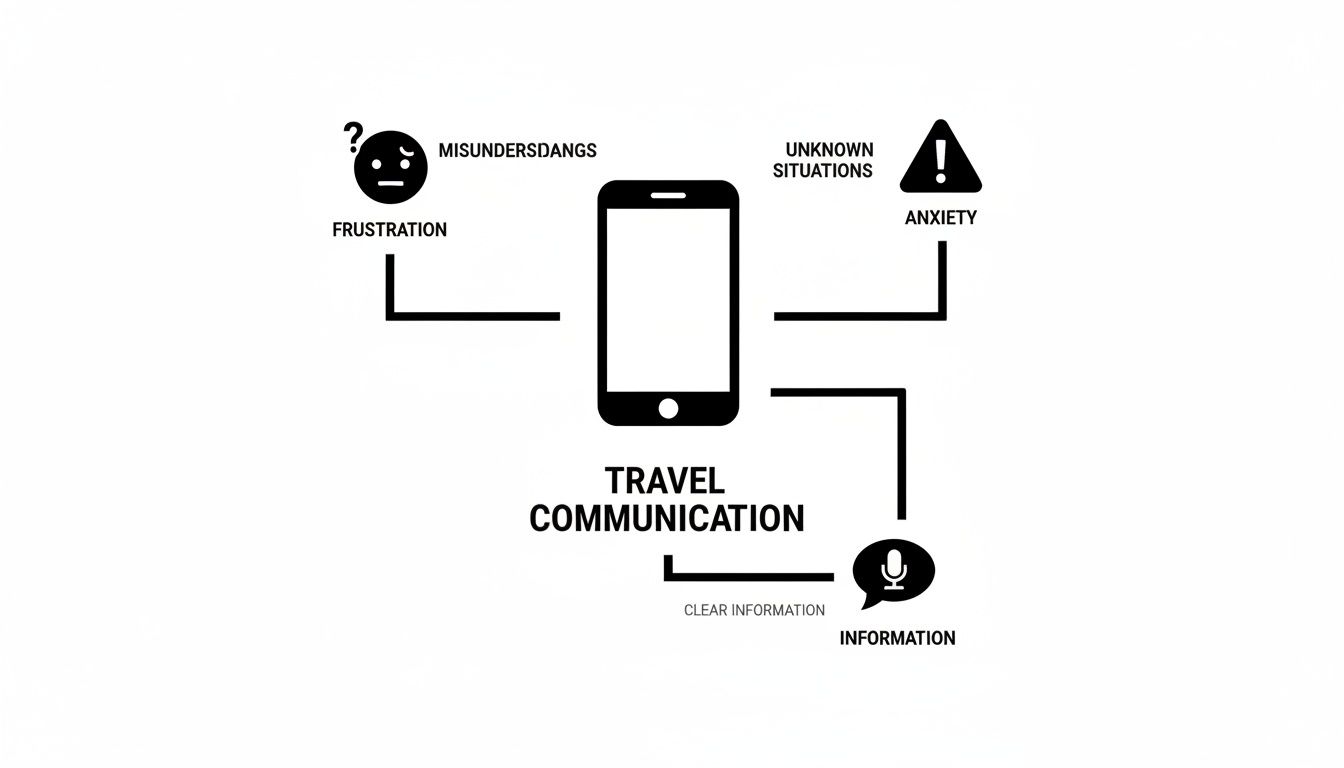
By providing an immediate fix, the right app turns moments of potential frustration and anxiety into confident, clear communication. If you want to get into the nuts and bolts of it, we have a whole guide on what makes a great live voice translation app.
2. Broad Language Support
This one seems obvious, but the devil is in the details. The number and variety of languages an app supports is critical. An app might be fantastic for Spanish, but what happens if your trip includes a detour to Hungary or Vietnam?
Look for a wide selection that includes less common languages. Just as important, check that your target languages are supported across all features—voice, text, and camera translation.
3. Unfailing Offline Functionality
Let’s be real: you can’t count on having Wi-Fi everywhere you go. You could be hiking in the mountains, navigating a subway system, or just visiting a country where data plans are ridiculously expensive. An offline mode is your safety net.
Think of offline functionality as the digital version of a trusty paper map. When your connection vanishes, it’s the one thing you can rely on to guide you. An app without a solid offline mode is a fair-weather friend—great when things are easy, but gone when you actually need help.
A good app will let you download entire language packs to your phone before you even leave home. This ensures you can still get directions, read a menu, or ask for help, no matter what your signal bars say.
To help you keep track, here's a quick rundown of what we've covered so far and what's coming up.
Essential Features in a Travel Translation App at a Glance
This table breaks down the key features you should look for and explains why each one can make or break your travel experience.
| Feature | Why It's a Game-Changer for Travelers |
|---|---|
| Real-Time Voice Translation | Keeps conversations flowing naturally, like having a personal interpreter for spontaneous chats. |
| Broad Language Support | Ensures you're covered no matter where your travels take you, from major cities to off-the-beaten-path destinations. |
| Offline Functionality | Your safety net when Wi-Fi is spotty or non-existent. It’s the difference between being lost and finding your way. |
| Device & Earbud Compatibility | Lets you use the gear you already own for private, hands-free conversations without buying special hardware. |
| Privacy & Data Security | Protects your personal conversations, ensuring what you say at a pharmacy or bank stays confidential. |
| Efficient Battery & Data Use | A marathon runner, not a sprinter. It works all day without killing your phone's battery or eating up your expensive mobile data. |
These features are the building blocks of a truly useful travel companion. Now, let's finish the list.
4. Universal Device and Earbud Compatibility
The best tech works with the gear you already have. A great travel translation app shouldn't force you into buying pricey, specialized hardware. It should connect seamlessly with your smartphone and whatever standard Bluetooth earbuds you prefer.
This flexibility is huge. It means you can have a private, hands-free conversation without fumbling with your phone or drawing a crowd. Just pop in your earbuds and chat away.
5. Robust Privacy and Data Security
When you're translating a personal conversation—like discussing a health issue at a pharmacy—you need to know your data is safe. Look for apps that are upfront and clear about their privacy policies.
On-device translation is a massive plus here, as it means your conversation isn't being beamed to a server somewhere. Always take a minute to review an app's permissions and data practices before you download.
6. Efficient Battery and Data Consumption
Finally, a travel app needs to be a marathon runner, not a sprinter. It has to work efficiently without sucking your phone’s battery dry or burning through your mobile data. An app that kills your phone by noon is more of a liability than a help.
Look for apps optimized for low power consumption, especially for features like continuous voice translation. A well-designed app helps you communicate all day without sending you on a desperate hunt for a power outlet.
Putting It to the Test: Real-World Travel Scenarios
Features and checklists are great, but the true test of a top-tier translation app is how it performs when you’re actually out there in the world. Abstract benefits don’t mean a whole lot when you’re lost, hungry, or trying to navigate a tricky situation. It's time to move from theory to reality and see how the right technology turns challenging travel moments into memorable successes.
These stories show how a powerful app in your pocket can be the difference between a travel disaster and a delightful discovery. We'll follow three very different travelers to see how they handle common—yet tricky—situations with a reliable translation tool.

The Culinary Explorer in Hanoi
Meet Alex, a foodie on an adventure through the vibrant street food stalls of Hanoi, Vietnam. The smells of grilling meat and fresh herbs are intoxicating, but Alex has a severe nut allergy, turning every meal into a potential minefield. He spots a bustling stall famous for its bún chả.
This isn't a time for pointing and gesturing; a simple misunderstanding could have serious consequences. Alex pulls out his phone, opens his translation app, and fires up the real-time voice feature. He speaks clearly in English: "I have a very serious nut allergy. Is there any peanut oil or nuts in this dish?"
The app instantly translates his words into fluent Vietnamese for the vendor. She listens, shakes her head, and replies in her own language, explaining that she uses a different oil and the dish is completely nut-free. The app translates her response back to Alex in seconds. With that clear, direct confirmation, Alex confidently orders his meal and enjoys one of the best dishes of his trip, completely worry-free.
This scenario hammers home the need for dead-on accuracy. When it comes to health and safety, "close enough" is a recipe for disaster. Precise voice translation ensures your most important messages are understood perfectly, giving you peace of mind.
The Spontaneous Adventurer in the Swiss Alps
Next up is Maya, an avid hiker who loves getting off the beaten path. While exploring a remote trail in the Swiss Alps, she takes a wrong turn. As the clouds roll in, she realizes her phone has no signal, rendering her GPS useless. A little bit of panic starts to creep in.
Just then, another hiker appears from the opposite direction. Maya doesn't speak a word of German, and the hiker doesn’t speak English. This is where her prep work pays off. Before her trip, she downloaded the German language pack for offline use.
Maya opens her app's offline mode, speaking into her phone to ask for directions back to the main trail. The app translates her question without needing an internet connection. The local hiker understands immediately, smiles, and gives her clear, simple directions in German, which the app translates right back for Maya. What could have become a dangerous ordeal is resolved with a friendly, two-minute conversation.
The Family Vacationer in Rome
Finally, let's join the Miller family on their trip to Rome. They're trying to book a last-minute guided tour of the Colosseum, but the only guide available is a local who speaks very little English. The dad, Tom, needs to sort out the time, meeting point, and price for his family of four.
Instead of shouting and playing charades in a crowded piazza, Tom uses an app that works with his everyday Bluetooth earbuds. He pops one in and starts a two-way dialogue with the guide.
Tom speaks in English, and the guide hears the Italian translation directly through Tom's phone speaker. The guide then replies in Italian, and Tom hears the English translation privately in his earbud. The conversation flows smoothly and discreetly—it’s incredibly efficient. They lock in all the details in under five minutes, turning a logistical headache into a seamless booking.
These stories show that the best translation app for travel isn't just a dictionary; it's a problem-solver, a safety tool, and a bridge to real human connection.
Our Top Pick: An App That Checks All the Boxes
So, after breaking down what makes a translation app truly useful for travel, the big question is: which app actually delivers on these critical features? You need a tool built for the messy, unpredictable, and wonderful moments you find on the road. This section highlights a top contender that rises to the challenge.
Meet Translate AI: The Smart Choice for Modern Travelers
Translate AI was designed from the ground up to solve the real communication problems travelers run into. It’s not just another dictionary app—it’s a smart communication partner that delivers on the critical features we’ve been talking about, making sure you’re ready for any conversation, anywhere. Let’s see how it stacks up.
Experience Truly Natural Conversations
The single most important thing a traveler needs is to have a smooth, real-time conversation. Clunky, delayed translations create those awkward pauses that just kill the vibe. Translate AI’s advanced engine is built for speed, delivering highly accurate, natural-sounding voice translations in an instant.
That means you can ask a question and get an answer without that frustrating lag. The app is smart enough to pick up on the nuances of how people actually talk, allowing for the kind of fluid dialogue you need when you’re haggling at a market or getting detailed directions from a local.
This focus on real-time isn't just a nice-to-have; it's what modern travelers expect. In fact, on-the-go translation is the fastest-growing part of the language software industry. The whole market was valued at USD 10.1 billion in 2023 and is expected to hit USD 16.2 billion by 2032, but it’s these instant, conversational features that are driving the growth. You can dig into the numbers yourself and check out the full language translation software market analysis.
Global Coverage and Unmatched Compatibility
A great travel app needs to be ready for wherever your adventures take you. With support for over 80 languages, Translate AI has you covered, whether you’re wandering the streets of Paris or hiking through Peru. That kind of broad language support means you’re never left stranded.
But Translate AI’s real game-changer is its universal compatibility. It works seamlessly with any Bluetooth earbuds or earphones you already own. There’s no need to shell out hundreds for specialized, single-purpose hardware.
This is huge for a few reasons:
- It saves you money: You can use the AirPods, Galaxy Buds, or whatever other earbuds you already have and love.
- It’s way more convenient: You don’t have to pack—or worry about losing—another expensive gadget.
- It lets you have private conversations: You can have a discreet, hands-free chat without holding your phone up or putting your conversation on speaker for everyone to hear.
This simple but powerful approach makes Translate AI one of the most practical and user-friendly options out there. It just works with the tech you already have, which you can learn more about on the Translate AI website.
Putting It All Together for the Traveler
By focusing on what travelers actually need, Translate AI gives you a tough, reliable tool that just works. It combines the must-have features into one simple package:
- Accurate Real-Time Voice: For conversations that finally feel natural.
- Broad Language Support: So you’re prepared for any destination.
- Universal Earbud Compatibility: For private, easy chats using your own gear.
When you’re looking for the best translation app for travel, the goal is to find something that makes you feel confident, not a tool that adds another layer of stress to your trip. Translate AI is designed to do just that, turning potential language barriers into genuine connections.
Download Translate AI and Travel with Confidence
Ready to break down language barriers on your next trip? Experience seamless, real-time conversations with Translate AI. You can download it now from the App Store and start speaking the world's languages like you've been doing it for years.
Pro Tips for Using Your Translation App Like a Local
Having the best translation app for travel is a fantastic start, but how you use it makes all the difference between a clunky interaction and a genuine connection. Technology is a powerful bridge, but it works best when you pair it with a bit of human touch and smart prep.
These tips will help you communicate smoothly and respectfully. You'll feel less like a tourist fumbling with a gadget and more like a confident world traveler.
Prepare Before You Depart
A little bit of prep work before your plane even takes off can save you a world of stress later. Don't wait until you're lost and without Wi-Fi to figure out your app.
- Download Offline Languages: This one is non-negotiable. Pinpoint the languages for your destinations and download the full offline packs. This ensures you can translate menus, ask for directions, or handle an emergency even when you have zero bars.
- Test Everything: Do a quick test run at home. Get comfortable with the voice, text, and camera features so you know where everything is. Make sure your microphone and camera permissions are already enabled so you’re ready to go from day one.
Speak for Maximum Clarity
AI translators are incredibly smart, but they can't read minds. The quality of the translation you get depends entirely on the quality of the words you feed it. As the old saying goes: garbage in, garbage out.
To get the most accurate results, speak in simple, clear sentences. Avoid using complex slang, regional idioms, or long, rambling thoughts. Instead of saying, "I was wonderin' if y'all could point me to a spot where I can grab a bite to eat," try a more direct approach: "Where is a good restaurant near here?"
This straightforward phrasing gives the AI the best possible chance to deliver a perfect translation.
Remember, the goal is clear communication, not winning a poetry contest. Simplicity is your best friend when talking to a machine, which in turn helps you connect better with a person.
This shift toward app-based solutions is a massive global trend. Travelers and expats are ditching older, single-purpose devices for versatile AI apps that run on the phones they already have. The market for standalone language translation devices is projected to grow from USD 1.65 billion in 2025 to USD 4.02 billion by 2034.
But software like Translate AI is leading the charge by integrating with the earbuds people already own and love. This trend is especially strong in the US, where the market is expected to jump from USD 470 million to USD 1.17 billion by 2034, driven by 85 million annual tourists needing instant voice translation. You can discover more insights about this growing market here.
Look Beyond the Screen
Your app is a tool, not a replacement for basic human interaction. It's easy to get so focused on the screen that you forget there’s a person standing right in front of you.
Combine your tech with these timeless social cues to build a real connection:
- Make Eye Contact: Look at the person you're speaking with, not just at your phone. A friendly smile goes a long way in any language.
- Use Positive Gestures: A simple nod or a thumbs-up can reinforce understanding and show you appreciate their help.
- Be Patient: Give the other person time to listen to the translation and formulate a response. Rushing the conversation only creates pressure and confusion.
By blending these small acts of courtesy with powerful technology, you transform a simple transaction into a positive human experience. It shows respect and a genuine desire to connect, which locals will always appreciate.
Ready to Talk to the World?
Picking the right translation app isn't just about downloading a tool; it's about finding a travel partner that genuinely has your back. It’s tempting to get swayed by flashy features, but what really matters on the ground is reliable voice translation, solid offline access, and knowing it will work with the phone and earbuds you already own.
We started this guide talking about that all-too-common traveler's anxiety—that sinking feeling when you can't read a sign, order a meal, or ask for help. A simple communication gap can quickly turn a dream trip into a stressful mess.
From Lost in Translation to Finding a Connection
Now you know exactly what to look for. You've got a clear roadmap to sift through the options and find an app built for the real world, not just a quiet office demo.
A great translation app doesn't just help people understand your words. It gives you the confidence to navigate any situation and sparks those small, human connections that make a place unforgettable. That's the real goal.
This is exactly what tools like Translate AI are built for—bridging that gap with the essential features that make your smartphone a powerful and reliable interpreter.
Your Next Adventure is Calling
With the right app in your pocket, a language you don’t speak is no longer a barrier. It’s an invitation. An opportunity to engage with people, share a laugh, and learn something new.
You’re now equipped to choose a tool that does more than just swap words. It helps you create memories. Your next adventure is out there, and this time, you'll be ready to speak its language.
Still Have Questions? Let's Clear a Few Things Up.
Even after you've narrowed down your options, a few last-minute questions always pop up. It's totally normal. Here are some of the most common ones we hear from travelers, with some straightforward advice to help you feel ready for your trip.
Is an Offline Mode Really That Important?
In a word: yes. It’s so easy to assume you’ll find Wi-Fi or have a solid data connection, but travel is full of surprises. One minute you're fine, the next you're on a subway between stations, hiking a trail with zero bars, or in a country where data costs a small fortune.
Think of an offline mode as your safety net. It’s what ensures you can still ask for directions when you’re lost, figure out a menu in a tiny cafe, or communicate in an emergency, no matter what. Honestly, for the peace of mind alone, I'd consider it a non-negotiable feature.
So, How Is an AI Translator Different From a Dictionary App?
Great question. A simple dictionary app is basically a digital phrasebook. It's great for looking up a single word or a pre-programmed, basic sentence. An AI translator, though, is much more like having a real, live interpreter in your pocket.
Here’s where they really differ:
- Context is King: AI is smart enough to understand the situation. It knows the difference between asking to "book" a table and wanting to read a "book."
- Real Dialogue: AI translators are built for actual conversations. They handle the natural back-and-forth of a chat, whereas a dictionary is just a one-way lookup tool.
- Better Accuracy: A good AI delivers translations that sound way more natural. You avoid the clunky, literal translations that often come from basic dictionary apps.
So, while a dictionary tells you what a word means, an AI translator helps you have a conversation.
Won't It Be Awkward to Use a Translation App with Locals?
It doesn't have to be! The trick is to use the app as a bridge to connect with someone, not as a wall between you. A little human touch goes a long, long way here.
Just start with a smile and make eye contact first. You can even point to your phone with a simple gesture to signal you'd like to use it to chat. Most people are incredibly receptive and will appreciate that you're making an effort to communicate in their language. Be friendly, be patient, and you'll find it works beautifully.
Can I Use My Own Earbuds with an App Like Translate AI?
Absolutely, and this is one of the biggest advantages of a modern app-based approach. With a tool like Translate AI, you can pair it with the Bluetooth earbuds you already own and love—whether they’re AirPods, Galaxy Buds, or any other brand.
This setup saves you from dropping a few hundred dollars on specialized hardware you might only use for one trip. Plus, using your own earbuds makes conversations feel much more private and natural. It’s a lot more discreet than holding a phone up between you and the person you’re talking to.
Ready to travel with the confidence that you can communicate anywhere, with anyone? Translate AI is designed to make global conversations effortless. Download it from the App Store and turn your smartphone into your personal interpreter.