

Ser or Estar: The Only Guide You'll Ever Need
Struggling with ser or estar? You’re not alone. If you've ever found yourself pausing mid-sentence, wondering which verb to use, you've hit the most common roadblock for Spanish learners. The core difference seems simple: ser is for permanent traits, and estar is for temporary states. But when you're in a real conversation, that distinction can feel incredibly blurry.
The good news is, you can master this. This guide is designed to give you a clear, actionable framework to choose the right verb with confidence. By the end of this article, you'll have the mental shortcuts and practice techniques to make the choice between ser and estar feel intuitive, not intimidating.
Your Quick Guide to Ser vs Estar
For most people learning Spanish, nailing the difference between ser and estar feels like a rite ofpassage. In English, we get by with just one verb, "to be," for everything from describing our personality to saying where we are. Spanish, however, makes you pause and think: are you talking about something permanent or something temporary? That choice completely changes the meaning of your sentence.
This isn't some obscure grammar rule you can ignore; it’s woven into nearly every conversation. With around 500 million Spanish speakers in the world, getting this right is your ticket to clear communication. It’s a well-known hurdle for learners, with some studies showing that up to 73% of English speakers find it tricky to get these verbs right in their first year. You can find some great discussions on this common challenge over at migaku.com.
The Fundamental Difference
At its heart, the choice between ser and estar boils down to a single question: Are you describing the very nature of something, or just its current state?
- Ser is for inherent qualities that define a person or object. This covers things like characteristics, origin, occupation, and telling time.
- Estar is for conditions that can change. This includes location, emotions, physical states, and actions in progress.
A simple rhyme to get you started is: "How you feel and where you are, that is when you use estar." For everything else that defines what something is, you'll most likely need ser.
This decision tree gives you a great visual for making that core choice between essence (ser) and state (estar).
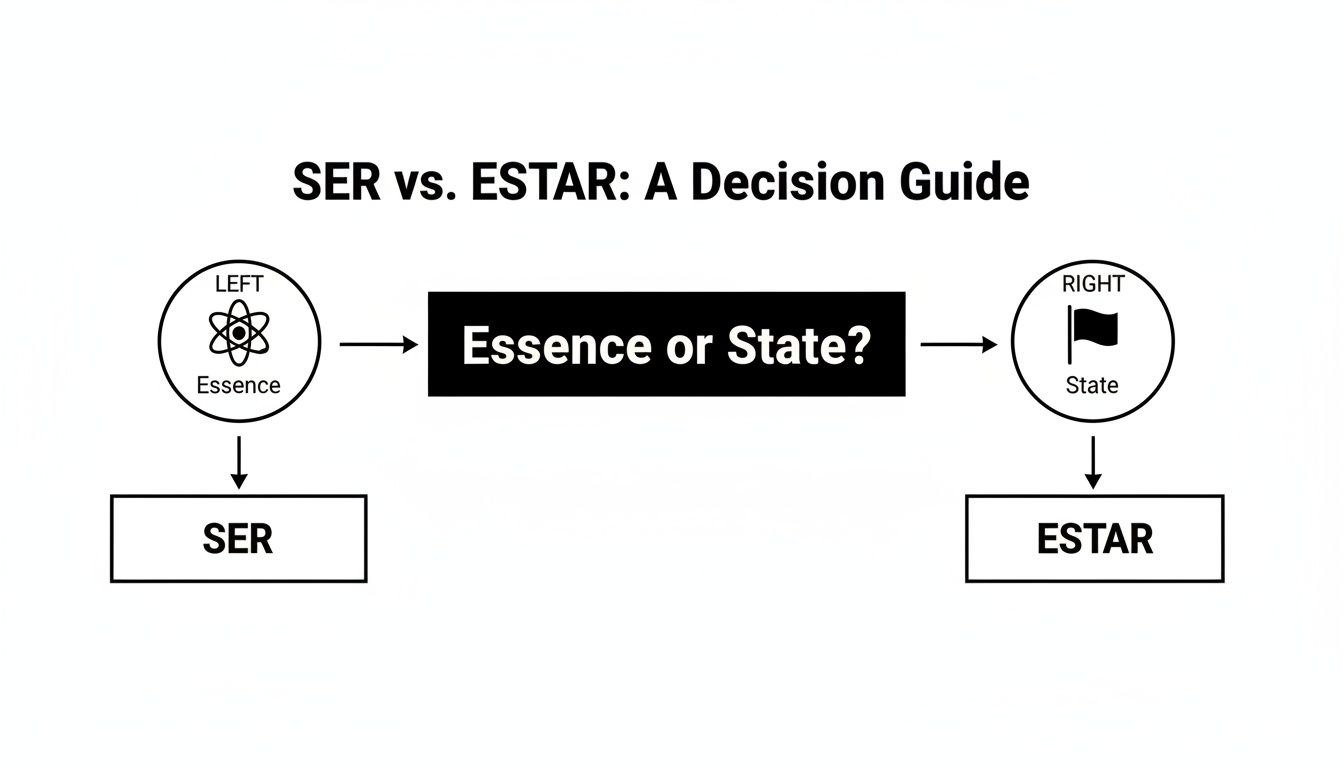
As you can see, asking "Is it essence or state?" is the first step. That one question will guide you to the right verb in most situations you'll encounter.
To make this even more concrete, here's a quick table breaking down the core functions of each verb. It's a handy cheat sheet for making the right call.
Ser vs Estar Core Differences at a Glance
| Usage Category | Ser (Permanent Essence) | Estar (Temporary State) |
|---|---|---|
| Description | Yo soy alto. (I am tall - an inherent characteristic) | Yo estoy cansado. (I am tired - a temporary condition) |
| Occupation | Ella es doctora. (She is a doctor - her profession) | Él está de camarero. (He is working as a waiter - temporary) |
| Origin/Nationality | Somos de Canadá. (We are from Canada) | Estamos en Canadá. (We are in Canada - our current location) |
| Time/Date | Son las tres. (It is three o'clock) | Estamos a martes. (It is Tuesday - emphasizing the current day) |
| Relationships | Él es mi hermano. (He is my brother) | Ella está casada. (She is married - a marital state) |
| Location | La fiesta es en mi casa. (The party is at my house - location of an event) | El libro está en la mesa. (The book is on the table - physical location of an object) |
Keep this table handy as you practice. You'll notice some interesting nuances, like how ser is used for the location of an event, but estar is used for the location of a person or object. We'll dive into those details next.
Mastering Ser: The Verb of Permanent Identity
To really get a handle on the whole ser vs. estar puzzle, we have to start with a solid foundation in ser. Think of ser as the verb that defines the permanent identity of a person, place, or thing. It describes the unchanging essence—the fundamental qualities that make something what it is.
When you use ser, you’re making a statement about an inherent characteristic. It’s not about how something feels or where it happens to be at the moment; it's about what it is at its very core. This isn’t a new concept, either. Grammarians have been trying to pin down this distinction for centuries, with the first major systemization dating all the way back to 1847 by the influential Andrés Bello. You can find more on the history and some of the funny mistakes learners make over at spanish.academy.
The DOCTOR Framework for Ser
To keep things straight, there’s a handy little mnemonic that Spanish learners have been using for ages: DOCTOR. Each letter stands for a category where ser is the only right choice. Let's walk through it.
-
Description: This covers the essential qualities that define something, like physical appearance or personality. For example, “Ella es alta y simpática” (She is tall and nice). These traits are considered a core part of who she is.
-
Occupation: A person's job or profession is seen as a key part of their identity, even if they end up changing careers down the road. You’d say, “Mi padre es ingeniero” (My father is an engineer).
-
Characteristic: This is pretty similar to description, but it’s more about the defining features that answer the question, "What is it like?" Think of “El coche es rojo y rápido” (The car is red and fast).
The key takeaway with ser is permanence. If you’re describing a quality that is an expected, long-term, or defining feature, ser is almost always your verb. It sets the baseline identity for whatever you're talking about.
Time, Origin, and Relationships
Finishing up the DOCTOR acronym, the last three letters help lock in ser's role in defining the fixed, objective facts of the world. These categories are less about personality and more about the unchangeable details.
-
Time: When you're telling time or stating the day or date, you always use ser. These are considered established facts. For instance, “Son las cinco de la tarde” (It is five in the afternoon) or “Hoy es martes” (Today is Tuesday).
-
Origin: This covers where someone is from (their nationality) or what something is made of (its material). Both are seen as fixed attributes. You’d say, “Mi amigo es de Colombia” (My friend is from Colombia) or “La mesa es de madera” (The table is made of wood).
-
Relationship: Family ties and other personal relationships also use ser. For example, “Ellos son mis hermanos” (They are my brothers).
By committing the DOCTOR mnemonic to memory, you give yourself a powerful mental checklist. The next time you're stuck between ser and estar, just ask yourself if you’re describing a core, defining trait. If it fits into one of these six categories, you can use ser with confidence.
Understanding Estar: The Verb of Temporary States

If ser carves out the permanent, unchangeable identity of something, then estar is all about the here and now. Think of it as painting a picture of the present moment—it’s the verb you’ll grab to talk about temporary states, conditions, and locations.
While ser is the foundation, estar is the snapshot of what’s happening right now. Getting this right is a huge step in sounding natural. Picking the wrong verb can completely warp your meaning, turning a simple observation into something that just sounds… off.
To nail the ser or estar choice, you need a solid framework for estar, just like we had for ser. And that's where a handy little mnemonic comes into play: PLACE.
The PLACE Framework for Estar
Just as DOCTOR is your cheat sheet for ser, the PLACE acronym is your go-to guide for estar. Each letter flags a specific scenario where estar is the only verb that works.
-
Position: This is all about the physical posture or position of a person or thing. It’s a temporary state that can (and will) change. For example, “El gato está dormido en el sofá” (The cat is asleep on the sofa).
-
Location: One of the most common uses, hands down. Estar tells you where someone or something is physically located at a specific moment. You’d say, “Nosotros estamos en el parque” (We are at the park).
-
Action: This is for the present progressive tense, which describes something happening right now. You form it with estar + a gerund (the -ando/-iendo form). For instance, “Yo estoy escribiendo un correo” (I am writing an email).
Think of estar as the "right now" verb. If you're describing where something is, how it feels, or what it's doing at this very moment, your instinct should point directly to estar.
Condition and Emotion
The last two letters of PLACE cover those internal and external states that are almost always temporary. These are absolutely essential for talking about feelings and physical well-being.
-
Condition: This describes the physical or mental state of something at a particular time. Think of things that can change, like being sick or tired. For example, “La puerta está abierta” (The door is open) or “Yo estoy enfermo hoy” (I am sick today).
-
Emotion: How you feel is a temporary state. Happiness, sadness, anger—these feelings come and go. Because of that, you always use estar to describe them, like in “Ellos están muy felices con la noticia” (They are very happy with the news).
Internalizing the PLACE framework gives you a reliable mental map for using estar. When you're in a conversation and that ser or estar question pops into your head, just ask yourself: am I talking about a Position, Location, Action, Condition, or Emotion? If the answer is yes, you can choose estar with confidence.
Instantly Check Your Understanding with Translate AI
Sometimes the best way to make these rules stick is to test them in real time. Hearing how a native speaker would phrase something gives you that immediate, practical feedback that textbooks just can't match. A killer way to do this is with an app like Translate AI. You can say a sentence in English like "The soup is hot" and see if it translates to “La sopa está caliente,” confirming that a temporary condition needs estar. This kind of instant feedback loop is incredibly powerful for turning abstract grammar rules into intuitive speaking habits.
How Adjectives Change Meaning with Ser and Estar

This is where Spanish gets really interesting. Once you move past the basic "permanent vs. temporary" rules, you discover how certain adjectives completely flip their meaning depending on whether you use ser or estar. Getting these right is a huge step toward sounding like a native speaker and avoiding some seriously awkward mix-ups.
Choosing the wrong verb can easily turn a compliment into an insult or make your description totally nonsensical. This isn’t just a minor grammar point; it's fundamental to communicating with nuance and clarity. In fact, this is one of the biggest reasons the ser vs. estar puzzle trips up so many learners.
A 2023 survey found that confusion between ser and estar is behind roughly 31% of all grammatical errors made by intermediate Spanish learners. That makes it the single most common mistake for non-native speakers, which tells you just how important it is to master. You can get more details on common language learning hurdles in the full report on mastering Spanish verbs.
Key Adjectives with Dual Meanings
Let's break down some of the most common adjectives that transform with ser vs. estar. The core logic stays the same: ser points to an inherent quality, while estar describes a current state or condition.
1. Listo/Lista (Smart vs. Ready)
Using ser with listo describes someone's intelligence—a core personality trait. But if you use estar, you're just saying they are prepared for something right now.
- Ser listo: Mi hermana es muy lista. (My sister is very smart.)
- Estar listo: ¿Estás listo para salir? (Are you ready to leave?)
2. Aburrido/Aburrida (Boring vs. Bored)
This is a classic. Mix these up, and you might find yourself in an embarrassing situation. Calling someone a boring person is a world away from saying they are simply feeling bored.
- Ser aburrido: La película es muy aburrida. (The movie is very boring.)
- Estar aburrido: Yo estoy aburrido en casa. (I am bored at home.)
The core principle never changes. Ask yourself: am I defining what someone or something is (a boring person), or am I describing how they are right now (feeling bored)? That question will always guide you to the correct verb.
3. Malo/Mala (Bad/Evil vs. Sick/Rotten)
Here, ser gets at a person's character or the fundamental quality of an object. In contrast, estar points to a temporary state of health or condition, like food that has gone bad.
- Ser malo: El villano de la historia es malo. (The villain of the story is evil.)
- Estar malo: El pescado está malo, no lo comas. (The fish is bad/rotten, don't eat it.) or El niño está malo hoy. (The boy is sick today.)
A Quick Reference Comparison Table
To help you see these shifts at a glance, here’s a table showing how some common adjectives change their meaning.
How Adjectives Change Meaning with Ser vs Estar
| Adjective | Meaning with Ser (Permanent Trait) | Meaning with Estar (Temporary State) |
|---|---|---|
| Bueno | To be a good person; high quality | To be attractive ("hot"); to taste good |
| Verde | To be the color green | To be unripe |
| Rico | To be rich (wealthy) | To be delicious (tasty) |
| Seguro | To be safe (not dangerous) | To be sure (certain) |
| Vivo | To be sharp or clever (a "live wire") | To be alive (not dead) |
This table is a fantastic tool to keep handy. Notice how ser consistently defines an inherent characteristic (the color green, a person's wealth), while estar describes a temporary or resultant state (an unripe banana, a delicious meal).
Practice Your Understanding with Translate AI
Memorizing a table is a solid start, but the real learning happens when you start applying these concepts yourself. A great way to test your gut feeling in a low-pressure environment is with a tool that gives you instant feedback. You can use the Translate AI app to build your own practice sentences. Try saying "He is boring" and see if the app gives you “Él es aburrido.” Then, try "He is bored" and check for “Él está aburrido.” This kind of immediate confirmation is what turns abstract rules into an intuitive skill.
Putting It All Together: Real-World Scenarios
Alright, theory is one thing, but using ser and estar in the middle of a fast-moving conversation? That's the real test. Let's move beyond the rules and acronyms and dive into the practical situations you’ll actually face as a traveler, professional, or language learner. This is where knowledge becomes a real skill.
When you're trying to find your way in a new city or talking with a client, you won't have time to mentally cycle through DOCTOR or PLACE. The goal is to make the right choice feel automatic. We'll walk through some common scenarios to show you how these verbs work in the wild.
Common Traveler Interactions
Imagine you've just landed in Madrid. From the airport to your hotel and out to dinner, you'll be using ser and estar constantly. Pay attention to how the verb you choose adds a specific, crucial layer of meaning.
1. At the Airport Asking for Directions
You need to find the train station. You're asking about its physical placement.
- You: Perdón, ¿dónde está la estación de tren? (Excuse me, where is the train station?)
- Response: Está al final de este pasillo. (It's at the end of this hallway.)
Here, está is the clear choice for location. You're asking for the physical spot where an object—the station—is located. This is a classic, must-know use of estar.
2. At a Restaurant Commenting on Food
You're having dinner and want to share your thoughts on the meal. Your choice of verb completely depends on what you want to say.
-
To describe the food's inherent quality: La paella es deliciosa. (The paella is delicious.)
- Using ser here describes the dish's fundamental character—it's just a high-quality, delicious recipe.
-
To describe the state of your specific plate right now: La sopa está un poco fría. (The soup is a little cold.)
- Here, estar describes its current, temporary condition. The soup isn't meant to be cold; it just happens to be cold at this moment.
The difference is subtle but powerful. Saying "La sopa es fría" would mean you're talking about a type of soup that is supposed to be served cold, like gazpacho. The verb you pick completely changes the context.
Professional and Social Settings
Now, let's see how ser and estar function in business meetings or social events. These interactions often revolve around identity, professional roles, and temporary conditions.
1. Introducing Yourself and Others
When you introduce yourself or state your profession, you’re defining who you are. This is core ser territory.
- You: Hola, soy Alex, el gerente de proyectos. (Hello, I'm Alex, the project manager.)
- Colleague: Mucho gusto. Ella es María, nuestra diseñadora. (Nice to meet you. She is Maria, our designer.)
In this context, your job (gerente) and your colleague's role (diseñadora) are treated as defining characteristics, not just temporary states.
2. Discussing a Project's Status
When you're talking about the progress of a project, you are describing its current condition, which is obviously subject to change. This calls for estar.
- Manager: ¿Cómo está el informe? (How is the report?)
- You: Está casi terminado. Solo necesito revisar los datos. (It's almost finished. I just need to review the data.)
The report’s state of completion is temporary, making estar the right choice. It’s also important to get the hang of common greetings that use estar. For a deeper look, check out our guide on what "como estas" means in English.
Practice with Translate AI
The best way to build that conversational muscle is to actually practice these scenarios. An app like Translate AI is perfect for this. You can run through real dialogues and get instant feedback on which verb you should have used. For example, set the app to translate from English to Spanish. Now, try saying these two sentences out loud:
- "The meeting is at my office." (The location of an event)
- "My office is on the third floor." (The location of an object)
The app will immediately show you “La reunión es en mi oficina” and “Mi oficina está en el tercer piso.” This kind of instant correction is exactly what helps lock in those subtle rules, like using ser for the location of events but estar for the location of objects. You can download Translate AI from the App Store to start practicing these real-world conversations today.
Putting Your Knowledge into Practice
Knowing the rules is one thing, but getting ser and estar right when you’re actually talking to someone? That’s a whole different ball game. True mastery comes from practice—getting to the point where you don’t even have to think about the rules anymore. You just feel which verb is right.
This only happens when you actively use the language. By building your own sentences, you start to internalize the difference between a permanent quality and a temporary state. All those grammar concepts, like the DOCTOR and PLACE mnemonics, shift from being abstract rules in your head to natural tools you can grab in a split second. It’s how you bridge the gap between knowing Spanish and actually speaking it.
Practice in Real Time with Translate AI
One of the fastest ways to sharpen your skills is with instant feedback. Modern tools let you check your understanding on the fly, which really speeds up the learning process. Getting that immediate confirmation is a huge help for making the core principles of ser and estar stick.
For example, an app like Translate AI can work like your own personal language coach. You can test yourself by coming up with your own sentences and seeing if you got it right.
Try this simple exercise: Say "She is a boring person" into the app, and you should see "Ella es aburrida." Then, say "She is bored," and the app should give you "Ella está aburrida."
This kind of hands-on practice is what locks in the nuances. Whether you’re a traveler getting ready for a trip or a professional who needs to communicate clearly, this method will help you use ser and estar like a pro. For more tips on building your vocabulary, you can also check out our guide on how to say any phrase in Spanish.
This is what builds that crucial muscle memory, helping you pick the right verb without hesitation when it counts.
Common Questions About Ser and Estar
Even after you've memorized the rules and the clever mnemonics, certain situations with ser and estar can still trip you up. Let's walk through some of the most common sticking points for Spanish learners. Getting these cleared up will give you the confidence to handle those tricky edge cases when they pop up in a real conversation.
Why Is It Wrong to Use Estar for a Job?
This is a classic. A job feels temporary, right? People change careers. But in Spanish, a profession is seen as a core part of someone's identity—who they are in a social and professional sense right now. It's not just a temporary condition.
Because of this, you always have to use ser. You would say, “Ella es abogada” (She is a lawyer). Using estar here would sound bizarre, suggesting that being a lawyer is some fleeting mood or state, which just doesn't work in Spanish.
What About Death? Is It Ser or Estar?
Here's an exception that confuses just about everyone. Death is obviously permanent, so it feels like it should be ser. And yet, Spanish uses estar.
You always say, “El perro está muerto” (The dog is dead). The logic here is that death is viewed as the result of a change—a transition from being alive to not being alive. It’s treated as a resulting state or condition, not an inherent characteristic, which is why estar is the right choice.
This idea of a "resulting state" is a key concept to grasp. Think of a closed door: la puerta está cerrada. The door isn't inherently a "closed thing"; its state is the result of someone closing it. Spanish treats death in a similar way.
How Do I Remember the Rules in a Conversation?
The honest answer? Don't try to mentally flip through a grammar textbook while you're trying to speak. You'll just freeze up.
Start with the most basic distinction: use ser for what something is (its identity and core traits) and estar for how or where it is (its condition and location). In the heat of the moment, that simple rule will serve you well.
The DOCTOR and PLACE acronyms are your best friends for practice, not for real-time recall. The more you speak, listen, and force yourself to form sentences, the more the choice will become second nature. Eventually, you'll develop a "feel" for which verb just sounds right.
Are There Regional Differences in Using Ser or Estar?
Yes, but they're not as dramatic as you might think. While the core rules are the same across the Spanish-speaking world, you'll hear minor local variations. For example, in some regions, you might hear someone use ser casado for marital status instead of the more standard estar casado.
These are subtle nuances, though, not game-changing rules. As a learner, your best bet is to stick to the standard DOCTOR and PLACE rules. That will ensure you’re understood everywhere, from Madrid to Mexico City. As your Spanish gets more advanced, you’ll start picking up on these regional quirks naturally. And for other grammar fundamentals, check out our deep dive on the future simple tense in Spanish.
With consistent practice and a clear understanding of these common questions, you'll be well on your way to mastering the ser or estar distinction. For real-time practice and instant feedback, give Translate AI a try. You can test your sentences and build conversational confidence by checking your verb choices on the fly. Download Translate AI from the App Store and start speaking Spanish more accurately today.