

What Does Como Estas Mean in English? (And How to Respond Naturally)
Ever heard the phrase "¿Cómo estás?" and felt a flicker of uncertainty? You probably know it means "How are you?", but you also know there's more to it. You don't want to just translate the words; you want to connect with people, avoid awkward silences, and respond with confidence—whether you're ordering coffee in Madrid or meeting a new colleague from Mexico.
That's the real challenge, isn't it? Moving from a textbook phrase to a real, smooth conversation.
Your goal is simple: to understand this essential greeting so well that you can use it and respond to it without a second thought. This guide will get you there. Forget rote memorization. We're focusing on practical, actionable advice you can use today.
Here's what you'll master in the next few minutes:
- The direct meaning and how to nail the pronunciation.
- When to use formal vs. informal greetings (a crucial difference!).
- Go-to replies to sound natural and keep the conversation flowing.
- Real-world examples to see how it all works in practice.
This phrase is a cornerstone of Spanish. It’s so fundamental, in fact, that around 85-90% of Spanish courses introduce it in the very first week. And for travelers, it pays off. Tourism boards in Spain report that about 78% of first-time visitors try using this greeting, making it a powerful way to connect. You can discover more about these essential Spanish lessons and how they bridge cultural gaps.
Let's dive in.
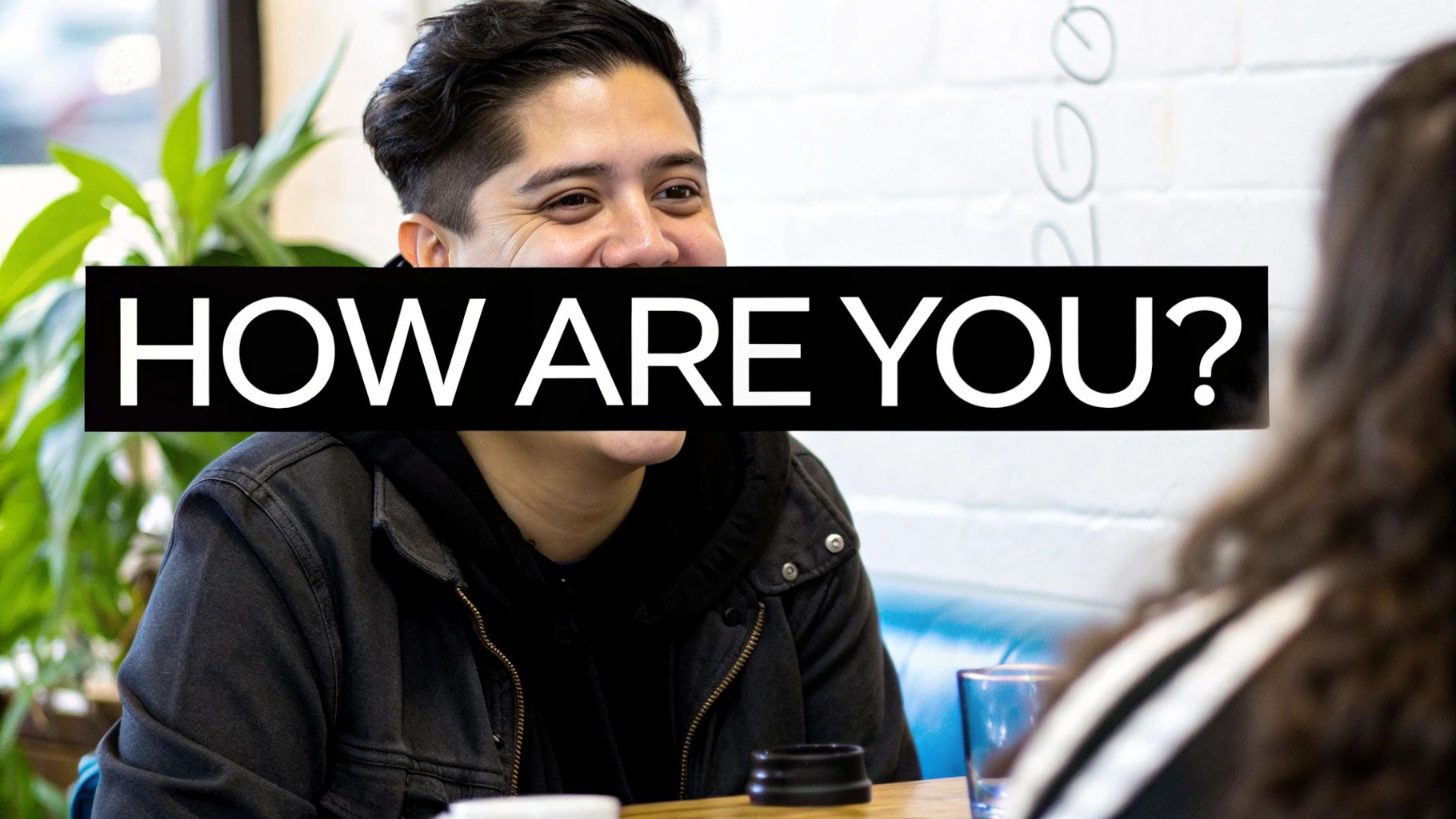
To get us started, here’s a quick snapshot of everything you need to know about the phrase.
Como Estas at a Glance
| Aspect | Explanation |
|---|---|
| Literal Meaning | "How are you?" |
| Common Usage | The most frequent informal greeting used with friends, family, and peers. |
| Formality | Informal (uses the tú form). |
| Pronunciation | KOH-moh ess-TAHS (stress on the final syllable). |
| Formal Version | ¿Cómo está? (used with usted). |
Think of this table as your cheat sheet. We'll explore each of these points in more detail next.
Understanding the Social Context of Como Estas
On the surface, "what does como estas mean in english" has a simple answer: "How are you?" But relying on the literal translation is a classic rookie mistake. The real meaning is all about reading the room.
Think of it less like a question and more like a social handshake. It can be a genuine inquiry, or it can be a simple acknowledgment, and knowing the difference is key to sounding natural.
In many casual situations—say, with a barista, a store clerk, or a coworker you pass in the hall—"¿Cómo estás?" is the Spanish equivalent of "What's up?" or "How's it going?" The expected reply is something short and sweet, like “Bien, ¿y tú?” (Good, and you?). Launching into a detailed story about your terrible morning would be just as out of place as it would be in English.
Actionable Advice: Reading the Room
Here’s where the magic happens. With a close friend or family member, those same two words can be a sincere invitation to open up. The context, your relationship, and the speaker’s tone of voice tell you everything you need to know.
The key is recognizing that "¿Cómo estás?" can be either a simple pleasantry or a sincere inquiry. Your ability to distinguish between the two is a major step toward cultural fluency and sounding less like a tourist.
This social dynamic is common in many languages. For a deeper look into similar nuances, you can explore our guide on understanding a common phrase in Spanish and its cultural weight.
Getting this right helps you steer clear of two common traveler missteps:
- Giving a TMI (Too Much Information) response in a purely casual setting.
- Giving a cold, brief answer when a friend is genuinely asking how you feel.
Learning to navigate these subtle differences is what helps you build real, natural connections. It’s about understanding the unspoken rules that turn a simple greeting into a meaningful conversation.
Choosing Between Formal and Informal Greetings
One of the fastest ways to show you get the culture in Spanish-speaking countries is knowing the difference between formal and informal greetings. It's a classic trip-up for language learners, but getting it right leaves a fantastic first impression. Spanish has different pronouns for formal (usted) and informal (tú) situations, and that changes how you ask, "How are you?"
The phrase this article is all about, "¿Cómo estás?", is the informal one linked directly to tú. You’ll want to use it when you're talking with friends, family, people your age, or anyone younger than you. It creates a feeling of warmth and casual connection. Just think of it as your go-to for most everyday social chats.
Actionable Advice: When to Use the Formal ¿Cómo Está Usted?
On the flip side, the formal version, "¿Cómo está usted?", is your best bet in more buttoned-up situations. Pull this polite form out when you're talking to:
- Elders or your partner's grandparents.
- New business clients or your boss at work.
- Anyone in a position of authority, like a police officer or an official.
- Someone you've just met in a professional setting.
This is a huge deal in the business world. Some research on business communication suggests that 62% of international business conflicts in Spanish-speaking markets come from simple misunderstandings over formality. Nailing the formal address can even help increase deal closure rates by an average of 18%. If you're looking for more tips on handling professional conversations, our guide on how to ask "what do you mean in Spanish" is a great next step.
To make this crystal clear, here’s a quick cheat sheet to help you decide which phrase to use on the fly.
Choosing Your Greeting: A Simple Guide
| Situation | Informal (¿Cómo estás?) | Formal (¿Cómo está usted?) |
|---|---|---|
| Chatting with a Friend | Yes, this is perfect. | No, it would sound strange and distant. |
| Meeting a Client for the First Time | No, this is too casual. | Yes, always start formal. |
| Greeting an Elderly Stranger | No, it's considered disrespectful. | Yes, this shows proper respect. |
| Talking to a Barista Your Age | Yes, this is friendly and normal. | It's okay, but might feel a bit stiff. |
| Addressing Your Boss | Usually no, unless you have a very casual relationship. | Yes, this is the safest and most professional choice. |
Ultimately, when in doubt, it’s always safer to start with the formal "¿Cómo está usted?". The other person will usually let you know if it's okay to switch to the more casual "tú" form.
This little decision tree gives you a simple way to think about how to reply based on who you're talking to.

As you can see, casual acquaintances are usually just looking for a quick "I'm good, you?" kind of response, while close friends might be ready for the real story.
How to Respond with Confidence
Knowing how to ask is only half the battle. Responding naturally is how you turn a simple greeting into a real conversation. Having a few go-to replies in your back pocket will make you feel much more prepared when someone asks how you are.
The most classic and versatile response is "Bien, gracias" (bee-EN, GRAH-see-ahs), which means "Good, thank you." This is your all-purpose, safe-for-any-situation reply. It’s polite, positive, and everyone understands it.
But if you want to sound a bit more like a local, it helps to have a few other options. Different situations call for different levels of enthusiasm, just like in English.
Actionable Advice: Common Spanish Responses
Here are some of the most useful phrases, ranging from positive to neutral, that you can use to answer like you’ve been doing it for years:
- Muy bien (MOO-ee bee-EN) – A simple way to add more positive energy. It means "Very good."
- Todo bien (TOE-doe bee-EN) – This translates to "All's good" and has a relaxed, casual feel. Perfect for informal chats.
- Más o menos (MAHS oh MEH-nohs) – Your go-to for an average day. It means "So-so" or "More or less."
- No me puedo quejar (no meh PWAY-doh kay-HAR) – A more nuanced reply meaning "I can't complain," which suggests things are going pretty well.
The most important part of any response is keeping the conversation going. After you answer, always return the question. This is the key to showing genuine interest.
To do this, just add "¿Y tú?" (ee TOO?) to your response in a casual setting. If you're in a more formal situation, you’ll want to use "¿Y usted?" (ee oos-TED?). A complete, polite exchange would be: "Bien, gracias. ¿Y tú?"
Handling Responses with Translate AI
Ever get a reply you don't understand or feel stuck for words? This is where a tool like Translate AI can be a lifesaver. You can speak your response in English, and the app will give you the correct Spanish translation instantly, helping you navigate any conversation smoothly and confidently.
Putting It All Together with Real-World Examples
Knowing the difference between formal and informal greetings is one thing, but seeing them in action is what really builds confidence. So, let’s move from theory to practice with a few short dialogues. These little scenes show you how the different versions of "how are you?" fit into real, everyday chats.

Watching how native speakers navigate these exchanges is the best way to get a feel for what cómo estás really means beyond a direct translation.
Scenario 1: A Traveler Checks into a Hotel (Formal)
In a hotel or any professional setting, politeness is everything. The traveler uses the formal "¿Cómo está usted?" to show respect to the receptionist, who does the same in return.
- Traveler: Buenas tardes. Tengo una reservación. (Good afternoon. I have a reservation.)
- Receptionist: ¡Bienvenido! ¿Cómo está usted? (Welcome! How are you?)
- Traveler: Muy bien, gracias. ¿Y usted? (Very good, thank you. And you?)
- Receptionist: Bien, gracias. ¿Su nombre, por favor? (Good, thank you. Your name, please?)
Scenario 2: Colleagues Grabbing Coffee (Semi-Formal)
Here we have two colleagues who are friendly but still in a work environment. They keep a professional boundary. The greeting "¿Qué tal?" is perfect here—it’s a friendly, all-purpose "How's it going?" that isn't overly personal.
- Colleague 1: ¡Hola, Ana! ¿Qué tal? (Hi, Ana! How’s it going?)
- Colleague 2: ¡Hola, Carlos! Todo bien. ¿Listo para la reunión de la tarde? (Hi, Carlos! All's good. Ready for the afternoon meeting?)
- Colleague 1: Casi. Primero, un café. (Almost. First, a coffee.)
Scenario 3: Friends Meeting for Dinner (Informal)
When you're with friends, the language gets much more relaxed. The casual, familiar "¿Cómo estás?" is the natural choice.
- Friend 1: ¡Elena! ¡Qué bueno verte! ¿Cómo estás? (Elena! So good to see you! How are you?)
- Friend 2: ¡Igualmente! Estoy muy bien, gracias. ¿Y tú? (You too! I'm very good, thanks. And you?)
- Friend 1: No me puedo quejar. ¡Vamos a sentarnos! (Can't complain. Let's go sit down!)
These examples show how that one simple question can shift and adapt to different social situations, helping you connect a little more genuinely wherever you go.
Handle Any Conversation with a Translation Tool
Ever freeze up, wondering which greeting to use? That’s where a good translation tool becomes your best friend. Think of it as a real-time language coach in your pocket, helping you navigate those tricky social moments with a lot more confidence.
Imagine you’re at a business dinner and need to greet a senior executive. An app can instantly confirm that ‘¿Cómo está usted?’ is the right formal phrase to use. It helps you understand what’s being said to you and suggests the right way to reply, taking a huge amount of pressure off.
A reliable translator transforms language learning from a stressful test into a confident, real-world practice. It lets you focus on the actual conversation, not just the words.
Master Conversations with Translate AI
A tool like Translate AI is built for these exact situations. Its voice translation feature lets you hear the correct pronunciation while seeing the text, so you can communicate clearly and respectfully. This is a game-changer when you're trying to keep up with fast-paced dialogue or local dialects.
To see how other apps stack up for your next trip, check out our guide on the 9 best translation apps for travel in 2025.
The screenshot below shows just how simple the interface is for picking languages in the Translate AI app.
This clean design means you can get your translation set up in seconds—which is exactly what you need for those quick, on-the-spot conversations. With this kind of tool ready to go, you can handle any greeting or response smoothly, making your interactions feel way more natural and a whole lot less stressful.
A Few More Questions People Ask
To finish up, let’s run through a few common questions that pop up when you're getting the hang of Spanish greetings. These quick answers should clear up any lingering confusion about what como estas means and how to use it in the wild.
Is It Okay to Just Say "¿Cómo Está?"
Absolutely. Saying ¿Cómo está? on its own is perfectly polite and normal in formal situations. The verb ending está already does the heavy lifting, signaling that you're using the formal usted. Dropping the pronoun just makes it a little quicker and more natural-sounding.
What’s the Difference Between "¿Qué Tal?" and "¿Cómo Estás?"
Think of ¿Qué tal? as the swiss-army knife of greetings. It's a bit like saying "How's it going?" or "What's up?" and you can use it in almost any context—with friends, your boss, or an older person—without it sounding out of place. It's friendly but not overly informal.
¿Cómo estás?, on the other hand, is specifically the informal "How are you?" that you'd use with someone you call tú.
How Should I Reply If I'm Having a Bad Day?
While “Bien, gracias” is the go-to answer, you can be honest without getting into a long story. A simple “Más o menos” (So-so) or “Así así” (also "So-so") works perfectly. It lets the other person know you're not having the best day but doesn't necessarily invite a deep dive unless you're talking to a close friend.
Feeling a bit more prepared but still want a safety net for your next conversation? With an app like Translate AI, you can handle any greeting, response, or follow-up question that comes your way in real time. It helps you understand what people are saying back to you and gives you the right words to respond with confidence.
You can master your Spanish conversations by downloading Translate AI from the App Store and giving it a try.