

A Simple Guide to the Future Simple Spanish Tense
Ever find yourself tripping over your words when trying to talk about future plans in Spanish? You know you want to say "I will travel," but your brain defaults to the more basic "I'm going to travel." If you've ever felt stuck trying to sound more natural and confident when discussing tomorrow's plans, this guide is for you.
This article has one clear goal: to teach you how to form and use the future simple tense (or futuro simple) correctly. By the end, you'll be able to confidently talk about predictions, promises, and future events without hesitation.
Why Mastering the Spanish Future Tense Matters
If you've ever paused, wondering whether to say viajaré or voy a viajar, you're definitely not alone. It’s a classic hurdle for Spanish learners. But nailing the difference is what separates basic chatter from truly fluent conversation. Getting a solid grip on the futuro simple lets you express things with much more nuance and certainty.
And there's a huge demand for clear, practical grammar guides to solve exactly these kinds of problems. The Cervantes Observatory reports that over 24 million people around the world are actively learning Spanish—a massive jump over the last decade. That means millions of us are tackling the same challenges, from weird verb endings to choosing the right future tense. You can actually see this trend in their detailed 2025 language report.

Your Roadmap to Fluency
This guide is your step-by-step roadmap. We're going to skip the dry textbook stuff and focus on real, actionable advice to help you:
- Form the future tense correctly—for both regular verbs and those tricky irregular ones.
- Understand the real difference between the future simple and the more common ir a + infinitive.
- Apply what you learn with real-world examples that actually make the rules stick.
For example, you could use the future simple to dream a little: “Algún día, volaré en un avión a Argentina” (One day, I will fly in an airplane to Argentina). Of course, mastering travel vocabulary is just as important, and you can brush up by checking out our guide on how to say airplane in Spanish.
By the end of this, you’ll have the confidence to talk about tomorrow, next year, and whatever else the future holds. Let's get started.
How to Form the Regular Future Tense Step by Step
Let's dive into the basics of forming the futuro simple in Spanish, which is refreshingly simple. Think of it like this: you take the entire verb as one solid piece and just click a new ending onto it. You don't have to remove or change anything from the original verb.
This is a huge relief for learners. Unlike other tenses that make you chop off the -ar, -er, or -ir endings, the future simple uses the verb's full infinitive form. Verbs like hablar (to speak), comer (to eat), and vivir (to live) stay completely intact.

All you have to do is attach one of the universal future tense endings right onto the end of that infinitive. It's that straightforward.
The Universal Future Endings
Here's the best part: the endings are exactly the same for all regular verbs. It doesn’t matter if it’s an -ar, -er, or -ir verb, the ending you add is always the same. This makes it so much easier than other conjugations you’ve probably wrestled with.
Key Takeaway: The single most important rule to remember for the regular future tense is to add the ending directly to the full infinitive verb. Don't drop any letters.
So, what are these magic endings? There are only six, and once you have them memorized, you’re good to go.
Regular Future Simple Endings
This table shows the one-size-fits-all endings you'll tack onto any regular Spanish verb to put it in the future.
| Pronoun | Ending | Example (Hablar) | Example (Comer) | Example (Vivir) |
|---|---|---|---|---|
| Yo | -é | Hablaré | Comeré | Viviré |
| Tú | -ás | Hablarás | Comerás | Vivirás |
| Él/Ella/Usted | -á | Hablará | Comerá | Vivirá |
| Nosotros/as | -emos | Hablaremos | Comeremos | Viviremos |
| Vosotros/as | -éis | Hablaréis | Viviréis | Viviréis |
| Ellos/Ellas/Ustedes | -án | Hablarán | Comerán | Vivirán |
As you can see, the pattern is identical across the board. Learn these six little endings, and you’ve just unlocked the ability to conjugate hundreds of regular Spanish verbs in the future tense.
Practice with Translate AI
A great way to make these rules stick is by actually hearing them used correctly in real time. Try this quick exercise to build that muscle memory:
- Open the Translate AI app.
- Select the English-to-Spanish voice translator.
- Say a simple future sentence like, "I will eat later."
- Listen closely to the Spanish translation: "Comeré más tarde."
This kind of immediate audio feedback is gold. It connects the written rule you just learned (comer + -é) to its natural, spoken sound. Hearing the correct conjugation instantly reinforces the pattern, which makes it much easier to remember and use in your own conversations. You can download Translate AI from the App Store to start practicing your future tense verbs today.
Tackling the 12 Common Irregular Future Verbs
Just when you think you’ve got the hang of the future simple Spanish tense, the exceptions show up. While most verbs follow the pattern we just covered, a small but extremely common group of 12 verbs march to the beat of their own drum.
But here’s the good news: all the hard work you just did still applies. The future endings you already know (-é, -ás, -á, -emos, -éis, -án) stay exactly the same. The only thing that changes is the verb's stem—the core of the word. Your only job is to memorize the new, shorter stem for these specific verbs.
The "-d-" Crew: Stem-Changing Irregulars
The first five verbs follow a simple, predictable pattern. They just drop the vowel from their infinitive ending (-er or -ir) and slide in a -d-. This little swap creates the new stem you'll use for all future conjugations. Easy peasy.
- Poner (to put) → Pondr-
- Yo pondré la mesa. (I will set the table.)
- Salir (to leave) → Saldr-
- Ellos saldrán a las ocho. (They will leave at eight.)
- Tener (to have) → Tendr-
- Tú tendrás mucho éxito. (You will have a lot of success.)
- Valer (to be worth) → Valdr-
- El coche valdrá menos el próximo año. (The car will be worth less next year.)
- Venir (to come) → Vendr-
- Nosotros vendremos a la fiesta. (We will come to the party.)
Here's a little trick: Just think "drop the vowel, add a 'd'." This mental shortcut is perfect for locking in this group of irregulars. Once you have the new stem like pondr- or tendr-, you just tack on the standard future endings.
The Truly Unique Stems
Okay, the next handful of verbs are a bit more quirky. Their stems don't really follow a neat pattern, so they require a bit more straight-up memorization. But since these are some of the most-used verbs in Spanish, you'll see and hear them so often that they'll feel natural in no time.
- Caber (to fit) → Cabr-
- ¿Cabrá todo en la maleta? (Will everything fit in the suitcase?)
- Haber (to have, auxiliary) → Habr-
- Habrá una reunión mañana. (There will be a meeting tomorrow.)
- Poder (to be able to) → Podr-
- Yo podré ayudarte más tarde. (I will be able to help you later.)
- Querer (to want) → Querr-
- Ella querrá un café. (She will want a coffee.)
- Saber (to know) → Sabr-
- Pronto sabremos la verdad. (Soon we will know the truth.)
The Two Big Ones: Decir and Hacer
Finally, we have two absolute giants of the Spanish language: decir (to say/tell) and hacer (to do/make). They transform into super short, simple stems that are easy to remember.
- Decir (to say/tell) → Dir-
- ¿Qué me dirás? (What will you tell me?)
- Hacer (to do/make) → Har-
- Yo haré la cena esta noche. (I will make dinner tonight.)
Practice Your Irregulars with Translate AI
The fastest way to get these new stems to stick is to actually use them. One of the best exercises is to speak them out loud and get immediate feedback on whether you got it right.
A tool like Translate AI, available on the App Store, can be your personal practice partner. Just say a sentence in English, like, "I will say the truth." The app instantly gives you the Spanish audio back: "Diré la verdad." That immediate connection helps burn the correct irregular forms into your brain way faster than just flipping through flashcards.
Choosing Between Futuro Simple and Ir a + Infinitive
Navigating the future in Spanish often feels like choosing between two similar roads. You've got the formal future simple tense (hablaré) and the much more common ir a + infinitive construction (voy a hablar). Both talk about what's coming, but they carry different vibes of certainty and formality. Picking the right one is a huge step toward sounding natural.
Here's a simple way to think about it: ir a + infinitive is like having a plan written down in your calendar. It's for intentions, near-future actions, and things you are pretty sure are going to happen.
In contrast, the futuro simple is for gazing into a crystal ball—it’s perfect for predictions, possibilities, and more distant or formal future events.
Certainty vs. Possibility
The biggest difference really boils down to how certain you are. Are you talking about a concrete plan you've made, or are you making a more general prediction? This is often a major hurdle for new learners.
- Use Ir a + Infinitive for Definite Plans: When you’ve made a decision and have a clear intention, this is your go-to. It's the workhorse of everyday spoken Spanish.
- Use Futuro Simple for Predictions and Guesses: When you're speculating about what might happen or making a promise you can't completely control, the future simple adds the right touch of possibility.
This flowchart breaks down the very first step: figuring out if a verb is regular or irregular. That decision tells you whether to just tack on the ending or if you need to change the stem first.
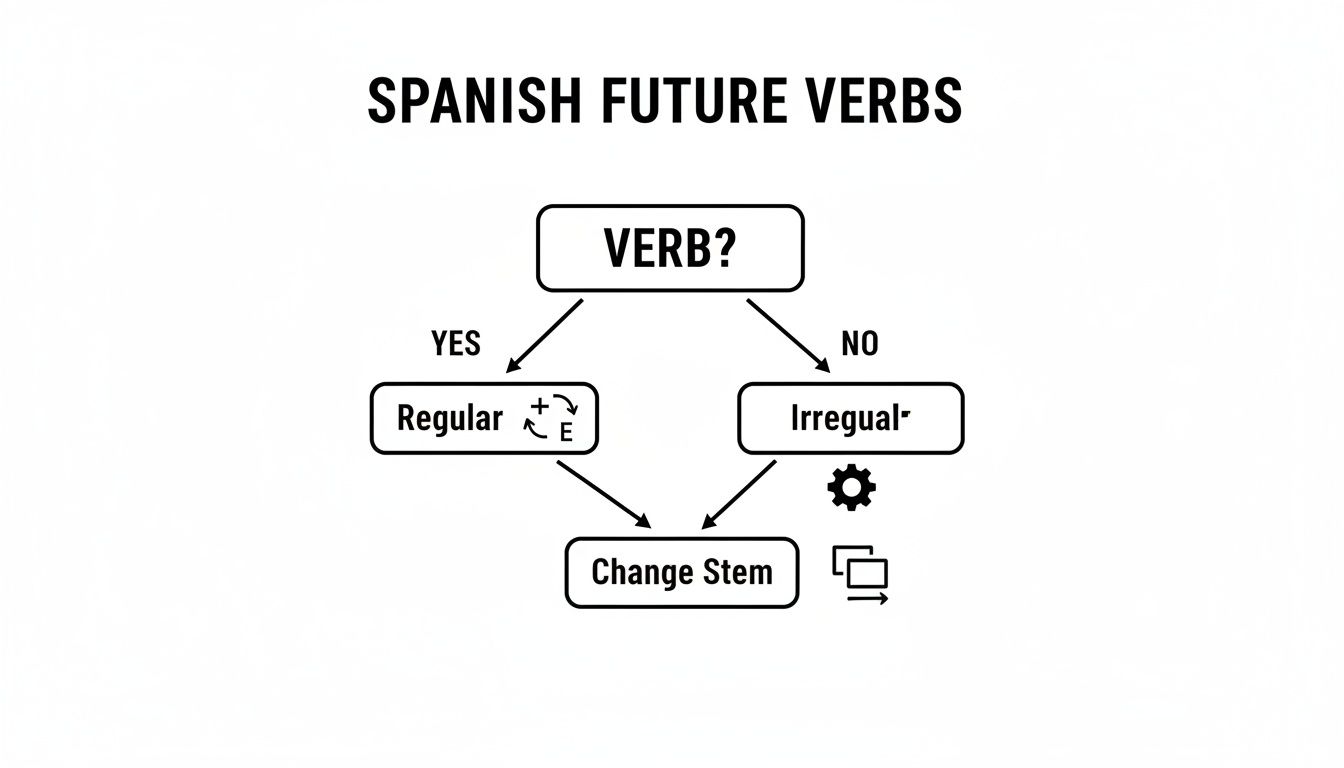
This visual is a great starting point because it reminds you that before you even add an ending, you have to know what kind of verb you're working with.
A Side-by-Side Comparison
To really see the nuance in action, it helps to put these two forms head-to-head. The table below shows how the feeling shifts from a solid plan to a more distant dream or a general statement.
Futuro Simple vs. Ir a + Infinitive Usage
| Usage Scenario | Futuro Simple (e.g., hablaré) | Ir a + Infinitive (e.g., voy a hablar) |
|---|---|---|
| Studying | Algún día, estudiaré medicina. (One day, I will study medicine) | Esta noche voy a estudiar para el examen. (Tonight I'm going to study) |
| Traveling | En diez años, viajaremos por el mundo. (In ten years, we will travel) | El próximo mes vamos a viajar a España. (Next month we are going to travel) |
| Weather | Creo que lloverá mañana. (I think it will rain tomorrow) | Mira esas nubes, va a llover. (Look at those clouds, it's going to rain) |
As you can see, the context is everything. Ir a + infinitive is for the here and now, while the futuro simple handles hopes, dreams, and educated guesses.
Key Takeaway: For immediate, certain plans, use ir a + infinitive. For predictions, promises, or more distant possibilities, the futuro simple is your best bet.
Practice and Overcome Common Errors with Translate AI
Getting this distinction wrong is one of the most common mistakes Spanish learners make. But don't worry, it's fixable. Classroom studies show that getting targeted feedback can slash these kinds of errors by 30–60%. This tells us that practicing with a tool that gives you immediate corrections can seriously speed up your learning curve. You can find more details in research about common errors among Spanish learners.
An app is a great way to create this kind of effective learning loop on your own. For example, you can use Translate AI to test your understanding in real time.
- Open the Translate AI live translator.
- Say a sentence expressing a definite plan, like "I'm going to cook pasta tonight."
- Listen for the app's response: "Voy a cocinar pasta esta noche."
- Now, try a prediction: "It will be sunny tomorrow."
- The app will give you the correct future simple form: "Estará soleado mañana."
This kind of instant feedback helps train your brain to automatically pick the right future form based on context. Before you know it, a confusing grammar rule starts to feel like an intuitive speaking habit.
Putting Your Knowledge into Practice
Okay, theory is one thing, but getting the future simple Spanish tense to roll off your tongue naturally is a whole different ball game. To really master these rules, you have to move them from your brain to your mouth. Speaking is the bridge between knowing the grammar and truly owning it in a conversation.
This is where a tool like a live translator can be a game-changer. Think of it as your personal language coach, giving you a safe space to try things out, make mistakes, and build confidence without the pressure of a real-time conversation partner.
A Quick and Simple Practice Exercise
This little exercise is designed to forge a strong connection in your brain between the concept of the future tense and the act of speaking it. It's a practical step you can take right now to make what you've learned stick.
Here’s how to do it:
- Open a translation app like Translate AI.
- Speak a simple plan in English. Try something like, “Next year, I will travel to Mexico.”
- Listen to the instant Spanish translation and audio: “El próximo año, viajaré a México.”
- Now, try a prediction: “I think it will rain tomorrow.”
- Hear the correct form: “Creo que lloverá mañana.”
This immediate feedback is incredibly powerful. It connects the abstract grammar rules directly to real speech, helping you master not just the words but the right phrase in Spanish for any situation.
Why This Matters in the Real World
Getting the future tense right isn't just an academic exercise—it's a high-impact skill. Spanish is a global language, with an estimated 558 to 636 million total speakers across more than 20 countries.
Think about it: a huge percentage of daily conversations involve making plans, promises, or predictions. Using the futuro simple correctly is essential for clear communication in countless interactions every single day. If you want to dive deeper into its global reach, you can explore the demographics of the Spanish language on Wikipedia.
Use Translate AI as Your Speaking Partner
For consistent practice, nothing beats an app that provides instant, spoken feedback. This method helps build the muscle memory needed to use the future simple Spanish tense correctly and automatically, without having to stop and think about conjugation tables.
You can download Translate AI from the App Store to start turning your knowledge into confident conversation today.
Your Next Steps to Spanish Fluency
Alright, you've made it through the essentials of the Spanish simple future tense. You've seen how to build the regular forms, memorized the must-know irregulars, and even understand the subtle differences between the futuro simple and ir a + infinitive.
That's a huge step. You now have the tools to talk about predictions, make promises, and lay out more distant plans, which adds a whole new layer of sophistication to your Spanish. The trick now is to get all that knowledge out of your head and into real conversation.
From Knowing to Doing
Start small. As you go about your day, just think in the future tense. What will you do tomorrow? What will you eat for dinner? ¿Qué haré mañana? ¿Qué comeré para la cena? Just get used to forming those sentences in your head.
That kind of consistent, active practice is what builds the bridge to fluency, and you’ve already laid a solid foundation. A great way to lock in these new skills is to use a tool that gives you instant feedback. For example, some of the newer tech like real-time language translator earbuds can turn everyday chats into mini-lessons, helping you hear how native speakers sound.
Get Instant Feedback with an App
Honestly, the fastest way to make grammar rules feel natural is to say them out loud and immediately hear if you got it right. It’s that instant validation that builds confidence and helps the patterns become second nature.
Active recall—especially speaking—is one of the best ways to move grammar and vocabulary from your short-term memory right into long-term fluency.
Try a quick exercise with an app like Translate AI, available on the App Store. Say a simple sentence like, "I will call my friend later," into your phone. The app will instantly give you the correct Spanish audio: "Llamaré a mi amigo más tarde."
Hearing that immediate connection between your thought and the right way to say it makes the learning process stick so much faster. It’s like having a personal tutor in your pocket, ready to go whenever you are.
A Few Common Questions About the Future Tense
As you start getting the hang of the future simple in Spanish, a few common questions always seem to pop up. Let's clear up these last few points of confusion so you can start using the future tense with confidence.
Can I Use the Present Tense to Talk About the Future?
Yes, absolutely! Just like we do in English, Spanish speakers often use the present tense for things happening in the near future, especially if they're already on the calendar. It sounds completely natural in everyday conversation.
For example, saying "Mañana viajo a Madrid" (Tomorrow I travel to Madrid) is perfect for a trip you've already booked. But if you're talking about general predictions or events further down the line, the future simple ("viajaré") is your better bet.
Are the Future Simple Endings the Same for All Verbs?
They are, and that’s what makes this tense a huge relief for learners. Forget memorizing different endings for -ar, -er, and -ir verbs like you do in other tenses. The futuro simple has just one set of endings that you tack onto the end of all regular verbs.
This little shortcut is a game-changer. You just add one of these six endings right onto the full infinitive:
- -é
- -ás
- -á
- -emos
- -éis
- -án
What’s the Easiest Way to Remember Which Future Form to Use?
A great rule of thumb is to think plans vs. predictions. Nailing this one distinction will guide you to the right choice most of the time.
If you're talking about a personal plan, something you've already decided to do, ir a + infinitive is usually the way to go. Think of it as your "going to" form, like "Voy a llamar a mi madre" (I'm going to call my mom).
On the other hand, if you're making a prediction, a guess, or a promise about something you don't fully control, the future simple is the more natural fit. For example, "Lloverá mañana" (It will rain tomorrow).
How Can I Practice Answering Questions in Spanish?
One of the best ways to make this stuff stick is to simulate a real conversation. Try asking yourself questions in English and then answering them out loud in Spanish, using a translator app to check your work.
An app like Translate AI is perfect for this. You can ask it, "Will I travel next year?" and then speak your answer in Spanish: "Sí, viajaré." The app will give you instant feedback on your pronunciation and confirm if you nailed the conjugation. Doing this regularly is how you build real speaking habits, not just textbook knowledge.
You can download Translate AI from the App Store to give it a try.