

One Way vs Two Way Communication: When to Use Each
You're at a hotel desk with a departure in two hours, and the clerk is reading a room type back while you nod. Or a guide is halfway through a fixed announcement and twenty people are listening with no chance to ask. One way vs two way communication is the choice inside both moments. The better mode depends on the task, the timing, and what an interruption would cost. The test that matters is whether both people can repair a misunderstanding before a name, a time, or a price goes wrong.
Comparing One Way and Two Way Communication at a Glance
A guide reads one script to a whole tour group. Nobody answers, and the same words land on every listener. A hotel clerk, by contrast, confirms a room type with one guest, then waits for a yes, a correction, or a question.
One-way communication sends a message with no built-in reply. Two-way communication lets both sides send, ask, and repair in real time.
| Criterion | One-Way Communication | Two-Way Communication |
|---|---|---|
| Direction of flow | Sender to receiver only | Both parties send and receive |
| Immediate reply | None built in | Built in at every turn |
| Verifies understanding | Only through a later check | Yes, through confirmation and repair |
| Reach to many listeners | High, one source reaches many at once | Lower, scales with the number of participants |
| Error recovery | After the fact | During the exchange |
| Time cost | Low and predictable | Higher, needs turn-taking |
| Best use | Announcements, instructions, alerts | Negotiation, clarification, shared decisions |
One-way communication is judged by how well it is delivered. Two-way communication is judged by whether the listener actually understood.
Neither mode wins by default. Urgency, audience size, and the cost of a wrong meaning decide the first pass. A safety line on a platform should stay one way so one voice reaches everyone before the train moves. A taxi destination should stay two way, because a wrong street costs the fare and the meeting.
Speed to many listeners favors a single speaker who does not stop. Error recovery during the exchange favors a pause after every key fact. Time cost is the row people skip, then regret when a briefing turns into a debate and the gate closes.
Find the table row that matters most for your next conversation. Let that row set the first pass, then switch only when the cost of being wrong changes.
How Each Mode Works Under the Hood
One-way communication is a straight line. A sender puts a message through a channel, and a receiver gets it with no built-in chance to answer. That line suits broadcasts, announcements, instructions, and emergency alerts, because one source can reach many people at once. It cannot check whether those people heard the right gate, the right dose, or the right street.
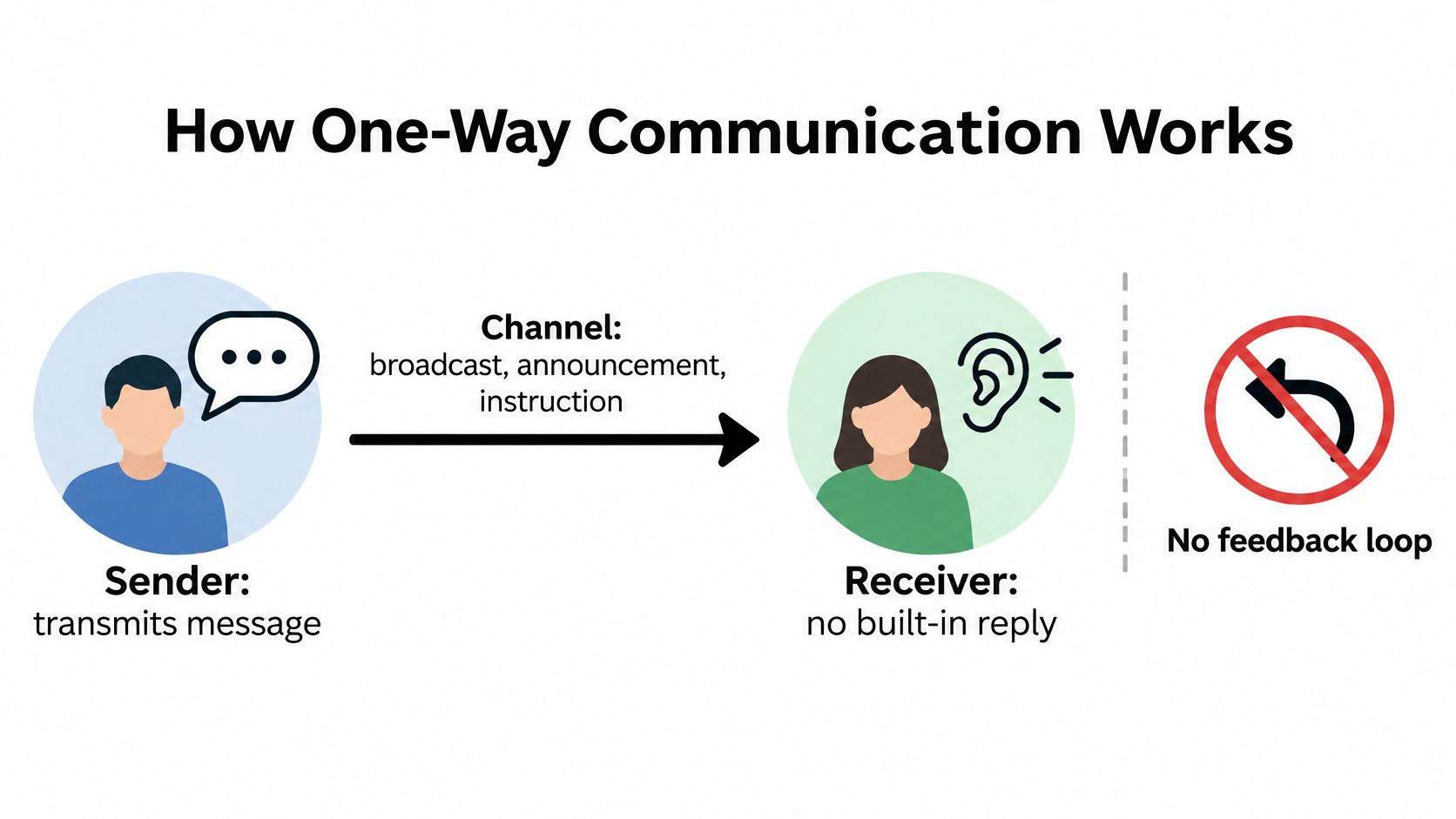
The Study.com lesson on the Shannon-Weaver model traces that line to Claude Shannon's 1948 paper, "A Mathematical Theory of Communication," in the Bell System Technical Journal. Shannon mapped a source, a transmitter, a channel, a receiver, and a destination so engineers could study encoding, decoding, capacity, and noise. Later critics pointed out the limit. The model treated communication as transmission in one direction, while real talk often needs a reply, a question, or missing context.
Two-way communication is a loop. Each message invites a response, and either person can ask, correct, or add context.
Three moving parts
Backchannel signals. A nod, an "okay," or a yes/no tells the speaker the line landed. These are short on purpose. They do not restart the topic.
Repair requests. "Did you mean the 3 p.m. train?" stops a wrong fact before it becomes a ticket. The repair is specific. Name the word you doubt.
Turn-taking. One person finishes, then the other starts. Without it, both talk, the translation overlaps, and nobody owns the next sentence.
An audio guide in a museum is the clean one-way case. The same recording plays for every visitor. There is no reply, and that is fine, because the painting does not change if someone missed a date. A front desk is the loop. The clerk and the guest confirm room type, name, and checkout date one fact at a time. Each answer becomes the next prompt.
Live voice translation works the same way when it is set up as a loop. Your line becomes the other person's input. Their line becomes yours. A translated sentence is not the end of the exchange. It is the cue to respond, repeat a number, or fix a name.
If a group must pick a dinner spot before that desk conversation, a short poll keeps the one-way briefing intact. Picking voting tools for hotel guests is a practical way to collect one choice without turning the lobby into a debate.
Sketch your next conversation as a single arrow or as a loop with returns. If you cannot draw a return path, you do not have two-way communication yet.
Where Each Mode Wins and Where It Fails
Speed is the first trade-off, and it is blunt. One-way communication reaches many listeners in a single pass. Two-way communication spends a turn on every exchange. A gate change shouted once beats a chat with each passenger. A contract clause read once, with no check, does not.
Coordination is where silence gets expensive. In collaborative search experiments covered by Clarkson University researchers Dale and Keller, one-way communication, where one person described information and the other could not respond, produced worse task coordination than interactive conditions. Even minimal two-way feedback, such as acknowledgments or yes/no signals, reduced errors. Full dialogue let people discuss alternatives and reach joint decisions. A translation channel that only pushes audio can carry the words and still miss whether a name, a number, or a correction landed.
Time cost cuts the other way. Dialogue takes longer. Turning a fixed boarding announcement into a discussion can miss the departure. If the content is already decided, extra turns buy friction, not clarity.
Control and privacy sit in the middle. One-way communication lets a speaker hold the floor, which matters in a safety briefing or a tightly run presentation. Two-way communication exposes both sides to questions. That is useful when you need the truth. It is costly when a private number, a salary, or a medical detail should not be spoken in a crowded lounge.
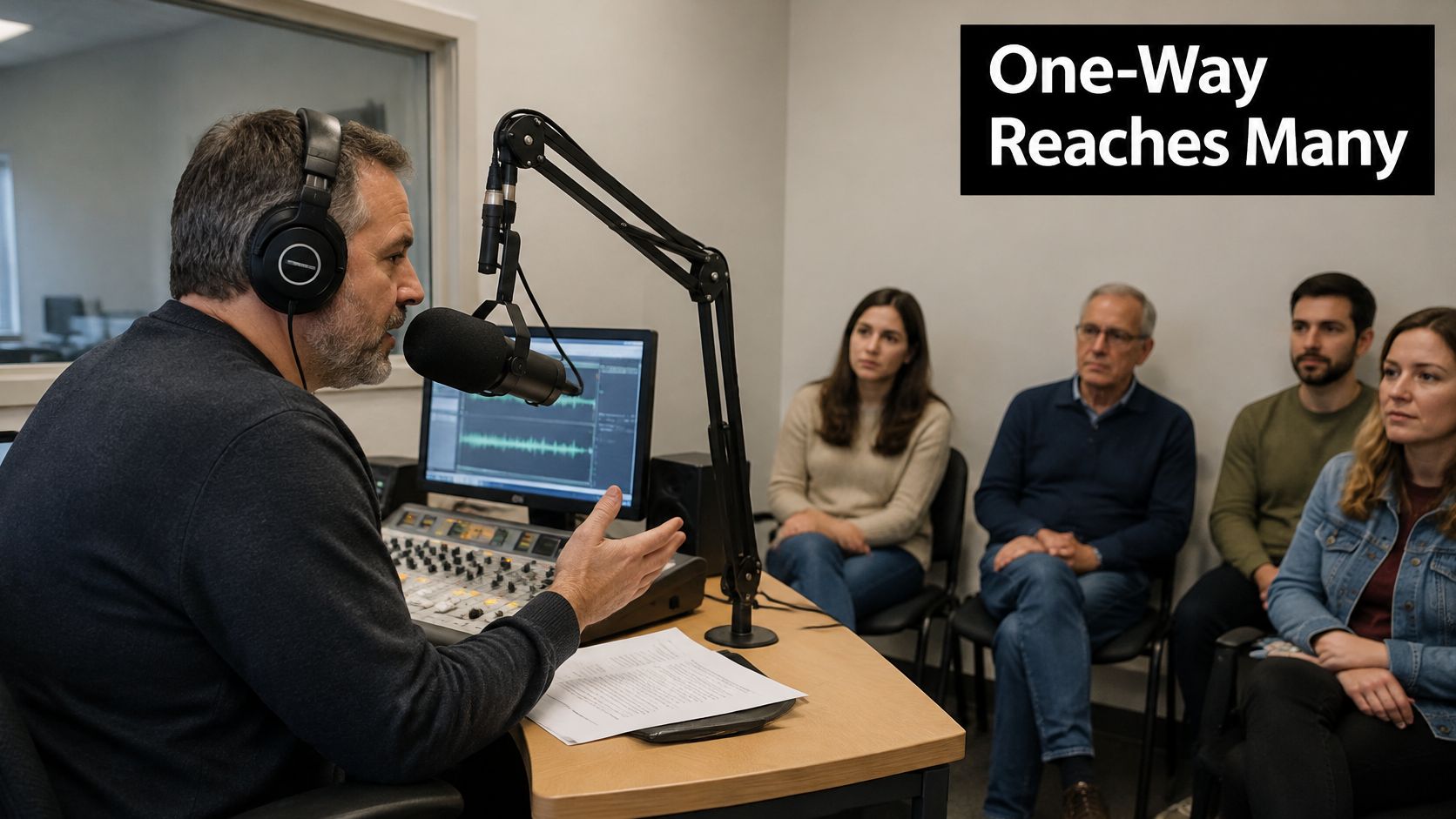
A studio audience that only listens is a fair one-way setup. The host owns the pacing. Questions wait for a marked slot. Open the floor too early and the show loses its shape.
More talk is not automatically better. A 2025 communication experiment involving private information found participants broadly truthful under both formats, yet aggregate payoffs were significantly higher with one-way communication than with two-way communication in that coordination game. Extra dialogue added cost without a matching gain.
More feedback helps when the decision depends on shared understanding. It adds friction when it does not.
How each mode fails
One-way communication fails. The listener smiles, walks to the wrong platform, and you find out after the train has left. There is no signal inside the message that meaning broke.
Two-way communication fails through friction and delay. People interrupt a clear instruction, reopen a settled point, or talk over a translation. The facts were fine. The turns ate the clock.
I would not open a feedback loop on a fire exit route. I would not close one on a price, a dose, or a pickup address.
Choosing the Right Mode for Each Situation
Run three checks before you speak. Does the listener need to answer? What happens if they misunderstand? How many people are listening? Those three answers pick the mode faster than a preference for "more dialogue."
| Situation | Better Mode | Why |
|---|---|---|
| Safety briefing or emergency alert | One-way | One source reaches many people fast; questions go to staff afterward |
| Hotel check-in or taxi destination | Two-way | Names, room types, numbers and places need confirmation |
| Cross-border deal terms | Two-way | Each side must confirm the deliverable, deadline and owner |
| Presentation to a large audience | One-way with a Q&A window | Dialogue slows pacing; a set question turn keeps control |
| Language practice with a partner | Two-way | Response-and-repair cycles build the skill |
| Multilingual team meeting that must decide | Two-way with a written recap | Silence does not confirm agreement |
How to read the table
When a wrong answer is costly, add two-way confirmation even if broadcasting is the default. Read the key facts out loud, then ask for a readback of the place, the time, and the owner. Keep the broadcast for the parts that do not change.
Conversations switch modes. A town-hall starts as a briefing. It becomes a dialogue only inside the Q&A window. Close the window when the decision is made, or the meeting never ends. A traveler does the reverse at a counter. The clerk's script is one way until the guest must confirm a name. That confirmation is the loop. After it, the printed receipt can go back to one way.
Default to one-way when the information is fixed and the listener needs no reply. Default to two-way when the outcome depends on shared understanding. I would rather spend twenty seconds on a readback than an hour fixing a wrong booking.
A four-question checklist
- Is the message fixed? If yes, script it and do not invite a rewrite.
- Does the listener need to answer? If yes, leave a real pause, not a rhetorical one.
- What does a misunderstanding cost? Money, safety, or a missed flight means you confirm.
- How many people are listening? A crowd argues for one speaker plus a later question slot.
Three actions this week
Write the mode down for your next conversation before you walk in. "One way until the price" is a usable note. "Be clear" is not.
Choose the confirmation line you will say. "Please repeat the address and the time" beats "Does that make sense?" People say yes to the second line when they are lost.
Test earbuds and the translation setup before the trip or the meeting, not in the lobby. A dead battery turns a planned loop into a mime show.
For travel, work, and everyday chats, Translate AI is built for exactly those switches between a short announcement and a live back-and-forth. The setup steps sit in the app subsection below, so you can match the tool to the mode instead of hoping a phrasebook covers a negotiation. If you want the habit behind the confirmation line, how to improve conversation skills walks through turn-taking you can practice before the flight.
Name the one conversation this week where you will switch from assuming to confirming. Put it on the calendar as a mode, not as a wish.
Real-World Examples in Travel, Meetings and Language Learning
Travel
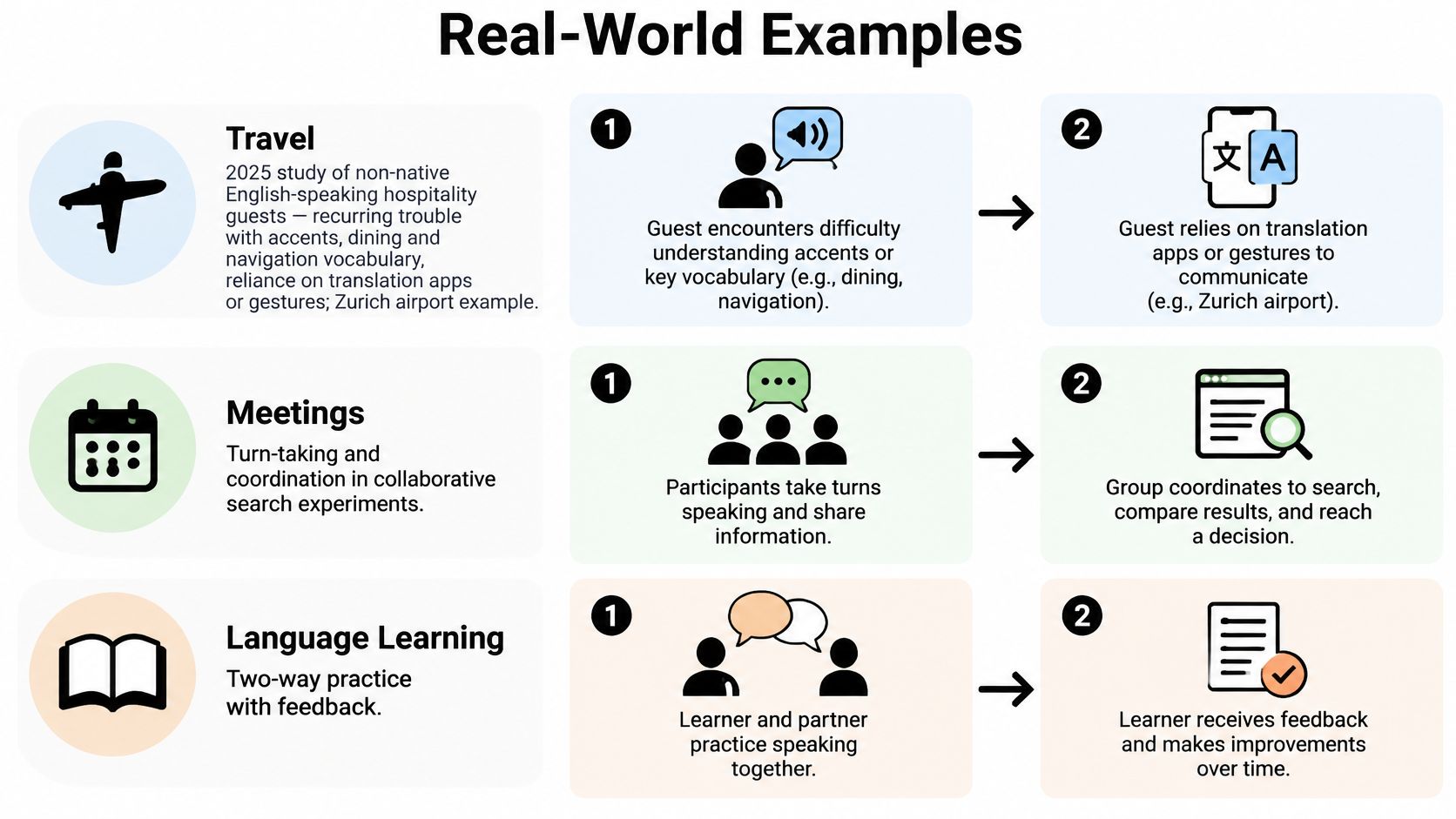
Say you are checking into a city you do not speak well. The clerk's English is fluent, and you still miss the breakfast floor. A 2025 study of non-native English-speaking hospitality guests found recurring trouble with accents, specialized vocabulary for dining and navigation, and reliance on translation apps or gestures. Guests also asked for multilingual written information and better-trained staff. Zurich Insurance, cited in that same review, reported that roughly one in three travelers consider language and ease of communication when choosing destinations, while 44% said language barriers discourage them from considering some trips.
A fluent reply can still hide a wrong meaning. The repair is the point. Interrupt, ask for the floor number again, and point at the written line. If you cannot safely stop the other person, you do not have two-way communication. You have a polished broadcast.
Meetings
Cross-border deals fail in the same quiet way. A CNBC report on executive miscommunication found that 49% of nearly 600 global executives had experienced communication misunderstandings that obstructed significant international business transactions. In a separate look at U.S. workplaces, the Family Enterprise Foundation reported that 44% of 403 U.S.-based professionals said miscommunication caused a project delay or failure.
Judge the meeting by repair speed, not by whether the slide was translated. After the terms, ask the other side to restate the deliverable, the deadline, and the owner. Silence is not agreement. For the habits that keep a remote room from talking over itself, virtual meeting etiquette tips pair well with a set question window.
Language learning
Practice is a response-and-repair cycle, not a monologue you grade for grammar.
- Ask an open question. One that cannot be answered with yes.
- Listen without interrupting. Let the full answer land.
- Paraphrase the answer. Use your own words, not a copy.
- Request correction. Invite the other person to fix the one detail you doubt.
Solo drills still help on the days you have no partner. The German Cultural Association practice methods show how to build speaking time alone, then bring that stamina into a real exchange where someone can correct you.
Try Live Two-Way Translation with Translate AI
The exchange is a short process. You speak. The line is translated. Your partner hears it. Your partner confirms or corrects. Then the roles flip.
Each person talks in their own language, and the partner hears the translation in theirs. Output is instant across 80+ languages, with context recognized in the wording rather than a word-for-word dump. Speaker mode covers hands-free chats, and the app works with most AirPods and earbuds, so you are not buying a special headset for a taxi ride. The translation is shown and spoken right after you finish, which keeps the loop tight enough to catch a wrong station name.
Get it on the App Store and run one test phrase before you need it.
Setting Up Each Mode So It Works
One-way setup
Write the message as a short script. Put names, numbers, and times in writing beside the spoken line. Reserve a question window at the end, and say when it opens. People stop inventing interruptions when they know a turn is coming.
Two-way setup
- Speak one or two short sentences. A long paragraph gives the listener too many facts to repair at once.
- Wait for the translation or the reply. Filling the pause yourself deletes the loop.
- Let the other person answer. Their words, not your summary of what you hope they meant.
- Paraphrase their answer back. A wrong street name shows up at that point.
- Confirm place, time, name, and owner. Those four fields cause most of the expensive mistakes.
A multinational study of 352 professionals from 28 countries found that 72% dealt with language-related communication issues on a regular or very regular basis. The same work put language barriers next to indirect communication, conflicting time orientations, and different expectations about hierarchy. A one-way request for directions can fail even when the vocabulary is correct. Short statements, a pause, and an invitation to correct you catch the error while you are still on the corner.
After you present next steps, ask the other person to repeat the deliverable, the deadline, and the owner in their own words. That readback is cheaper than a follow-up email that discovers the gap on Monday. Written follow-up then records what you already confirmed. It does not replace the live check.
Live translation setup
Choose the language pair before anyone speaks. Turn on speaker mode when your hands are full with a bag, a badge, or a child. Check earbuds with one test phrase, such as today's date, before the important conversation. If the date comes back wrong, fix the pair or the hardware now.
Our app is one option for that live exchange. You speak, the line is shown and spoken immediately, and speaker mode keeps the chat hands-free. Context recognition helps with the dining and navigation words that trip people at a counter. If you are choosing hardware, live translation with headphones covers how a normal earbud pair fits a two-person talk without a shared phone held in the middle.
You know the exchange is working when each side can repeat the other's point, and both people ask for a correction without treating it as an insult. That is the repair, and it is the whole point of choosing two-way communication when the cost of being wrong is real.
Translate AI turns a one-way announcement into a repairable conversation by translating both ways in real time, so each person speaks their own language and hears the reply in theirs. Use it when a name, a time, or a deal term cannot survive a silent misunderstanding, whether you are traveling, in a cross-border meeting, or practicing out loud. Visit Translate AI and run your next confirmation as a real loop, not a guess.