

Live Translation Earbuds: Your Guide to Breaking Language Barriers
Ever found yourself in a new country, nodding along to a conversation you desperately wish you could understand? That feeling of hitting a language wall—of being so close to a real connection but held back by a few simple words—is frustrating. It’s exactly the problem live translation earbuds are designed to solve.
Imagine them as your personal interpreter, whispering real-time translations directly into your ear. Suddenly, confusing foreign sounds become a clear, natural conversation. This guide will show you how this technology works and how you can use it to turn moments of miscommunication into genuine human connection, often with the phone and earbuds you already own.
Why This Guide Is for You
This guide is for anyone who has ever felt held back by a language barrier. Our goal is to give you specific, actionable advice to help you:
- Understand the technology behind live translation.
- Decide between dedicated hardware and more flexible app-based solutions.
- Confidently choose and use a translation tool for your next trip or meeting.
By the end, you'll know exactly how to turn your smartphone into a powerful communication device and connect with the world more freely.
From Sci-Fi Dream to Everyday Reality
Imagine landing in Tokyo and confidently ordering ramen from a street vendor, asking for directions to the Louvre in Paris, or sharing a laugh with a local artisan in a market in Marrakech—all without fumbling with a phrasebook or resorting to awkward gestures.
For years, an instant, in-ear translator felt like pure science fiction. But today, thanks to powerful AI and efficient hardware, it's a reality. Better yet, you don't need to spend hundreds on a specialized, single-purpose gadget. The smartest solutions work with the tech you already carry in your pocket.
Who Can Benefit from Live Translation?
The secret is sophisticated software that transforms your everyday smartphone and standard Bluetooth earbuds into a powerful translation tool. Instead of relying on pricey hardware, app-driven systems use your phone's processor to do the heavy lifting, making real-time translation accessible for:
- International Travelers: Navigate foreign cities with complete confidence.
- Business Professionals: Build rapport and close deals with global partners without miscommunication.
- Expats and Newcomers: Handle daily life—from doctor's appointments to grocery shopping—like a local.
- Language Learners: Get real-world practice by chatting with native speakers naturally.
The goal is simple: make communication effortless. When you remove the language barrier, you can focus on the conversation and connect with the person in front of you, building an understanding that goes beyond just words.
How Real-Time Voice Translation Actually Works
Ever wonder what’s happening in the seconds between you speaking English and someone hearing your words in perfect Spanish? It’s not magic, but it’s close. Think of it as a lightning-fast digital interpreter living inside your phone, turning complex language barriers into simple, seamless conversations.
The whole process boils down to three core steps that happen almost instantly. First, your earbud's microphone grabs your voice and turns it into digital data. This isn't just a simple recording—it's smart enough to isolate your speech from the background chatter of a busy café or train station.
Next, that data zips off to a powerful AI engine, usually in the cloud, which does all the heavy lifting. This is where the actual translation takes place, converting the sounds you made into meaningful text in a completely different language.
The Journey From Your Voice to Their Ears
To really get it, let's follow your voice on its digital relay race, where speed and accuracy are everything.
- Speech Recognition: The AI first uses Automatic Speech Recognition (ASR) to transcribe what you said into text. Imagine a super-accurate typist who can keep up with your every word.
- Machine Translation: That text is then fed into a Neural Machine Translation (NMT) engine. This is the really clever part. Instead of just swapping words one-for-one, the system analyzes the entire sentence to grasp context, grammar, and even subtle nuances. You can learn more about this in our full guide on what machine translation is. It's what makes the final output sound natural, not robotic.
- Speech Synthesis: Finally, the translated text is converted back into spoken words using Text-to-Speech (TTS) technology. This synthetic voice is designed to sound clear and human-like, delivering the message right into the listener's earbud.
This is how technology transforms a moment of confusion into a genuine human connection.
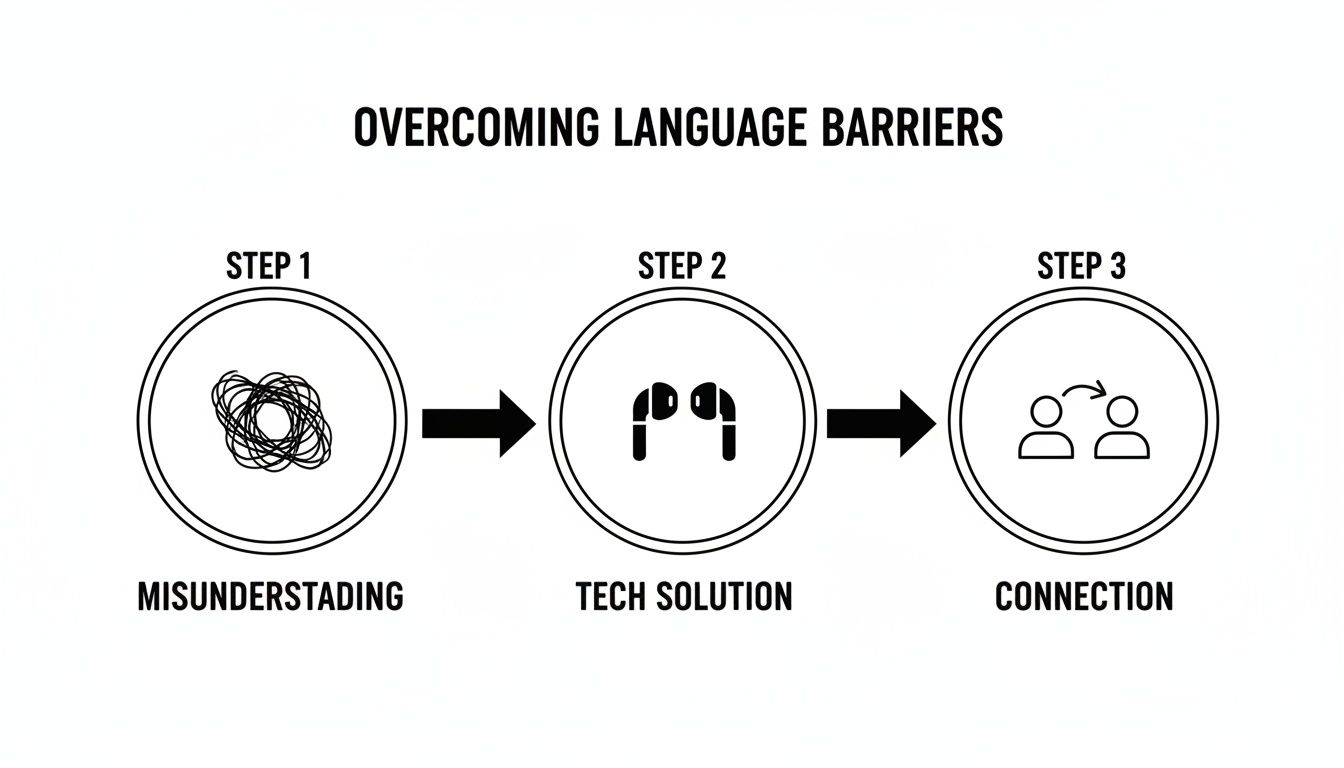
As you can see, the right tech acts as a bridge, making it possible for two people to connect directly, even if they don't share a single word.
Two Paths to Instant Translation
So, how does this technology actually get to you? There are two main ways: through dedicated, single-purpose hardware or through flexible, app-driven software.
One path is buying dedicated translation earbuds. These are gadgets built from the ground up for one purpose: translation. While they can be powerful, they often come with a high price tag and are another single-use device you have to remember to pack and charge.
The other path is the app-based model, which offers a much more accessible alternative. It uses the powerful processor you already carry around in your smartphone as the "brain" for the translation. Your everyday earbuds simply become the microphone and speaker, while a specialized app does all the complicated work behind the scenes.
This approach has really opened up live translation for everyone. By using the hardware millions of people already own, advanced communication tools are no longer a niche, expensive gadget.
The market numbers back this up. The real-time translator earbud market was already valued at USD 1.5 billion in 2023 and is projected to more than double to USD 3.5 billion by 2031. While dedicated hardware is a big part of that, app-based solutions are set to reach an even wider audience by working with the billions of standard earbuds already out there.
Comparing Translation Tech Hardware vs App-Based Solutions
Deciding between dedicated hardware and an app-based solution really comes down to your needs, budget, and how you travel. Here’s a quick breakdown of the trade-offs.
| Feature | Dedicated Hardware Earbuds | App-Based Solution (with any earbuds) |
|---|---|---|
| Initial Cost | High (often $200–$400+) | Low (App subscription, uses hardware you already own) |
| Hardware Requirement | Must buy a specific device | Works with any standard Bluetooth earbuds (e.g., AirPods) |
| Primary Use-Case | Single-purpose; primarily for translation | Multi-purpose; use your favorite earbuds for music, calls, and translation |
| Offline Capability | Often available, but usually for a limited set of languages | Typically requires an internet connection for best performance |
| Convenience | One extra device to carry, charge, and manage | No extra hardware needed; just an app on your phone |
| Best For | Frequent business travelers needing reliable offline options | Casual travelers, tech-savvy users, and budget-conscious individuals |
Ultimately, while dedicated earbuds have their place, the flexibility and cost-effectiveness of an app-based approach make it a compelling choice for most people who just want to communicate more freely on their travels.
Real-World Scenarios Where Translation Earbuds Shine
The tech behind live translation is impressive, but let's be honest—what really matters is how it works out in the real world. This is where AI and speech synthesis stop being buzzwords and start creating genuine human connections, one conversation at a time.
It’s about the confidence you feel stepping into a new country, knowing the language barrier won’t hold you back. This isn’t just about making things easier; it’s about creating moments that would otherwise be completely impossible.

For the Fearless Traveler
Picture this: you’re wandering through a bustling market in Seoul, the air thick with the smell of sizzling street food. Instead of just pointing and hoping for the best, you use your earbuds to ask the vendor about her spiciest dish. A second later, her recommendation comes through in perfect English, and you both share a laugh.
That’s what live translation earbuds unlock for travelers. They empower you to:
- Order with confidence at local restaurants and food stalls.
- Ask for directions and actually understand the replies.
- Haggle for souvenirs and connect with local artisans.
- Handle logistics like booking a taxi or checking into a hotel without a hitch.
It’s the difference between just looking at a culture from the outside and actually getting to participate in it.
For the Global Business Professional
Now, switch gears to a high-stakes negotiation with a potential partner in Germany. The conversation is complex, full of nuances that could make or break the deal. With translator earbuds, the discussion flows naturally, without the clunky pauses you get with a human interpreter.
You can build rapport directly, catch the subtle shifts in tone, and make sure your key points land with total clarity. This tech helps professionals sidestep costly misunderstandings and build stronger, more personal business relationships founded on clear communication.
The Asia-Pacific region currently holds a 34.52% share of the translator earbuds market, which is on track to hit USD 645.5 million by 2025. This boom is driven by soaring cross-border business in countries like China, Japan, and India. While this means more hardware options are hitting the market, smart apps are leveling the playing field by pairing with the earbuds you already own. You can learn more about the growth of the translator earbuds market on FutureDataStats.com.
Using translation tech in business is more than just a tool—it's a sign of respect. It shows you're invested in understanding your counterpart on their own terms, which can be incredibly powerful in building trust.
Everyday Life for Expats and Language Learners
Finally, think about an expat trying to navigate a doctor's appointment in a new country, where explaining your symptoms accurately is absolutely critical. Or a language learner practicing conversational French with a native speaker, getting real-time feedback that builds confidence with every single sentence.
In these personal, everyday moments, live translation earbuds provide a sense of independence and security. They break down the walls that can make daily life in a new place feel isolating, turning stressful tasks into manageable interactions. For learners, they make language practice more engaging and effective than ever before.
How to Choose the Right Translation Solution
Trying to find the right live translation tool can feel like a maze. You've got dedicated hardware, tons of apps, and a whole lot of tech jargon to sift through. So, how do you actually pick the right one for you?
The secret is to ignore the flashy marketing and focus on what will genuinely make your conversations smoother. A great translation tool should almost feel invisible, letting you connect with the person in front of you instead of fiddling with technology.
To get there, you need a simple framework to cut through the noise.
Key Factors for Your Decision
When you're comparing live translation earbuds or different app solutions, it really boils down to four critical areas. Getting these right will make all the difference when you're actually trying to have a conversation.
- Translation Accuracy: Does it just swap words, or does it actually get the meaning? Look for solutions that can handle context and nuance. This is the absolute foundation of a clear conversation.
- Language Support: Check if it covers the languages and dialects you'll actually encounter. It's no use having 100 languages if the one you need for your trip to rural Vietnam isn't on the list.
- Ease of Use: How quickly can you get it working? A clunky setup or confusing interface can create awkward pauses that kill the flow of a natural chat.
- Overall Cost: Think about the long-term value. Is a one-time hardware purchase better for you, or does the flexibility of an affordable app subscription make more sense? It all depends on how often you'll use it.
Overlooked Yet Crucial Details
Beyond the big four, a few small details can make or break your experience. These are the things people often forget to check until it's too late.
For example, app-based translators run on your phone, which means they use your phone's battery. If you plan on having long conversations all day, you'll want to think about carrying a power bank.
And don't forget to glance at the data privacy policy. It's important to know how your conversations are being stored and used, especially if you're discussing sensitive business matters. To get a better sense of your options, you can check out our guide on the differences between a real-time language translation device and an app-based approach.
The market for these tools is exploding. By 2025, global production of translator earbuds is expected to hit 15 million units a year. The whole market is projected to reach USD 6.5 billion by 2035, mostly because AI is now hitting 95%+ accuracy. For you, that means more choices, better quality, and more competitive prices. You can find more stats on the translator earbuds market on ArchiveMarketResearch.com.
In the end, the right choice has to fit your lifestyle. A frequent business traveler might need a device with solid offline capabilities, while a casual tourist will likely prefer the simple, cost-effective convenience of an app that works with the earbuds they already own.
Turn Your Phone into a Translator with Translate AI
You might think that getting real-time, in-ear translation means shelling out for expensive, specialized hardware. But what if the key to breaking down language barriers is already in your pocket?
The truth is, the same earbuds you use for music and calls—whether they’re AirPods or any other Bluetooth pair—are more than capable of becoming a powerful translation device. The magic isn't in the earbuds themselves; it's in the software that drives them.
A smart app acts as the engine, turning your phone into the central processor for the whole operation. This makes seamless, two-way conversations a reality for everyone, without needing yet another gadget to charge and carry around.
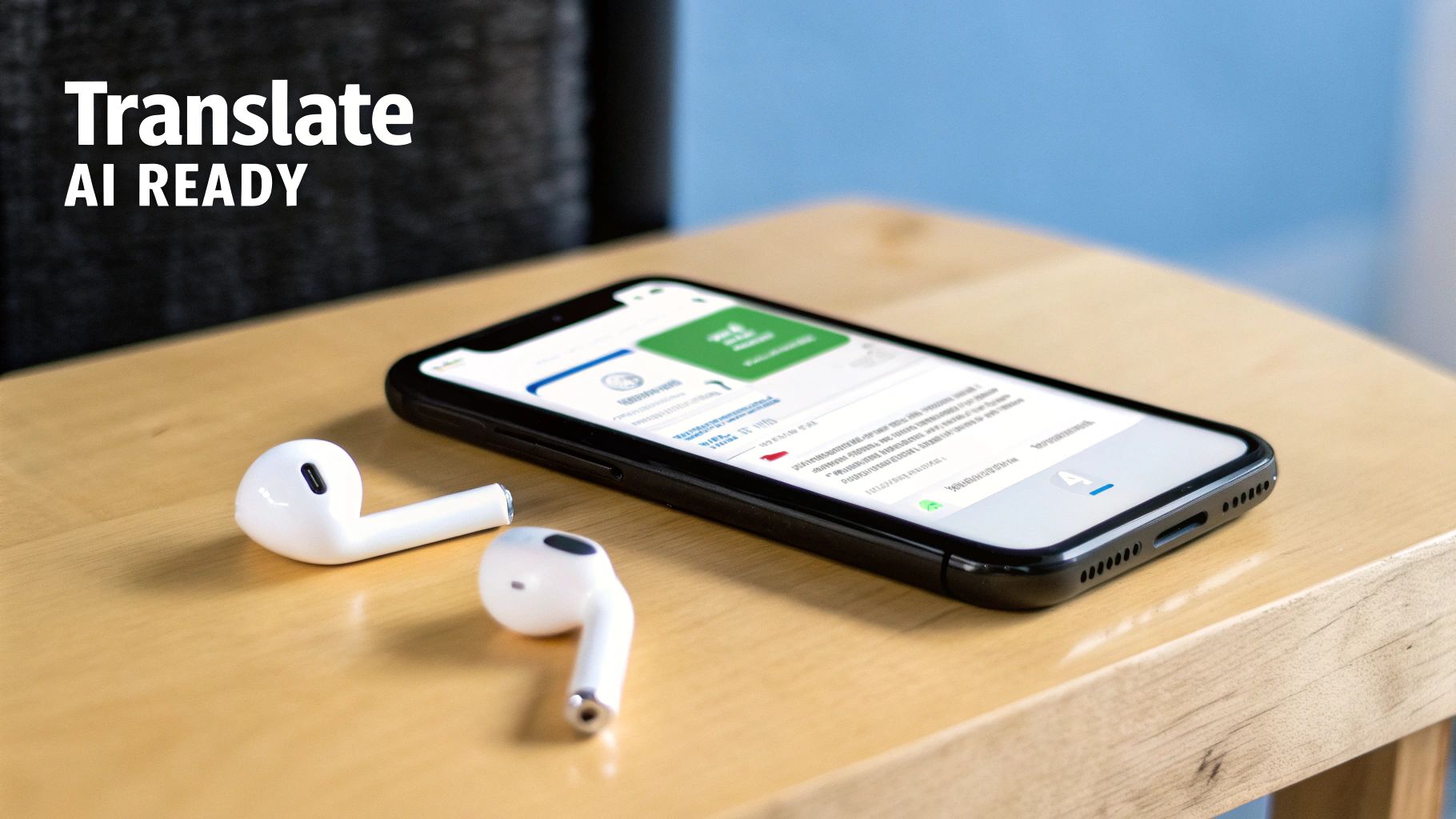
This is exactly the principle behind Translate AI, an app we designed to turn the tech you already own into a robust translation tool. By pairing your everyday earbuds with our app, you create a system that delivers accurate, natural-sounding conversations in over 80 languages.
How to Use an App for Live Translation
We designed the whole process to be dead simple, so you can focus on the conversation, not the technology. Once you have the app, the setup takes just a few moments before you can start talking.
- Download and Pair: First, install the app on your smartphone. Then, connect your favorite Bluetooth earbuds just like you normally would.
- Select Your Languages: Open the app and pick your language and the language of the person you're speaking with from the list.
- Start the Conversation: Just tap to start. As you speak, the app captures your voice, translates it in near real-time, and sends the audio to your partner’s earbud, and vice-versa.
This setup supports a natural, back-and-forth dialogue. No awkward pauses or clunky handovers. The conversation flows smoothly, just as it would if you both spoke the same language, making it perfect for everything from ordering coffee in a new city to negotiating a business deal. To see how it can work for you, discover more about Translate AI on our website.
The key takeaway is that you don't need to buy a single-purpose gadget. The combination of your smartphone's processing power and a smart app unlocks the potential of the hardware you already own and rely on every day.
Getting Started with Translate AI
Ready to try it yourself? You can download the app directly and start your first conversation in minutes. It’s designed to be intuitive, so you can focus on the person you're talking to, not the tech. You can find Translate AI on the App Store and begin breaking down language barriers today.
Your Questions About Live Translation, Answered
Even after seeing how it all works, it’s normal to have a few questions. The idea of a personal translator in your ear is amazing, but you’re probably wondering about the real-world details—like cost, accuracy, and whether your conversations are private.
Let's walk through the most common questions people have about live translation earbuds and the apps that power them.
Do I Need to Buy Special Earbuds?
This is the big one, and the answer is a clear no. You absolutely do not need to buy a special, single-purpose gadget for translation anymore.
While dedicated hardware exists, the most flexible and affordable way to get live translation is through an app on your phone.
Apps like Translate AI are built to work with the standard Bluetooth earbuds you already have—from Apple AirPods to Google Pixel Buds and everything in between. The app does all the heavy lifting; your earbuds are just the microphone and speaker. This approach saves you from buying, carrying, and charging yet another device. Before you spend hundreds on new hardware, it's smart to see what your current tech can do with the right software.
How Accurate Is the Real-Time Translation?
Accuracy has come a long way. The old, clunky word-for-word translations are gone. Modern systems use advanced AI (neural machine translation, to be specific) to understand the entire context of a sentence, which results in translations that feel much more natural and are far more precise.
Under good conditions—meaning clear speech and not a ton of background noise—the best translation apps can hit over 95% accuracy. Of course, a few things can trip it up:
- Very thick or regional accents
- Lots of slang or complex idioms
- Super loud environments, like a busy market or train station
Still, the tech is designed for real conversations. The goal isn't just to be technically perfect, but to make the dialogue flow smoothly so you and the other person can communicate without awkward pauses.
The real measure of success isn't 100% word-for-word perfection. It's whether you can have a natural, uninterrupted conversation. Today's AI makes that possible.
Can Translation Earbuds Work Offline?
This is a huge question for travelers, and the answer is: it depends. Most real-time translation tools need a stable internet connection (Wi-Fi or mobile data) to give you the best, most accurate results. That connection lets them tap into powerful AI servers in the cloud that handle the complex processing.
However, some premium apps and dedicated devices do offer an offline mode. To make it work, you have to download specific language packs to your phone before you lose your connection. Just know that offline translations are usually a bit less accurate and support way fewer languages than the online version. If you know you'll be somewhere with spotty internet, an offline mode is a feature you should actively look for.
Are My Conversations Kept Private and Secure?
Privacy is a big deal, and it should be. Reputable developers know this. When you use a translation service, your conversation snippets are usually sent to an AI server to be processed. The good services use strong encryption to protect your data while it's in transit and being analyzed.
Most companies also state in their privacy policies that they don’t store your conversations long-term or use them for anything other than improving the translation models. That said, it's always smart to read the privacy terms of any translation tool you plan to use, especially if you’ll be discussing sensitive business or personal information. Look for companies that are transparent about how they handle your data.
Ready to break down language barriers with the tech you already own? Translate AI turns your smartphone and favorite earbuds into a powerful live translator. Download the app today and start communicating with the world.