

How to Say Science in Spanish (and Actually Use It)
Stuck trying to talk about your favorite subject, a news article, or even your job in Spanish? You're not alone. Figuring out how to say "science" is a common hurdle, but the goal isn't just to learn a word—it's to use it confidently in a real conversation.
The good news? The direct translation is simple: ciencia.
This guide will give you the specific, actionable steps to go from knowing the word to mastering its use, from pronunciation to practical examples you can use today.
Your Quick Guide to Science in Spanish

Let's dive into the essentials. Knowing ciencia is the first step, but understanding how to use it in a sentence is what truly matters. This section is your cheat sheet for pronunciation, grammar, and key details so you can sound natural from your very first conversation.
Here’s everything you need to know at a glance.
Science in Spanish at a Glance
This table breaks down the most important information for using the word ciencia correctly.
| English Word | Spanish Translation | IPA Pronunciation | Grammar Note |
|---|---|---|---|
| Science | ciencia | [ˈsjen.sja] or [ˈθjen.θja] | Always a feminine noun (e.g., la ciencia). |
Now, let's break down what this means for you.
Core Translation and Grammar
The direct translation is simple: science is ciencia. However, to use it correctly, you need to remember one key piece of Spanish grammar.
- Gender: In Spanish, every noun has a gender. Ciencia is feminine, so you'll always pair it with feminine articles like "la" (the) or "una" (a/an).
- Actionable Tip: When talking about the concept of science in general, always use "la ciencia". Saying "Me interesa ciencia" is a common mistake for English speakers. The correct phrase is "Me interesa la ciencia" (I am interested in science).
Pronunciation Essentials
How you say ciencia depends on where you are. There are two main variations you'll hear, one common in Latin America and the other in Spain.
- Latin American Spanish: Pronounced [ˈsjen.sja]. The "c" sounds like an "s," making it sound like "see-EN-see-ah."
- Castilian Spanish (Spain): Pronounced [ˈθjen.θja]. The "c" takes on a soft "th" sound (like in "think"), making it sound like "thee-EN-thee-ah."
Neither is more "correct"—it's about geography. Your goal is to be understood, so pick the one that matches the region you're in or the people you're speaking with.
Mastering the Pronunciation of Ciencia
Nailing the pronunciation of ciencia is a small detail that makes a big difference in how natural you sound. The word might look tricky, but you can master it by breaking it down into two syllables: cien-cia.
The key is knowing which of the two main pronunciations to use. This isn't just about sounding authentic; it's about being easily understood whether you're in Madrid or Mexico City. This same regional difference applies to many words. For another example, see our guide on how to say airplane in Spanish, which explores similar nuances.
Here’s how to practice each sound.
The Latin American "S" Sound
In most of Latin America, the "c" in ciencia is pronounced with a soft "s" sound, just like the "s" in "see." This is the most common pronunciation globally and is the easiest for most English speakers to start with.
- Step 1: Pronounce the first syllable as "syen."
- Step 2: Pronounce the second syllable as "syah."
- Actionable Tip: Combine them smoothly: "syen-syah." Practice saying it out loud five times. This is the version you’ll hear from Mexico to Argentina.
The Castilian "Th" Sound of Spain
If you’re traveling in Spain, you'll hear a distinct sound for any "c" before an "i" or "e." This is the Castilian lisp, where the "c" sounds like the "th" in "think."
- Step 1: Pronounce the first syllable as "thyen."
- Step 2: Pronounce the second syllable as "thyah."
- Actionable Tip: Put them together: "thyen-thyah." This might feel strange at first, but practicing this sound will tune your ear to European Spanish and show native speakers you've done your homework.
Need to Hear it Spoken? Use an App
Reading about pronunciation is one thing, but hearing it is another. A great way to get it right is to use a tool that can speak the word for you.
For instant, real-world pronunciation practice, an app like Translate AI is invaluable. You can listen to both the Latin American and Castilian pronunciations on demand, helping you master the sound you need for your next conversation.
Using Ciencia in Everyday Spanish Conversations

The real goal is to use ciencia naturally, without hesitating. This is where you move from memorizing to actually speaking. Putting the word into context helps it stick. The examples below give you ready-made phrases you can start using right away.
Examples in an Academic Setting
If you're a student or just talking about school, these phrases are perfect conversation starters.
- Me gusta la clase de ciencia. (I like science class.)
- La biología es una rama de la ciencia. (Biology is a branch of science.)
- Tenemos un examen de ciencia el viernes. (We have a science test on Friday.)
Discussing Science in General Conversation
Science isn't just for the classroom. You'll likely talk about it when discussing news, technology, or personal interests.
Actionable Tip: Notice how ciencia is almost always paired with "la." In Spanish, you use the definite article ("la" or "el") when talking about general concepts. Getting this right is a huge step toward sounding more natural.
- La ciencia ha hecho grandes avances. (Science has made great progress.)
- Creo en la ciencia. (I believe in science.)
- ¿Lees artículos de ciencia? (Do you read science articles?)
Expanding Your Vocabulary Beyond Just Ciencia
Knowing how to say science in Spanish is a great start, but to have a meaningful conversation, you need more than one word. Think of ciencia as your foundation. Now, let’s add the tools to build more complex ideas. These related terms will let you discuss scientific topics with much more confidence.
Key People and Concepts in Science
To have a real conversation, you need words for the core ideas and the people involved.
Here are the most important terms to learn first:
Científico / Científica(Scientist): Match the ending to the person's gender:un científico(male) anduna científica(female).Investigación(Research): A feminine noun. “La investigación es fundamental para la ciencia.” (Research is fundamental to science.)Descubrimiento(Discovery): A masculine noun for when something new is found. “El descubrimiento de la penicilina cambió la medicina.” (The discovery of penicillin changed medicine.)Experimento(Experiment): A masculine noun for testing a hypothesis.
Actionable Tip: Master these four terms, and you can now talk about who does science (
científico), how they do it (investigación,experimento), and what they find (descubrimiento). This paints a much richer picture than just usingcienciaalone.
Naming Different Fields of Science
Just like in English, Spanish has specific terms for different disciplines. Many of them use the plural form ciencias.
Ciencias Naturales(Natural Sciences): Biology, physics, chemistry.Ciencias Sociales(Social Sciences): Sociology, psychology, history.Ciencia Ficción(Science Fiction): A useful phrase for talking about books and movies.
This quick reference table gives you more essential scientific terms.
Key Scientific Terms in Spanish
| Spanish Term | English Translation | Example Usage Hint |
|---|---|---|
La teoría | The theory | Use for scientific explanations, like la teoría de la relatividad. |
La hipótesis | The hypothesis | The starting point for an experiment; an educated guess. |
El análisis | The analysis | Refers to the detailed examination of data or results. |
Los datos | The data | The information or facts collected during research. |
El laboratorio | The laboratory | Where the experiments happen. |
La tecnología | The technology | The application of scientific knowledge for practical purposes. |
El avance | The advance / breakthrough | Describes progress or a significant step forward. |
Why Knowing Ciencia Matters on a Global Scale
Learning how to say science in Spanish does more than just add a word to your vocabulary. It connects you to a massive, influential global scientific community.
While English is often seen as the default language of research, Spanish is the second most used language for scientific texts worldwide. Spanish scientific publications grew by 30% between 2009 and 2021—a faster expansion than German or French. You can read more about the global influence of Spanish science to get the full picture.
This infographic breaks down the core pillars of the scientific process in Spanish.
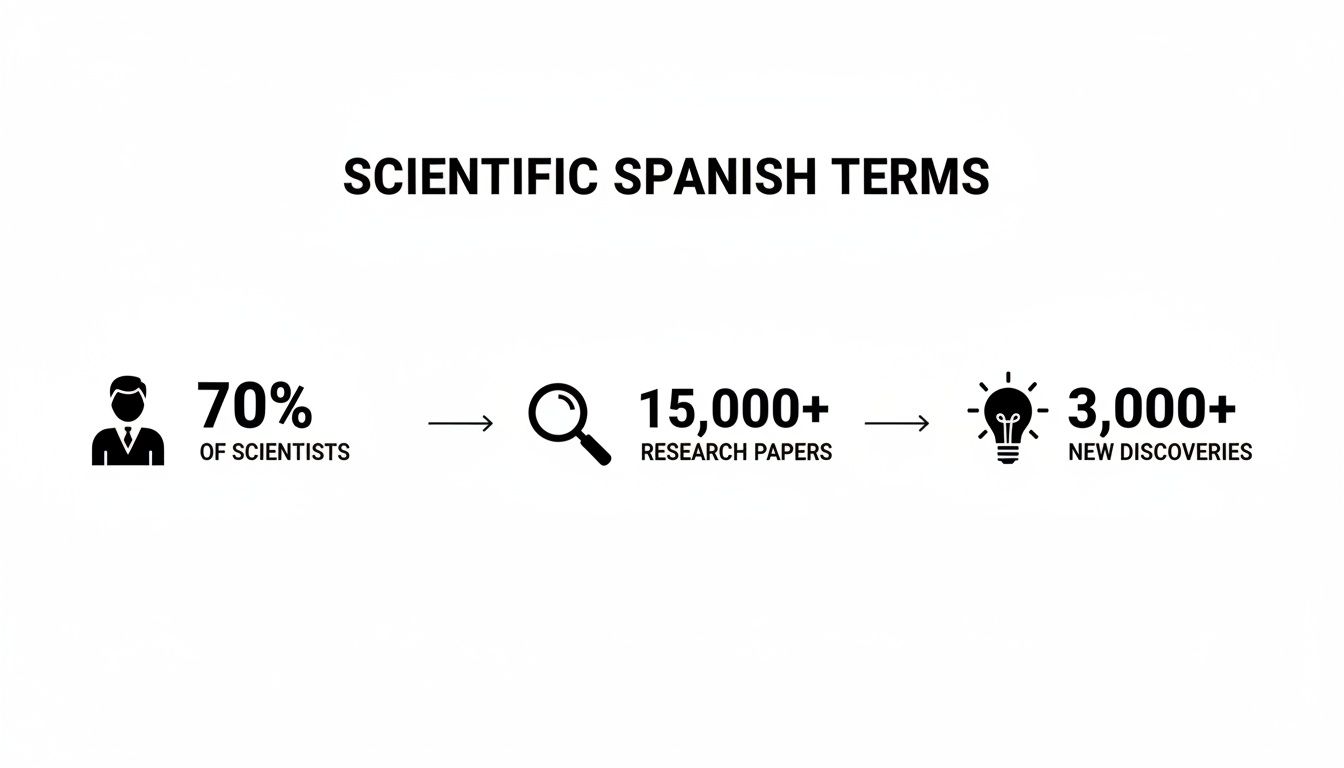
Knowing these terms opens doors to collaboration with researchers across Spain, Argentina, and Colombia. This is especially true when working abroad, where staying connected is everything; our guide on how to get internet access while traveling abroad can help with that.
Ultimately, understanding ciencia isn't just about translation—it's about accessing a whole new world of knowledge and innovation.
Practical Tools for Your Spanish Learning Journey
Knowing the word is one thing, but using it is how you truly learn. Interactive tools are what really speed up the process, especially for nailing pronunciation.
Learning how to say science in Spanish is a gateway to a language spoken by over 630 million people worldwide. According to the 2025 Cervantes report, that makes Spanish the second most common mother tongue on the planet. To join that conversation, you need to practice. You can read more in the full Cervantes report on the Spanish language.
Master Pronunciation with Translate AI
One of the best ways to build confidence is with an app designed for real-world conversation. A tool like Translate AI is like having a personal language lab in your pocket.
The app’s voice feature lets you hear ciencia pronounced by a native speaker, helping you fine-tune your accent for either the Latin American 's' or the Castilian 'th' sound. You can also use its conversation mode to practice using your new vocabulary in back-and-forth dialogues.
For anyone traveling, a reliable app is essential. A solid translation tool means you can bridge communication gaps in any situation.
Finding the right tool for your needs makes all the difference. Our guide to the 9 best translation apps for travel in 2025 is a great place to start your search.
Common Questions About Using Ciencia
As you start using ciencia, a few questions often come up. This quick-reference guide will help you solve common problems and speak with more accuracy.
Getting this right matters. In the U.S. alone, 74% of multilingual media consumers want more science content in Spanish. You can explore the full Science Friday survey on Spanish media demand to see the data for yourself.
Is Ciencia Always a Feminine Noun?
Yes, always. Ciencia is a feminine noun without exception. This means you will always pair it with feminine articles and adjectives, like la ciencia (the science) or una ciencia exacta (an exact science).
How Do You Say ‘Science Fiction’ in Spanish?
It's a direct and easy-to-remember translation: ciencia ficción. You can say, "Mi género favorito es la ciencia ficción" (My favorite genre is science fiction). Note that in Spanish, the words stay separate—there's no "sci-fi" shortcut.
What's the Difference Between Ciencia and Científico?
This is the difference between the subject and the person or description related to it.
- Ciencia is the noun for 'science' (the concept).
- Científico is the adjective for 'scientific' (e.g., un avance científico—a scientific breakthrough).
- Científico/a is also the noun for a 'scientist' (un científico for a male scientist, una científica for a female).
Can I Use Ciencia for a Specific Field?
Yes. To talk about a specific discipline, you'll usually use the plural form, ciencias, and add a descriptor. For instance, 'social sciences' is ciencias sociales, and 'natural sciences' is ciencias naturales.
Ready to put this into practice? With Translate AI, you can perfect your pronunciation and start using ciencia in real conversations today. Don't just learn the words—speak them with confidence. Download the app and start your journey to fluency now at https://www.translate-ai.app.
Article created using Outrank