

How to Learn Multiple Languages at Once Without Burning Out
Dreaming of ordering coffee in Rome one day and navigating the Tokyo subway the next? The ambition to learn multiple languages at once is exciting, but let's be real: it’s also daunting. You've probably wondered if it's even possible without your brain turning into a scrambled mess of vocabulary.
The good news? It's absolutely doable. The secret isn't about having a "gift for languages." It's about having a smart strategy. This guide will give you a clear, actionable plan to learn multiple languages effectively, helping you make real progress without the burnout.
Setting the Stage for Success

If you're trying to learn several languages, you're not alone. This ambition is more common than ever. But here’s the trap many aspiring polyglots fall into: they believe they need to give equal, intense focus to every language, every single day. That’s a surefire recipe for frustration and burnout.
The real secret is understanding that different languages need different levels of attention at different times. True progress comes from strategic prioritization, not from trying to advance equally in everything at once.
Once you embrace this mindset, everything changes. Stop thinking of your languages as competitors for your time. Instead, see them as parts of a larger, interconnected system where each has its own role and pace.
Strategic Language Pairing
One of the biggest hurdles you'll face is language interference—that frustrating moment when you mix up grammar or vocabulary between similar languages. Choosing your languages wisely from the start is your best defense.
A highly effective strategy is to combine languages from completely different families. For an English speaker, this could mean pairing a Romance language like Spanish with an East Asian one like Japanese.
- Spanish: It shares the Latin alphabet and a ton of cognates (words with common origins) with English, which makes picking up new vocabulary feel more intuitive at first.
- Japanese: With its different writing systems (Hiragana, Katakana, Kanji) and a completely different grammatical structure, it creates a very clear mental separation.
This contrast essentially forces your brain to build distinct pathways for each language, which dramatically cuts down on confusion. On the other hand, trying to learn two languages at the same time like Italian and Portuguese when you're a total beginner can create a lot of unnecessary mix-ups.
Here's a quick look at how you can pair languages strategically to make your life easier.
Effective Language Pairing Strategies
This table shows you how to strategically pair languages to reduce interference and accelerate your learning.
| Strategy | Good Combination Example | Why It Works | Challenging Combination Example |
|---|---|---|---|
| Different Language Families | Spanish (Romance) + Japanese (Japonic) | Totally different grammar, writing, and phonetics create clear mental separation. Almost no overlap to cause confusion. | Italian + Spanish (Both Romance) |
| Varying Difficulty Levels | French (Familiar) + Russian (Challenging) | You can make quick, motivating progress in the "easier" language while slowly building a foundation in the more complex one. | Arabic + Mandarin Chinese (Both challenging for English speakers) |
| Different Writing Systems | German (Latin alphabet) + Korean (Hangul) | Using different scripts forces your brain to "switch modes" completely, preventing visual interference when reading and writing. | Dutch + German (Both use the Latin alphabet with similar-looking words) |
Ultimately, choosing pairs that create contrast is one of the best ways to set yourself up for success and avoid the common pitfalls of language interference.
Tiered Goals and Realistic Expectations
Once you've picked your languages, it’s time to set tiered goals. This just means you don’t aim for the same level of fluency in all of them at the same time. You need to assign one as your "major" and the other(s) as your "minor."
For instance, you might decide your main goal is to reach conversational fluency (a B1 level) in French within six months. That's your major. Meanwhile, your goal for German could be much smaller, like building a foundational vocabulary of 500 core words. That's your minor.
This approach keeps you focused and prevents you from feeling overwhelmed. You'll make real, measurable progress in one language while still gently nurturing your skills in another.
This idea is catching on in formal education, too. The multilingual education landscape has seen a huge shift, with more schools teaching students multiple languages at once. Recent data shows that at the lower secondary level, 60.7% of EU pupils were learning at least two foreign languages in 2022. You can read the full Eurostat report to see how these trends are shaping modern education.
Laying the Groundwork: Smart Goals for Your Language Journey
Jumping into learning multiple languages is exciting, but it’s easy to get lost without a clear map. We've all been there—starting with a vague ambition like "I want to learn French and German" only to feel frustrated weeks later. Why? Because goals like that have no direction and no way to tell if you're actually succeeding.
The secret is to swap those broad dreams for a concrete plan of action. This is where adapting the SMART goal system comes in clutch. Instead of just aiming for "fluency," you define what fluency means to you, right now. This completely shifts your focus from an intimidating, far-off destination to a series of smaller, achievable steps you can take today.
A powerful, actionable goal sounds totally different. For example, you might aim to: "Achieve an A2 level in German for daily conversations in three months, while spending 20 minutes daily maintaining my B1 French." See the difference? That goal is Specific, Measurable, Achievable, Relevant, and Time-bound.
The Major/Minor Strategy: Prioritize to Win
One of the most effective strategies for anyone juggling more than one language is the 'major' and 'minor' approach. This isn't about picking a favorite; it's a strategic way to allocate your limited time and mental energy where it will make the biggest splash.
A common mistake is trying to sprint in two (or more) languages from scratch at the same time. This is a fast track to cognitive overload and burnout. By picking one primary language to focus on, you ensure you're making real, tangible progress. That progress builds the confidence you need for the long haul.
Your 'minor' language isn't forgotten, of course. It's just maintained or advanced at a much slower, less intense pace. This approach creates a sustainable rhythm that you can actually stick with.
Let’s look at a real-world scenario. A university student needs to get her Mandarin up to par for an academic program but also wants to learn some Korean just for fun.
- Major Language (Mandarin): She carves out one hour every day for focused study—lessons, homework, and dedicated vocabulary drills. Her clear goal is to pass a proficiency exam at the end of the semester.
- Minor Language (Korean): She sets aside 20-30 minutes daily for more relaxed activities. Think watching a K-drama without subtitles, listening to K-pop, or playing around on a language app. The goal here is simply to build a base vocabulary and recognize common phrases.
This system keeps her from feeling overwhelmed. She’s making steady, measurable progress toward her academic requirement while still enjoying her passion project on the side.
The key isn't to treat all your languages equally all the time. It's to give each one what it needs at the right stage of your journey, ensuring you move forward without burning out.
From Vague Ideas to Concrete Steps
So, how do you actually build these goals? Start with your why. Why are you learning this language? Is it for an upcoming trip, for your career, to connect with family, or just because you love the culture? Your motivation is what defines what success looks like for you.
Once you know your 'why,' you can set tangible targets.
| Vague Goal | SMART Goal |
|---|---|
| Get better at Spanish. | Hold a 5-minute conversation in Spanish about my hobbies with a language partner by the end of the month. |
| Learn some Japanese. | Learn the complete Hiragana script and 50 essential vocabulary words in the next two weeks using flashcards. |
| Improve my French. | Read one short news article in French each day for a month and summarize it in three sentences. |
This kind of specificity kills ambiguity. It gives you a clear checklist to work from, and each time you tick an item off, you get a little jolt of motivation. As you build your speaking confidence, remember that consistent practice is everything. For more tips on that, check out our guide on how to improve conversation skills.
You're in Good Company
By taking on this challenge, you're joining a massive global community. Being multilingual is increasingly the norm, not the exception. Some estimates suggest that nearly half the world's population is functionally bilingual.
This is especially true in places where speaking multiple languages is just a part of daily life. For instance, 70% of Paraguay's population is bilingual, and across Europe, that number is 67%. This isn't some rare superpower; it's a skill that millions of people develop and maintain every day. You can too.
Designing a Realistic Language Learning Schedule
Smart goals are a fantastic starting point, but even the sharpest plan will crumble without a schedule that actually fits your life. Your ambition to learn multiple languages needs a practical routine—one that sidesteps burnout and keeps you making consistent progress. This is where we get tactical.
Forget the idea of cramming two or three languages into every single day. That's a fast track to mental exhaustion. The real goal is to build a structure that gives each language enough room to breathe, letting your brain process everything without feeling like it's short-circuiting.
The flowchart below breaks this down into a simple, three-step process: define your goals, prioritize them, and then build your schedule.
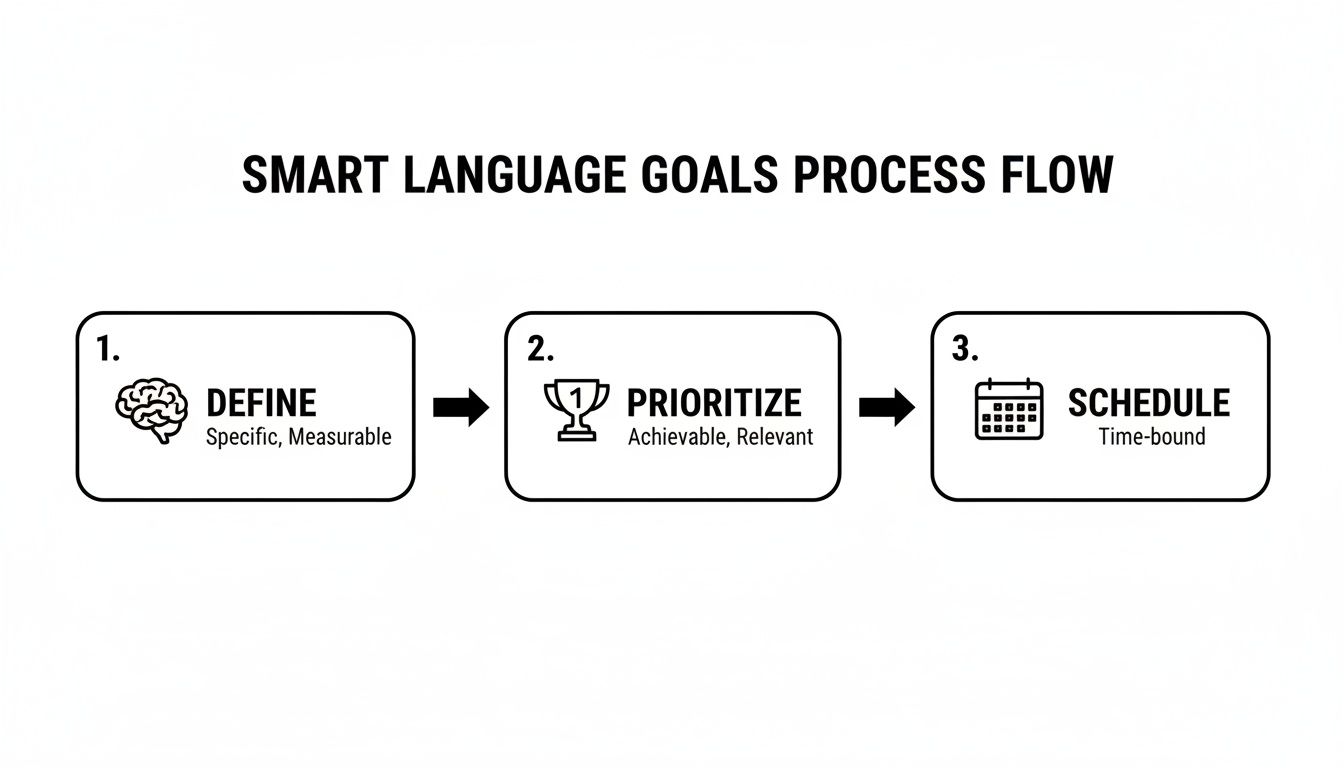
This visual shows how a solid schedule isn't just about random study blocks; it’s built on clear goals and smart choices.
Proven Scheduling Techniques for Polyglots
There’s no magic, one-size-fits-all schedule, but a few proven methods can be molded to fit almost any lifestyle. The trick is finding a rhythm that feels right for you and sticking to it.
- Timeboxing: This is where you dedicate specific, non-negotiable blocks of time to each language. You might decide, for example, that Monday, Wednesday, and Friday from 7:00 to 7:45 AM are for your 'major' language. Period. This builds an incredibly strong habit.
- Alternating Days: This strategy allows for deeper, more focused learning on a single language per session. Instead of splitting your focus every day, you give an entire day to one language, giving your brain a full 24 hours to immerse itself before you switch. This is especially helpful for keeping similar languages from blurring together.
The Power of Themed Learning
To really level up your schedule, try weaving in themed learning. This means picking a specific topic—like food, travel, or family—and studying the related vocabulary and grammar across all your languages for that week.
Here’s what that might look like:
- Monday & Tuesday (Spanish): You learn vocabulary for ordering in a restaurant, watch a YouTube video on Spanish cuisine, and practice food-related dialogues.
- Wednesday & Thursday (Japanese): Now, you shift to learning the names of common Japanese dishes, practice phrases for asking about ingredients, and use an app to review food-related kanji.
- Friday: You wrap up by reviewing the food vocabulary for both languages, maybe even writing out a sample grocery list in each.
This approach reinforces learning through connection, not confusion. Your brain starts linking concepts thematically, making it far easier to pull out the right words in the right language when you need them.
Sample Schedules for Different Lifestyles
Let's make this concrete. Here are a few templates showing how these strategies can work for different people. Feel free to steal these ideas and mix them up to create your own perfect week.
Remember, the best schedule isn't the most intense one; it's the one you can consistently follow week after week. Sustainability is your most powerful tool.
For the Busy Professional:
- Mon/Wed/Fri: 30-minute German practice during the morning commute (podcasts, audio lessons).
- Tues/Thurs: 30-minute French review during the lunch break (flashcards, reading news articles).
- Saturday: 1-hour immersive session for German (like watching a movie or having a conversation exchange).
For the Full-Time Student:
- Major Language (Mandarin): 1-hour dedicated study sessions on Monday, Wednesday, and Friday afternoons.
- Minor Language (Korean): 20 minutes of fun activities daily before bed (listening to K-pop, playing a language game).
- Weekend: 2-hour deep dive into Mandarin on Sunday to prep for the week ahead.
For the Frequent Traveler:
- Daily Habit: 15 minutes of vocabulary review for both languages first thing in the morning. No excuses.
- Alternating Days: Focus on Spanish on travel days (listening to audiobooks on the plane) and Italian on non-travel days (grammar drills and speaking practice).
- Flexible Goal: Aim for a total of 5 hours per language per week, slotting it in whenever downtime appears.
By building a schedule that's both structured and flexible, you turn the daunting task of learning multiple languages into a manageable and genuinely rewarding daily routine.
Proven Techniques to Minimize Language Interference
Let's be honest: mixing up your Spanish verb conjugations with your brand-new Italian vocabulary is one of the biggest—and most common—fears when you're learning multiple languages. It’s a totally normal part of the process. In fact, it's a sign your brain is working hard to forge new connections.
But you don't have to let that confusion derail your progress.
The trick is to create clear, distinct mental pathways for each language. This isn't about building a wall between them, but about creating unique contexts and routines that signal to your brain which "language mode" to switch into. With a few simple but powerful tactics, you can turn that potential jumble into confident clarity.
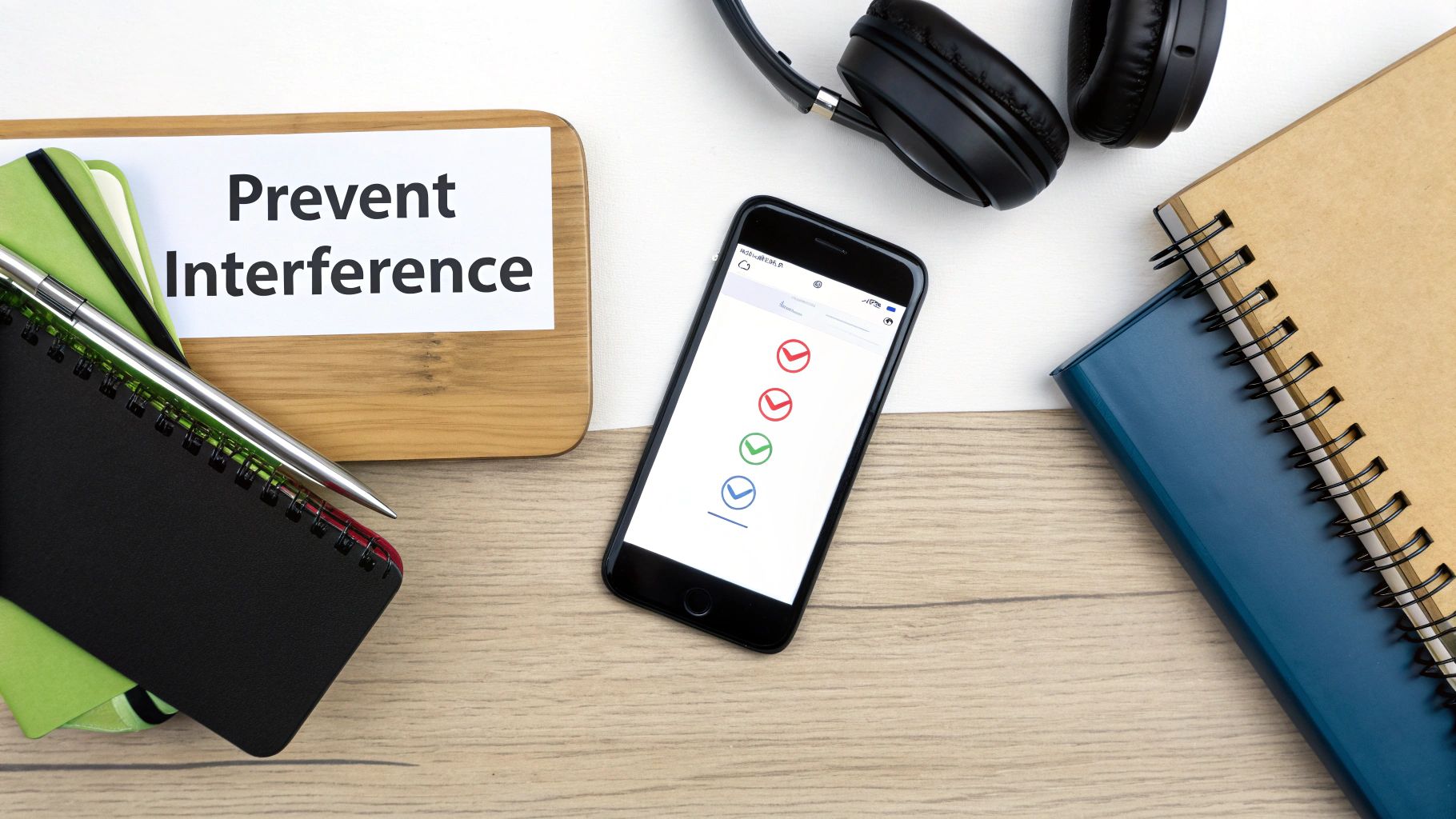
Create Separate Physical and Mental Spaces
One of the sneakiest ways to compartmentalize languages is to tie them to different physical things. This creates strong sensory associations that help your brain make the switch without you even thinking about it.
For instance, you could use a blue notebook exclusively for French and a red one for German. The simple act of opening the blue notebook primes your brain for French grammar and vocab. It's a small physical act that reinforces a huge mental separation.
You can take this even further:
- Designated Study Spots: Try studying Spanish in your favorite armchair and Japanese at your desk.
- Device-Specific Learning: Use your tablet for one language's apps and your smartphone for another's.
- Time of Day: Dedicate mornings to your "major" language and evenings to your "minor" one.
This strategy is incredibly effective. One of the biggest hurdles is managing the crossover between languages, but these small habits can make a big difference. If you want to dive deeper, you can also explore proven techniques to minimize native language interference to improve clarity across all your target languages.
Implement Context-Specific Immersion
You don't need to move abroad to create an immersive environment. Instead, build small, context-specific "immersion moments" throughout your day by linking each language to a specific daily activity.
For example, make a rule: you only listen to Italian podcasts while you cook. Soon, the act of chopping vegetables and the smell of garlic become cues for your brain to engage with Italian. At the same time, you might reserve your daily commute for drilling German flashcards on an SRS app like Anki.
This method anchors each language to a routine, making practice feel automatic rather than like another task on your to-do list. Your brain learns that "cooking time" means "Italian mode" and "commute time" means "German mode."
The power of this contextual learning is massive. Research from Africa shows that children who learned in a familiar language were 30% more likely to read with understanding. In Mozambique, a strategic shift to bilingual education boosted learning rates by 15%. This just shows how linking a language to a familiar context accelerates learning.
Structure Your Practice Across All Four Skills
To build robust, independent skills in each language, your practice needs to be balanced. You have to hit all four core competencies: listening, speaking, reading, and writing. If you neglect one area, you create weak spots that invite interference.
A balanced weekly plan for two languages might look something like this:
| Day | Language A (e.g., French) | Language B (e.g., Mandarin) |
|---|---|---|
| Mon | Listening: 20-min podcast episode | Reading: Short article on a news app |
| Tue | Speaking: 15-min practice with a partner | Writing: 5 journal sentences |
| Wed | Reading: One chapter of a graded reader | Listening: 20-min YouTube lesson |
| Thu | Writing: Comment on a French blog post | Speaking: 15-min solo pronunciation drill |
| Fri | Active recall with flashcards (all skills) | Active recall with flashcards (all skills) |
This structure ensures you're actively producing language, not just passively consuming it. That's what really cements what you've learned and keeps the languages separate in your head. For a deeper dive into sharpening one of these skills, check out our guide on how to improve listening comprehension.
Master Your Speaking Practice with Translate AI
Speaking is often where interference feels the most obvious, as your brain scrambles for words. The best defense is consistent, focused speaking practice.
This is where a tool like Translate AI really shines. You can use the app to have mock conversations in one language, then immediately switch to another. This is like a gym workout for your brain, training it to toggle between linguistic systems on demand.
For example, spend a few minutes practicing how to order coffee in German. Then, switch gears and practice asking for directions in Japanese. The instant feedback helps you catch and correct mistakes in real-time, strengthening the right pathways before interference can even get a foothold.
Building Your Personal Language Learning Toolkit
Technology has given us an incredible menu of language learning resources, but staring at that menu can feel paralyzing. How do you choose? And more importantly, how do you combine them into a system that actually works when you're juggling multiple languages?
The goal isn't just to download a bunch of popular apps. It's about building a cohesive, personal toolkit where every single tool has a specific job to do. A great system goes beyond a single app and creates an ecosystem—maybe a flashcard app for vocab, a streaming service for immersion, and a conversation platform for practice—all working together to help you hit your goals.
Find Tools That Actually Fit You
First things first: not every tool works for every person or every language. A visual learner might crush it with video-based lessons, while an analytical learner might prefer digging into detailed grammar guides. The whole point is to pick tools that align with how you learn and what each specific language demands.
For instance, learning Spanish is a dream for immersion because of the sheer volume of amazing music and shows on Netflix. But if you’re tackling Japanese, an app dedicated to memorizing Hiragana, Katakana, and Kanji is pretty much non-negotiable.
Don't be afraid to experiment. Try a tool, and if it doesn't click, drop it.
The most powerful toolkit is the one you actually use. It’s far better to have two or three tools you engage with daily than ten apps just collecting digital dust on your phone.
This is all about creating a streamlined system, not hoarding resources. Your toolkit should feel supportive, not like another chore on your to-do list.
Assemble Your Core Language "Stack"
I like to think of a toolkit as a "stack," with different layers, each one targeting a core language skill. A balanced stack ensures you're doing more than just memorizing words; you're building well-rounded fluency.
Here’s what a solid, balanced toolkit might look like:
- Vocabulary and Spaced Repetition (SRS): An app like Anki is a must for burning vocabulary into your long-term memory. Spaced repetition is one of the most efficient learning methods out there, period.
- Listening and Immersion: This is where you bring your languages to life. Use Netflix for shows, YouTube for creators in your target language, or podcast apps for practice on the go.
- Reading Practice: Start simple with graded readers or news apps built for learners. As you get more comfortable, you can graduate to blogs, online magazines, or ebooks.
- Speaking and Conversation: This is often the toughest piece of the puzzle to solve. Finding good conversation partners is invaluable. To get started, you might want to check out our guide on the best language exchange apps.
By consciously picking one or two primary tools for each of these categories, you create a complete system that covers all your bases for each language you're learning.
Supercharge Your Speaking Practice with Translate AI
Finding consistent, on-demand speaking practice is a huge roadblock, especially when you're learning multiple languages. This is exactly where a dedicated tool can make a world of difference for your progress and confidence.
Think of Translate AI as your personal, always-available conversation partner for over 80 languages. It's built to help you bridge that gap between knowing a word and actually being able to use it in a sentence.
You can practice ordering food in Spanish, then immediately switch gears to ask for directions in Japanese, all within the same app. That kind of flexibility is perfect for the aspiring polyglot.
Here’s how you can use it to level up your speaking skills:
- Pick your languages. Just select your native language and the one you want to practice.
- Speak naturally. Talk right into your earbuds. You can ask a question, describe what you did today, or run through a specific scenario you're nervous about.
- Get instant feedback. The app gives you an immediate, natural-sounding audio translation. This is huge for hearing the correct pronunciation and picking up authentic phrasing in real time.
This simple loop trains your brain to switch between languages more smoothly and builds the muscle memory you need for real-world conversations. It’s an amazing way to build speaking confidence across all your target languages, anytime, anywhere.
You can download Translate AI from the App Store and start practicing today.
Got Questions? Let's Talk Strategy
Diving into more than one language at a time is a huge thrill, but it's totally normal for questions to pop up along the way. As you get deeper into your studies, you'll hit little roadblocks and moments of curiosity. This section tackles some of the most common questions with direct, practical answers to keep you moving forward with confidence.
What Are the Best Languages to Learn Together?
To keep your brain from getting its wires crossed, the smartest move is to pair languages from different families, especially if you're a total beginner in both.
For an English speaker, picking up a familiar Romance language like Spanish alongside something completely different like Japanese is a fantastic combo. Their unique grammar, sounds, and writing systems create clear mental boundaries, making it much harder to mix them up.
Whatever you do, try to avoid learning two very similar languages at the same time, like Italian and Portuguese. If you're new to both, the huge overlap in words and sentence structure is a recipe for confusion. Once you’re comfortably intermediate in one, however, picking up its linguistic sibling becomes way easier.
How Much Time Should I Actually Study Each Day?
Here’s the thing: consistency beats intensity, every single time. Aim for a realistic 30-45 minutes of focused study for each language, every day. If life gets crazy, just remember that a solid 15 minutes is infinitely better than skipping a day altogether.
A great little trick is to assign a "major" and "minor" language. Your major might get 45 minutes of deep work, while your minor gets a lighter 20-minute review session. You can also alternate days, giving each language a longer, more immersive study block. This helps prevent burnout while making sure you're still making real, measurable progress.
Help! I'm Starting to Mix Up My Languages
First off, don't panic. This is a completely normal part of the process. In fact, it's actually a good sign—it means your brain is busy building new connections. The goal isn't to never make a mistake, but to manage the interference by creating sharp distinctions between your languages.
Language interference isn't a sign of failure; it's a sign of an active, learning brain. The solution is to create stronger, more distinct contexts for each language.
Try these simple but powerful tricks to create that separation:
- Use different notebooks or even different colored pens for each language.
- Study in different physical spots. Maybe you do your German at your desk and your French on the couch.
- Assign languages to a time of day. For example, German in the morning with your coffee, and French in the evening to unwind.
When you catch yourself slipping—say, using a Spanish word in an Italian sentence—just consciously stop, correct it, and review the right word or phrase. Over time, your brain will build stronger, separate channels for each one, and the mix-ups will happen a lot less.
How Do I Know if I'm Actually Making Progress?
To really see how far you've come, you have to move beyond just a vague "feeling" of improvement and set some concrete, measurable goals. Hitting tangible milestones gives you a clear picture of your skills and is a massive motivator.
Here are a few ways to track your progress that actually work:
- Record yourself having a five-minute conversation with a language partner or even just talking to yourself.
- Try writing a 100-word journal entry without looking up a single word.
- See if you can get through a short podcast episode or a YouTube video from start to finish.
Another pro-level move is to periodically use the CEFR self-assessment grids. It’s a framework that lets you honestly evaluate your listening, speaking, reading, and writing for each language. This gives you a structured overview of where you stand and what you need to focus on next—clarity that is absolutely crucial when you're figuring out how to learn multiple languages at once.
Ready to put these strategies into practice and really level up your speaking skills? Translate AI can act as your personal conversation partner, letting you practice speaking in over 80 languages whenever and wherever you want. It's the perfect way to build confidence, nail your pronunciation, and make real progress. Download the app and start your first conversation today!