

English to Thai Translator: How to Get Accurate Results
It's close to midnight on a side street in Bangkok. The hotel gate is shut, the driver doesn't read Latin script, and your booking confirmation shows an address that means nothing to him. You type the English line into your phone, hold up the screen, and watch his face change from puzzled to certain. He nods, drives four minutes, and stops exactly where you needed to be.
Now a different night, same phone. You're trying to explain to a landlord why one clause in a lease should change. The Thai on screen reads smoothly. It also sounds, to the person across the table, like a demand from a stranger rather than a request from a tenant. Nothing in the app warns you.
The gap between those two scenes isn't the software. It's knowing which mode fits the moment, what happens between your sentence and the listener's understanding, and which details deserve a second check. That's what follows, with the failure points named plainly and the fixes written out.
Match Your Situation to the Right Translator Mode
Start with a cost estimate, not a feature list. If a mistake costs you a detour, take the fastest mode and move on. If it costs money, documents or a missed connection, use the mode that lets you read the Thai before anyone acts on it.
Travel is why many travelers open an English to Thai translator at all. Thailand welcomed 11,350,463 international visitors between January 1 and April 21, 2025, according to the Tourism Authority of Thailand, and the vast majority of those conversations are short, repeated and logistical: a fare, a room key, a bowl of noodles.
| Situation | Best mode | Why it fits | Main risk |
|---|---|---|---|
| Hotel check-in or taxi | Live two-way voice | Both sides hear replies right away | Street noise and accents |
| Ordering food | One typed or spoken phrase | Short input gives clean output | Dish names and spice level |
| Business meeting with a Thai partner | Live two-way voice with speaker mode | Hands-free, real-time turns | Technical terms and contract wording |
| Reading a Thai sign, message or email | Text input | You can check the Thai before acting | Missing context in short text |
| Learning Thai phrases | Typed input compared with spoken output | Shows script and sound together | Leaning on machine phrasing without checking |
The mode test: if you'd want a receipt, use text. If you'd want a nod, use voice.
Two sentences cover almost everything else. Use voice when both people must answer in real time and the stakes are low. Use text when a mistake would be expensive and you have a moment to inspect the Thai before you send it.
What separates the modes isn't the model behind them. It's how much of the process you can see before the other person reacts, which is the difference between reading a translation and living with it.
How Text and Live Voice Translation Work
Think of translation as a relay with three runners: you, the software, and the listener. A trained interpreter runs all three legs at once and adjusts mid-stride. A phone runs them in sequence, and the whole sequence takes a couple of seconds.
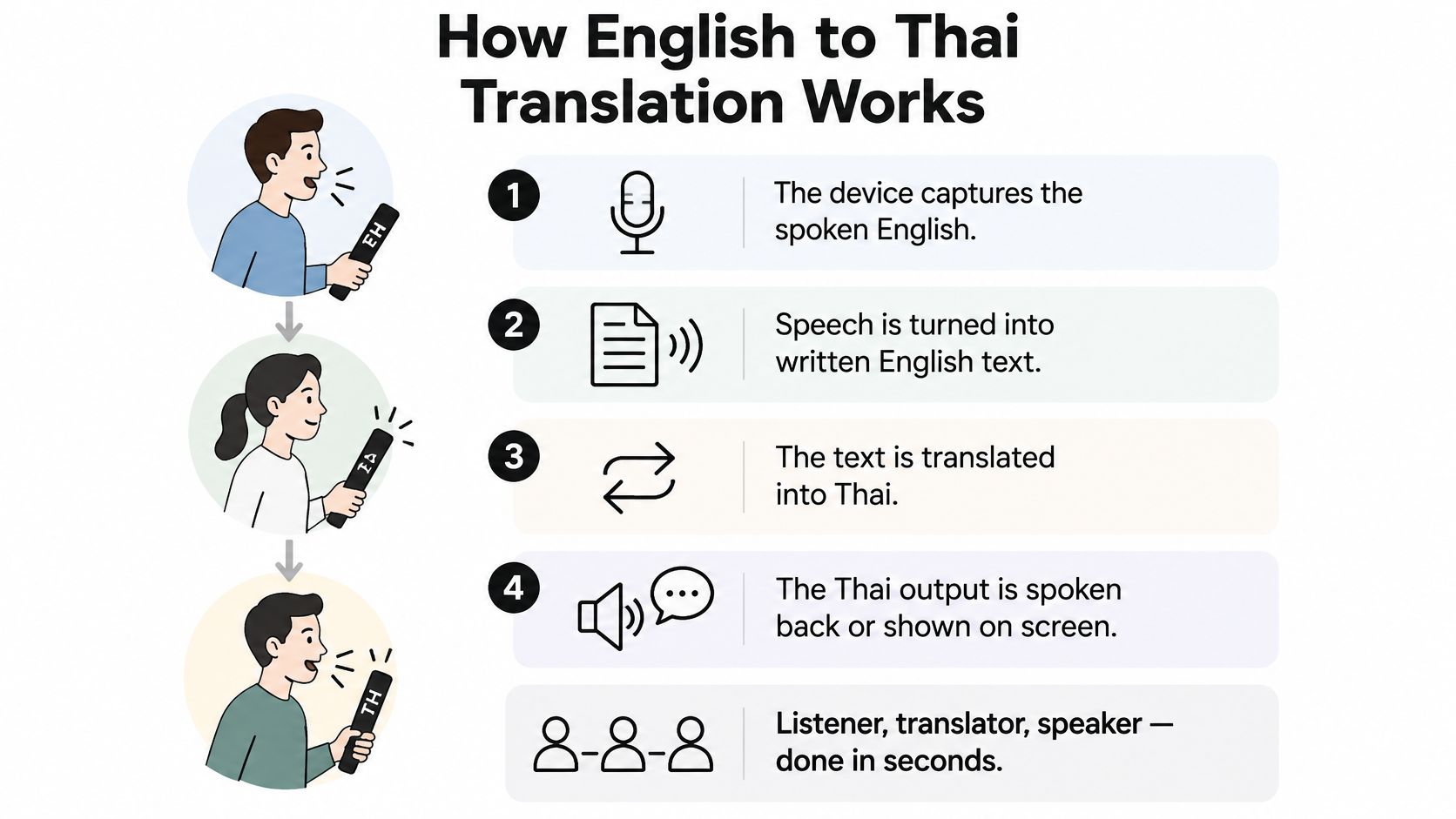
The relay starts when the device captures your English, either as typed characters or as sound through a microphone. In voice mode, speech recognition turns the audio into an English string. That stage disappears entirely when you type, which is why typed input usually beats speech on a noisy sidewalk.
Next, the system splits the English into meaningful units and passes them to the translation model, which produces Thai. The Thai appears on screen and, in voice mode, is spoken aloud for the listener. Four visible stages, one invisible idea: the software is rebuilding meaning, not swapping words.
Why Thai word boundaries change the output
Thai is written without spaces between words, so the system has to locate word boundaries before it can assemble meaning. Move a boundary one syllable early and you change vocabulary lookup, the alignment between the two sentences, and the grammar the model assumes for the rest of the clause.
Research on Thai word segmentation has reported accuracy in the 95 to 99% range for advanced methods, while flagging unknown words as the persistent weak point, since names, new terminology and colloquial forms defeat dictionary matching (ACL 2000 study). A street name the dictionary has never seen is exactly the kind of input that slips.
Why older systems and modern models behave differently
Early English to Thai systems encoded hand-written grammar rules, so they failed predictably and often ungrammatically. Modern neural models weigh the whole sentence and use context, which means they produce smoother Thai but can also smooth over a detail they never understood. Fluent output is not the same as correct output, and you can't tell the two apart from the Thai alone if you don't read Thai.
Live talk feels slower than typing because every stage adds a fraction of a second, and because you're also waiting for a human to finish thinking. The practical check sits at the end of the pipeline: before you speak or send, glance at the Thai and ask whether it carries the meaning you intended.
Where English to Thai Translation Still Fails
Machine output fails in patterns, and the patterns are predictable enough to plan around. Scan the left column until you find the failure you've just met, then read across.
| Limit | What you will see | Practical response |
|---|---|---|
| Regional dialect | Words outside Central Thai in replies | Keep Central Thai and confirm key points |
| Domain terms | Medical, legal or business wording shifts | Use a glossary or a human for final text |
| Literal word order | English idiom turned into awkward Thai | Simplify the English and translate again |
| Names and places | Hotel, street or product names garbled | Show the English spelling beside the Thai |
| Numbers and times | Digits, units or dates misread | Read the figures back in English |
The most revealing number in this work is a gap. A 2022 survey of Thai language technology published at LREC puts Thai at roughly 70 million speakers and still classifies it as under-resourced, and the same paper reports a benchmark evaluation scoring 29 BLEU for Thai-to-English against 17.77 for English-to-Thai. BLEU is an automatic score of overlap with reference translations, so a higher figure means closer agreement with a human version, not guaranteed fluency and never factual accuracy.
That asymmetry describes something you'll notice in practice. Reading a Thai menu or a roadside sign is a recognition job with plenty of surrounding context. Writing a natural Thai sentence for one specific listener is a generation job, and generation is where particles, tone and word order come apart.
A working rule: trust the app to tell you what Thai text says. Verify the Thai text it writes for you.
Why the same app is strong on menus and weak on contracts
Training material decides domain strength. The same survey counts 5.4 million English–Thai sentence pairs in OPUS-MT data, 68.8 million English tokens against 53.1 million Thai tokens, drawn largely from web and news text. That's a deep well of everyday language and a shallow one for lease clauses, clinical instructions and regional dialect.
So a tool that handles a taxi request cleanly can still fumble a contract line, because the contract line never appeared in its training material in a usable form. Quality varies by subject, not by app.
The checking routine near the end of this guide exists to catch exactly this class of error before money or documents change hands. Treat every unfamiliar domain as a first draft.
Politeness and Tone in Thai Output
Thai carries politeness as grammar, not as garnish. A sentence can be perfectly understandable and still land badly because its ending doesn't match what the speaker is doing with it.

Linguistic research identifies khráp, khá and khâ as polite particles whose forms and functions are not interchangeable, and reports that khá and khâ have different sentence compatibility and usage requirements (Journal of Pragmatics study). Khâ can occur when giving information, responding, or confirming facts. Khá can signal an intention to demand attention, request information, or request a response.
Put that in a shop. Asking where the bus to the old town stops is a request for information, so the utterance follows one shape. Confirming that the fare is 150 baht is a confirmation of fact, so it follows the other. Same courtesy, different machinery, and a translator that appends one ending to everything gets half your sentences wrong.
A three-step check before you speak
- Name the speech act. Are you requesting, asking, answering, confirming, or calling for attention?
- Check that the Thai ending matches that act. Read the final particles as a signal, not decoration.
- Don't bolt on a polite word. Translating the whole utterance preserves the act; adding a generic ending can blur it.
Romanized spellings hide these distinctions, which is why you should read the Thai script or play the audio rather than trusting your own transliteration. If the particle choice still looks arbitrary, that's your signal to simplify.
Politeness is a small act of what transcreation in translation means in practice: you're adapting intent to a new social setting, not restating words.
Register shifts between settings too. A counter exchange at a hotel wants brevity and warmth. A message to a senior business partner wants more distance and a formal frame. When you're unsure, keep sentences short and neutral, and have a Thai speaker review any formal message before it goes out.
Phrase English Input for Cleaner Thai
"Can you do me a solid?" is the kind of line that breaks a translator. There's no literal Thai equivalent, so the model guesses, and the listener receives something between odd and incomprehensible. The English you feed in determines how much repair work you do later.
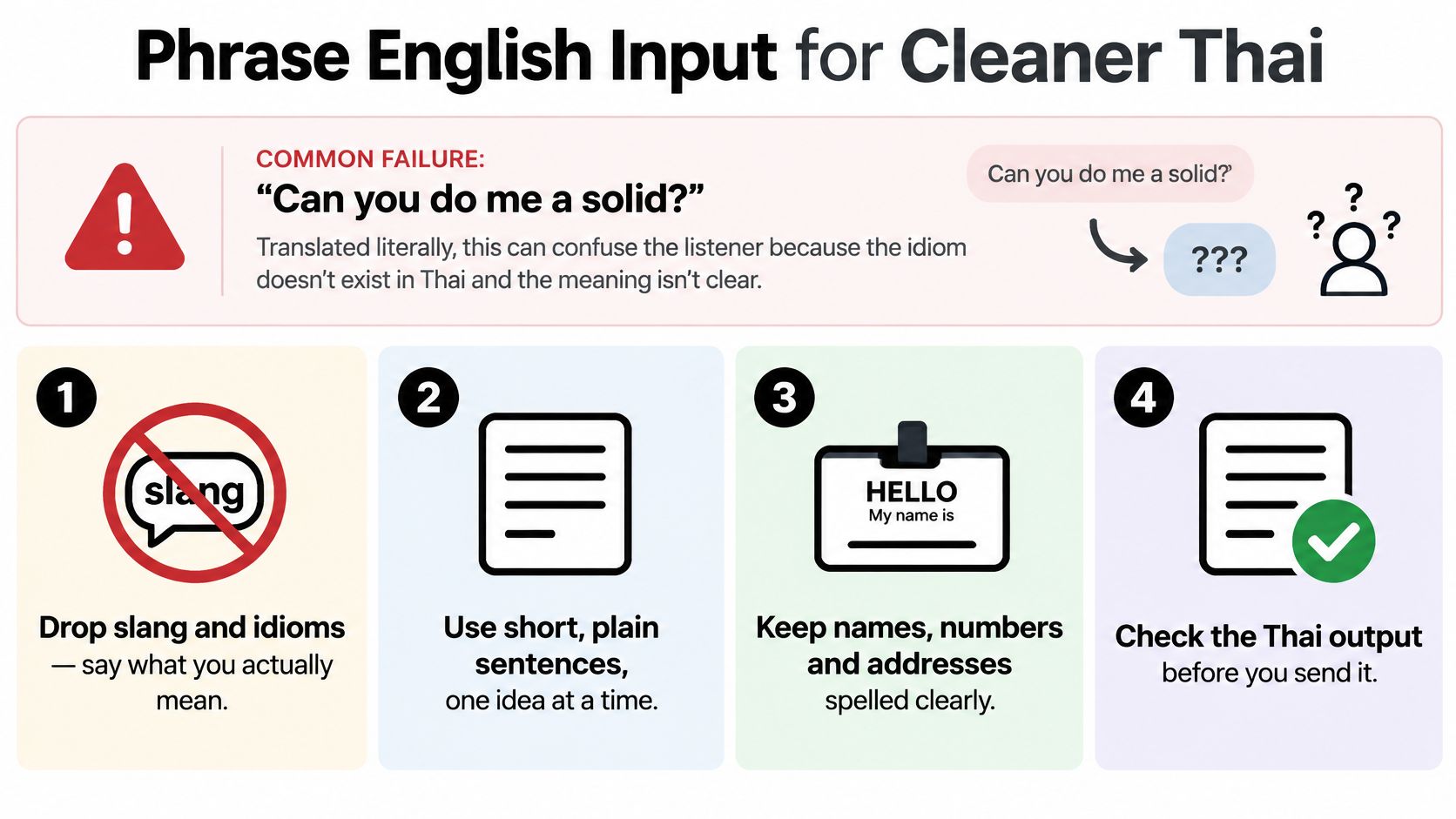
- One idea per sentence. Split "pick us up, stop at an ATM, and wait while we buy water" into three separate translations, because each has its own object and timing.
- Name the specifics. Destination, number of people, date and time belong in the source sentence, not in a follow-up question.
- State the constraint. Say whether the request concerns price, route or departure time, so the Thai doesn't leave the decision open.
- Drop slang, sarcasm and idioms. Compressed phrases carry ambiguity before translation and multiply it after.
- Read the Thai against your meaning before you send or show it. If you don't read Thai, use back-translation, covered below.
- Ask for confirmation whenever money, medicine, identity documents or a travel connection is involved.
Plain wording matters more here than in an English-only setting. Thailand's official reporting identified China, Malaysia, Russia, India and South Korea as the five largest visitor groups between January 1 and April 13, 2025, with roughly 1.47 million Chinese visitors and 1.33 million Malaysian visitors among them (Thailand.go.th). Many people in these conversations aren't first-language English speakers either, so simple source sentences help both sides.
Here's the rewrite. Vague: "Can we go to the hotel around noon, two of us, the big one by the river?" Precise: "Take us to Hotel X in Bangkok. Two passengers. Leaving at 12:00." The second version survives translation with fewer edits because every element maps onto a Thai slot: destination, count, departure time.
If a reader from another country would misread your English, the translator will probably misread it too.
For learning, type the phrase, compare the Thai script with the spoken audio, and repeat aloud until your version matches what the listener hears. That typed-versus-spoken comparison shows script and sound together, though it can hide phrasing that no Thai speaker would use.
Run a Live English and Thai Conversation in Translate AI
At a café table, the useful test is whether both people can take a turn, hear the result and correct a misunderstanding. Before relying on an app during a trip, practise translating a conversation in real time with someone who can respond.

Translate AI's voice conversation setup takes four steps:
- Choose both languages. Select your native language and your partner's language from the app's list.
- Tap the microphone and speak naturally. Use your normal voice and give the app one complete thought at a time.
- Read and listen to the result. The translation appears on screen and is spoken immediately after you speak.
- Enable speaker mode for hands-free chats. At a shared table, both people can listen without holding earbuds.
The app supports two-way dialogue: you speak in your language and your partner hears the translation in theirs. Their reply is translated back for you. Treat the exchange like passing a microphone: finish your turn, let the other person hear it, then leave room for a reply.
Repair moves when the conversation breaks
In a 2025 study of Thai vendors serving foreign tourists, 76.67% named tourists' accents as their main listening difficulty, 63.33% used gestures to fill gaps, 43.33% asked visitors to repeat themselves and 43.33% used machine translation (Thai Journal of Tourism research).
A successful exchange includes a way to recover.
- Repeat the unclear word slowly. Repeating the whole sentence louder gives the listener more material to untangle.
- Pause between complete thoughts. Give your partner time to hear the translation before adding another request.
- Move away from competing noise. Then tap the microphone and try the missed phrase again.
- Point to the relevant item or screen. A menu item, name or number gives both people a shared reference.
- Ask for a simpler restatement. If regional wording or a politeness particle leaves you unsure, ask what the person means rather than guessing from the main vocabulary alone.
For an English and Thai exchange, check whether the listener understood the request and its tone. If they hesitate, ask whether the wording sounds polite before repeating it unchanged.
Include mobile connectivity in your trip preparation. The Simsima guide to Thai connectivity covers eSIM options for Thailand; test your setup before you need to hold a conversation on the street.
Get Translate AI
Translate AI provides instant voice translation in over 80 languages for travel, work and everyday chats. You can download Translate AI from the App Store.
Before a trip or meeting, run a two-minute practice chat with a friend using languages available in the app. Take turns speaking, listening and deliberately asking for a repeat. The rehearsal should include a misunderstanding, so you practise recovering rather than merely hearing a translation.
Decide When to Trust a Translation or Hire an Interpreter
The rule is short. Routine logistics can rely on the translator. High-stakes details need verification or a person. Sort the case in front of you with the table below.
| Tier | Typical cases | What to do |
|---|---|---|
| Routine | Directions, ordering, check-in, simple taxi request | Translate and confirm the meaning on screen |
| Verify | Names, addresses, times, amounts, travel connections | Translate back into English and confirm each detail |
| Human only | Medical, legal or financial instructions | Use a qualified interpreter |
Back-translation is the habit that makes the middle tier work: translate your sentence into Thai, read the Thai against your intended meaning, then translate it back into English and see what changed. Show or play the Thai to the listener and watch their reaction, because a frown at a number is information.
What back-translation catches is meaning shift. What it can't catch is politeness, so run the particle check before sending any formal message. And keep the tiers honest: a live voice tool gives instant translations in over 80 languages, translates both ways, and works with most AirPods and earbuds, which is plenty for a train platform and never enough for a hospital consent form. Distinctions like that are why the difference between an interpreter versus a translator still matters in a phone-shaped world.
Pick one row from the situation table, test it with a friend or a Thai speaker this week, and keep the back-translation habit for every number and every name.
Translate AI was built for the moments this guide describes: a taxi at midnight, a counter conversation, a meeting where you need the reply in your own language before you answer. It translates both ways across more than 80 languages, shows and speaks each translation instantly, and supports hands-free speaker mode for real back-and-forth talk. Install it before your next trip or cross-border call by visiting Translate AI.