

Master German Conversations With An English To German Voice Translator
Planning a trip to Berlin or closing a deal in Frankfurt? You know the language barrier is a real hurdle. Fumbling with a phrasebook feels awkward, and mistranslations can lead to missed connections, wrong train tickets, or costly business misunderstandings. The goal of this guide is simple: to show you how to use a modern english to german voice translator to communicate confidently and clearly, turning stressful situations into seamless conversations.
Why Instant Voice Translation Is a Game Changer in Germany
Picture this: you're standing on a busy U-Bahn platform in Berlin, trying to ask for directions, but your high-school German just isn't cutting it. Or imagine you're in a Frankfurt business meeting where a crucial detail gets lost in translation, putting a whole deal on the line. These aren't just minor hiccups; they are moments of real disconnect that can derail your travel or business goals.
The real problem is the gap between knowing a few phrases and actually holding a conversation. That’s exactly where a modern english to german voice translator becomes your most essential tool.
Beyond Basic Phrases: Actionable Advice
Fumbling with phrasebooks or clunky apps creates awkward pauses that kill the natural flow of any chat. An instant voice translator bridges that gap, allowing for real-time dialogue that feels human and fluid.
This is a huge deal for a few groups in particular:
- For Travelers: Ask for directions, order dinner, or handle a delayed train without stress.
- For Professionals: Ensure every point lands perfectly in meetings or negotiations where there's no room for ambiguity.
- For Language Learners: Use it as a digital practice partner to nail pronunciation and comprehension with a native sound.
The Power of an Intuitive App
The best tools today are designed to be dead simple. Take a look at the straightforward interface on a powerful translation app, for example.
The screen makes it obvious how to pick your languages and get a translation started. It gets the tech out of the way so you can just focus on the person you're talking to. This demand for accessible tools is a big reason why the global speech-to-speech translation market is expected to hit USD 1.25 billion by 2031, with Germany being a major driver of that growth in Europe. You can read more about the growth of speech translation technology and its market trends to see just how big this is becoming.
The goal isn't just to complete a transaction, it's to build real understanding. Whether you're sharing a story with a new friend or clarifying a contract, the right tech lets you communicate your thoughts accurately and personally.
Your First Conversation From Setup to Speaking
Let's get you translating in the next few minutes. This section provides actionable steps to get your english to german voice translator app ready for a live conversation. Our goal is to make sure everything works perfectly from the moment you open it.
First, install the app. The single most important step during setup is granting permissions. When the app asks for microphone access, say yes. Without it, the voice translation features won't work.
With permissions handled, pick your languages. You'll see two slots on the main screen.
- Tap the first slot and set your source language to English.
- Tap the second slot and set your target language to German.
This tells the app, "I'm speaking English, and I need you to speak German back."
Making Your First Translation: A Step-by-Step Guide
Alright, setup's done. Time for the fun part. The interface is designed to be dead simple—look for the big microphone icon. That's your go-button.
Here’s how to translate a common phrase:
- Tap and hold the Microphone icon.
- Speak clearly into your phone: "Excuse me, can you help me?"
- Let go when you're done speaking.
Instantly, you'll see the German text "Entschuldigung, können Sie mir helfen?" on the screen and hear the translated audio. That immediate feedback confirms everything is working.
That first successful translation is a huge confidence boost. It proves how easy this technology is to use and gets you ready for more complex, real-world chats without feeling hesitant.
Using a Powerful Tool Like Translate AI
To make this whole process feel seamless, you need a well-designed app. A great option is Translate AI, which is built specifically to get you from installation to conversation with zero friction. Its clean layout makes choosing languages and starting a translation feel completely natural. If you want a reliable tool that just works, you can get the Translate AI app on the App Store. It turns a potential tech headache into a simple, two-tap process, letting you focus on the person you're about to talk to.
Holding Natural Two-Way Dialogues
One-way translations are useful, but the real power of an effective English to German voice translator is handling fluid, back-and-forth conversations. This section will give you specific advice on managing real dialogues.
The secret is a feature often called "conversation mode." When enabled, the app listens for both languages simultaneously. You speak English, and your German counterpart hears the translation; they reply in German, and you hear it in English. This makes the exchange feel natural, not clunky. The AI language translation market jumped from USD 1.88 billion in 2023 to USD 2.34 billion in 2024, a 24.9% annual leap, highlighting how vital this kind of communication has become.
Mastering the Flow of Conversation: Actionable Tips
To make these chats feel seamless, adopt these simple habits:
- Speak in clear, complete sentences. Avoid starting a thought, pausing, and then finishing it. This gives the AI the full context it needs.
- Embrace the pause. After you finish speaking, give the app a beat to process and deliver the translation. Jumping in too quickly can break the flow.
The setup process itself is incredibly straightforward, as this little graphic shows.
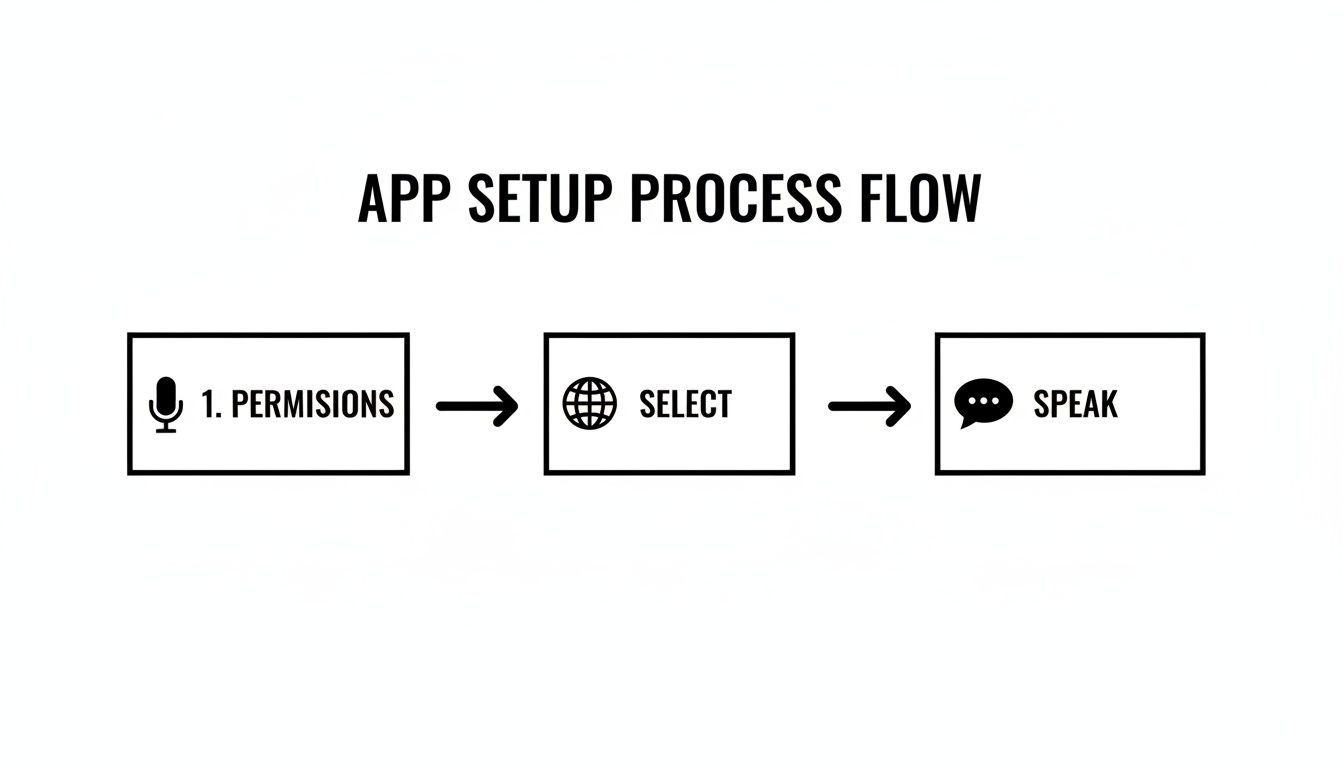
As you can see, getting started is as simple as giving the app microphone permissions, picking your languages, and talking.
Choosing Your Communication Mode: Speaker vs. Earbuds
Your location should dictate how you handle audio. Your choice between using the phone's speaker or earbuds can make or break the experience.
Here’s a quick guide to help you decide:
| Scenario | Best Mode | Reasoning |
|---|---|---|
| Ordering at a quiet café | Speaker | Allows for a natural, open conversation where both you and the barista can easily hear the translations. |
| A private business discussion | Earbuds | Keeps the conversation confidential and ensures clarity, even if there's some background chatter. |
| Navigating a loud market | Earbuds | Cuts through the noise so you don't miss a single word of the translation. |
| Checking in at a hotel lobby | Speaker | Simple and direct. Both you and the receptionist can follow the dialogue without any extra hardware. |
| Asking for directions on a busy street | Earbuds | Lets you hear the directions clearly over traffic noise, while the other person hears from the phone. |
Be flexible. Start with speaker mode in quiet places, but always have earbuds handy for loud or private conversations.
A Powerful Tool for Two-Way Dialogue
To put all this into practice, you need an app built for fluid conversation. This is where Translate AI really shines, thanks to its intuitive two-way dialogue feature. The experience is designed to manage the natural give-and-take of a real discussion, making your interactions feel less like transactions and more like genuine connections. You can learn more in our guide on how to translate a conversation in real time.
Pro Tips for Crystal-Clear Translation Accuracy
Getting a basic translation is easy, but getting an accurate one requires finesse. Here is some specific, actionable advice to improve the quality of your translations. Think of your english to german voice translator as a skilled listener: the cleaner the audio you provide, the better the German it returns.
Tidy Up Your Speaking Habits
The way you talk has the biggest impact on translation quality. AI is smart, but it translates what it hears. Feed it clean, clear audio.
Here are three simple adjustments you can make right now:
- Ditch the Slang: Phrases like "it's raining cats and dogs" or "let's hit the road" have no direct equivalent in German and will confuse the AI. Stick to direct language.
- Use Complete Sentences: Instead of "Ticket... Munich?" say, "I would like to buy a ticket to Munich." A complete grammatical structure is key to an accurate translation.
- Enunciate Clearly: Mumbling is the enemy of voice translation. You don't need to shout, but speaking distinctly makes all the difference.
Control Your Environment
Background noise is the biggest cause of bad translations. It competes with your voice and confuses the AI.
Your goal is to give the app a "clean" audio signal. A bustling café, a windy street corner, or a crowded train station all introduce sounds that can throw the AI off track.
Before starting a conversation, take a second to look around. Can you step into a quieter corner? Can you turn your back to the main source of noise? Even a small reduction in background chatter can dramatically improve your results. This simple act is often the secret to a flawless translation. You can learn more about how a top-tier live voice translation app processes audio.
Putting Your Translator to the Test in Germany
Theory is one thing, but how does this work in the real world? This section provides actionable examples for common situations in Germany where an english to german voice translator becomes an essential tool.
Germany is a massive hub for global business and tourism, making it one of Europe's biggest markets for translation services. This need for clear communication is growing, and starting in June 2025, the European Accessibility Act will require many services to be more accessible across different languages. You can learn more about the growing demand in the translation market.
Let's see how a translator can help you on the ground.
Ordering at a Restaurant in Berlin
This is the perfect first test. Instead of just pointing at a menu, you can make specific requests. Imagine you have a nut allergy—a scenario where clarity is non-negotiable. Activate your translator and say:
"I have a severe nut allergy. Can you tell me if this dish contains any nuts or nut oils?"
The app instantly relays this in perfect German, removing all ambiguity.
These small wins build confidence. When you successfully order a meal, you prove you can handle daily life in Germany, making the trip less intimidating and more fun.
Buying a Train Ticket at Munich Hauptbahnhof
A massive station like Munich’s Hauptbahnhof can be overwhelming. Don't wander around feeling lost. Walk up to the information desk with your phone ready.
- You say: "I need to buy a one-way ticket to Nuremberg for today, please. Which platform does the next train leave from?"
- The result: This direct question cuts through the confusion. The agent gives a clear answer, your app translates it back, and you can buy the right ticket and head to the correct platform.
Holding a Business Meeting in Frankfurt
For business travelers, clear communication is everything. A voice translator can be your secret weapon. For instance, when wrapping up a meeting, confirm a deadline by saying:
"Thank you for the presentation. Just to clarify, is the deadline for the proposal next Friday, the 15th?"
This ensures there are no expensive misunderstandings about project timelines.
The Right Tool for Any Scenario
To handle these real-world moments, you need a fast, accurate, and easy-to-use app. A tool like Translate AI was built for these situations, offering translations that understand context. Its two-way dialogue mode makes conversations feel natural, not robotic. Download the Translate AI app from the App Store to turn these challenges into confident conversations.
Meet Your Go-To Translation Tool
To put these strategies into practice, you need an english to german voice translator that's powerful, intuitive, and reliable. The right tool in your hand is what turns an awkward interaction into a successful conversation. The ideal app should feel less like a clunky piece of tech and more like a natural extension of your own voice.
Introducing Translate AI
This is where an app like Translate AI makes all the difference. It was built from the ground up for seamless, live voice conversations in over 80 languages, delivering flawless English-to-German translations that sound natural and keep the dialogue flowing. Powered by advanced AI, it captures the real meaning behind your sentences, ensuring your message is truly understood.
One of the app's most practical features is its universal compatibility.
You don't need to buy special hardware. Translate AI works perfectly with any standard earbuds or AirPods you already own, making it an accessible and cost-effective solution.
Getting started is designed to be incredibly simple. Just select your languages, tap the microphone icon, and start talking. You can use speaker mode for a group chat or switch to your earbuds for a private discussion. For more on this, check out our guide on choosing the best voice translation devices.
For anyone traveling or doing business in Germany, Translate AI is the key to breaking down language barriers with confidence.
Get Started with Translate AI
You can download Translate AI directly from the App Store and start your journey to effortless communication today.
Your Top Questions, Answered
Relying on an english to german voice translator can bring up a few questions. Let's clear up some common concerns.
Just How Accurate Are These Things, Really?
Modern AI translators often hit over 95% accuracy for everyday conversations. They have gotten much smarter at understanding context, leaving older tech in the dust. For the best results, speak clearly, avoid niche slang, and find a spot with minimal background noise.
Do I Have to Be Online for It to Work?
Yes, for the best real-time translation, top apps like Translate AI need an active internet connection (Wi-Fi or cellular data). This allows the app to access powerful, cloud-based AI engines that deliver the most precise and natural-sounding translations.
Can I Just Use My Own Earbuds?
Absolutely. You don't need special hardware. The best apps are designed to work perfectly with the Bluetooth earbuds, AirPods, or wired headphones you already own. This makes getting started convenient and cost-effective.
The key takeaway is that modern voice translators are built for real-world use. They're accurate, easy to set up, and integrate smoothly with the tech you already carry.
Ready to have seamless, confident conversations in German? Translate AI puts a world-class interpreter right in your pocket.
Give the app a try and start communicating without hesitation. You can download it from the App Store today.