

Cuales Son Los Verbos en Ingles: Your Practical Guide to Speaking with Confidence
Feeling stuck trying to form sentences in English? You know the words, but making them work together feels like a puzzle. If you're a Spanish speaker, you've probably noticed that English verbs can be tricky. They don't always behave the way you expect.
The good news is, you don't need to memorize hundreds of grammar rules to speak confidently. The secret is to focus on what matters most. This guide will give you a clear, actionable plan to master the essential English verbs so you can stop translating in your head and start speaking naturally.
Why Verbs Are the Engine of Every Sentence

Think of verbs as the engine of a car. Without them, a sentence is just a collection of parts that goes nowhere. The verb provides the action (run), expresses a state of being (is), or describes something happening (happens).
For Spanish speakers, mastering verbs is the key to unlocking fluent conversation. Once you understand how they work, you can build sentences, ask questions, and share your thoughts on any topic. This is especially true when it comes to concepts like "ser" vs. "estar," which English often bundles into a single verb, "to be." If that's a pain point, our guide on when to use ser or estar can help.
This diagram gives you a bird's-eye view of the main verb categories we’re about to dive into.
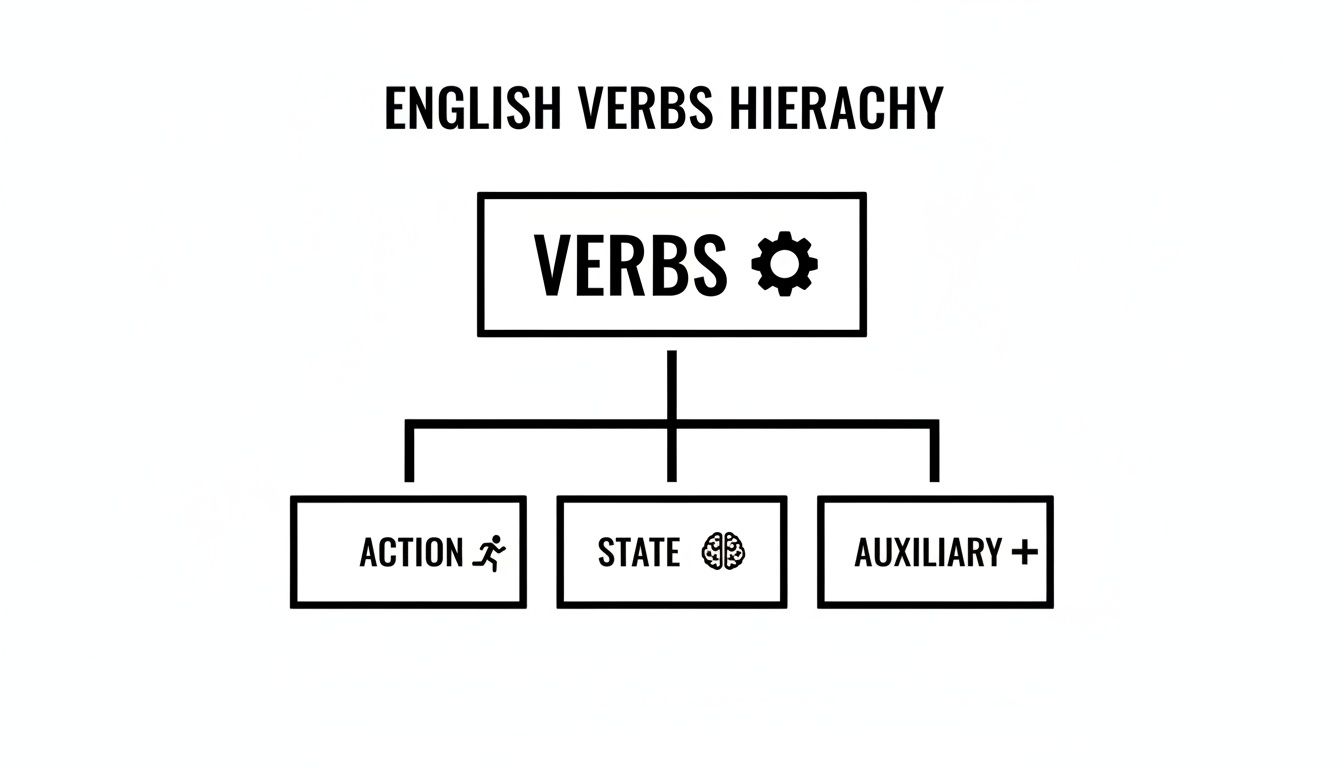
Every verb fits into one of these fundamental groups. Understanding their roles is your first step.
A Quick Look at English Verb Categories
Here is a simple breakdown of the main categories of verbs you'll encounter.
| Verb Type | What It Does | Simple Example |
|---|---|---|
| Action | Describes a physical or mental action. | She runs every morning. |
| Stative | Describes a state, feeling, or opinion. | I know the answer. |
| Transitive | An action verb that needs an object. | He kicked the ball. |
| Intransitive | An action verb that doesn't need an object. | The baby cried. |
| Regular | Follows a predictable conjugation pattern. | I walked to the store. |
| Irregular | Has unique, unpredictable conjugations. | She ate the apple. |
| Phrasal | A verb combined with another word to create a new meaning. | Please turn off the light. |
Getting familiar with these will make your English sound much more natural. Let's explore the most important ones.
Goal 1: Understand Action vs. State Verbs
To really get a handle on cuales son los verbos en ingles, we need to split them into two fundamental teams: verbs that do something and verbs that simply are something. Mastering this difference is one of the fastest ways to sound more natural.
What Are Action Verbs?
Action verbs are the energetic, dynamic words. They describe a physical or mental action—if you can actively do it, it’s probably an action verb.
Think of words like run, read, think, and build. They all paint a picture of a specific activity taking place.
What Are State Verbs?
State verbs (or stative verbs) describe a condition, a feeling, a sense, or a state of being.
Think of them as describing a constant truth or a personal state rather than a specific, temporary action. Common examples fall into a few groups:
- Feelings: love, hate, prefer
- Thoughts: believe, know, understand
- Senses: seem, sound, taste
- Possession: have, own, belong
The biggest rule separating these two is how they work with continuous tenses (the "-ing" form).
Actionable Advice: You can say, "He is building a house" (an action happening now). But you would say, "He owns a house" (a state). Saying "He is owning a house" sounds very unnatural to a native speaker. Avoid using state verbs with "-ing".
Getting this one simple rule down is a huge leap forward. It helps you dodge common mistakes and makes your English sound much more fluid.
Your Action Step: Practice with an App
Trying to master this on your own can be tough. Real-time feedback is key. An app like Translate AI can be an amazing practice partner. You can speak a sentence in Spanish and hear the correct English translation instantly. This is a great way to train your ear and internalize which verbs can take the "-ing" form and which ones can't.
Goal 2: Master Regular and Irregular Verbs

One of the biggest hurdles for any English learner is figuring out how verbs change in the past. The good news is they fall into two camps: regular and irregular. Getting a feel for this difference is a massive step toward sounding natural.
Regular verbs are your best friends because they follow one simple, predictable rule. To make them past tense, you just add -ed to the end.
- walk becomes walked
- play becomes played
- ask becomes asked
This reliable pattern works for the vast majority of verbs in English.
The Challenge of Irregular Verbs
And then you have the rebels—irregular verbs. They don't play by the rules. Instead of adding -ed, they transform in unique ways you have to memorize.
For example, the past tense of go isn’t “goed,” it’s went. The past of see is saw, not “seed.” This might sound daunting, but there are only about 200 common irregular verbs, and you only need a fraction for most conversations.
Actionable Advice: Don't try to memorize all 200 at once. The key is to focus on the most common ones first. By learning just the top 20 or 30, you’ll be ready for almost any real-world situation.
The 20 Most Essential Irregular Verbs
To get you started, here is a list of the heavy hitters. Mastering these will dramatically improve your ability to talk about past events.
| Base Form (Infinitive) | Simple Past | Past Participle |
|---|---|---|
| be | was/were | been |
| do | did | done |
| go | went | gone |
| have | had | had |
| make | made | made |
| say | said | said |
| see | saw | seen |
| take | took | taken |
| get | got | gotten/got |
| know | knew | known |
| think | thought | thought |
| come | came | come |
| give | gave | given |
| find | found | found |
| tell | told | told |
| become | became | become |
| leave | left | left |
| feel | felt | felt |
| put | put | put |
| mean | meant | meant |
Focus on learning a few of these at a time. And while you’re mastering the past, you might find it helpful to see how English handles the future. Check out our guide on the future simple tense in Spanish and English.
Goal 3: Focus on High-Impact Verb Tenses
If you’ve ever felt overwhelmed by a chart of twelve English verb tenses, you're not alone. Here’s the good news: you don't need all of them to have a real conversation.
A tiny handful of tenses do almost all the heavy lifting. This is the 80/20 rule in action. By focusing on just a few key tenses, you can handle most situations and communicate with confidence.
The Tenses Native Speakers Actually Use
Research on spoken English shows that the simple present tense is a powerhouse, accounting for a massive 57.51% of all verbs used in daily speech. The simple past is second with 19.7%. You can dig into the full research on English verb frequency for more details.
By getting comfortable with just those two tenses, you've covered over 77% of conversational English.
Actionable Advice: Prioritize these three tenses to learn smarter, not harder. You’ll build a strong foundation for clear communication without getting lost in complex grammar.
- Simple Present: For habits, facts, and routines. (e.g., "I work in an office.")
- Simple Past: For any action that's finished. (e.g., "We visited London last year.")
- Simple Future: For spontaneous decisions or predictions. (e.g., "I will call you later.")
Your Action Step: Practice with Real-Time Feedback
Knowing the rules is one thing, but using them correctly when you're talking is another. Instant feedback makes a huge difference.
A tool like Translate AI can be incredibly helpful. You can say a sentence in Spanish and immediately hear how it’s said in natural English. This helps you connect the situation with the correct tense, which is more effective than just memorizing charts.
Turn Your Knowledge Into Fluent Conversation
Knowing grammar rules is one thing. Using them in a fast-paced conversation is a different ballgame. This is where you move from wondering cuales son los verbos en ingles to actually mastering them. You need a way to build muscle memory without the pressure of making mistakes in front of people.
Tools designed for language learners can bridge the gap between theory and real-world speech, giving you a safe space to practice.
Your Action Step: Practice Verbs with Instant Feedback
Using a smart translation app lets you speak naturally in Spanish and instantly hear how your sentences sound in English. It's a powerful way to get real-time feedback, helping you connect grammar rules to the natural rhythm of speech. You can immediately hear the correct verbs and tenses used in context.
This instant correction loop is a game-changer. It builds confidence and gets you ready for real interactions, whether you're traveling, in a business meeting, or making new friends.
This approach is especially helpful for nailing down tricky concepts. To see this in action, check out our guide on how to form a basic but powerful phrase in Spanish and watch how it translates.
An app like Translate AI is perfect for practicing these skills anytime, anywhere, right from your phone.
Answering Your Top Questions About English Verbs

As you use English more, a few tricky verb-related questions always seem to come up. Let's clear up some of that confusion right now.
What Is the Difference Between a Main Verb and an Auxiliary Verb?
Think of a sentence as a movie. The main verb is the star—it carries the core action. In "I run every morning," the word 'run' tells you what's happening.
An auxiliary verb (or "helping verb") is the supporting actor. Its job is to help the main verb by adding details about time (tense), asking a question, or forming a negative. The big three are 'be', 'do', and 'have'.
For example, in "I am running late," 'running' is the main action. The word 'am' is the auxiliary verb, helping create the present continuous tense. The main verb gets the spotlight, but the auxiliary verb makes the scene work.
How Can I Learn the Most Common English Verbs Quickly?
The smartest strategy is to focus on impact, not just memorizing endless lists. The 100 most common verbs in English account for about 50% of all the language you'll hear and read.
Actionable Advice: Instead of drilling a list, make it personal. Don't just learn 'to have'. Create a sentence that’s true for you, like, "I have a dog named Max." Tying new words to your own life makes them stick.
What Are Phrasal Verbs and Why Are They So Confusing?
A phrasal verb is a verb plus a small word like 'up', 'on', or 'out'. When they join forces, they create a totally new meaning you often can't guess.
For instance, 'give' means to offer something. But 'give up' means to quit. That's what makes them so confusing!
Actionable Advice: The best way to learn them is to treat each one like a brand-new vocabulary word. Pay attention to how native speakers use them in movies and podcasts, and learn them in their natural habitat, not from a giant list.
Ready to put all this verb knowledge into practice? With Translate AI, you can speak naturally and hear your sentences translated instantly, helping you master verb tenses and phrasal verbs in real conversations. Start building fluency today by downloading the app from the App Store.