

Translate English to Persian Voice: Step-by-Step Guide
You have a message from a colleague in Tehran sitting unanswered, a hotel address in Shiraz you're not sure how to pronounce out loud, and a flight in three days. The English half of that conversation is easy. The Persian half depends on whether the voice translation in your hand gets the variety, the numbers and the level of politeness right, and you can't catch your own mistakes in a language you don't speak.
The scale is real. Iran recorded 3,129,449 international visitors between January and June 2024, according to UN tourism figures reported by Travel and Tour World, and plenty of them arrive without a word of Persian. Voice translation now carries a genuine conversation. It also fails in specific, predictable places: a dialect the model wasn't trained on, a digit rendered in a form you don't recognize, a name spelled with a letter English doesn't have.
Verification is the skill worth building. You check three ways: by ear before you hand the phone over, on screen before you copy anything into a booking, and once more with the person standing in front of you.
How to Start a Live English-to-Persian Voice Chat
Two people are waiting on your reply. One is a taxi driver in Tehran holding his phone up with a speech bubble already on screen. The other is a colleague in Kabul with a chat window open and a meeting time to confirm. Neither needs you to speak Persian. They need your English to arrive as Persian they can hear and read, before the traffic light changes.
The sequence below is the one that keeps your first word from being cut off and keeps a shaky translation out of the other person's ear.
The flow is worth following for the first three or four conversations, until it becomes habit rather than a checklist.
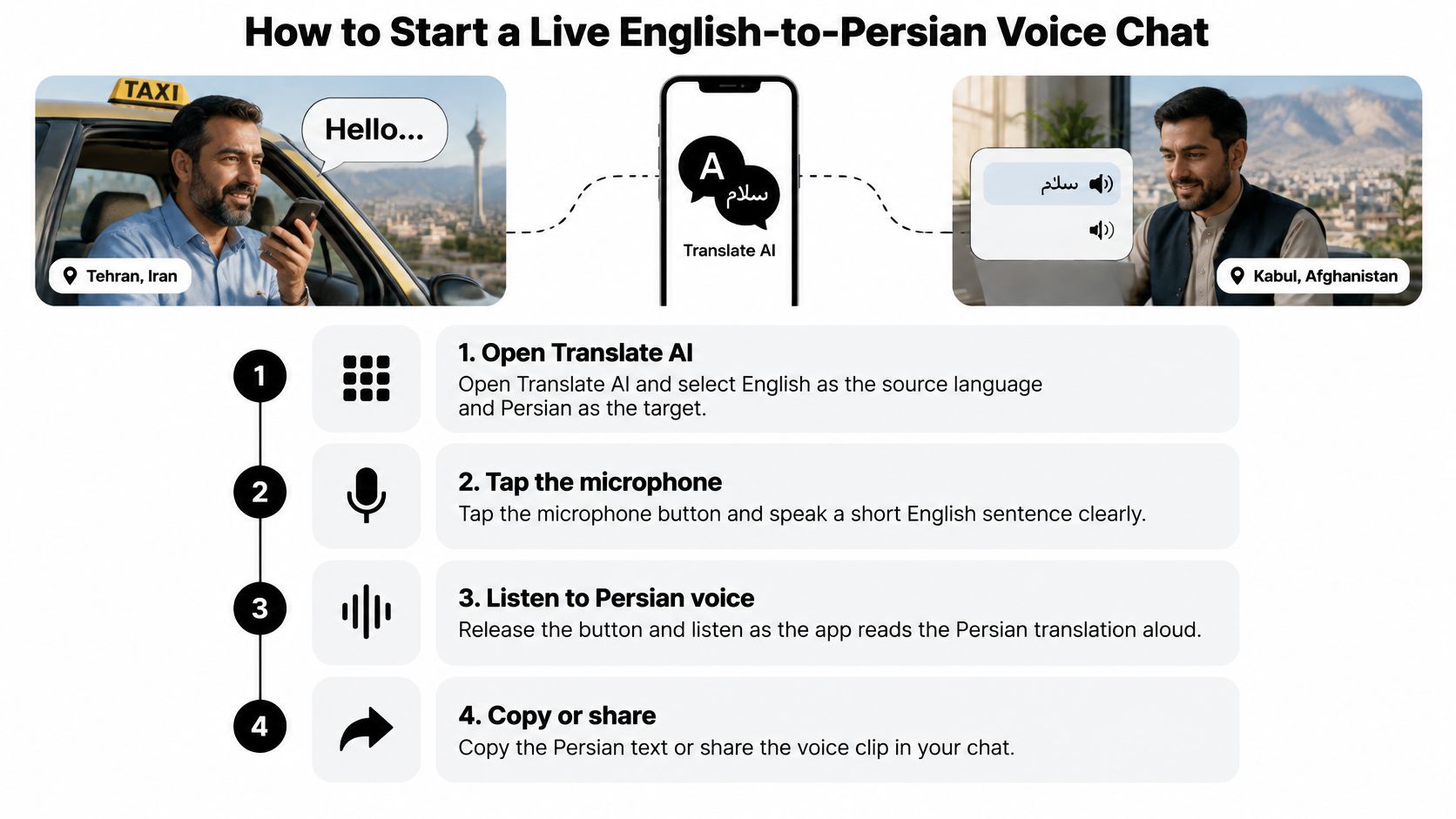
Settle the variety before you touch the microphone. Iran means Farsi, Afghanistan means Dari, Tajikistan means Tajik. Getting this wrong produces vocabulary and script mismatches even when both sides broadly understand each other, and it costs one tap to avoid.
- Set both languages in one go. Select English as your native language and Persian as your partner's from the app's language list. Declaring the pair tells the recognizer which sounds to expect, so it stops guessing between similar words in the wrong language.
- Tap the microphone, then talk. The tap starts capture. Speak first and the opening syllable disappears, and a dropped first word can turn "I need to go to the bazaar" into a fragment the translator has to invent around.
- Read the screen and listen at the same moment. Your Persian appears as text and is spoken aloud immediately after you finish. Check both: a numeral can look right and sound wrong, and a phrase can sound fluent while the printed name is misspelled.
- Use speaker mode when your hands are busy. Hands-free chat keeps the phone out of the middle of the exchange, which is what you want in a moving taxi or at a reception desk with a bag in each hand.
- Let your partner answer in Persian. Two-way dialogue returns their reply to you in English, so the conversation runs in both directions without passing the phone back for every sentence.
If you're still comparing tools, the GPT translation agent listing at AI Tool Seekers collects LLM-based translation agents in one place, which helps you see what else handles Persian before you commit to one.
The three-part check before you trust anything: your English appears as text, the Persian is spoken aloud, and your partner's reply comes back to you in English. If one of the three fails, stop and fix it there instead of pushing the conversation forward on a broken line.
Pick the Right Persian Variety for Your Listener
| Listener's country | Variety to select | Writing script |
|---|---|---|
| Iran | Farsi (Iranian Persian) | Perso-Arabic |
| Afghanistan | Dari (Afghan Persian) | Perso-Arabic |
| Tajikistan | Tajik (Tajik Persian) | Cyrillic |
Persian isn't one uniform target. Language teaching resources distinguish three major varieties, Iranian Persian (Farsi), Afghan Persian (Dari) and Tajik Persian (Tajik), and note that Tajik is generally written in Cyrillic while Farsi and Dari use a Perso-Arabic script, as the Penn Language Center's Persian program page sets out. The same resource advises identifying the listener's country before the conversation starts and selecting that variety when the app offers the choice.
The audience behind that choice is large. Figures attributed to Ethnologue and summarized by Science of Apps' Persian language profile put Persian at approximately 82 million speakers worldwide, about 65 million of them native speakers. The variety question isn't a niche detail you can defer.
It also comes up closer to home. In the United States, about 620,000 people aged five and older spoke Persian, including Farsi and Dari, at home in 2025, per USAFacts using U.S. Census Bureau data. Two varieties of one language can sit in the same city, and a single setting won't serve both.
The country rule carries real consequences. A shopkeeper in Kabul hearing Iranian Farsi phrasing will hit vocabulary that sounds foreign to him, even though he'd understand the gist. A guest in Dushanbe needs Tajik, and the written output will appear in Cyrillic rather than the Perso-Arabic script you were expecting to check on screen.
When the exact variety isn't offered, shorten your sentences and confirm the load-bearing words out loud: place names, prices, names of people. This overview of language types and varieties explains how apps group dialects and variants, which helps you predict what a menu label gets you.
Speak Clearly and Fix Misheard Words
Recognition errors rarely come out of nowhere. They cluster around speech habits you can change in a minute and around accents and noise you can't change but can route around.
Speak in Short Sentences With Clean Vowels
Give the recognizer one idea at a time. A dozen words is a clean unit to translate; a forty-word sentence with three clauses gives the engine three chances to lose the thread. Pause between a proper name and a number so each is captured as its own unit instead of smearing into the word beside it.
There's a phonetic reason to keep your English vowels crisp. Persian has six basic vowels, three short (a, e and o) and three long (ā, ū and ī), plus four diphthongs, and the short ones are pronounced distinctly rather than with the gliding English speakers use in words like "cat," "forte" or "bold," as the University of Texas Persian phonology resource describes. Mumbled English gives the system less to match against that system.
Picture a taxi in Shiraz. Say the street name, stop, then give the house number as separate digits. The driver hears an address in two clean units, and you get a second chance to correct the first one.
Where Recognition Actually Slips
Systems do better on Standard Persian than on accented speech, with especially weak results for Mashhadi and Yazdi varieties, and performance drops further on children's speech and difficult acoustics, according to the 2025 Persian speech recognition benchmark. The data gap behind those numbers is stark: a new spontaneous Persian dataset contains only 694 minutes from 65 speakers and covers the Tehrani dialect alone. Careful speech and live casual speech are not the same problem.
Metrics mislead here too. A benchmark of commercial Persian and English ASR found word error rate can overstate quality gaps by about threefold, because it penalizes semantically correct transliteration variants, while its strongest system still reached 13.2% overall WER and 0.936 BERTScore, as reported in the Persian-English ASR benchmark on arXiv. Worse metrics don't always mean worse understanding.
Even correct output can sound less natural than a human. Persian text-to-speech studies report mean opinion scores in the 3.94 to 4.12 range for two multi-speaker synthesizers on a 120-hour, 67-speaker corpus, and another dataset scored 3.76 against 4.01 for natural speech, per the Persian speech corpus evaluation in Language Resources and Evaluation. Judge the audio by ear, because the text being right doesn't guarantee the speech is comfortable to listen to.
| Symptom | Likely cause | Fix |
|---|---|---|
| Wrong Persian word appears | English word was misheard | Say the word alone, slowly, and spell it |
| Output sounds off or too formal | Variety or register doesn't match the listener | Reselect the variety and use simpler phrasing |
| Partner's speech isn't captured | Fast, accented or noisy speech | Move closer, cut background noise, ask them to slow down |
| Names come out garbled | Names have no spelling anchor | Spell the name and confirm it on screen |
| Translation arrives in jumpy pieces | Mid-sentence revisions while speech is still running | Pause at the end of each phrase and wait for the final version |
The Recovery Loop
- Say the sentence once, normally.
- Read the English transcript and the Persian output together.
- Find the first wrong word and say that word alone, slowly.
- If it's still wrong, spell it letter by letter, which matters most for names.
- Ask your partner to repeat the key phrase in a short sentence, then replay the English line to confirm you both meant the same thing.
Someone from Yazd rattling off directions at speed will beat most recognizers. Ask them to slow down and break the address into landmarks and place names, then confirm each one back.
Do a dry run before it counts. In a quiet room, try a formal sentence and a casual one, a name and a price. You'll learn which phrasings your setup handles cleanly while nothing is at stake.
If the English side of the chain is what worries you, this guide to English voice translation covers how recognition behaves before translation even begins.
Check Persian Numbers and Script Before You Trust Them
A price, a room number, a meeting time: these are the outputs where one wrong character survives the whole conversation and resurfaces on an invoice a week later. Rough prose gets forgiven. A digit doesn't.
| Western digit | Persian digit |
|---|---|
| 0 | ۰ |
| 1 | ۱ |
| 2 | ۲ |
| 3 | ۳ |
| 4 | ۴ |
| 5 | ۵ |
| 6 | ۶ |
| 7 | ۷ |
| 8 | ۸ |
| 9 | ۹ |
Persian commonly displays digits in forms different from Western Arabic numerals, and Persian Language Online's background reference lists the Persian forms for 1 through 9 as ۱، ۲، ۳، ۴، ۵، ۶، ۷، ۸ and ۹. Strands like ۳۰۴ and ۳۰۹ look close enough to fool a tired reader expecting Western shapes.
The verification routine takes under a minute and covers the cases that cost money. Listen to the Persian audio first, before you read anything. Then read the text from right to left rather than scanning it like English. Say each critical number digit by digit and ask the listener to repeat it back. Copy only the confirmed number into the booking, invoice or navigation note, never the raw translated line.
Read the Script Right to Left
Persian runs right to left in a modified Arabic-derived alphabet of 32 letters, four of which, پ (p), چ (ch), ژ (zh) and گ (g), were added for sounds the 28-letter Arabic alphabet doesn't represent, as the Council of Europe's Persian language information sheet explains. A name containing those sounds will look unfamiliar even when the app got it exactly right, so check the audio before you judge the spelling.
Reading also can't resolve everything. A 2025 study of Persian speech resources notes that short vowels are usually omitted in writing, the Ezafe connective vowel is unwritten but must be pronounced, and letters can map to different phonemes depending on context. The printed line carries less information than the spoken one, which is why you listen first and read second.
Say you're confirming room 304 at a hotel in Mashhad. Say "three, zero, four" one digit at a time, watch each Persian digit appear, and wait for the receptionist to read the number back. Only then does the number go into your notes.
Non-negotiable: any number that affects money, a departure time or where you sleep gets repeated digit by digit and confirmed out loud before you move on.
For the reverse direction, this guide to Persian to English translation covers what happens when your partner's spoken reply is the input instead of your own.
Start Your First English-to-Persian Voice Chat
A checklist you never test is just reading. The point of all of this is a real conversation this week, in a taxi, at a hotel desk or on a call with a supplier.
Translate AI translates both ways: you speak English and your partner hears Persian, then they answer in Persian and hear English back. It works with most AirPods and earbuds, so the hardware question is settled by whatever is already in your pocket.
Set up the first conversation
Open Translate AI and select your native language and your partner's language from the list, so the pair is English and the Persian variety that matches your listener. Tap the microphone button and speak naturally. The translation appears on screen and plays aloud immediately, and speaker mode is there for hands-free chats when your hands are busy with luggage or paperwork.
Three moves and you're running. Choose the pair at the start of the conversation. Spend two minutes with a friend on one short sentence, one name and one number, listening to the Persian output and checking the right-to-left script before you judge it. Then use that same setup for a taxi ride, a check-in or a meeting this week while the process is still fresh.
The first real conversation teaches you more than any checklist, so book one this week and treat it as practice rather than a test.
Translate AI covers both halves of the exchange, with instant voice translations in over 80 languages, speaker mode for hands-free use, and AI that recognizes context in translations rather than handling every sentence word by word. Pair it with the checks above, the variety pick, the digit-by-digit confirmation and the read-right-to-left pass, and you can trust the output before you act on it. Visit Translate AI to get started and run a two-minute test with a name and a number before your next real conversation.