

English Voice Translation for Live Conversations
You're on a call with a supplier in Osaka, the line is clean, and the app has already turned your last sentence into Japanese. The reply comes back in English after a short pause, sounds completely reasonable, and answers a slightly different question than the one you asked. You let it pass because the audio was smooth.
Fluent audio is not a correct decision. The failure mode of English voice translation is rarely a robotic voice or a missing word. It's a clean, confident sentence with a number wrong, a negation flipped, or a name replaced by something that sounds close enough to nod at. By the time the invoice or the prescription arrives, nobody remembers which turn introduced the error.
The working model below treats English voice translation as a system with a quality versus delay dial and three risk tiers attached to it. That framing is more useful than a language count, because it tells you what to do in the ten seconds before you open your mouth, and when to put the phone down and find a person.
English Is Not a Universal Fallback
You land at 11pm, the hotel clerk asks a question you catch in pieces, and you answer in English hoping the rest sorts itself out. Sometimes it does. The next morning, at a clinic reception window or a taxi rank, the same bet fails and you're standing there holding a phrase you can't verify. Assuming English works everywhere is the most expensive habit a traveler carries, and it survives because it's right just often enough to feel safe.
European survey data shows how uneven that bet is. In the 2024 Eurobarometer survey, 47% of Europeans reported being able to speak English as a foreign or second language, while 59% could hold a conversation in at least one foreign language and only 28% could converse in more than one (European Commission). Among people aged 15 to 24, those shares rise to 79% for at least one foreign language and 39% for more than one. Roughly half the people you'll meet in Europe can hold an English conversation, which means the other half can't, and nothing about a person's job title tells you which group they're in.
The goal from here is narrow. Understand how English voice translation turns speech into another language fast enough for a live exchange, and know the point where its output stops being safe to act on.
What that changes at the counter
- Choose the local language first. Default to the language of the place you're standing in and switch to English only when the other person offers it.
- Speak in short phrases. One idea per sentence gives the recognizer less to lose and the translator less to guess.
- Move anything you'll act on into writing. Addresses, prices, dates, and medication instructions belong on screen, where you can read them twice.
The rest of this guide runs through a risk table, the three-stage pipeline that turns sound into speech, the measured lag between speaking and hearing, the room conditions that drop meaning, and the trip and work scenes where a phone in your hand is enough. Success isn't a perfect translation. Success is deciding, before the first sentence leaves your mouth, whether this conversation needs voice translation, a written check, or a qualified human interpreter.
When to Trust Voice Translation
You can settle the question before anyone speaks. Sort the conversation into one of three tiers and use only what that tier allows. The app's fluency doesn't move a conversation between tiers, and a warm, natural-sounding voice reading a medication instruction is still a medication instruction.
| Situation | Risk | What to do |
|---|---|---|
| Restaurant orders, directions, shopping, casual chat | Low | Use voice translation with one idea per turn |
| Prices, transit times, hotel check-in, meeting times | Medium | Read names, numbers, dates, and addresses back from the text |
| Workplace scheduling and everyday service counters | Medium | Repeat negations and proper names before you agree |
| Medical, legal, financial, emergency, or safety talks | High | Use a qualified interpreter; treat AI speech as a draft only |
Low risk is where voice translation earns its keep. Ordering a dish, asking which platform the train leaves from, finding a pharmacy: the cost of a small error is embarrassment and a thirty-second correction. Speak one idea, glance at the screen, move on.
Medium risk is where the words carry commitments. A hotel rate, a departure time, a delivery date, a shift swap. The translation is usually right here, but "usually" isn't the standard you want for a number you'll be held to. Read the figure off the transcript, not off your memory of the voice you just heard.
High risk is a different category of tool, and the gap is measurable. Clinical research comparing speech-mode machine translation with professional interpreters found clinically significant errors in 33.3% of cases for machine translation against 4.8% for qualified interpreters across six languages (PMC). Nothing in that finding suggests a better-sounding voice closes the distance. A medical, legal, financial, emergency, or safety decision needs a person who is accountable for the interpretation, plus a bilingual staff member or a written copy of whatever was agreed.
A four-step habit that holds under pressure
- Set both languages before anyone speaks. Fumbling the language pair mid-sentence wastes the turn and invites the other person to switch to broken English instead of their own language.
- One idea per turn. Two clauses joined by "and" is where negation gets lost, because the second half arrives after the system has already committed to the first.
- Confirm names and numbers from the text. Spelling, digits, and dates are exactly the tokens that survive audio badly and matter most. Read them back aloud from the screen.
- Stop when something feels off. If the tool hesitates, an idiom lands strangely, or a "not" disappears, don't push through. Rephrase in plainer words or hand the conversation to a person.
The rule that covers the gaps: if you couldn't defend the sentence to someone afterwards, you don't have the meaning yet.
Take your next real conversation, place it on one row of that table, and follow only that row. Most of the anxiety around these tools comes from applying high-risk caution to a restaurant order, or low-risk casualness to a hospital intake.
How Spoken English Becomes Another Language
When a translated line comes out wrong, it helps to know which of three stages broke. English voice translation is a relay, not a single act of understanding, and each leg fails in its own way.
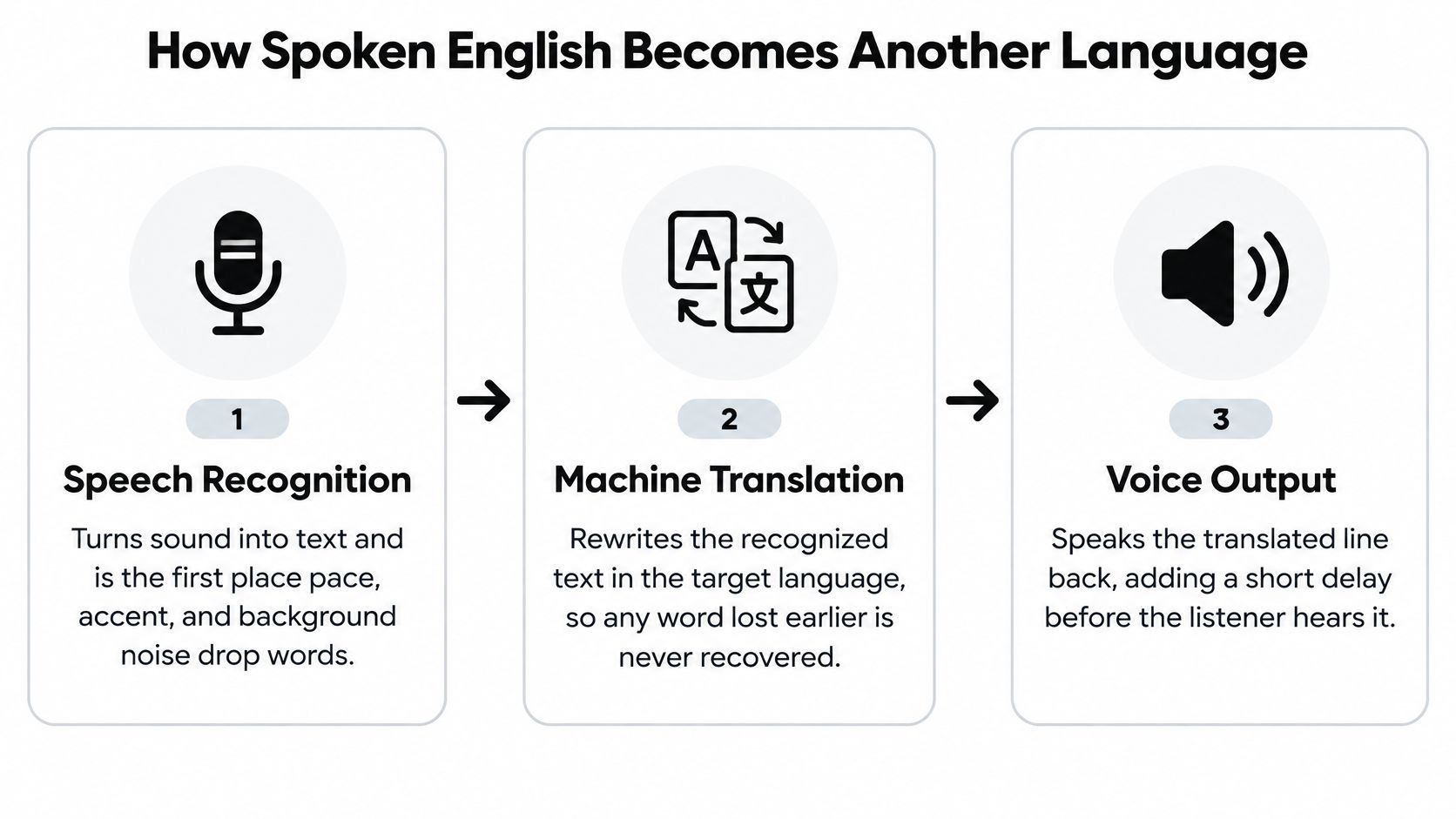
The three legs of the relay
- Speech recognition turns sound into text. Pace, accent, and background noise drop words here first, and everything downstream inherits the loss.
- Machine translation carries meaning into the other language. It doesn't preserve English word order, so a verb that sits early in English may not surface until late in the target sentence.
- Voice output or on-screen text is what the other person receives. A correct translation delivered with flat prosody or at the wrong moment can still confuse the listener.
A failure in any one leg sounds identical to the person across from you: like a bad translation. Missed audio, shifted meaning, and a voice that spoiled a correct line all present the same way, which is why the first diagnostic question is whether the text was right before the speech played.
These legs were built as separate problems long before anyone joined them. In 1954, Georgetown University and IBM demonstrated computer translation by converting 49 Russian sentences into English on an IBM 701, with a vocabulary of roughly 250 words and six grammar rules (machine translation archive). Speech recognition ran on a parallel track: Bell Labs' Audrey system recognized spoken digits from a single speaker in the early 1950s, and IBM's Shoebox recognized a 16-word vocabulary from multiple speakers in 1962. In 1988, IBM researchers replaced hand-written rules with probability estimated over aligned bilingual text, and English sat on one side of a large share of those datasets.
Learning a language abroad is where people feel the relay most sharply. Student experiences shared on HeyLocals describe the same pattern: meaning that arrives intact in a classroom exercise collapses the moment a real conversation moves fast.
Why a clause has to settle first
Waiting for a stable phrase before translating is the same relay discipline, applied in milliseconds. Don't start the second leg until the first has something it can commit to. If you want the mechanism behind leg two, this explanation of what neural machine translation actually does covers how meaning gets carried across without word-for-word substitution.
Once you can name the break, correction gets cheap. Missed audio means move closer, slow down, cut the room noise. Shifted meaning means rephrase in shorter clauses. A voice that spoiled a correct line means switch to reading the screen.
Why Faster Speech Often Means Weaker Meaning
In a hotel check-in, a meeting, or a noisy street conversation, a translation that arrives quickly can keep the exchange moving. But speed has a cost: the system may have to translate before it has heard enough of the sentence to resolve its meaning.
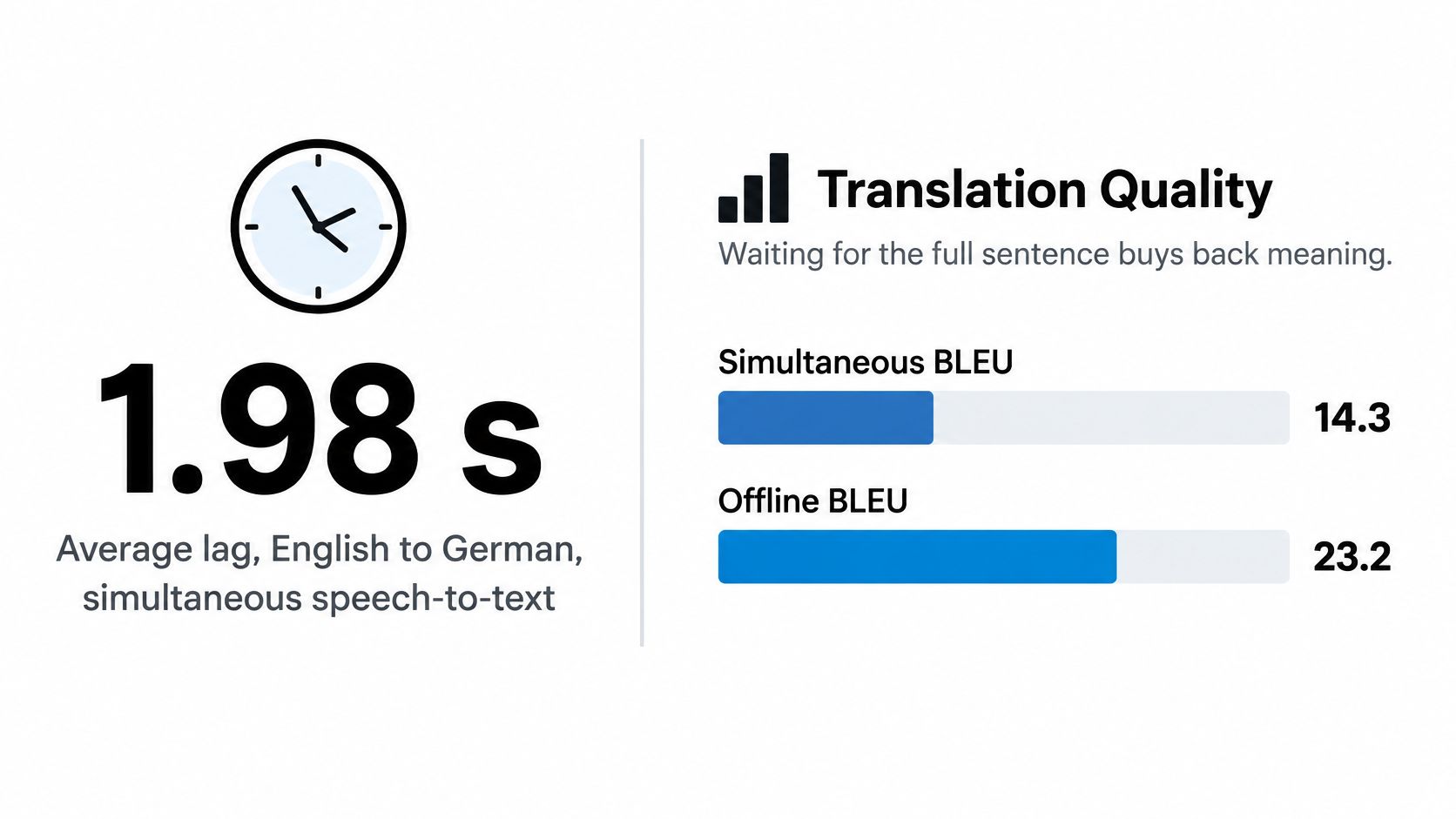
In IWSLT's simultaneous-translation evaluation, baseline English-to-German speech-to-text averaged 1.98 seconds of lag and scored 14.3 BLEU, compared with 23.2 for an offline system that waited for the full utterance (IWSLT 2023). BLEU measures text overlap, not whether a listener understood the message, so treat the figures as a quality comparison rather than a guarantee of conversational accuracy.
| Pair from English | Average lag | Simultaneous BLEU | Offline BLEU |
|---|---|---|---|
| German | 1.98 seconds | 14.3 | 23.2 |
| Chinese | 1.77 seconds | 14.2 | 18.7 |
| Japanese | 1.82 seconds | 6.63 | 11.2 |
The scores show different trade-offs. English-to-Chinese loses about 4.5 BLEU points, the smallest drop in raw points. German loses about 8.9 points, the largest raw drop, while Japanese retains the smallest share of its offline score. Similar lag does not mean similar translation quality.
The words a live system should hold back
A live system can release stable clauses quickly, but early guesses about negation, numbers, ambiguous verbs, and names can change the decision a listener makes. Check those details on screen before acting on them.
IWSLT reported a 2.5-second starting offset for its speech-to-speech target as a rough ceiling for a conversation that still feels responsive, and described sub-two-second lag as a reasonable target for interactive speech-to-text. A brief pause before the other person hears you can be normal. A reversed “not” or an incorrect digit can change an instruction, booking, or payment. Read the translated text as well as listening to the audio.
A short delay buys context. A wrong number can change the decision.
Judge the spoken result, not just the text
Text metrics cannot capture every part of a spoken exchange. A translation may be readable yet difficult to understand aloud, poorly timed, or delivered with misleading prosody. The COMPASS framework evaluates speech-to-speech systems across eight dimensions, including translation quality, synthesized-speech naturalness, speaker consistency, prosody and emotion, isochrony, isometry, and lip synchronization. It also scores the translated text separately from a transcript of the synthesized speech (COMPASS).
That distinction helps locate the failure. If the translated text is right but the spoken version is wrong, the problem may be pronunciation, audio quality, or prosody rather than translation. For routine conversation, a short delay may be a fair trade for a clearer sentence. For legal, medical, financial, or safety-critical decisions, fluent audio is not proof of correct meaning. Use a qualified human interpreter when a mistake could have serious consequences.
Accents Noise and Idioms in Real Rooms
The useful question isn't whether a tool supports English. It's which English, in which room, at what distance from the microphone. A model that handles a news anchor reading a script can still stumble on a fast Scottish accent in a station concourse.

Accent is the first variable and the most personal. Indian, Nigerian, Singaporean, and Scottish English are all English, and all sit at different distances from the accents that dominate training audio. Add rapid speech, two people talking over each other, and a name the model has never stored, and the recognizer starts guessing.
Background noise does the rest. A café, a platform announcement, an open-plan office, a car with the window down: each one feeds the first stage of the pipeline a degraded signal, and no amount of translation quality recovers a word that was never recognized. Network conditions matter too, because a stalled stream produces gaps that sound like dropped meaning.
The conditions that quietly break a smooth voice
- Code-switching. A sentence that starts in English and finishes in Spanish or Arabic is common in real bilingual households and rare in clean test sets.
- Idioms. A literal rendering of a casual expression can be perfectly fluent and completely misleading, and nothing in the audio signals that the meaning shifted.
- Language distance. Structurally close European pairs are easier to carry than pairs whose word order sits far from English.
- Thin data for the pair. Direct speech-to-speech research still identifies data sparsity, high computational cost, and weak generalization as continuing limits, especially for low-resource languages (speech translation survey).
That last point is why a long language list isn't a reliability claim. Breadth and dependability get evaluated separately, and a pair that exists on the menu may still be the weakest link in the room.
A five-minute pretest before the meeting or the trip day
Run this once, in the actual environment, before anything consequential.
- One accent sample. Have the person you'll talk to record ten seconds of natural speech, not slowed-down speech.
- One noisy clip. Play it back with the room's real background sound to see whether the transcript survives.
- One name and one number. A street name and a phone digit string. Check both on screen.
- One idiom. Say something idiomatic and confirm the other person understands the intent, not the words.
If any of those four fails, fall back to written text, a slower exchange, or a person. Offline text mode is the backup when connectivity drops, and it's worth knowing where it lives before you need it. Honing your ear helps too; these listening comprehension exercises train the same skill of catching meaning through accent and noise.
Conversations Travelers and Colleagues Actually Have
The scale behind this problem is easy to underestimate. An estimated 1.4 billion international tourist arrivals were recorded worldwide in 2024, an 11% increase over 2023, roughly 140 million additional arrivals, which brought international tourism back to 99% of its pre-pandemic level (UN Tourism). Every one of those journeys puts someone in front of a counter where the local language is the working language.
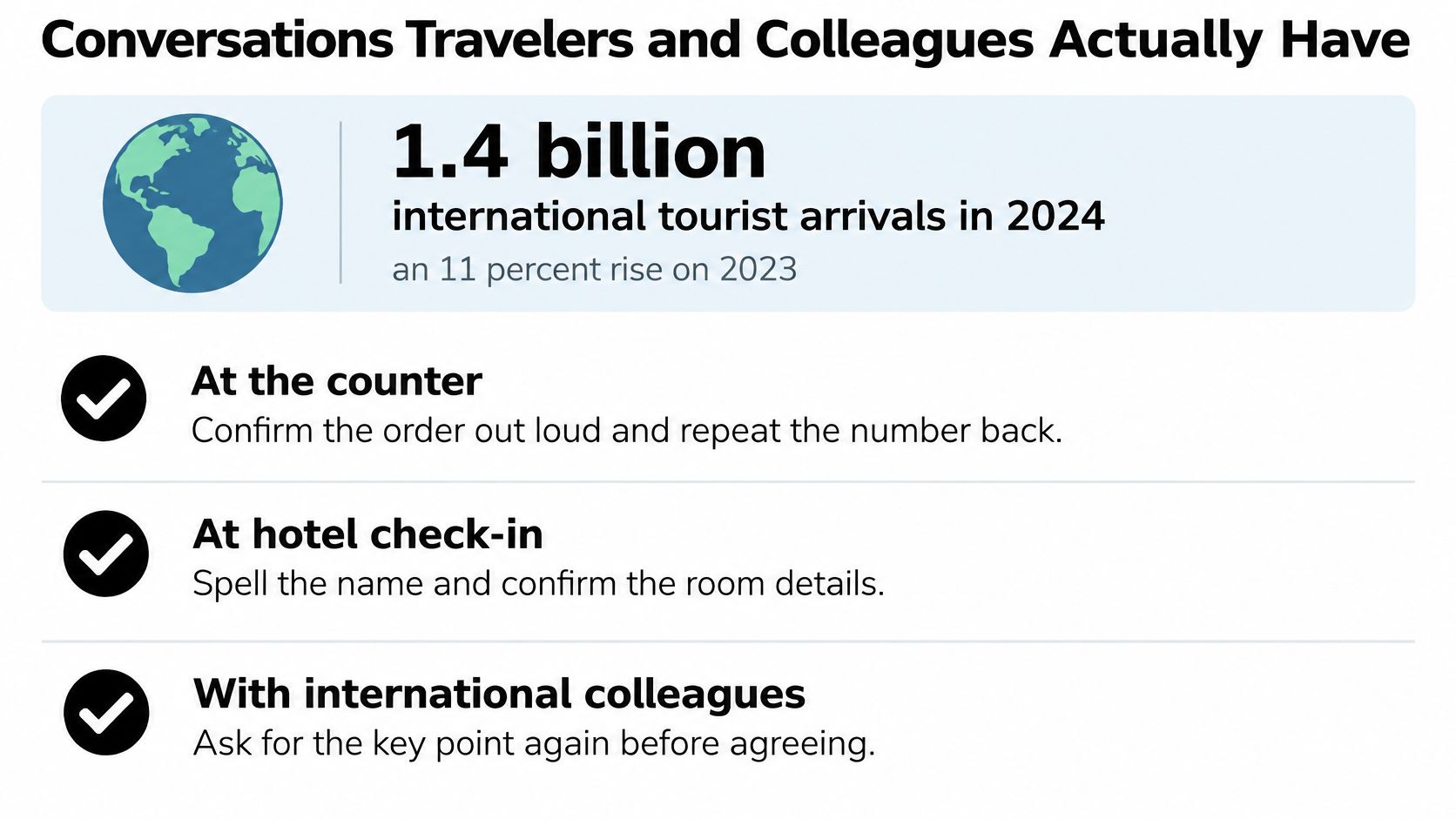
Three scenes cover most of what people do with these tools, and each one maps to a row you already know.
At the counter, low risk
A traveler at a taxi rank names both languages, asks one thing (the fare to a street two blocks over), and reads the amount on screen before getting in. Same pattern at a restaurant: one dish, one question about an ingredient, a glance at the total. Nothing here needs a transcript, and speed is the whole point.
Across a work call, medium risk
Two colleagues on a cross-border call, each hearing the other's language. One decision per turn keeps the exchange clean. When a date or a deliverable is agreed, it gets pasted into the meeting note while both people are still on the line, so the record exists in writing rather than in two different memories of a synthetic voice. The verification habit doesn't need repeating here; the only change is that the number goes into the shared document, not just into your head.
At the bank or the school office, medium risk with higher stakes
A newcomer preparing for housing, banking, healthcare, or school enrollment gets the most value from preparing recurring phrases in advance and saving unfamiliar words for later study. The exchange runs both ways, each person hearing their own language, and anything that creates a financial or legal obligation moves to the high-risk row and to a person.
Language attitudes explain why this bridge matters beyond the transaction. 76% of Europeans believe improving language skills should be a political priority and 86% believe everyone should speak at least one foreign language (European Commission). Voice translation is a bridge while the phrase is being learned, not a replacement for learning it. That's also why English conversation practice tools compared is worth reading alongside a translator: the goal each time is to do the same task next month with less help.
The cross-cultural layer is where these scenes connect. What reads as evasive in one country is polite in another, and a literal translation of a refusal often arrives as a yes. These notes on cross-cultural communication cover the conventions that no word-level translation carries.
Try a Two-Way English Conversation Today
Pick one low-risk conversation and run it this week, not on the day you're stuck. Asking for a platform number, a menu item, or a meeting time is enough to feel how the delay behaves and how much you rely on reading the screen.
Set both languages before you start. That single decision does more for a smooth exchange than any setting you'll adjust mid-sentence.
Start a two-way conversation with Translate AI
Translate AI is built for the scene you just chose. The steps are short.
- Select your native language and your partner's language from the app's list of languages.
- Tap the microphone button and speak naturally. No special phrasing, no slowed-down delivery.
- Read and hear the translation at once, and let the other person hear their language so the exchange runs in both directions.
The app gives instant voice translations in over 80 languages, including English, and it's designed for travel, work, and everyday chats. It works with ordinary earbuds or AirPods rather than a dedicated headset, which matters when you're standing in a taxi queue rather than sitting in a studio.
Keep the boundary from earlier in place without rebuilding it: this is for the low-risk conversation you picked, names and numbers stay on screen, and medical, legal, financial, or safety decisions go to a qualified interpreter. You can find the app at translate-ai.app and install it from the App Store listing.
If you'd rather start with text, tools that turn speech into translated text are a useful first step, because reading a transcript builds the same habit of checking names and digits before you act.
Translate AI gives you a live, two-way voice channel in over 80 languages, so you can speak English and have your partner hear their own language back immediately, then answer in theirs. Use it for the counter, the taxi rank, the hotel desk, and the weekly call with colleagues, where a fast exchange beats a perfect one. Visit Translate AI and set your two languages before the next real conversation starts.