

How to Say Hammer in Spanish: Martillo Explained
Martillo is the Spanish word for hammer; it's masculine, so you say el martillo for the hammer and los martillos for the hammers. But does that same word work when you're hammering a nail, describing a loud blow, or talking about a sport?
If you're asking how to say hammer in Spanish, the useful answer goes beyond a vocabulary swap. Learn the object first, then match your wording to what you need to say, whether you're borrowing a tool, buying equipment, or explaining a repair.
The Spanish Word for Hammer at a Glance
Martillo names the ordinary hammer, and el martillo is the basic phrase to learn. The Royal Spanish Academy's dictionary entry classifies it as masculine and describes a percussion tool with generally an iron head and a usually wooden handle.
Spanish uses different words for the, a, and some. Learn those words together with the noun rather than memorizing martillo on its own.
Hammer in Spanish: forms, sound and gender
| Form | Spanish | IPA | Phonetic (approx.) |
|---|---|---|---|
| Hammer, singular | el martillo | /marˈtiʎo/ (Spain, a regional pronunciation) | mahr-TEE-yoh |
| Hammers, plural | los martillos | /marˈtiʎos/ (Spain, a regional pronunciation) | mahr-TEE-yohs |
| A hammer | un martillo | /un marˈtiʎo/ | oon mahr-TEE-yoh |
| Some hammers | unos martillos | /ˈunos marˈtiʎos/ | OO-nos mahr-TEE-yohs |
| Hammer, singular (Latin America) | el martillo | /marˈtijo/ | mahr-TEE-yoh |
The sound symbols in the IPA column describe pronunciation more precisely than English spelling can. In the definite-form rows, the transcription focuses on the noun; the final column also provides an easy practice target.
Use these sentences immediately:
- Finding it: ¿Dónde está el martillo? (Where is the hammer?)
- Requesting it: Necesito un martillo. (I need a hammer.)
Why the masculine form matters
Grammatical gender determines which articles and adjective forms go with a noun. It doesn't mean the tool itself has a gender.
For example, un martillo pesado means a heavy hammer. Both un and pesado match the masculine noun.
Avoid la martillo, because la doesn't agree with martillo. For the plural, write los martillos, not los martillo: the article and noun both need their plural forms.
Context also affects the English translation. A courtroom martillo can be a gavel, while the same noun names the implement used in hammer throw. Martillo neumático identifies a pneumatic hammer or jackhammer, rather than an ordinary hand tool.
If you're collecting practical equipment vocabulary, the guide to grúa in English offers another example of why the situation matters when translating a tool or machine name.
Remember: martillo, masculine, and add -s for the plural. Learn el martillo as a complete phrase so the article comes naturally.
How to Pronounce Martillo and Regional Accents
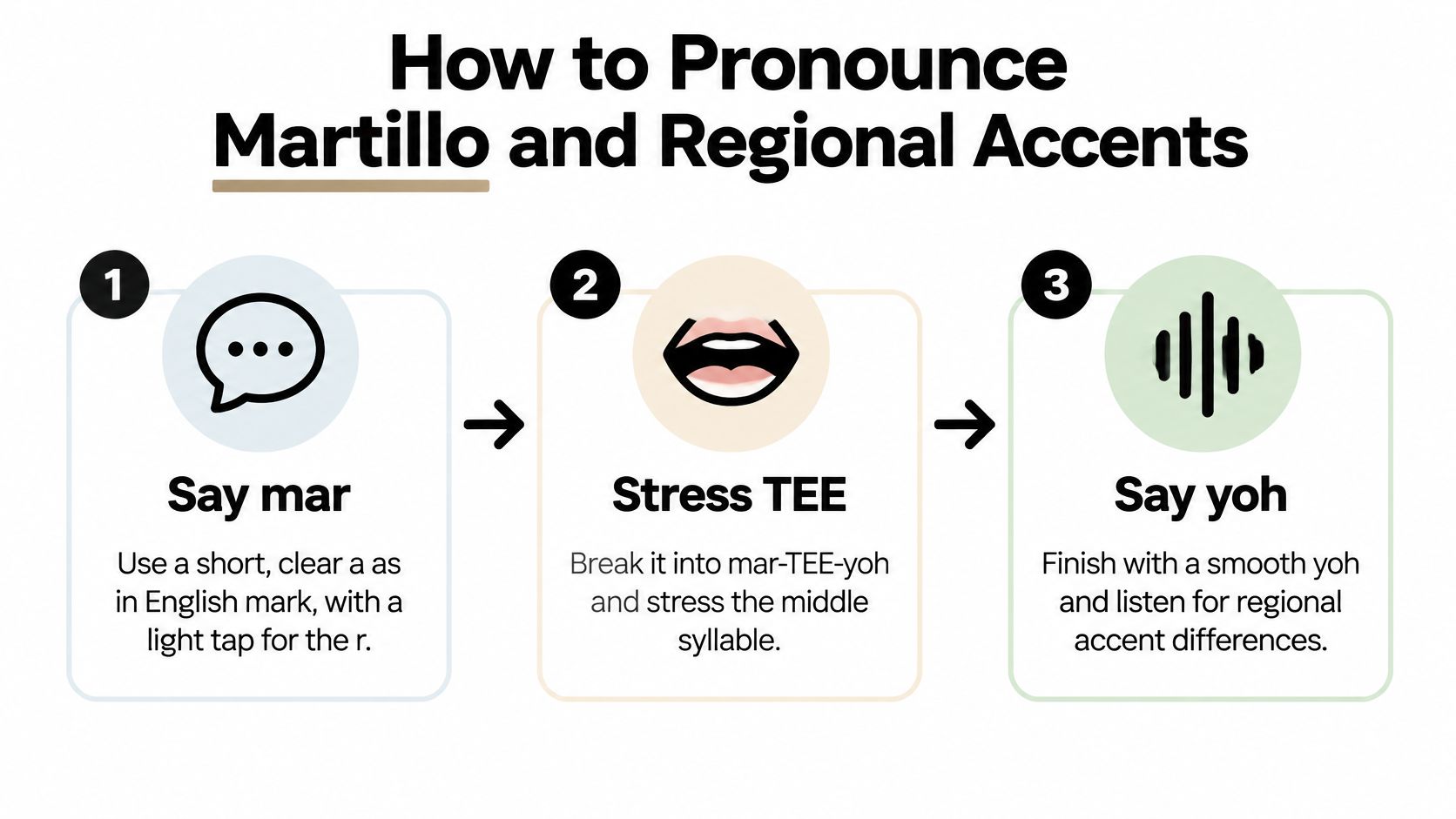
Aim for mar-TEE-yoh, with the emphasis in the middle, not at the beginning. Parrot's pronunciation guide breaks martillo into three syllables and identifies the middle syllable as stressed.
Don't try to pronounce the word as though it were English. Keep the vowels clear, and treat the English phonetic spelling as a starting aid rather than an exact recording.
Build the sound slowly
-
Say mar. Use a short, clear a, roughly like the vowel in mark, without stretching it. Give the r a light tap rather than a strong English r.
-
Put the emphasis on TEE. Let that syllable stand out slightly in pitch and strength, without dragging it out. The rhythm should be mar-TEE-yoh, not MAR-tee-yoh.
-
Make ll sound like y in yes. That's a useful practice target across much of the Spanish-speaking world. Don't pronounce the letters as separate English l sounds.
-
Finish with a clean oh vowel. Keep your mouth steady rather than adding the glide you may use in English oh. The middle vowel should remain ee, not an English ham-like vowel.
-
Join the sounds and add el. Say mar-TEE-yoh, then el martillo, without pausing inside the word. Practicing the whole phrase helps you move from isolated pronunciation to something you can use in conversation.
A common English-speaker slip is to give the opening syllable too much weight. If your recording sounds like MAR-tee-yo, soften the beginning and bring the emphasis back to TEE.
You don't need to speak quickly. A measured, clearly stressed word is a better target than a rushed imitation of an unfamiliar accent.
Recognize accents without chasing them
You may see /marˈtiʎo/ for a pronunciation found in Spain and /marˈtijo/ for the common y-like pronunciation heard across much of Latin America. These aren't strict national boundaries: many speakers in Spain also use a y-like sound.
Spanish has a broad international audience. Language Magazine, reporting Instituto Cervantes figures, states that more than 600 million people worldwide spoke Spanish in 2024, including almost 500 million native speakers.
For a practice benchmark, say el martillo three times in one comfortable breath, keeping the emphasis steady. Regional accents will sound different: in parts of Argentina and Uruguay, ll can sound closer to sh or zh. You don't need to copy that sound to make yourself understood.
Phrases for Buying, Borrowing and Asking
¿Tiene un martillo? (Do you have a hammer?) is a useful opening at a hardware store. Necesito un martillo para clavar este clavo (I need a hammer to drive this nail) adds the purpose, which helps the other person understand your request.
The Royal Spanish Academy's earlier dictionary entry for martillo confirms the physical tool meaning behind these requests. In conversation, your next choice is usually whether you're buying, borrowing, locating, or describing it.
Hammer phrases by situation
| English phrase | Spanish | Context |
|---|---|---|
| Do you have a hammer? | ¿Tiene un martillo? | Hardware store |
| Where is the hammer? | ¿Dónde está el martillo? | Looking for a tool at home |
| I need a hammer | Necesito un martillo | Asking for help |
| I need a hammer to drive this nail | Necesito un martillo para clavar este clavo | Home repair |
| Can I borrow your hammer? (informal) | ¿Me prestas tu martillo? | Talking to a friend |
| Can I borrow your hammer? (formal) | ¿Me presta su martillo? | Talking to a stranger or elder |
| Where can I buy a hammer? | ¿Dónde puedo comprar un martillo? | Shopping |
| Hand me the hammer, please | Pásame el martillo, por favor | Working alongside someone |
| The hammer is heavy | El martillo es pesado | Describing the tool |
Borrowing politely
With a friend, use ¿Me prestas tu martillo? The wording asks whether they'll lend you their hammer, which is the natural equivalent of asking to borrow it.
With someone you address formally, use ¿Me presta su martillo? Notice the change from prestas to presta, and from tu to su. These changes reflect how you address the person, not a different kind of hammer.
Questions don't change the noun's gender. You still use el or un, whether you're asking where the tool is or whether someone has one.
Asking for the right type
A shop assistant might ask ¿Qué tipo de martillo busca? (What kind of hammer are you looking for?). You could answer Uno de garra, por favor (A claw hammer, please).
A claw hammer has a claw for pulling nails. If the subtype name escapes you, describe that function: Necesito un martillo para sacar clavos (I need a hammer for pulling out nails).
That approach also works when explaining a problem. Pair your tool request with a clear description of the damaged object, using practical vocabulary from this guide to saying broken in Spanish.
Verbs and Related Words for Hammer Actions
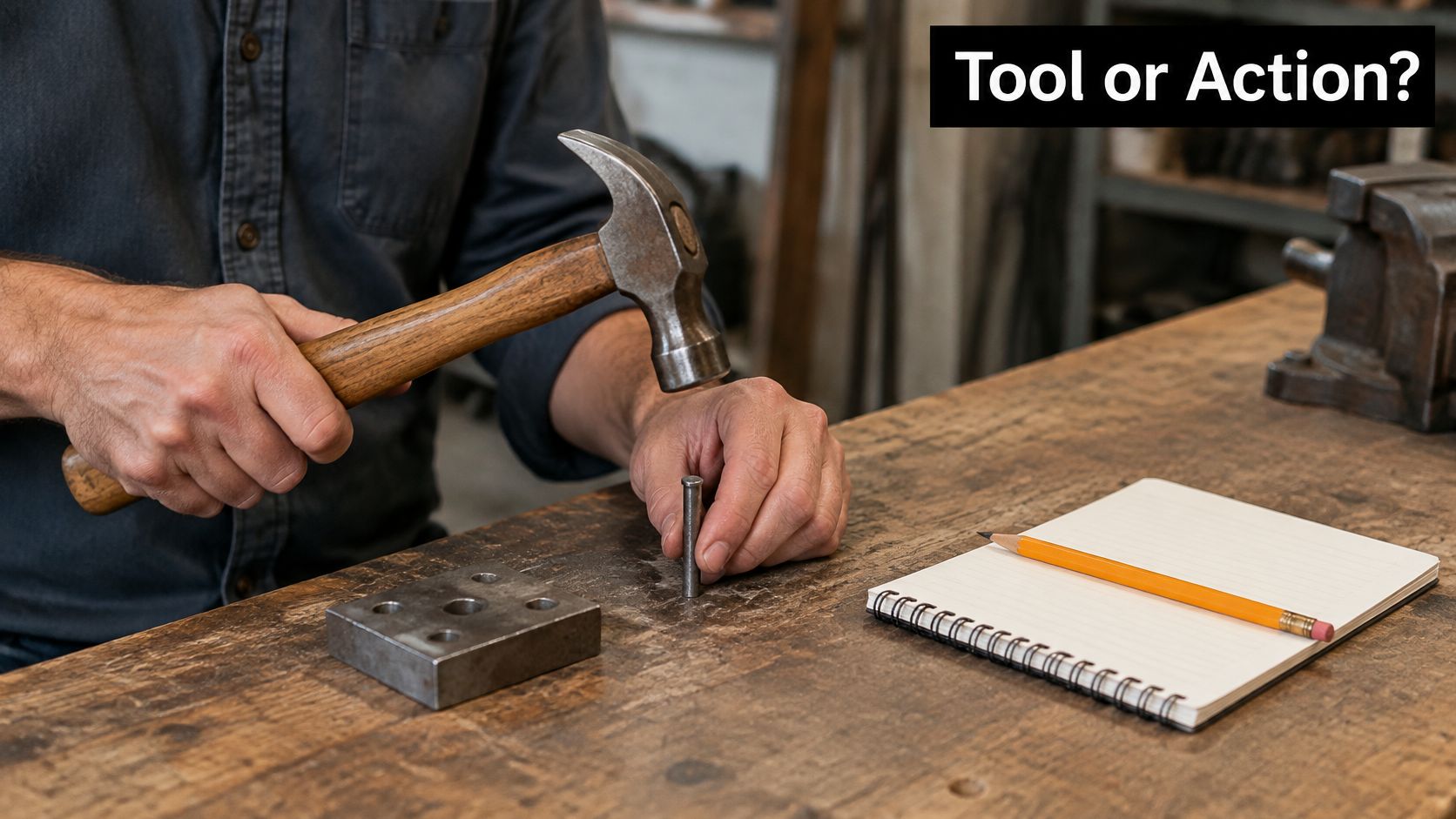
Before translating hammer, ask whether you mean an object, an action, a blow, a sound, or an event. If you mean an action, choose the Spanish verb according to what the person is doing.
The Royal Spanish Academy defines martillar as striking with a hammer. That makes it appropriate for literal hammer work, but it doesn't make it the natural choice for every English sentence containing hammer.
Hammer actions and related terms in Spanish
| English meaning | Spanish | Example |
|---|---|---|
| To strike with a hammer | martillar (also martillear) | Martilla el metal |
| To drive a nail in | clavar | Clava el clavo |
| To knock on a door | dar golpes en / golpear | No martilles la puerta; da golpes suaves |
| A forceful hammer blow | martillazo | Dar un martillazo |
| Repeated hammering or hammer-like noise | martilleo | Ruido de martilleo |
| Hammer throw (sport) | lanzamiento de martillo | Lanzamiento de martillo (the event) |
| Heavier or mallet-like tool | mazo | Mazo de goma (rubber mallet) |
Choose the verb by the result
Martilla el metal means Hammer the metal. The focus is the striking action.
Clava el clavo means Hammer the nail in. Here, clavar emphasizes driving the nail into something rather than hitting it.
No martilles la puerta; da golpes suaves means Don't hammer the door; knock gently. For knocking or pounding on a surface, dar golpes or golpear avoids implying that someone should use a tool.
Martillear is also a common verb for hammering, as reflected in the Collins English-Spanish entry for hammer. Use a martillazos when you want to emphasize hammer blows as the means of doing something.
Separate the blow, noise and equipment
A martillazo is a forceful hammer blow. Martilleo describes repeated hammering or a hammer-like sound, so ruido de martilleo means hammering noise, consistent with the Royal Spanish Academy's entry for martilleo.
For equipment, mazo refers to a heavier or mallet-like tool, and mazo de goma specifies a rubber mallet, as illustrated by SpanishDict's tool translations. Don't substitute it automatically when someone asks for an ordinary hammer.
If you're discussing sizes as well as tools, knowing how to express an inch in Spanish helps you make the request more specific.
Translate the intended meaning, not the English wording. Hammer a point home can become remachar un punto, rather than a literal martillar un punto.
The same caution applies to auctions. Under the hammer may be rendered as en subasta, or bajo el martillo where the auction imagery fits the context.
Practice Martillo Aloud and Use It Live
Make your practice resemble a conversation you might have. A sentence about borrowing a hammer from a neighbor is easier to use later than an unrelated vocabulary list.
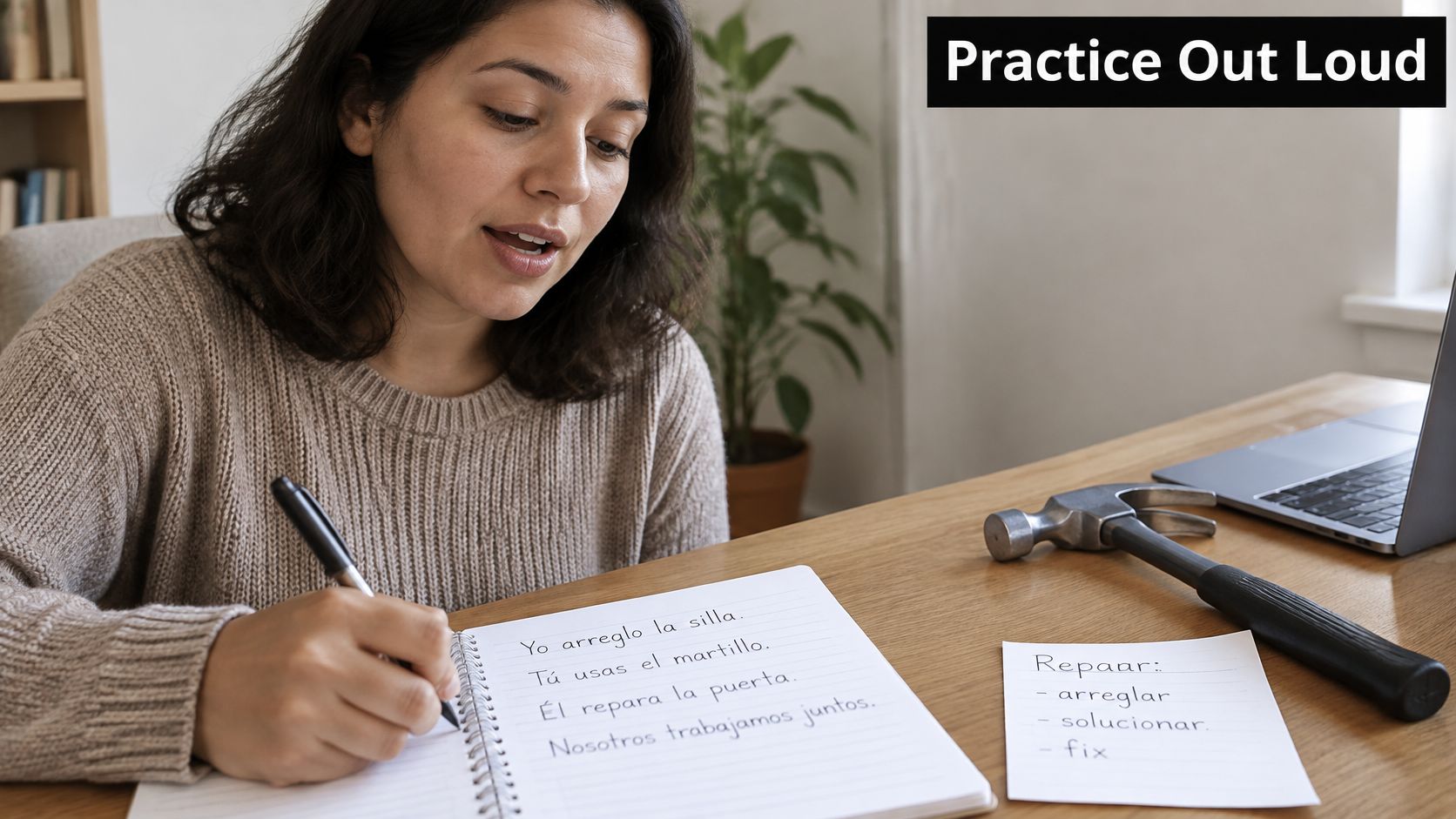
Keep a notebook nearby, and choose a small task such as putting up a picture or repairing a loose board. You're practicing how to communicate a need, not demonstrating that you can recite every related word.
Turn vocabulary into a usable request
-
Repeat the noun phrases. Say el martillo and los martillos aloud ten times each as a practice exercise. Keep the middle syllable clear and make the plural ending audible.
-
Write three sentences for a home repair, then read them aloud. Try Necesito un martillo para clavar un clavo (I need a hammer to drive in a nail), ¿Me prestas tu martillo? (Can I borrow your hammer?), and Quiero colgar una repisa (I want to hang a shelf). Using a separate sentence for the shelf avoids suggesting that hammering alone is the right installation method.
-
Record and compare. Use your phone's recorder, then listen to a native pronunciation recording. Focus on the stressed syllable and the ll sound rather than trying to remove every trace of your accent.
Change a sentence after you've practiced it. Replace a request to borrow with a request to buy, or add por favor where it belongs. This checks whether you can use the phrase rather than only repeat it.
Practice Live with Translate AI
Alongside a dictionary recording or conversation partner, the live voice translation app on the App Store offers spoken and written English-Spanish translation for two-way conversations.
- Choose English and Spanish as your conversation languages.
- Tap the microphone and say I need a hammer.
- Listen to the Spanish translation and read the displayed wording.
- Repeat the translated sentence aloud, then compare your stress and vowel sounds with the playback.
Treat playback as a listening model, not as a pronunciation score. Hearing a translation gives you something to imitate; it doesn't, by itself, confirm that your pronunciation is accurate.
For a more useful rehearsal, add your purpose instead of translating only the isolated noun. A complete request gives the listener context and lets you practice the words you'll need.
Your next action: Write a hammer sentence for a real task this week, then say it aloud before you need it.
Translate AI offers spoken and written translation for English-Spanish conversations, so you can rehearse a tool request and understand the reply. Visit Translate AI and practice a complete sentence about buying or borrowing a hammer before your next repair or hardware-store visit.