

How to Say Broken in Spanish for Any Situation
You're in Madrid for a big meeting, and your laptop suddenly goes black. Or maybe you're driving through Costa Rica, and the rental car sputters to a stop. In moments like these, knowing exactly how to say broken in Spanish isn't just a vocabulary quiz—it's a critical tool for solving a real-world problem.
The tricky part? There's no single magic word. While a quick search might tell you to use roto, saying that about a malfunctioning engine will sound strange to a native speaker. The right word always depends on what is broken.
This guide will give you the specific, actionable words you need to describe any "broken" situation with confidence. By the end, you'll know exactly which term to use for a shattered screen, a faulty machine, or even a broken heart, so you can communicate clearly and get the help you need, fast.
Why 'Broken' in Spanish Is More Than One Word

Think about it in English—you wouldn't use the same word for a shattered glass and a car that won't start. Spanish is a language rich with this kind of context, and learning a few key distinctions can be the difference between getting help and getting a confused look.
Instead of just memorizing a word, you’ll understand the logic behind each choice, which is way more useful for real-world problems.
The Power of Precise Language
Nailing the right term doesn't just get your problem solved faster; it also shows a deeper respect for the language and its nuances. With over 519 million native speakers worldwide, Spanish is the second most spoken native language, making these skills incredibly valuable. This massive community is spread across 20 countries, from Spain to Mexico, creating a vibrant global culture you can connect with more effectively.
You can dig deeper into the global reach of Spanish with insights from the Instituto Cervantes. And to build your vocabulary even more, check out our guide on how to say science in Spanish, which tackles similar contextual puzzles.
The key takeaway: Match the word to the situation. A cracked phone screen needs a different word than an out-of-order elevator. Getting this right is your first step toward sounding natural.
Throughout this guide, we'll break down the most important words for 'broken,' including:
- Roto for things that are physically shattered, cracked, or torn.
- Averiado for machines and electronics that have malfunctioned.
- Quebrado for items that have snapped, like a bone or branch.
- Estropeado for things that are ruined or spoiled.
Mastering ‘Roto’ for Physically Broken Items
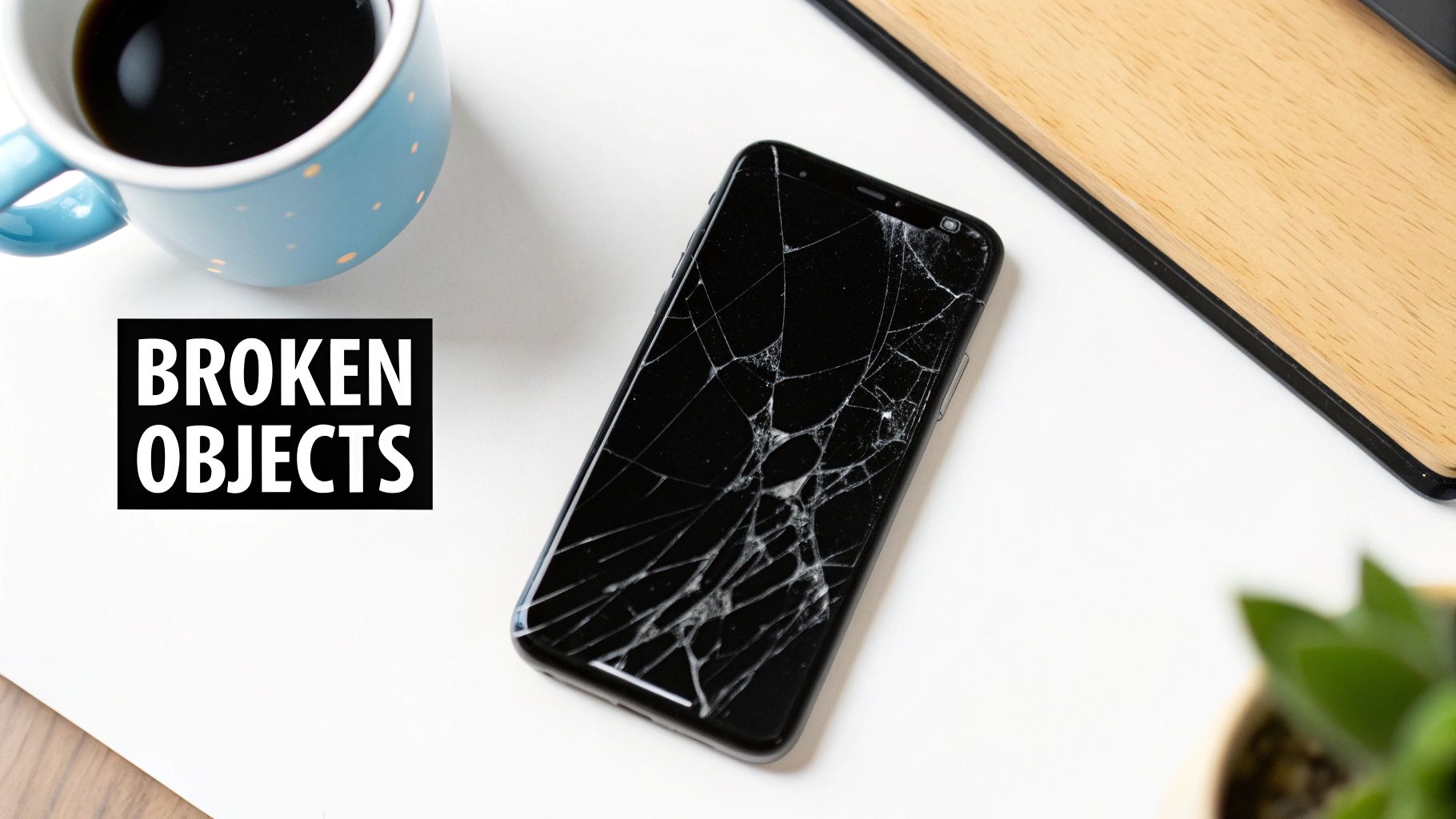
Let's start with your most valuable player in the "how to say broken in Spanish" game: roto. This is your go-to word for about 80% of situations where something is physically broken, cracked, or shattered.
Think of it this way: roto is the direct result of the verb romper, which means "to break." So, if you drop a plate and it breaks (rompe), the result is a broken plate (un plato roto). Simple as that.
Actionable Advice: Match Roto with Gender and Number
Now for a tiny bit of grammar that makes a huge difference. In Spanish, roto is an adjective, which means it has to change its ending to match the gender and number of the thing it’s describing.
For example, a phone (teléfono) is a masculine noun, so a broken phone is un teléfono roto. But a chair (silla) is feminine, so a broken chair is una silla rota.
This small tweak is one of the quickest ways to make your Spanish sound more natural. Getting it right shows you understand how the language fits together, not just that you memorized one word from a dictionary.
The same idea applies when you're talking about more than one thing. Two broken phones become dos teléfonos rotos, and a couple of broken chairs are dos sillas rotas.
Using Roto, Rota, Rotos, and Rotas Correctly
To really nail this down, here’s a quick table showing how roto changes based on the object. Notice how the ending shifts from -o to -a for feminine things and adds an -s for plural items.
| Object (English) | Spanish Noun (with gender) | Correct Phrase in Spanish | Literal Translation |
|---|---|---|---|
| The phone | El teléfono (masculine) | El teléfono está roto. | The phone is broken. |
| The window | La ventana (feminine) | La ventana está rota. | The window is broken. |
| The shoes | Los zapatos (masculine, plural) | Los zapatos están rotos. | The shoes are broken. |
| The glasses | Las gafas (feminine, plural) | Las gafas están rotas. | The glasses are broken. |
Once you get the hang of these four forms, you can describe almost any broken object you come across.
Getting this right is especially important when you consider that Spanish has a staggering 558 million total speakers worldwide, with 87% of them being native speakers. You can explore more about the world's most spoken languages to see just how massive that community is.
Practice with Translate AI
Want to hear how these phrases sound in a real conversation? A great way to build muscle memory is by using a tool like Translate AI.
Just speak "the chair is broken" into the app, and you'll instantly hear the correct Spanish pronunciation of "la silla está rota." It's a quick and easy way to practice both the vocabulary and the grammar until it feels second nature.
Using Averiado for Machines and Electronics
So what do you say when the problem isn’t a shattered plate, but a silent, uncooperative air conditioner? While roto is perfect for physical damage, averiado is the word you need when machines and electronics just stop working.
Think of it as the difference between "smashed" and "out of order." A window that's been hit by a baseball is roto. But an ATM that refuses to give you cash? That's averiado. It pinpoints a malfunction, a breakdown, or some kind of internal technical failure.
Using averiado shows you’ve moved beyond direct, word-for-word translation. It tells a native speaker you get the nuance—the issue isn't that the machine is in pieces, but that it has stopped doing its job. This distinction is a game-changer for getting the right help, whether you're at a hotel reception or a mechanic's shop.
Actionable Advice: When to Use Averiado in Real Life
This word will become your best friend in any travel or professional setting where technology decides to take an unscheduled break. Nailing this term helps you report problems clearly and get things fixed faster.
Here are a few situations where you'd use it:
- For a broken-down car: "Mi coche está averiado." (My car is broken down.)
- For an out-of-order elevator: "El ascensor está averiado." (The elevator is out of order.)
- For a faulty laptop: "Mi portátil está averiado, no enciende." (My laptop is faulty, it won't turn on.)
- For a malfunctioning coffee machine: "La cafetera está averiada." (The coffee machine is malfunctioning.)
Key Insight: Sure, you could probably say "el ascensor está roto" and people would figure it out. But a native speaker would almost always choose "averiado" to signal it's stopped working. Using the right word here makes your Spanish sound much more natural and precise.
This subtle vocabulary shift is what separates a beginner from someone who's really starting to think in Spanish.
Practice Averiado with Translate AI
Not quite sure how averiado (ah-veh-ree-AH-doh) is supposed to sound? You can use an app like Translate AI to hear it spoken with a native-sounding voice.
Just type or say a phrase like "The air conditioner is broken" into the app. It'll give you the correct translation—"El aire acondicionado está averiado”—and let you play the audio back as many times as you need. It's a perfect feedback loop for building the confidence to use the phrase for real when you need it most.
Getting Specific with Quebrado and Estropeado
Once you've got the basics of roto and averiado down, Spanish offers even more precise words to add color to your descriptions. Let's look at quebrado and estropeado—two fantastic words that handle very different kinds of "broken."
Think of quebrado as the perfect word for something that has snapped cleanly. While you'll often hear it used interchangeably with roto in many parts of Latin America, its real strength is describing a clean fracture. This makes it the go-to, medically accurate term for a broken bone (un hueso quebrado) or a pencil snapped in half (un lápiz quebrado). It’s less about general damage and more about a sharp, definite break.
On the other hand, estropeado is a wonderfully versatile word that takes "broken" a step further into "ruined" or "spoiled." It describes a state of total disrepair that goes way beyond a simple crack or a machine that won't turn on.
Actionable Advice: When to Use Estropeado
You can pull out estropeado for a wide range of situations where something is just not in its ideal state anymore. This includes:
- Spoiled food: "La leche está estropeada." (The milk is spoiled.)
- A busted engine: "El motor del coche está estropeado." (The car's engine is broken/ruined.)
- Ruined plans: "Nuestros planes para el fin de semana están estropeados." (Our plans for the weekend are ruined.)
Using estropeado correctly is a subtle sign of real fluency. It shows you get that some things aren't just physically broken—they're completely spoiled or ruined, and this word captures that feeling perfectly.
Choosing between all these words can feel a bit tricky at first, but a quick mental checklist can make it much easier. This simple decision tree will help you land on the right term most of the time.

As the flowchart shows, the first question is key: if it's a machine or electronic device, averiado is often your best bet. For almost everything else with physical damage, roto is a safe and reliable choice.
Choosing the Right Spanish Word for Broken
To make things even clearer, here’s a quick-reference table that lays out the most common words for 'broken' side-by-side. Think of it as your cheat sheet for describing everything from a cracked phone to a ruined weekend.
| Spanish Word | Primary Meaning | Best Used For | Example Sentence |
|---|---|---|---|
| Roto | Broken (general) | Physically broken objects like a plate, window, or chair. The most common, all-purpose term. | El vaso está roto. (The glass is broken.) |
| Averiado | Broken down, out of order | Malfunctioning machines, electronics, and appliances like a car, phone, or washing machine. | El aire acondicionado está averiado. (The air conditioner is broken.) |
| Quebrado | Snapped, fractured | A clean break, like a bone, a stick, or a pencil. Often used in Latin America. | Tengo un brazo quebrado. (I have a broken arm.) |
| Estropeado | Ruined, spoiled, damaged | Things that are beyond repair or have gone bad, including food, plans, or a car engine. | La fruta está estropeada. (The fruit is spoiled.) |
This table should help you quickly pinpoint the most natural-sounding word for whatever situation you find yourself in. It's all about matching the word to the specific type of "broken" you're dealing with.
Practice with Translate AI
Want to actually hear the subtle difference in how a native speaker says quebrado versus estropeado? This is where an app like Translate AI becomes incredibly useful for practice.
You can type in phrases like "broken bone" and "spoiled milk" to hear the correct translations—hueso quebrado and leche estropeada—and get a feel for the rhythm and pronunciation. That kind of immediate audio feedback is one of the best ways to build the confidence to use these nuanced words in a real conversation.
Expressing Broken Hearts and Broken Promises

Language gets really interesting when we move from physical things to feelings and ideas. The word "broken" is a perfect example, and Spanish often handles these abstract concepts in beautiful, poetic ways. Getting these phrases right is how you go from just speaking Spanish to truly connecting with people.
A classic case is the universal feeling of heartbreak. Thankfully, Spanish keeps this one direct and powerful: un corazón roto. It carries the exact same emotional weight as "a broken heart," so it’s instantly understood whether you hear it in a song, a movie, or a personal conversation.
It works the same way for a broken promise. When someone doesn’t follow through on their word, you’d call it una promesa rota. Both of these phrases use roto/a because they represent something whole—trust, a commitment—that has been shattered, just like a glass plate.
Actionable Advice: When a Direct Translation Fails
But this is where it gets tricky. Not every abstract concept translates so neatly. What if you need to say you’re "broke" as in, you have no money?
Using roto here would just lead to confused looks. A direct translation simply doesn't work. This is where you have to lean into Spanish’s rich world of idioms to sound natural.
Key Takeaway: For emotional ideas like hearts and promises, roto is your go-to. But for being financially "broke," you absolutely need to switch to specific idioms to get your point across.
Here are a couple of essential phrases you’ll hear for being out of money:
- Estar sin blanca: This literally means "to be without white." It’s a cool historical nod to an old, low-value coin called a blanca.
- Estar en la ruina: A bit more dramatic, this translates to "to be in ruin." It’s a very common and understood way to express serious financial trouble.
Learning these little expressions is what makes the difference between sounding like a textbook and sounding like a real person.
Hearing These Phrases in Action with Translate AI
Knowing the difference between corazón roto and estar sin blanca is one thing, but saying them with confidence is another. If you want to hear how these phrases flow in a real conversation, an app like Translate AI can be a huge help.
You can speak "I have a broken heart" into the app and instantly hear a native-sounding voice say, "Tengo el corazón roto." It’s a great way to nail the pronunciation and get comfortable with the rhythm of these more emotional phrases before you have to use them for real.
Putting Your Spanish into Practice
Alright, knowing the right words is a great first step. But using them with confidence when you’re actually talking to someone? That’s a whole different ball game. This is where a little bit of tech can really help you bridge the gap between theory and real-world conversation.
Think about it. Before you even try to speak with a hotel clerk, you can practice getting the pronunciation just right. With a tool like Translate AI, you could say, "The shower is broken," into your phone and instantly hear the correct Spanish reply: La ducha está averiada.
Use Technology as Your Interpreter
Better yet, you can just play the translation for them directly from the app. It's like having a personal interpreter in your pocket, perfect for smoothing over those unexpected travel hiccups.
The two-way conversation feature in Translate AI is built for this. With a simple interface and big microphone icons, it keeps the back-and-forth intuitive and stress-free.
This is how you turn what you’ve learned into a real communication skill. If you're ready to build on this, a great next step is to check out our guide on how to ask for any phrase in Spanish. It’s packed with more tips to get you talking.
Common Questions About Saying Broken in Spanish
Even with the main words down, a few tricky questions always come up. Let’s clear up the common hangups so you can use these words with confidence.
One of the biggest is about overusing roto. Can you just use it for everything? Pretty much, yes. If you say "mi coche está roto," everyone will know what you mean. Think of it like saying your car is "busted" instead of "malfunctioning"—one is just a bit more precise, but both get the point across.
Can I Use 'Quebrado' in Spain?
This is a great question about regional differences. While quebrado is super common in Latin America for things that have snapped or fractured, you’ll barely hear it in Spain. If you’re in Madrid or Barcelona, just stick with roto. It's the safer, more natural-sounding choice.
Learners also get tripped up on the difference between averiado and estropeado. Here’s a simple way to think about it: if a machine just isn't working right now, use averiado. But if it's completely ruined, beyond repair, or has gone bad (like spoiled food), estropeado is your word. It implies a much more permanent and severe kind of damage.
The best way to master these nuances? Just listen. Pay attention to how native speakers around you describe things that aren't working. Context is always your best teacher.
And if you're ever stuck trying to understand what someone means by a specific word they've used, our guide on how to ask what do you mean in Spanish can help you ask for clarification like a local.
Ready to actually hear how these words sound in a real conversation? Translate AI can be your pocket language coach. The app gives you instant voice playback for any phrase, so you can lock in your pronunciation of roto, averiado, and all the others.
Download it from the App Store and start speaking Spanish more confidently today.