

How to Order Food in Chinese: Phrases, Menus and Tips
You are at the counter with a pen already in the server's hand. The menu is a wall of characters, the person behind you has decided, and the one line you practiced does not match this moment. You freeze.
How to order food in Chinese is a short sequence, not a speech. You get attention, name a quantity, set limits, and confirm before the kitchen starts. A grammatically correct sentence can still bring a dish that is too spicy, the wrong size, or full of something you cannot eat. Every key phrase below sits next to the follow-up that stops that mistake.
You don't need fluent Mandarin for one meal. You need a small card, a routine you can repeat under pressure, and a way to hear the reply when staff talk faster than you expected.
Core Phrases to Order Food Like a Local
Three lines carry most meals. 服务员 (fúwùyuán) gets a person to you. 我要 (wǒ yào) starts the order. 买单 (mǎidān) ends it. If you only memorize those three, you can still sit down, point, and pay.
Almost every dish uses the same pattern: 我要 plus a quantity plus the dish name. You are not building a paragraph. You are filling a slot. The table follows the meal in order, from the greeting to the receipt.
| Use it when | Chinese | Pinyin | Meaning |
|---|---|---|---|
| Get the server's attention | 服务员 | fúwùyuán | waiter or server |
| Ask for the menu | 请给我菜单 | qǐng gěi wǒ càidān | please give me the menu |
| Say what you want to order | 我要…… | wǒ yào… | I would like… |
| Order one portion | 一份 | yí fèn | one portion |
| Say you will eat in | 堂吃 | tángchī | dine in |
| Say you want takeaway | 打包 | dǎbāo | takeaway |
| Ask for no spice | 不要辣 | bú yào là | not spicy |
| Ask for mild spice | 少辣 | shǎo là | a little spicy |
| Ask how many people | 几位? | jǐ wèi? | how many people? |
| Ask what the house recommends | 你们的招牌菜是什么? | nǐmen de zhāopái cài shì shénme? | what is your signature dish? |
| Point at an item | 我要这个 | wǒ yào zhège | I want this one |
| Ask the price | 多少钱? | duōshao qián? | how much is it? |
| Ask for the bill | 买单 | mǎidān | the bill, please |
| Ask for a receipt | 发票 | fāpiào | receipt or invoice |
Tones matter, and short phrases forgive a wobble when the rhythm is clear. 不要辣 needs a clear falling tone on là. A flat la can sound like a different word, and the kitchen may hear a request you didn't make. Spice words are worth saying while you point, which is the method Ola China treats as normal at a busy counter. If you want the spelling and the sound kept separate in your notes, translation versus transliteration is the distinction to use on the card.
Practical rule: Say your five most important phrases aloud twice before you arrive, and keep the characters on a card so you can point if the sound fails.
Numbers and Measure Words Every Order Needs
两 (liǎng) replaces 二 (èr) before a measure word. Two portions are 两份 (liǎng fèn), not 二份. That swap is the mistake that makes an otherwise clean order sound off.
Chinese puts a measure word between the number and the noun. 一个人 (yí gè rén) is one person. A dish needs its own counter, often 份. Numbers one to ten are yī, èr, sān, sì, wǔ, liù, qī, bā, jiǔ, shí. Learn them as sounds you can tap on the table, not as a list you recite from one.
| Measure word | Pinyin | Use it for | Example |
|---|---|---|---|
| 份 | fèn | a portion of a dish | 一份饺子 (yí fèn jiǎozi), one portion of dumplings |
| 碗 | wǎn | a bowl of rice or noodles | 一碗米饭 (yì wǎn mǐfàn), one bowl of rice |
| 杯 | bēi | a cup of tea or a drink | 一杯茶 (yì bēi chá), one cup of tea |
| 瓶 | píng | a bottle of water or beer | 一瓶啤酒 (yì píng píjiǔ), one bottle of beer |
| 盘 | pán | a plate of stir-fry | 一盘炒青菜 (yì pán chǎo qīngcài), one plate of stir-fried greens |
| 个 | gè | small items such as buns, or when unsure | 两个包子 (liǎng gè bāozi), two buns |
| 位 | wèi | counting people politely | 三位 (sān wèi), three people |
Say three friends are sharing two dishes and ordering beer. You answer the headcount with 三位 (sān wèi). You order each dish as 两份. You add 一瓶啤酒 (yì píng píjiǔ) if one bottle is enough, or 三瓶 if each person wants one. The number and the counter travel together. Drop the counter and the server has to guess the size.
If the right counter won't come, use 个 (gè). It works for many small countable things, including buns. It sounds less precise for soup or a drink, so switch back to 碗, 杯, or 瓶 when you remember.
Watch how the quantity comes back to you. The server repeats the number, or writes it on the pad. If neither happens, say the number again and hold up your fingers. That second pass is what stops two bowls from becoming four.
How to Order Step by Step in Mandarin
The Today Chinese ordering guide lays out a workflow you can run in any room: name the service format, get the menu, then build quantity, measure word, and dish. The picture below is the same path in seven moves.
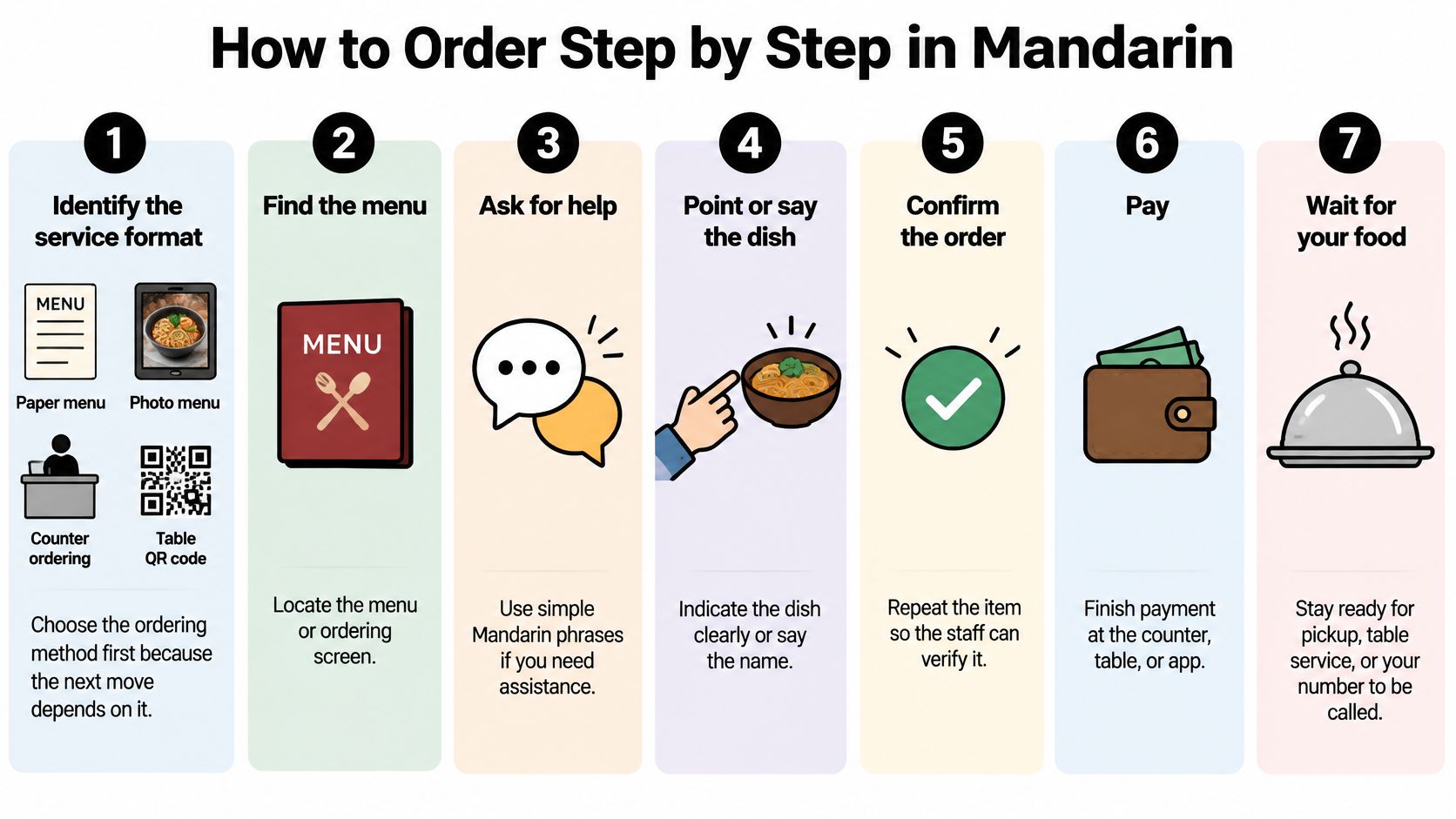
- Identify the service format. Look for a paper menu, a photo menu, a counter, or a table QR code. The next move depends on which one you have. Guessing wrong is why people sit and wait at a pay-first noodle shop.
- Get the menu or signal that you are ready. Say 请给我菜单 (qǐng gěi wǒ càidān), or 我要点菜 (wǒ yào diǎn cài). At a counter, point at the board instead of waiting for a booklet that isn't coming.
- Ask for the house recommendation before you invent a dish name. 你们的招牌菜是什么? (nǐmen de zhāopái cài shì shénme?) lets the server pick one or two known plates. You avoid guessing at a regional name you cannot pronounce.
- Order with quantity, counter, and dish. 我要一份饺子 (wǒ yào yí fèn jiǎozi) is one portion of dumplings. 份 fits a portion, 碗 a bowl, 杯 a cup, and 瓶 a bottle. Forgetting the counter is the usual slip, and 我要这个 (wǒ yào zhège) while you point is the fallback.
- State limits in the same breath. 不要辣 (bú yào là), 不要肉 (bú yào ròu), or 不要太咸 (bú yào tài xián) have to land before the ticket goes back. A later change often misses the wok. A line that is technically right can still be unusable if the chili, meat, or salt was left implicit.
- Check payment timing and sold-out items. Ask whether you pay in the QR flow now or at the end. Use 有没有 (yǒu méiyǒu) when a dish might be gone. Skipping this is how you wait twenty minutes for something the kitchen already crossed off.
- Ask for the bill with 买单 (mǎidān) or 结账 (jiézhàng). Do it when you are finished, not while plates are still arriving, or you may get a partial total.
Before the server leaves, repeat the full order: dishes, quantities, and spice. If they nod at a different number, stop and correct it with your fingers.
Hearing the lines once makes the rhythm stick faster than reading them. This short clip is worth one play before you go out.
Sample Dialogues for Four Common Settings
Dine-in for three
- Server: 几位? (jǐ wèi?) How many people?
- You: 三位。 (sān wèi.) Three.
- You: 请给我菜单。 (qǐng gěi wǒ càidān.) Please give me the menu.
- You: 我要一份炒饭。 (wǒ yào yí fèn chǎofàn.) I would like one portion of fried rice.
- You, later: 买单。 (mǎidān.) The bill, please.
Shared tables often add more plates than one person would order alone. If the reply comes back in fast local speech, don't smile and guess.
Takeaway at the counter
- You, first: 我要打包。 (wǒ yào dǎbāo.) I want this to go.
- You: 两份饺子。 (liǎng fèn jiǎozi.) Two portions of dumplings.
- You, when the bag appears: 好的,谢谢。 (hǎo de, xièxie.) Okay, thank you.
Say takeaway before the dish name. Said afterward, it can be heard as a request to pack leftovers from a meal you meant to eat there.
A delivery note
- In the app note field: 不要葱。 (bú yào cōng.) No spring onion.
A written constraint does the same job as a spoken one, and the rider cannot fix the wok after pickup. If the restaurant calls to confirm and you miss the words, the same repeat request below still applies.
Street food
- You, pointing: 我要这个。 (wǒ yào zhège.) I want this one.
- You, three fingers up: 三个。 (sān gè.) Three.
- You, before you hand over cash: 多少钱? (duōshao qián?) How much is it?
Ask the price before you pay. Skewers are often priced per stick, and a nod can mean the bunch, not one.
When the answer is a blur, use one follow-up: 你能再说一遍吗? (nǐ néng zài shuō yí biàn ma?) Can you say that again?
If you want that line in your ear while you practice, a voice translator from English to Chinese lets you hear the reply shape before you are standing in the queue.
Reading Menus and Fixing QR Ordering Problems
You point to a dish photo and say 我要这个 (wǒ yào zhège), “I want this one.” The server nods, but you still do not know whether it contains an ingredient you cannot eat or how many portions you just ordered. Pairing the phrase with a follow-up question prevents a clear order from becoming the wrong meal.
Start with the photo, then check the dish name and any small-print notes. If the dish has a number, use it to identify your choice, but confirm the quantity separately. A photo may show the dish, not its ingredients. Ask about anything important before the order is confirmed.
A table QR code may open a Chinese mini-program instead of a regular web page. Look for an English language option, check the table number and quantities, and see whether the page asks for payment before the kitchen starts. If you cannot use the menu, ask staff for help or use the paper menu.
| Symptom | Likely cause | Fix |
|---|---|---|
| QR code opens a page you cannot read | Mini-program in Chinese | Look for a language option, or ask staff for help |
| Dish arrives too spicy | Spice level not stated | Say 不辣 (bú yào là), “not spicy,” or 少辣 (shǎo là), “less spicy,” and confirm before ordering |
| Rice arrives as a plate instead of a bowl | The portion was unclear | Say 一碗米饭 (yì wǎn mǐfàn), “one bowl of rice” |
| No one comes to your table | Staff have not been alerted | Raise a hand and say 服务员 (fúwùyuán), “server” |
| Bill higher than expected | Items or quantities were not confirmed | Ask for the bill with 买单 (mǎidān), then check each line before paying |
The measure word in 一碗米饭 specifies a bowl. If you order rice, say the serving you want rather than relying on a literal translation of “one rice.”
Using Translate AI During Your Order
Use a set phrase for familiar requests. For a follow-up you cannot phrase confidently, such as asking whether a dish contains shrimp, Translate AI can translate both ways so you speak in your language and your partner hears the translation in theirs.
- Select your language and your partner's language from the app's list.
- Tap the microphone button and speak naturally.
- The translation appears and is spoken immediately. Speaker mode is available for hands-free chats.
For a broader look at translation tools, see this guide to the best Chinese translator app.
Dietary Restrictions and Allergies to State Clearly
我吃素 (wǒ chī sù) means you eat vegetarian. It does not, by itself, rule out pork lard, chicken stock, or oyster sauce. Travel Hub China treats that gap as the main risk: a linguistically correct order can still be unsafe, and gluten-free eating isn't a category every kitchen shares.
Preference and medical allergy are different jobs. "I don't love chili" can survive a compromise. A peanut allergy cannot. Beginner lists often stack vegetarian, vegan, halal, and allergy lines as if they were the same strength. They aren't. Simple wording can hide a stock, a sauce, or an oil and leave you falsely calm.
| Phrase | Chinese | Pinyin | What it may still include |
|---|---|---|---|
| I am vegetarian | 我吃素 | wǒ chī sù | lard, meat stock or oyster sauce |
| I do not eat meat | 我不吃肉 | wǒ bù chī ròu | fish sauce or meat stock |
| Not spicy | 不要辣 | bú yào là | Sichuan peppercorn or chili oil |
| I am allergic to peanuts | 我对花生过敏 | wǒ duì huāshēng guòmǐn | peanut oil, peanut sauce or crushed peanut topping |
| Does this dish contain…? | 这个菜里有……吗? | zhège cài lǐ yǒu……ma? | the ingredient you name, confirmed by staff |
我对花生过敏 has to name the forms. Say peanut oil, peanut sauce, and crushed peanut topping, not only the word peanut. Then ask 这个菜里有花生油吗? and wait for a yes or no you understand.
Use this order when the limit is serious:
- State the restriction in Chinese, with allergy language if it is medical, not a soft preference.
- Name the hidden sources you are worried about, such as lard, stock, oyster sauce, or peanut oil.
- Ask 这个菜里有……吗? and don't accept a vague nod.
- Ask for the answer in writing on a slip or in the ordering note.
- Pick a place that already cooks for that limit when a shared wok or a fryer makes avoidance unlikely.
Pointing at a photo is fine for choosing a look. It isn't a safeguard. A picture doesn't list the oil in the pan.
Pay the Bill and Leave Without Surprises
On a QR table the total is often already tied to the order, and you confirm it in the mini-program before you stand up. In a traditional room you say 买单, and the server brings the slip to you. Either way, read it before you tap pay.
Prices are written in 元 (yuán) and spoken as 块 (kuài). 三十五块 (sānshíwǔ kuài) is 35 yuan. 五毛 (wǔ máo) is 0.5 yuan. If you only watch the big number, a packaging fee or an extra drink hides in the lines under it.
Check each line against what you ordered, including a service charge or a box fee. Pay with WeChat Pay or Alipay where that is what the QR expects, and keep a little cash for smaller shops that still take notes. Say 请给我发票 (qǐng gěi wǒ fāpiào) before you leave. An invoice is hard to get once you are on the street. Tipping isn't expected in ordinary restaurants, so don't leave cash on the table unless the place clearly asks for it.
Sorting travel money before you fly saves a stuck checkout. RedSim payment options is a practical place to see which methods you can have ready. If the total still doesn't match and you need the server to hear your question in Chinese while you hear theirs, go back to the Translate AI steps above. It translates both ways: you speak in your language and your partner hears it in theirs.
Pick one restaurant this week. Run the seven steps, keep the phrase card in your hand, and check every line before you pay.
Translate AI is a live voice translator for the moment a menu, a spice answer, or a bill outruns the lines you memorized. You speak, the other person hears Chinese, and you hear their reply in your language, including ingredient questions you cannot afford to guess. Visit Translate AI and try one practice order out loud before your next meal.