

English to Mandarin Chinese Translator: Which Type to Use
You're standing in a noodle shop in Shanghai, the menu is in Chinese characters, and you need to ask whether a dish is very spicy before you order it. Or you're on a call with a team in Taipei and one contract clause could change a delivery date. In both moments, the right English to Mandarin Chinese translator isn't just about accuracy. It's about choosing the right type of tool, the right Mandarin for your listener, and knowing when to double-check a fluent-sounding answer before you act on it.
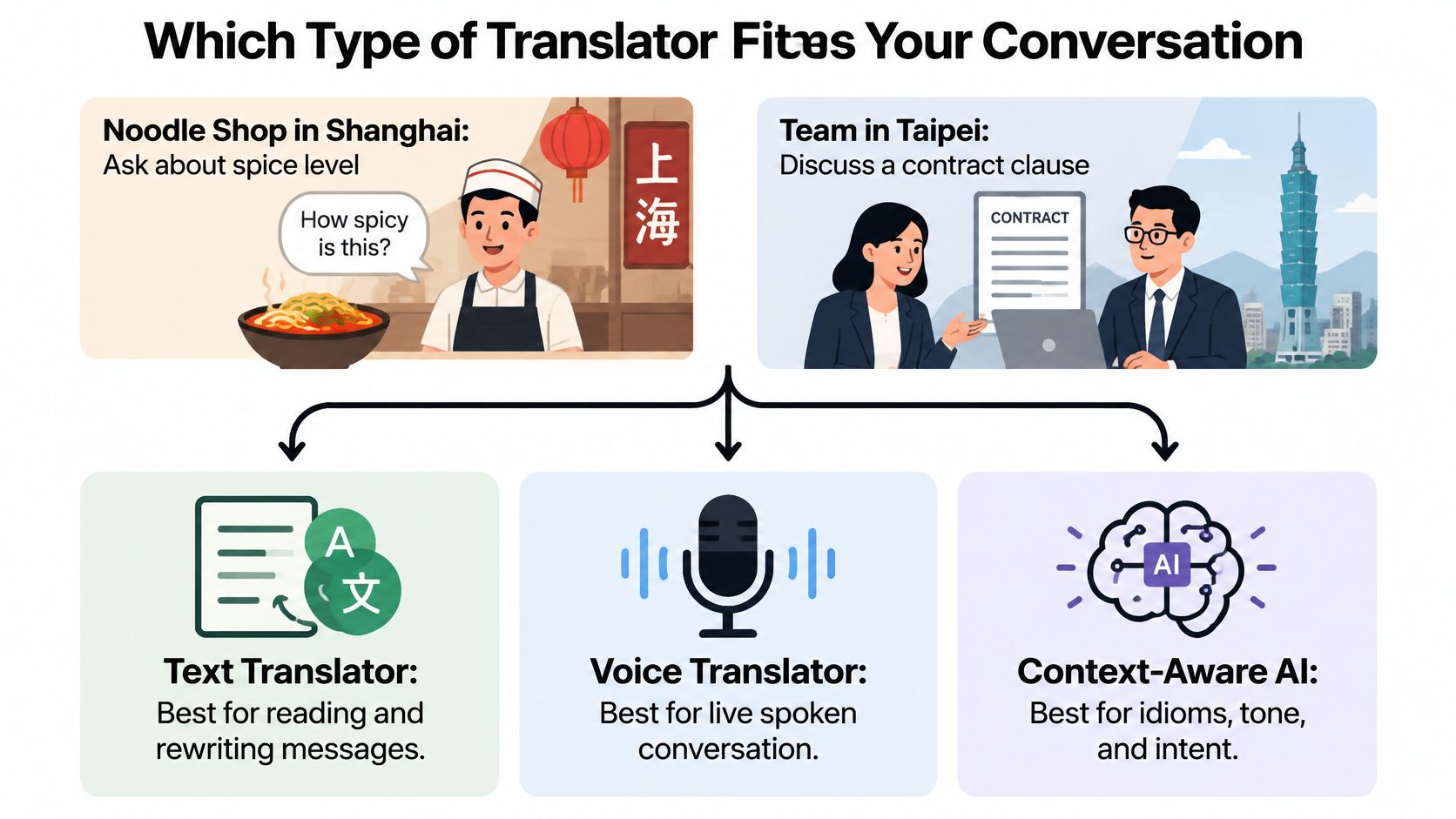
Which Type of Translator Fits Your Conversation
Use text translation for written details you need to read carefully, voice translation for short spoken questions, and a real-time two-way translator when both people need to keep talking. Most travelers and professionals end up using a mix, because a menu, a taxi ride, and a meeting don't make the same demands.
| Type | Best for | How it works | Main limit |
|---|---|---|---|
| Text translator | Menus, signs, emails and booking details | You type or photograph English and read Chinese characters with Pinyin | No live back-and-forth; you must pass the phone over |
| Voice translator | Short phrases, questions and directions | You speak English and play back Mandarin audio, one direction per turn | Turn-taking slows the conversation |
| Real-time two-way translator | Meetings, hotel check-ins and longer chats | Both people speak and each hears the translation in their own language as they talk | Needs good microphone quality, a usable network and clear speech |
The visual below maps those three choices to everyday and work situations.
Why the choice matters at scale
Mandarin isn't a niche extra on a language list. Estimates reported for 2022 place Mandarin at approximately 990 million native speakers and about 194 million additional second-language speakers, for a total of roughly 1.184 billion speakers, according to the Mandarin Chinese overview. It's spoken from Yunnan in the southwest to Xinjiang in the northwest and Heilongjiang in the northeast, and it has official-language status in the People's Republic of China and Taiwan, plus a place as one of Singapore's four official languages.
That reach explains why a single tool rarely fits every job. At a restaurant counter, playing one clear Mandarin sentence from your phone is enough. In a supplier meeting, passing a phone back and forth breaks the flow and makes it harder to catch a question about price or timing.
Quick decision rule: Choose text for details you'll re-read, voice for one short question, and real-time two-way mode when the other person needs to answer, clarify, and ask questions of their own.
Check offline support and microphone quality before you rely on any option. Offline packs vary by product, and a weak microphone in a noisy station can turn a good translator into a guessing game.
Choose the Right Mandarin Variety and Script
Start with where your listener lives, not with the word Mandarin on a settings screen. Find their row first, then set your translator to match.
| Listener location | Mandarin variety | Script | Practical note |
|---|---|---|---|
| Mainland China | Standard Mandarin (zh-CN) | Simplified characters | Standard Mandarin is the safe default for cross-regional speech |
| Taiwan | Taiwanese Mandarin (zh-TW) | Traditional characters | Vocabulary and politeness can differ from mainland usage |
| Singapore | Singaporean Mandarin (zh-SG) | Simplified characters | Local phrasing and slang differ; confirm names and places |
| Hong Kong | Standard Mandarin for visitors; Cantonese is common locally | Traditional characters | Ask whether the listener expects written Mandarin or spoken Cantonese |
| Overseas Chinese communities | Family and regional background decide the variety | Simplified or Traditional, by reader preference | Ask which script and variety the reader uses |
Simplified and Traditional are not interchangeable
A scholarly overview reports that the official General List of Simplified Characters contains 2,236 characters, published in 1964 and republished with minor revisions in 1986, and that simplified characters are adopted in mainland China and Singapore while Taiwan and Hong Kong use traditional characters, as set out in the Center for Applied Linguistics heritage brief on Chinese language planning. The meaning can be right and the script can still feel wrong. A Traditional reader in Taipei may understand Simplified output, but it can look unfamiliar or careless in a formal message.
Spoken variety adds another layer. Mandarin has regional sub-varieties, and broader Chinese language planning recognizes several major regional groupings beyond Mandarin itself. To understand how those groupings relate to each other, this guide to what languages are spoken across China provides a clear overview. A listener whose everyday language is Cantonese or Min may still understand Standard Mandarin, especially in formal settings, but you shouldn't assume it's their preferred language for a detailed conversation.
Regional wording matters too. Mainland, Taiwanese, and Singaporean Mandarin can differ in everyday vocabulary, politeness habits, and local expressions, even when speakers understand one another. That's why selecting zh-CN, zh-TW, or zh-SG is a practical choice, not a technical detail buried in settings.
A three-step workflow
- Identify the listener's location: Ask where they'll read or hear the message, not just what language they speak.
- Pick variety and script together: Match both rows in the table before you translate a full paragraph.
- Confirm critical details in writing: Show names, addresses, and instructions as text so your listener can check characters, not just sounds.
If your listener uses a local word you don't recognize, ask whether they prefer a more standard term. That one question prevents you from repeating slang in a setting where it sounds too casual.
Tones, Pinyin and Measure Words That Change Meaning
English speakers often treat tone like emotion. You raise your voice for a question or stress a word for emphasis. In Mandarin, tone is part of the word itself, so changing the pitch pattern can change what you've said.
| Pinyin | Tone | Character and meaning |
|---|---|---|
| mā | First tone (high level) | 妈 mother |
| má | Second tone (rising) | 麻 hemp |
| mǎ | Third tone (dipping) | 马 horse |
| mà | Fourth tone (falling) | 骂 to scold |
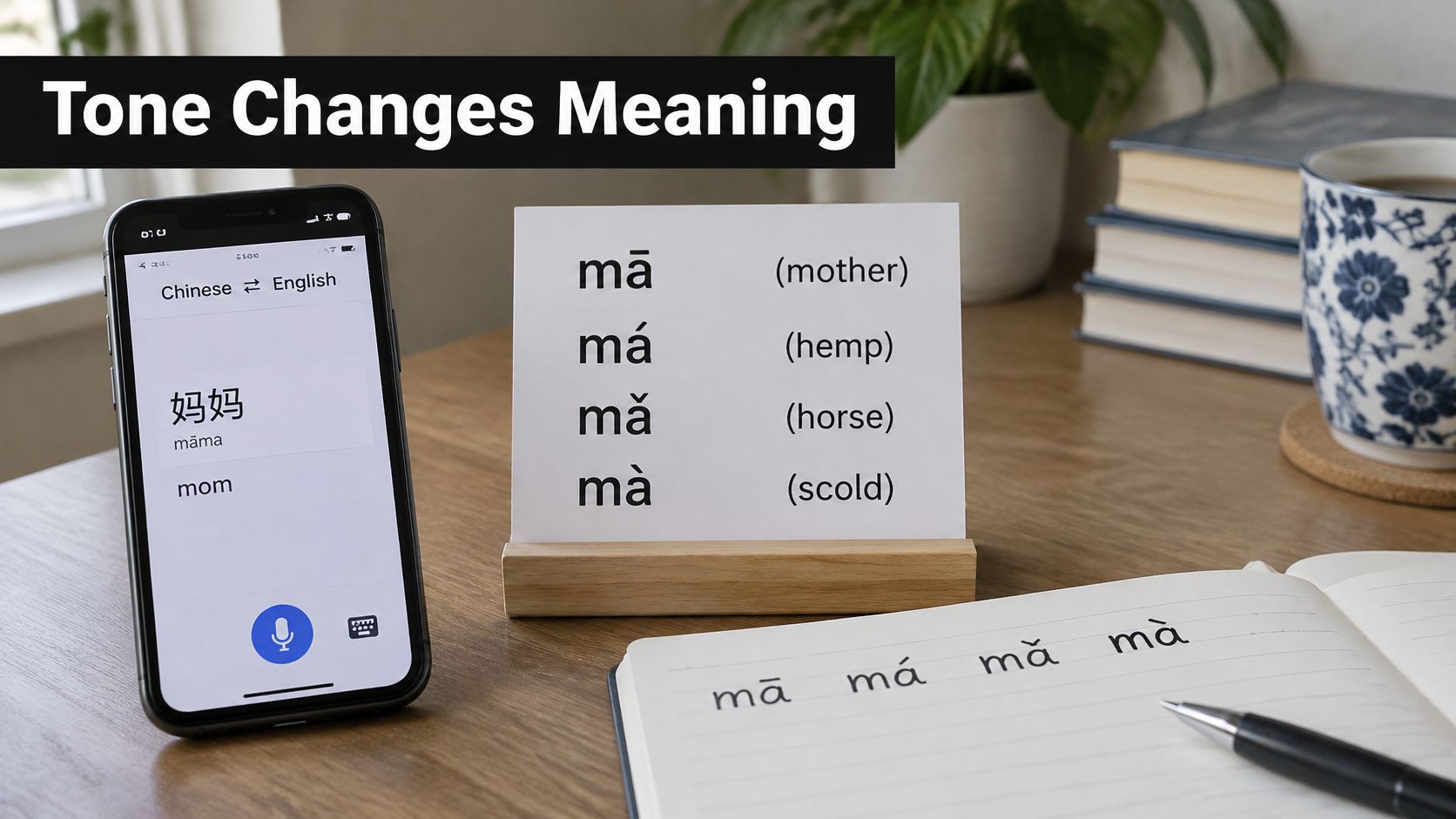
Standard Mandarin has four contrastive tones, high-level, rising, low or dipping, and falling, written in Pinyin as marks such as ā, á, ǎ, and à, according to the Education University of Hong Kong Mandarin pronunciation guide. That's why a good English to Mandarin Chinese translator gives you audio plus Pinyin with tone marks, not characters alone. Characters tell a reader what the word is. Pinyin and audio tell you how to say it.
The image below shows why learners often keep tone cards beside the app while practicing.
Tones shift in connected speech
Words don't always keep their dictionary tone in a sentence. The negative word 不 is pronounced bú before a fourth-tone syllable instead of its citation pronunciation bù. You don't need to memorize every tone-change rule before a trip, but you do need to copy the audio rather than guessing from spelling. Short, daily pronunciation drills for clearer speech can help you hear the difference between a rising and dipping tone before you depend on it in public.
This is also where translation and sound-based writing meet. Pinyin represents Mandarin sounds in Roman letters, which is different from translating meaning, a distinction explained in this comparison of translation and transliteration. Use Pinyin as a pronunciation aid, not as a replacement for checking meaning.
Measure words carry grammar English doesn't
Mandarin usually places a measure word, also called a classifier, between a number and a noun. Three books becomes 三本书, three, measure word, books. The general classifier 个 is common, but it isn't interchangeable with every specific classifier.
Say you translate three separate requests word by word. Three bottles of water points to a container, three tickets points to a flat item or pass, and three pieces of information may need a structure for items or messages rather than physical objects. A translator that sees only the English noun can pick a generic pattern and sound unnatural, or unclear.
Send the full sentence and state the purpose. Speech, signage, a booking, and formal business writing call for different levels of politeness and precision. Then read the Pinyin aloud. If you can't connect the sound back to your English meaning, ask for a simpler rephrase before you use it.
Where Fluent Translations Still Go Wrong
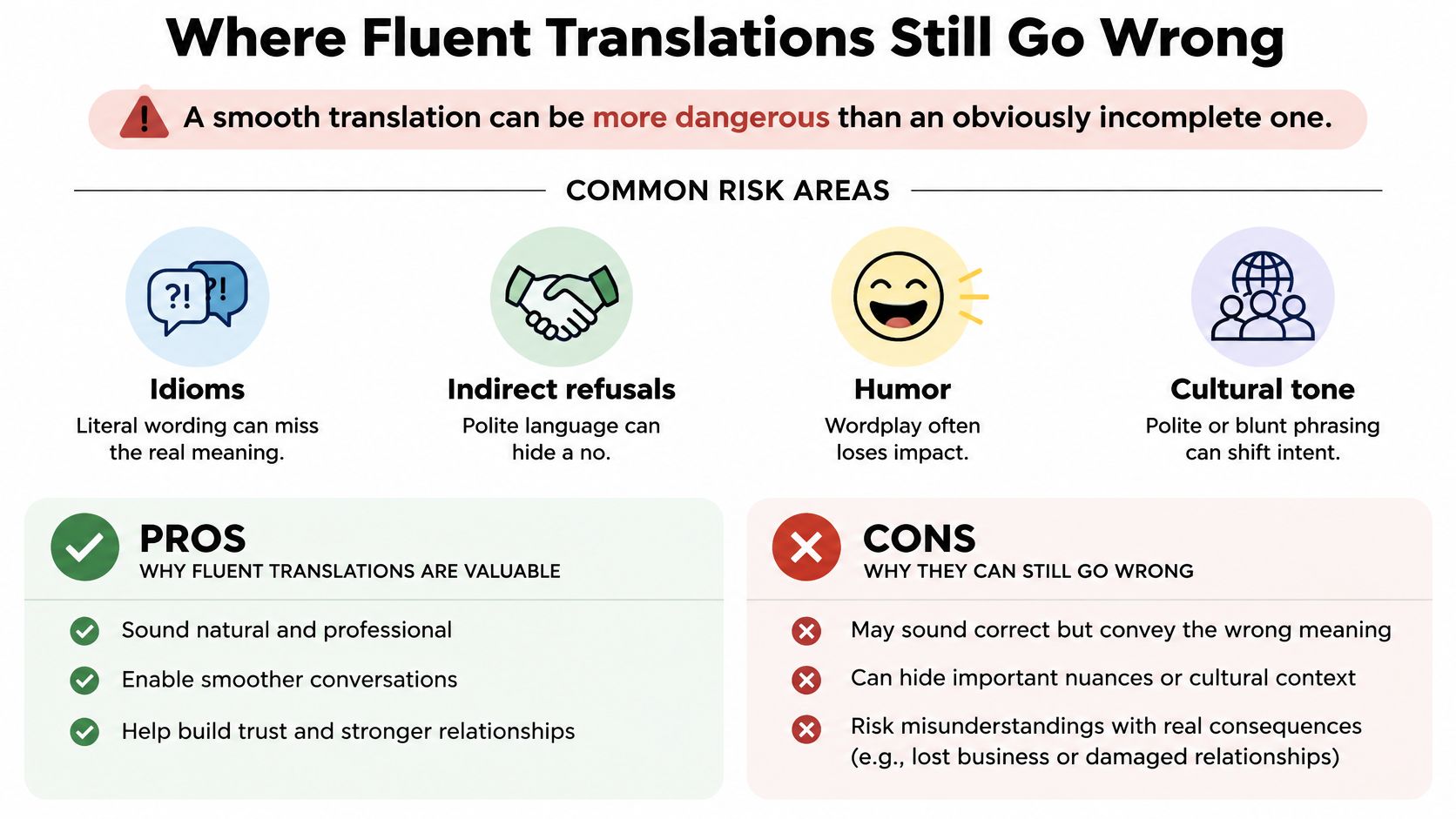
A smooth translation can mislead you more than an obviously broken one, because you stop checking it. Fluency tells you the sentence sounds natural. It doesn't tell you the intent survived.
The riskiest material is rarely a simple direction or price. Watch for idioms, indirect refusals, humor, hierarchy, and emotionally sensitive wording. A polite phrase that sounds like maybe later may function as a soft no. A joke translated word for word may land as an insult or as nonsense.
Cultural references expose the same gap. An evaluation found that Google Translate struggled with Chinese traditional allusions and with preserving contextual connections, attributing errors partly to missing historical and contextual knowledge, in the evaluation of Mandarin translation and traditional allusions. The output can read cleanly while the reference that gave the sentence its force disappears.
Written benchmarks don't predict live speech
Live conversation adds pauses, restarts, overlap, abbreviations, and background noise. In a study using 123 hours of Mandarin telephone speech from the CallHome and HKUST corpora, a general-purpose NLLB model achieved only 5.98 BLEU on the conversational test set without adaptation, while fine-tuning on matched conversational telephone-speech data raised the score to 14.16 BLEU, according to the conversational speech translation study. A model that handles news text well can still struggle when people talk like people.
Grammar creates quieter errors. English forces you to mark tense, number, articles, and explicit subjects. Mandarin often relies on context, aspect markers, classifiers, or omission. A translation can therefore drop whether something already happened, blur who did it, or choose the wrong classifier while sounding polished. If you want the underlying mechanics, this explainer on how machine translation works shows why systems predict likely wording rather than verify facts.
The short video below is useful for hearing how small wording choices change a live exchange.
Use a risk protocol before you act
- Ask for repetition: Have your listener restate the key point in their own words, then translate that back.
- Confirm names and numbers in writing: Show typed digits, dates, addresses, and spellings on screen.
- Flag idioms before translating: Replace slang and jokes with plain English first, such as changing a figure of speech into its literal meaning.
- Switch to typed text for critical details: Use text for prices, times, allergies, medication, and meeting obligations.
- Escalate when stakes rise: Use a qualified human interpreter for legal, medical, and contract discussions.
Fluency is not reliability. Treat a polished translation as a draft whenever money, health, safety, or a formal commitment depends on it.
Features to Check Before You Download an App
Don't judge an app by translating hello in a quiet room. Run this checklist in a shop, cafe, or hotel lobby, where you'll use it.
| Feature | Why it matters | Test before you rely on it |
|---|---|---|
| Two-way conversation mode | Each person hears their own language | Speak a full sentence with a number, a name and a place |
| Offline mode | Works on flights, in subways and in weak signal | Turn off Wi-Fi and mobile data, then translate one sentence |
| Earbud and headphone compatibility | Lets you keep the phone in your pocket | Connect your own earbuds and check the listener hears clearly |
| Speaker mode | Hands-free chats and group talks | Place the phone between two people and check the volume |
| Variety and script selection | Matches mainland, Taiwan or Singapore listeners | Switch between Simplified and Traditional output |
| Pinyin with audio | Lets you practice tones aloud | Compare the audio with a native speaker's tone |
| Privacy and data handling | Conversations can include personal or business details | Read the privacy policy on stored audio and data sharing |
The rows readers overlook
Earbud compatibility changes the social feel of a conversation. Holding a phone between faces works for one question, but it gets awkward in a meeting or a long taxi ride. Test with the earbuds you already own, walk a few steps away from the phone if the setup allows it, and check whether both sides still hear complete sentences.
Privacy handling deserves the same attention as accuracy. Look for clear answers on whether audio is stored, whether conversations are used to improve the service, how long transcripts remain available, and whether the microphone stays active only while you speak. Don't paste contracts, medical details, or identification numbers into an app whose policy you haven't read.
Variety and script selection also need a real test. Switch the same sentence between Simplified and Traditional output and confirm the setting changes the text you'll show your listener. A menu label that says Chinese isn't specific enough for careful work.
Check pricing in practical terms. Does a free tier cover your trip, class, or project, or will it stop at the moment you need a longer conversation? Review limits before you travel rather than at a ticket counter.
Finish with a three-part test. Speak one sentence containing a number, a name, and a place, repeat it in cafe noise, then ask a Mandarin speaker to restate the meaning. If any of the three details changes, adjust your speaking pace, microphone position, or app choice.
Real-World Use Cases for Travelers, Business and Learners
A traveler asking about peanuts, a colleague confirming a delivery date, and a learner practicing tones need different things from a Mandarin translator. The language also serves different audiences, so consider who will read or hear the translation and confirm consequential details before acting on a fluent-sounding result. The China Internet Network Information Center reported 1.108 billion internet users by December 2024, representing 78.6% internet penetration, in its official statistical report on internet development.
Travelers
At a restaurant in Chengdu, ask whether a dish contains peanuts, then show the allergy statement in written Chinese so staff can read it. For a train platform or taxi destination, keep the address as text as well as audio. Characters are easier to compare with signs and maps than an unfamiliar pronunciation.
For allergies or other safety-related needs, ask the listener to confirm the meaning before you rely on the translation.
Action for this week: Save your hotel address, allergy needs, and emergency contact in Chinese text before you leave home.
Business users
On a cross-border call, quantities, delivery dates, and approval of price changes can be easy to mishear. Use live translation to keep the discussion moving, then write down each decision and send a bilingual summary for confirmation. Treat the fluent audio as a conversation aid, not as the final record.
This gives both sides a chance to catch a unit, decimal point, or pronoun that may have been blurred in speech.
Action for this week: Practice a conversation with a colleague using realistic product names, quantities, and dates, then compare the transcript with the intended meaning.
Learners
When practicing a greeting, listen to the translated audio, check the Pinyin tone marks, and repeat one short sentence at a time. Tones can change a word's meaning, so a smooth-sounding sentence is not proof that your pronunciation is clear. You can also translate your own Mandarin sentence into English and check whether the returned meaning matches what you intended.
For a broader study routine, language app comparisons from Simply Tech Today can help you compare dedicated learning apps with a live translator. They serve different purposes: one can support structured study, while the other helps with spoken exchanges.
Action for this week: Practice one greeting, one question with a number, and one polite refusal. Ask a listener to repeat each meaning back before you assume the message was clear.
Set Up Your First Live Conversation in Translate AI
Set up the conversation before you're standing at a counter with a queue behind you. A calm first test shows you which buttons matter, how your earbuds behave, and how long to pause between sentences.
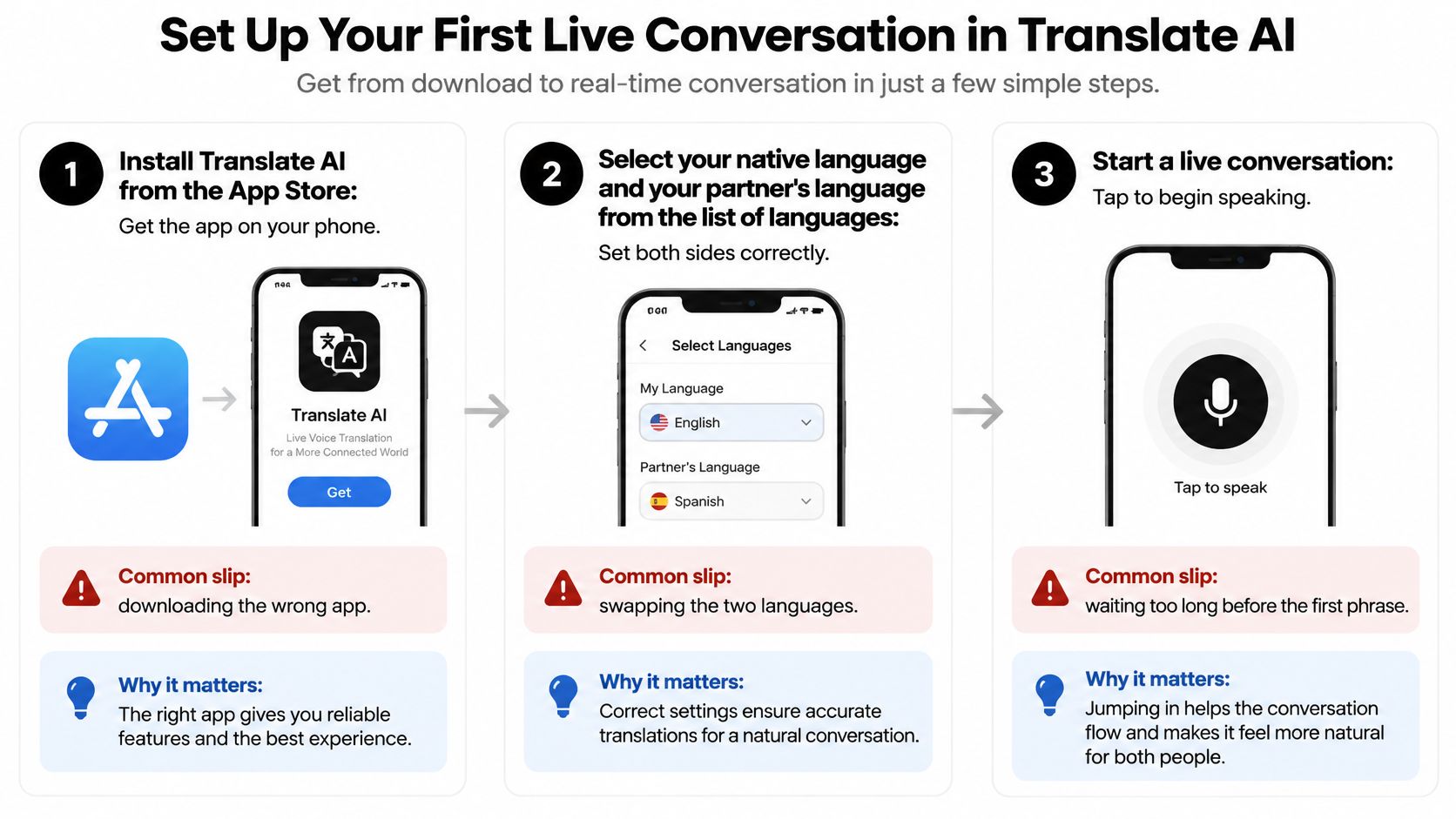
Steps for your first conversation
- Install the app: Download Translate AI from the App Store. A common slip is installing a similarly named translator and then hunting for settings that aren't there.
- Select both languages: Step 1 of using Translate AI is to select your native language and your partner's language from the app's list of languages. Check the direction carefully, because swapping English and Mandarin makes the first sentence unintelligible.
- Connect your audio: Connect your earbuds or AirPods, or use the phone speaker for a hands-free chat. Test volume with a harmless sentence before you discuss anything important.
- Tap and speak naturally: Step 2 of using Translate AI is to tap the microphone button and speak naturally. Use short, complete sentences, since fragments give the translator too little context for pronouns, quantities, and politeness.
- Read and listen: In Translate AI, the translation is shown and spoken immediately after speaking, so you can check the screen while your partner hears the Mandarin version. Let them finish their full reply before you respond.
- Use speaker mode for groups: Speaker mode is available for hands-free chats, which helps at a hotel desk, in a small meeting, or anywhere passing earbuds around would slow things down.
- Confirm critical details in text: Type names, numbers, times, and prices after the spoken exchange. Don't let a clear voice recording substitute for a visible record.
Background noise causes missed words, especially names and numbers at the end of a sentence. Pause briefly after each sentence, keep the microphone facing the speaker, and move away from music or traffic when a detail matters. If a word looks wrong on screen, rephrase it in simpler English instead of repeating it louder.
Get Translate AI
You can download the app from the Translate AI App Store listing and learn more on the Translate AI website. We built Translate AI for live two-way conversations across 80+ languages, and it works with existing earbuds or AirPods, so you don't need specialized hardware to start.
Run one practice conversation before a real meeting, trip, or class. Use a realistic sentence with a place, a time, and a price, then confirm those details in writing. That single rehearsal turns an English to Mandarin Chinese translator from a backup plan into a tool you can operate under pressure.
Ready to hold a real English to Mandarin conversation without passing your phone back and forth? Translate AI lets you speak naturally while your partner hears clear Mandarin, and you hear their reply in English, with your own earbuds or in speaker mode. Visit Translate AI to set up your first practice conversation today and test it with a name, a number, and a place before your next trip, meeting, or lesson.