

No Entiendo Meaning: How to Say and Use It in 2026
No entiendo means “I don't understand” and is said as noh en-TYEN-doh. You're standing at a counter, in a taxi, or beside a colleague, and the last sentence went by too fast. You don't need a long explanation in that moment. You need one clear line, plus a way to show the other person exactly what to repeat.
That's the goal here. You'll learn the core No entiendo meaning, how to soften it, when to switch tense, and how to repair the conversation instead of ending it.
What No Entiendo Means and How to Say It
No entiendo means “I don't understand.” It's a complete statement about your own comprehension problem, not a question and not a command. You can use it alone as a reply, or add what you missed, as in No entiendo alemán, “I don't understand German.”
Say it smoothly in one breath: noh en-TYEN-doh. Put the stress on TYEN, the second syllable of entiendo. Don't pause between no and entiendo, or it can sound hesitant.
Choose the variant that names the problem
Each variant below points to a different breakdown. Picking the right one tells the listener whether to slow down, repeat, or explain an idea differently.
| Phrase | Meaning | Approximate pronunciation | Best used when |
|---|---|---|---|
| no entiendo | I don't understand | noh en-TYEN-doh | you cannot follow what was said |
| no te entiendo | I can't understand you | noh teh en-TYEN-doh | the other person's speech, accent or speed is the problem |
| no lo entiendo | I don't understand it | noh loh en-TYEN-doh | you cannot grasp a concept, instruction or behavior |
| no entiendo nada | I don't understand anything | noh en-TYEN-doh NAH-dah | nothing made sense at all |
| no comprendo | I don't comprehend | noh kom-PREN-doh | a more formal or written-style equivalent |
| no entendí | I didn't understand | noh en-ten-DEE | the previous sentence was missed |
Notice the practical difference. No te entiendo asks the speaker to adjust how they're speaking. No lo entiendo asks for a clearer explanation of an idea, instruction, or decision.
One common confusion is no entienda. SpanishDict's entry for no entienda classifies it as the usted negative imperative of entender, addressed to another person. It doesn't describe your own confusion, so don't use it in place of no entiendo.
Say no entiendo aloud three times in one breath, stressing TYEN each time. Then compare yourself with a native recording and fix the stress before you read on.
How the Grammar of No Entiendo Works
Build the phrase in three steps. First, the verb entender means to understand. Second, entiendo is the form for yo, “I.” Third, put no directly before the verb to make it negative.
Spanish doesn't need an extra word like English “do.” The pattern is no + conjugated verb. The Royal Spanish Academy dictionary entry for entender lists entender as an irregular verb with the sense of having a clear idea of something.
Why the spelling changes
Entender is a stem-changing verb. The stem changes from entend- to entiend- in the yo, tú, usted/él/ella, and ustedes/ellos forms. It doesn't change in nosotros, so you get entendemos, not a form with ie.
| Subject | Present form | With no | Meaning |
|---|---|---|---|
| yo | entiendo | no entiendo | I (don't) understand |
| tú | entiendes | no entiendes | you (don't) understand, informal |
| usted / él / ella | entiende | no entiende | you (formal), he or she (doesn't) understand |
| nosotros | entendemos | no entendemos | we (don't) understand |
| ustedes / ellos | entienden | no entienden | you (plural), they (don't) understand |
Spanish usually drops the subject pronoun because the ending already identifies the speaker. Yo no entiendo is grammatical, but yo adds contrast, for example when everyone else understood and you didn't.
Don't mix subjects with objects. No entiendes is about the listener as subject, “you don't understand.” In no te entiendo, te is the object, “I can't understand you.”
Rule to memorize: Use no plus the present-tense verb, and let the verb ending show who doesn't understand.
Formal and Informal Ways to Say I Don't Understand
No entiendo is correct on its own, but it can sound abrupt with staff, officials, or colleagues. A softener changes the tone without changing the meaning. Perdón, no entiendo means “Sorry, I don't understand,” and Lo siento, no entiendo means “I'm sorry, I don't understand.” SpanishDict's entry for no entiendo gives that polite pattern with Perdón or Lo siento.
Match the phrase to the setting
| Situation | Phrase to use | Tone |
|---|---|---|
| Casual chat with a friend | No entiendo, ¿puedes repetir? | casual, informal |
| Shop or restaurant staff | Perdón, no entiendo | polite, neutral |
| Formal meeting or official office | Perdone, no entiendo; ¿puede repetir, por favor? | formal, respectful |
The key switch is tú versus usted. With friends and peers, use tú forms like ¿Puedes repetir? With officials, elders, or senior colleagues, use usted forms like Perdone and ¿Puede repetir, por favor?
In a meeting, don't stop at the bare phrase. It can sound like you're closing the topic. Add the next step: repeat, slow down, or clarify one part.
Practice the switch out loud. Say the friend version, then the formal version, changing only the softener and verb form until it feels automatic.
No Entiendo Versus No Entendí
One phrase doesn't cover every moment. Your tense tells the listener when comprehension failed, and that changes what they should do next.
The exchange below shows the moment learners often misjudge, when the other person has finished but the meaning hasn't landed.

Pick by timing
- No entiendo: The confusion is happening now and is still ongoing. Use it while someone is explaining and you're lost.
- No entendí: You missed a sentence that just ended. It means “I didn't understand.”
- No entendía: You had an ongoing or repeated difficulty in the past, as in “I couldn't follow him back then.”
The Tell Me In Spanish guide to saying I don't understand contrasts present no entiendo with no entendí for something just finished. After a colleague's sentence, No entendí lo último, “I didn't catch the last part,” points to exactly what should be repeated.
The tense shows when the breakdown happened, and the complement shows what failed.
Watch No entiendo por qué, “I don't understand why.” It often expresses disbelief, disagreement, or frustration, not a request for translation. Tone matters.
Try two quick checks. A driver just gave directions and you missed the turn: use no entendí. You're reading a contract clause that still makes no sense: use no entiendo. If you use no entiendo after a completed sentence, people will usually still follow you, but no entendí is more precise.
Sample Dialogues for Real Conversations
Short exchanges are easier to remember than isolated phrases. Read each one for the repair sequence: signal the gap, name the part, confirm you've got it.
At a market stall
Vendor: Son dos euros.
Traveler: No entiendo, ¿cuánto cuesta?
Vendor: Dos euros, ¿de acuerdo?
Traveler: Ah, ahora entiendo.
It's two euros. / I don't understand, how much is it? / Two euros, okay? / Ah, now I understand. The question after no entiendo tells the vendor to repeat the price, not the whole conversation.
In a meeting
Colleague: El informe necesita la aprobación del jefe.
Learner: Perdón, no entiendo la última parte.
Colleague: (repeats slowly) La aprobación del jefe.
Learner: Ah, ya entiendo.
The report needs the boss's approval. / Sorry, I don't understand the last part. / The boss's approval. / Ah, now I understand. Naming la última parte keeps the repeat short and professional.
In a taxi
Driver: Doble a la derecha.
Passenger: No entiendo, ¿derecha o izquierda?
Driver: (points right) Derecha.
Passenger: Gracias, ahora entiendo.
Turn right. / I don't understand, right or left? / Right. / Thanks, now I understand. Offering two options makes it easy for the driver to answer with one word.
Practice each dialogue aloud twice, once in Spanish and once in English, then swap roles with a partner. For more structured speaking drills, try these beginner conversation practice exercises and reuse the same three-step repair pattern.
Troubleshooting Tips When You Still Lose the Thread
Saying no entiendo starts the repair, but it doesn't finish it. Use this five-step routine so the other person knows how to help.
The visual below condenses the routine into the three moves you'll use most often.
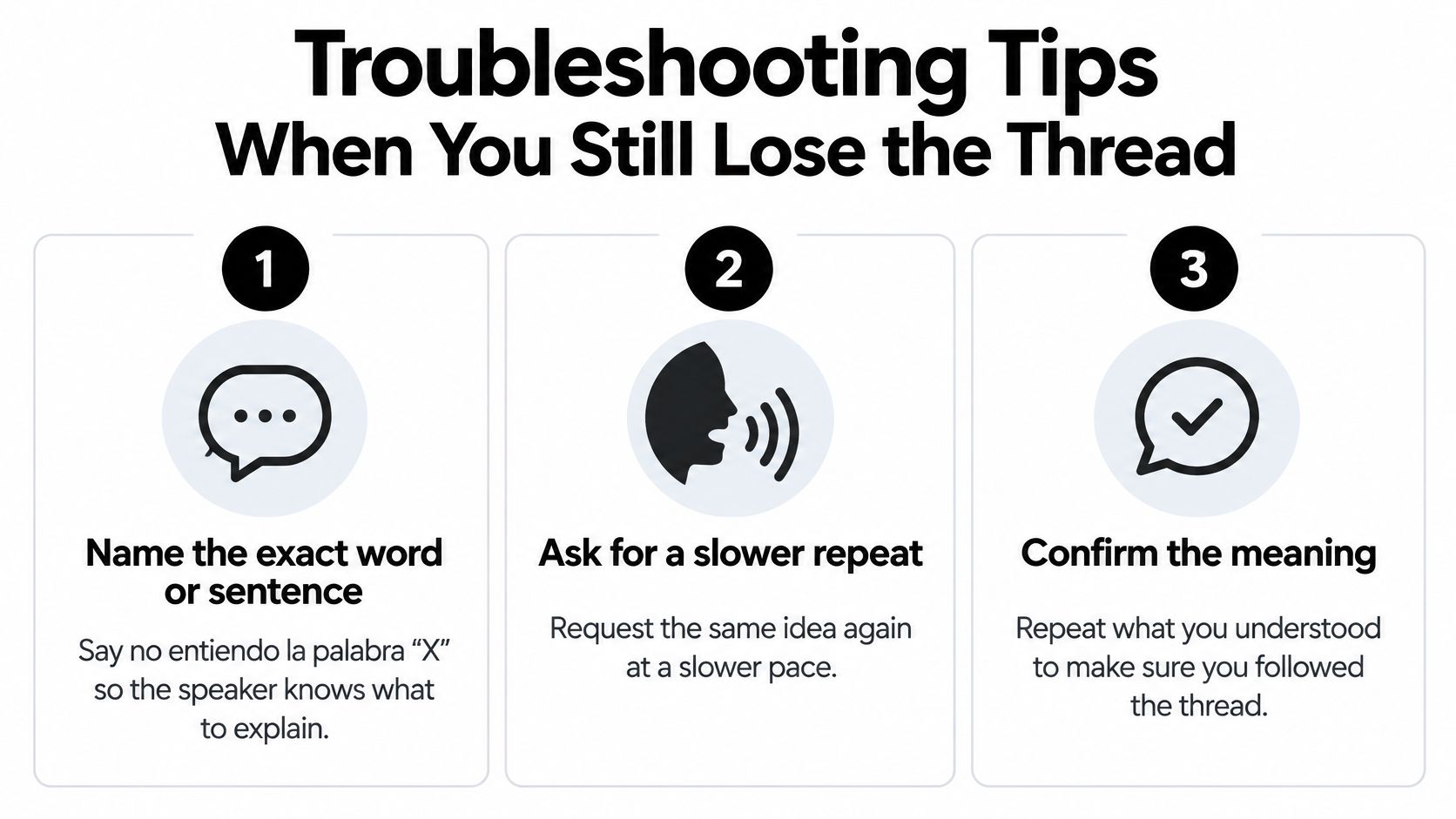
A five-step repair routine
- Name the exact part: Say No entiendo la palabra “plazo” so the speaker explains that word.
- Ask for slower speech: Say Más despacio, por favor. You can also review how to say slowly in Spanish for related wording.
- Ask for an example: Say ¿Puede dar un ejemplo? or ask for a rephrase.
- Check your guess: Say ¿Quiere decir…? and offer your interpretation.
- Confirm clearly: Say Ah, ahora entiendo so the conversation can move on.
This works because no entiendo by itself doesn't say whether speed, vocabulary, sound, or the idea caused the problem. The Pan-Hispanic Dictionary of Doubts entry on entender supports adding a complement, as in No entiendo la pregunta or No entiendo lo que dices, to identify what needs clarification. Service teams use the same principle when they rely on customer communication scripts and examples to move from confusion to a specific next question.
For daily practice, pick a slow audio clip with a transcript. Pause at each unknown word for ten minutes, then replay without reading and note which routine step you skipped.
Regional Alternatives and Common Slips
You'll hear other ways to ask for help, and they aren't interchangeable in every setting. No te capto, roughly “I don't catch that,” is casual and common in Spain. ¿Cómo? is a widely used request to repeat, while ¿Mande? is a polite repeat request you'll hear in Mexico.
Use No me queda claro when the idea, not the sentence, is unclear. No me queda claro el plazo means “The deadline isn't clear to me.” It suits work discussions better than claiming you missed the words. If you want a related clarification phrase, see how to say what do you mean in Spanish.
Three slips to fix
- Dropping no: Entiendo alone means “I understand,” the opposite of what you mean. Keep no: No entiendo.
- Using no entienda for yourself: That form addresses someone else as a command. For your own confusion, say No entiendo.
- Ignoring timing: For a sentence that just finished, No entendí is sharper than No entiendo.
Read each correction aloud, then swap in one regional alternative where it fits. Choose one alternative to practice this week, not all three at once.
Practice Real Conversations With Translate AI
When speech is fast, noisy, or full of unfamiliar words, a live translation tool can keep the exchange moving while you build skill. The photo below reflects the kind of travel moment where that support helps most.

Translate AI supports two-way live voice dialogue: you speak in your language and your partner hears the translation as it happens. Speaker mode allows hands-free chats when you aren't wearing earphones. In a restaurant, that can pair with a service to translate your menu so you can handle both the written options and the spoken questions.
Be clear about the limit. The app translates what's said, but it doesn't replace learning perdón, no entiendo, no entendí, or más despacio, por favor. Use it when speed blocks you, and use your repair lines to stay an active participant.
Watch the short demo below to see how a two-way exchange flows before you try it yourself.
Get Translate AI
Download it from the Translate AI App Store listing and check current language and earphone details there, or visit the Translate AI website. Pick two phrases from the variants table, practice them aloud, then test one dialogue in a low-stakes conversation before a trip or meeting.
Next time Spanish moves too fast, say Perdón, no entiendo, name the part you missed, and keep the conversation alive instead of nodding along. Visit Translate AI to practice two-way live voice translation for those moments, then use your new repair phrases with a real speaker today.