

Is Learning Spanish Hard? a Realistic Guide for 2026
Spanish is one of the easier major languages for English speakers, with about 600 to 750 classroom hours needed for professional working proficiency, but how hard it is for you depends on your first language and the skill you need. If Spanish is relatively accessible, why can you understand a written menu yet struggle to follow the waiter's reply?
That gap explains much of the frustration behind the question, is learning Spanish hard? Recognizing words, understanding speech, and answering spontaneously are different abilities. You can make genuine progress in one while still feeling like a beginner in another.
The useful goal isn't to decide whether you're good at languages. It's to identify your starting advantages, choose a task you need Spanish for, and practice the skill that task demands.
How Hard Spanish Is for Your Starting Language
Spanish is comparatively approachable for native English speakers, but easy doesn't mean effortless. The Foreign Service Institute's Category I classification and approximately 600 to 750 classroom hours describe professional working proficiency under intensive conditions, according to Verbavia's explanation of the FSI benchmark.
That estimate isn't a universal countdown. It assumes structured instruction and substantial independent practice, not occasional vocabulary review between other commitments.
FSI category and classroom hours to Spanish, by starting language
| Starting language | FSI category | Classroom hours | Biggest early advantage |
|---|---|---|---|
| English (native) | Category I | 600 to 750 | Shared alphabet and cognate vocabulary |
| Portuguese, French or Italian | No Spanish-learning category assigned | No published count given for this starting language | Familiar verb patterns; watch for false friends |
| Russian | Not a category for learning Spanish | No published count given for this starting language | Familiarity with gender and inflection; learn unfamiliar Latin letters |
| Arabic, Mandarin or Japanese | Not a category for learning Spanish | No published count given for this starting language | Existing language-learning strategies; vocabulary and sound systems need deliberate work |
FSI categories describe languages that English speakers learn, not categories of learners. Russian's classification as a target language, for example, doesn't tell a Russian speaker how long Spanish will take. Assigning an English-speaker benchmark to someone starting from another language would create false precision.
Your learner profile matters more than a universal rating
Portuguese, French, and Italian speakers can often recognize familiar vocabulary and grammatical patterns. Their challenge is resisting automatic transfer when Spanish uses a different pronunciation, stress pattern, or expression.
English speakers benefit from familiar-looking words and letters, but must build habits around gender and changing verb endings. Russian speakers may already be comfortable with grammatical gender and inflection, although Spanish uses those features differently.
For Arabic, Mandarin, and Japanese speakers, the sensible approach is to test individual skills rather than assume everything will be equally difficult. Your experience with English or another alphabet-based language may also change your starting point.
Teuida's explanation of Spanish's Category I status emphasizes why linguistic distance matters. Previous study can also give you practical advantages: you may already know how to organize review, tolerate uncertainty, and ask useful questions.
Planning rule: Use your first language to anticipate obstacles, not to predict your ceiling.
Motivation helps when it becomes a routine with a purpose. Preparing for family conversations gives you clearer practice targets than vaguely hoping to become fluent. Find your starting-language profile, then use your available weekly study time to build a realistic calendar.
Spanish Difficulty by Skill at a Glance
Spanish can be easy to start and harder to master. The difficulty changes according to whether you're reading, listening, writing, or producing an answer under pressure.
Spanish difficulty by skill for English speakers
| Skill | Ease for English speakers | Main obstacle | Where learners plateau |
|---|---|---|---|
| Reading | Easy to start | Overreliance on familiar spelling; false friends such as actual | Dense texts, idioms, and literary tenses |
| Writing | Moderate | Accents, gender agreement, and verb endings | Maintaining agreement across longer texts |
| Listening | Hard early on | Connected speech, reduced sounds, and regional accents | Following native speakers at full speed |
| Speaking | Moderate to hard | Conjugating in real time; preterite versus imperfect | Forming sentences without long pauses |
| Grammar | Moderate to hard | Subjunctive, object pronouns, ser versus estar | Applying familiar rules spontaneously |
| Pronunciation | Approachable | Rolled r, pure vowels, and syllable stress | Refining accent and rhythm |
Why recognition comes before confident use
Reading gives you time to stop, inspect endings, and infer meaning. In a study of academic spoken vocabulary published in Applied Linguistics, approximately half of the word items examined were Spanish–English cognates, while fewer than 1% were false cognates; the cognates were generally more transparent in spelling than pronunciation.
That finding concerns the academic vocabulary studied, not every Spanish conversation. Still, it explains why an English speaker might recognize información immediately without recognizing it as quickly in speech.
Spanish's relatively transparent spelling also supports early reading aloud, as discussed in this study of orthographic systems. But decoding a written word isn't the same as retrieving it while speaking.
Writing adds another layer: you must select the right word and coordinate its ending with the sentence. Speaking requires those decisions without the opportunity to revise.
Match the difficult skill to your actual goal
The intermediate plateau often appears when you know a rule but can't apply it quickly. You might explain the difference between completed past actions and background descriptions, then hesitate between the preterite and imperfect while telling a story.
Choose practice by task:
- For travel: Prioritize questions, likely replies, and listening-comprehension practice.
- For work: Rehearse explanations, clarification requests, and follow-up questions aloud.
- For reading: Combine subject-specific vocabulary with sentence-level grammar.
- For everyday relationships: Practice keeping an exchange going, not just delivering a prepared introduction.
Your weakest skill isn't always your first priority. Start with the one that most often prevents you from doing something important.
Common Myths About Learning Spanish Debunked
An orderly lesson can make Spanish feel predictable. An unexpected conversation reveals what you haven't yet practiced.
Familiar beliefs that create unhelpful expectations
-
Spanish is English with different words. Familiar vocabulary doesn't mean identical meaning or sentence structure. Embarazada means pregnant, not embarrassed, so confirm an unfamiliar word in context before adopting it.
-
Consistent spelling makes speaking easy. Knowing how a word should sound doesn't mean your mouth can produce it comfortably. Practice troublesome sounds inside useful phrases, then compare your recording with a clear model.
-
Understanding lessons means understanding native speakers. A teacher may separate words clearly and avoid unfamiliar expressions. Learner-reported evidence in the Journal of Language and Linguistic Studies identifies pronunciation and speaking as substantial difficulties, reinforcing the need to practice beyond written exercises.
-
Spanish isn't useful until you're fluent. A successful interaction can be much smaller than unrestricted conversation. Prepare a food order, a request for directions, and a way to ask someone to repeat their answer.
-
There's only one correct Spanish. Speakers in Spain, Mexico, the Caribbean, the Andes, and the Southern Cone don't all use identical vocabulary, pronunciation, or pronouns. Choose a main variety for your own speech while gradually listening to others.
When lessons feel easy but conversations don't
Try listening to a short exchange without reading its transcript. Then inspect the text and identify exactly what blocked you: an unknown expression, a familiar word pronounced differently, or a boundary between words you couldn't hear.
Those problems need different fixes. Look up the expression, replay the pronunciation, or imitate the whole phrase rather than drilling isolated words.
Difficulty following natural speech is a reason to adjust your practice, not a verdict on your ability.
Insufficient natural listening practice is often the missing piece. Don't respond by endlessly repeating exercises you can already complete comfortably.
Realistic Timelines by Goal and Weekly Study
Your goal sets the timeline. Ordering lunch, maintaining a friendship, and handling a professional discussion require different kinds of preparation.
Estimated study time by goal and weekly hours
| Goal | Estimated study hours | At 10 hours a week |
|---|---|---|
| Survival phrases, including greetings, ordering, and directions | Hypothetical planning budget of 150 to 200 hours | Approximately 4 to 5 months |
| Everyday conversation, around B1 | Hypothetical planning budget of 400 to 500 hours, not a verified B1 threshold | Approximately 9 to 12 months |
| Professional working proficiency | Approximately 600 to 750 classroom hours | Approximately 14 to 17 months of classroom study |
The first two rows are worked planning examples, not established proficiency thresholds. For the professional goal, International House Madrid's explanation of the FSI estimate places general professional proficiency for native English speakers at fewer than 750 classroom hours.
Calculate a schedule without turning it into a promise
Divide a target study budget by the hours you can reliably complete each week. The calendar estimates above use that arithmetic, rounded into months; they don't predict when a particular learner will pass an assessment.
For example, a hypothetical 200-hour budget divided by 10 weekly hours equals 20 weeks. At 5 weekly hours, the same budget takes 40 weeks, roughly 9 months.
Add breathing room rather than scheduling every week as if illness, travel, and work deadlines won't happen. In a worked planning example, adding a 20% contingency to 20 weeks produces 24 weeks; that buffer is a scheduling choice, not a language-learning finding.
Count the right kind of time
Classroom hours aren't interchangeable with total effort. Homework, conversation, listening, and review add to your workload, while passive exposure doesn't necessarily address the skill you need.
Someone working alongside Spanish-speaking colleagues may get repeated practice handling interruptions and clarification. Someone studying alone must deliberately create those opportunities.
Track completed tasks alongside hours. Being able to resolve a misunderstanding tells you more than maintaining a study streak.
For an initial measurable target, Calwhat's language-learning guide suggests 100 high-frequency phrases and 15 minutes of speaking practice daily. Choose phrases connected to your life, then test whether you can use them without reading.
Study Methods That Work for Spanish Learners
A useful routine combines recall, understandable input, and spoken use. You don't need to fit every technique into every session.
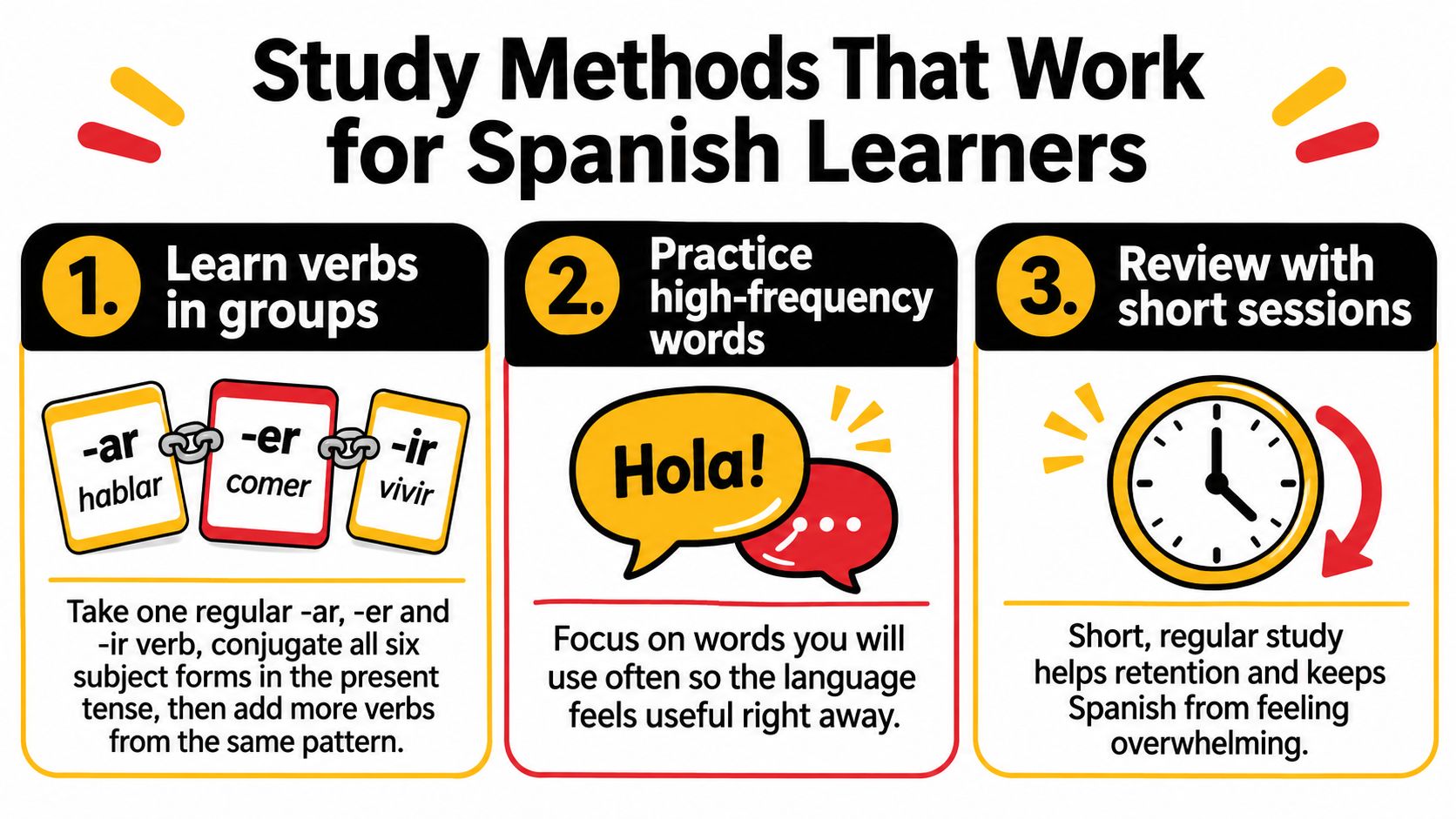
Build patterns you can retrieve
-
Learn verbs in groups. Predictable endings give you a framework for unfamiliar verbs: practice a regular -ar, -er, and -ir verb across the subject forms, then add ser, ir, tener, and hacer. The Germanna Community College Spanish verb guide explains the regular stem-and-ending system and the exceptions that require separate attention.
-
Store nouns with their articles. Recognizing a cognate doesn't guarantee accurate gender processing, according to this study of English-speaking Spanish learners. Learn la mesa and el mapa as units, then add an adjective so you practice agreement rather than a disconnected label.
-
Use spaced repetition for useful words. Retrieval practice means answering before revealing the card, not repeatedly rereading it. Build a starter deck of 100 high-frequency words as a practical study target, include audio or a short sentence, and let your flashcard tool schedule reviews at growing intervals.
Connect study to actual speech
-
Build comprehensible input. Material you can mostly follow lets you notice how speakers assemble meaning. Start with slow audio and a transcript, then replay short sections of natural podcasts or shows until you can separate the words without looking.
-
Shadow a speaker aloud. Repeating immediately after a recording gives you a concrete model for rhythm and stress. Use a suggested 10-minute practice block, pause when necessary, and finish by saying a similar sentence about your own life.
-
Record and inspect your errors. A recording lets you examine problems you can't monitor while talking. Make a suggested two-minute weekly recording, identify a recurring mistake, and turn it into next week's speaking prompt.
For a sample daily allocation, give verbs, nouns, or flashcards 5 minutes, and input or shadowing 10 minutes. A 20-minute routine can pair listening with shadowing; alternate shorter grammar and vocabulary blocks on other days.
For broader scheduling ideas, use this guide to studying languages effectively. If you teach rather than study independently, Tutorbase for language schools is a separate resource to consider for organizing school operations and lesson schedules.
Keep the routine small enough to repeat. Include spoken practice rather than letting silent exercises occupy every session.
A 12-Week Plan You Can Follow
This sample plan uses 20 minutes a day, about 2.3 hours a week, plus one weekly check. Those are suggested practice allocations, not a promise of a particular proficiency level.
Use these rules:
- Protect the daily appointment. Complete the routine before optional extra study.
- Check your performance on Sunday. Mark the task pass or repeat.
- Repeat an unfinished stage. Give the same focus another week rather than rushing ahead.
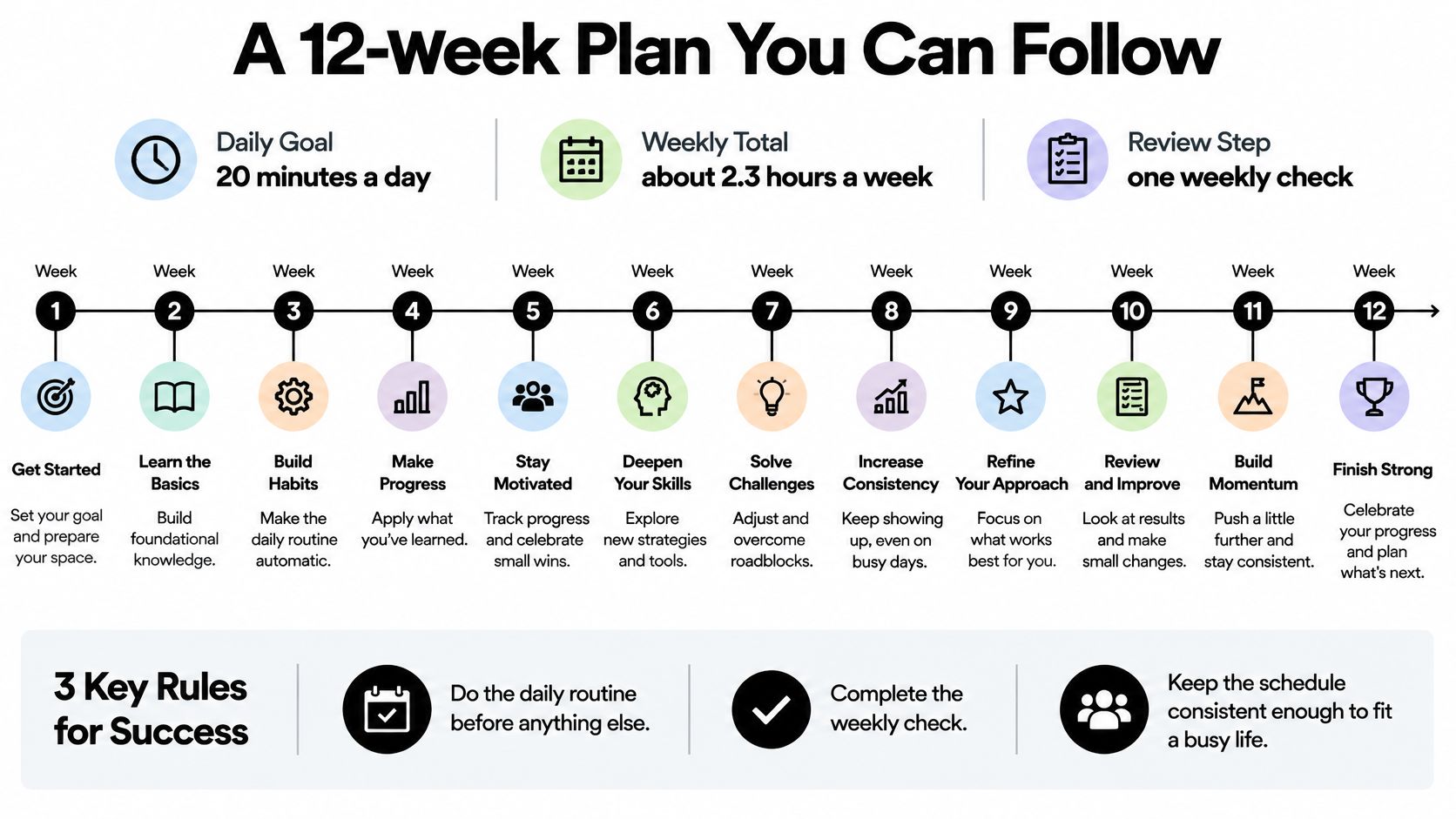
12-week sample study plan at 20 minutes a day
| Weeks | Focus | Daily 20-minute routine | Weekly check |
|---|---|---|---|
| 1 to 2 | Sounds and greetings | Read aloud for 10 minutes; use the remainder to learn 10 new words with articles | Introduce yourself in 30 seconds |
| 3 to 4 | Present tense, ser and estar | Conjugate 3 regular verbs and practice 1 irregular; say examples aloud | Describe your home in 5 sentences |
| 5 to 6 | Ir, tener, hacer, numbers, and time | Verb drill plus 10 minutes of slow listening | Role-play ordering food |
| 7 to 8 | Preterite and imperfect | Contrast the tenses in 10 short sentences; read and retell them | Tell a past story in 60 seconds |
| 9 to 10 | Object pronouns and daily life | Listen to a slow podcast for 15 minutes; summarize aloud for 5 | Role-play asking directions and shopping |
| 11 to 12 | Speaking under time pressure | Speak with a partner or app for 15 minutes; review difficulties for 5 | Record a 2-minute talk and compare it with week 1 |
Judge improvement without demanding perfection
Make a baseline recording before beginning, even if you need pauses or English words. Keep each weekly recording so you can compare what you produced rather than relying on how confident you felt.
A reasonable practice aim is a short conversation about your day with fewer long pauses. It isn't a guaranteed outcome, and covering a grammar topic doesn't mean mastering it.
If you can read an answer but can't produce it aloud, repeat the task with simpler language. Successful communication comes before elaborate sentences.
Choose Your First Practice Step This Week
Start with practice that involves real speech. Arrange a language exchange, join a Spanish-speaking community group, book tutoring, or use Spanish television and radio as material for an aloud summary.
Choose an interaction you'd really like to handle, such as discussing weekend plans or asking about an appointment.
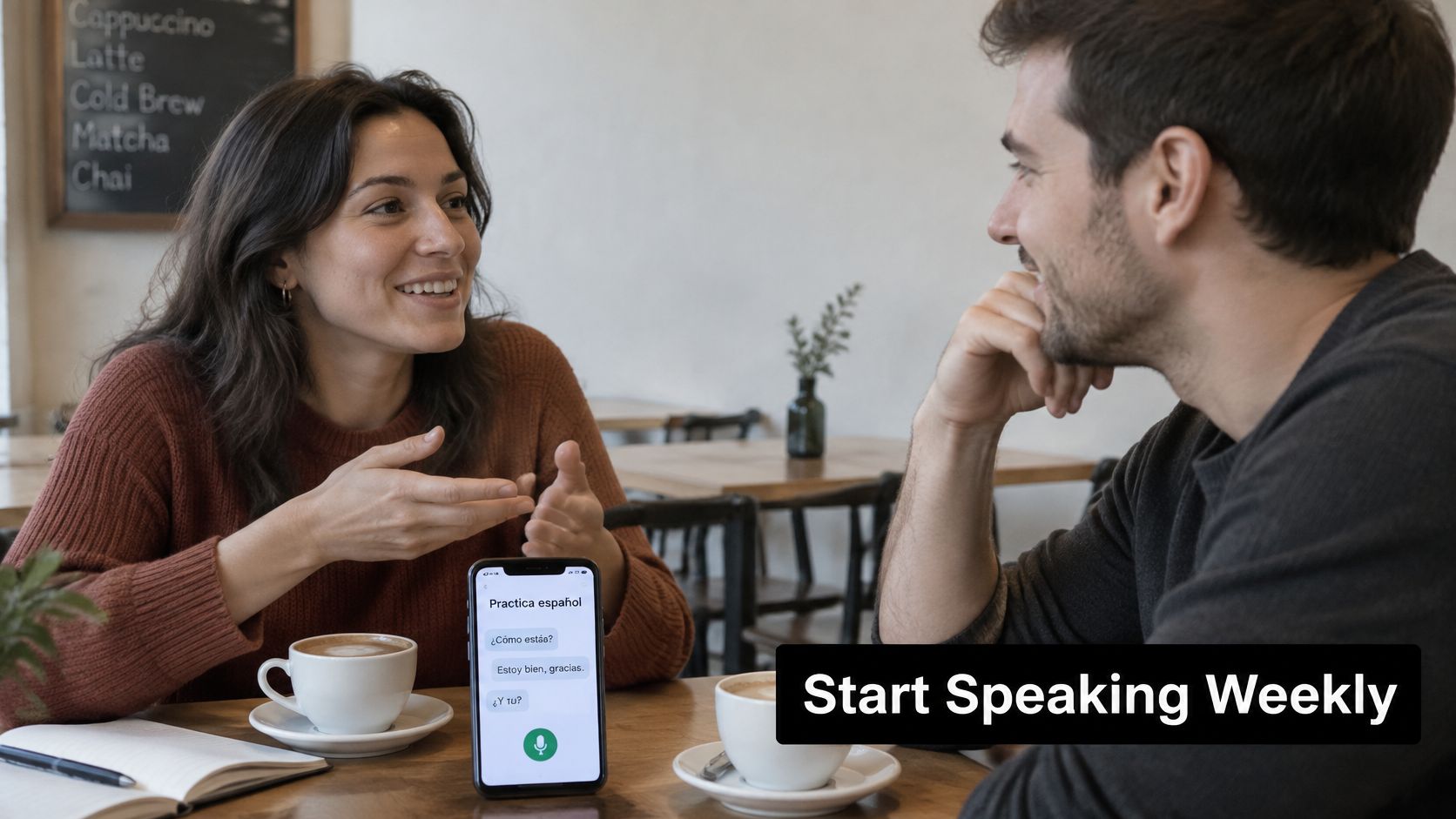
Treat weekly contact with Spanish as an appointment rather than something you'll do when you feel ready. Bring a specific task to a tutor or exchange partner, and ask them to vary their replies so you aren't merely reciting a script.
For manageable starting activities, use these conversation-practice ideas for beginners. Your partner doesn't need to correct every ending; ask for feedback on the mistakes that made your meaning unclear.
Using Translate AI for Real Conversations
Our live voice translation app supports two-way conversations while your Spanish develops. You can download Translate AI from the App Store and use it to check an attempt rather than avoid making one.
Follow this practice sequence:
- Choose the languages. Select your native language and your partner's language from our app's list.
- Start speaking. Tap the microphone button and speak naturally.
- Inspect the meaning. Read the translation and compare it with what you intended to communicate.
- Try again in Spanish. Repeat the exchange, using the app only to check your attempt.
Whenever possible, say the sentence in Spanish first. If you need support, examine the translation, put it aside, and reconstruct the sentence yourself.
Use this demonstration as a prompt for your next practice exchange.
Choose the skill that currently blocks your most important conversation. This week, book your first practice session and record a baseline two-minute talk, even if it's hesitant, so you have something concrete to compare at the end of your plan.
Translate AI offers live, two-way voice translation to support real conversations while you build your Spanish. Visit Translate AI, choose a situation you want to practice, and use translation to check your own spoken attempt rather than replace it.