

Fibre vs. Fiber: Spelling, Meaning and Usage in 2026
Fiber and fibre are both correct spellings of the same word with the same meaning, and your market decides which one you should use. Reported usage favors fiber over fibre at about 97:3 in the United States, while the United Kingdom favors fibre at about 79:21.
That split looks simple until you're standing in a supermarket abroad, editing a manual for two markets, or building flashcards in the wrong variety of English. A copy editor doesn't ask which spelling is correct in the abstract. She asks who will read this document, which style guide governs it, and whether the word on a label means the same thing once a regulator defines it. Most fibre vs. fiber explainers stop at American versus British. That answer is right, but it's incomplete, and the gap matters most on food labels, in technical standards, and in product copy that has to pass automated proofreading.
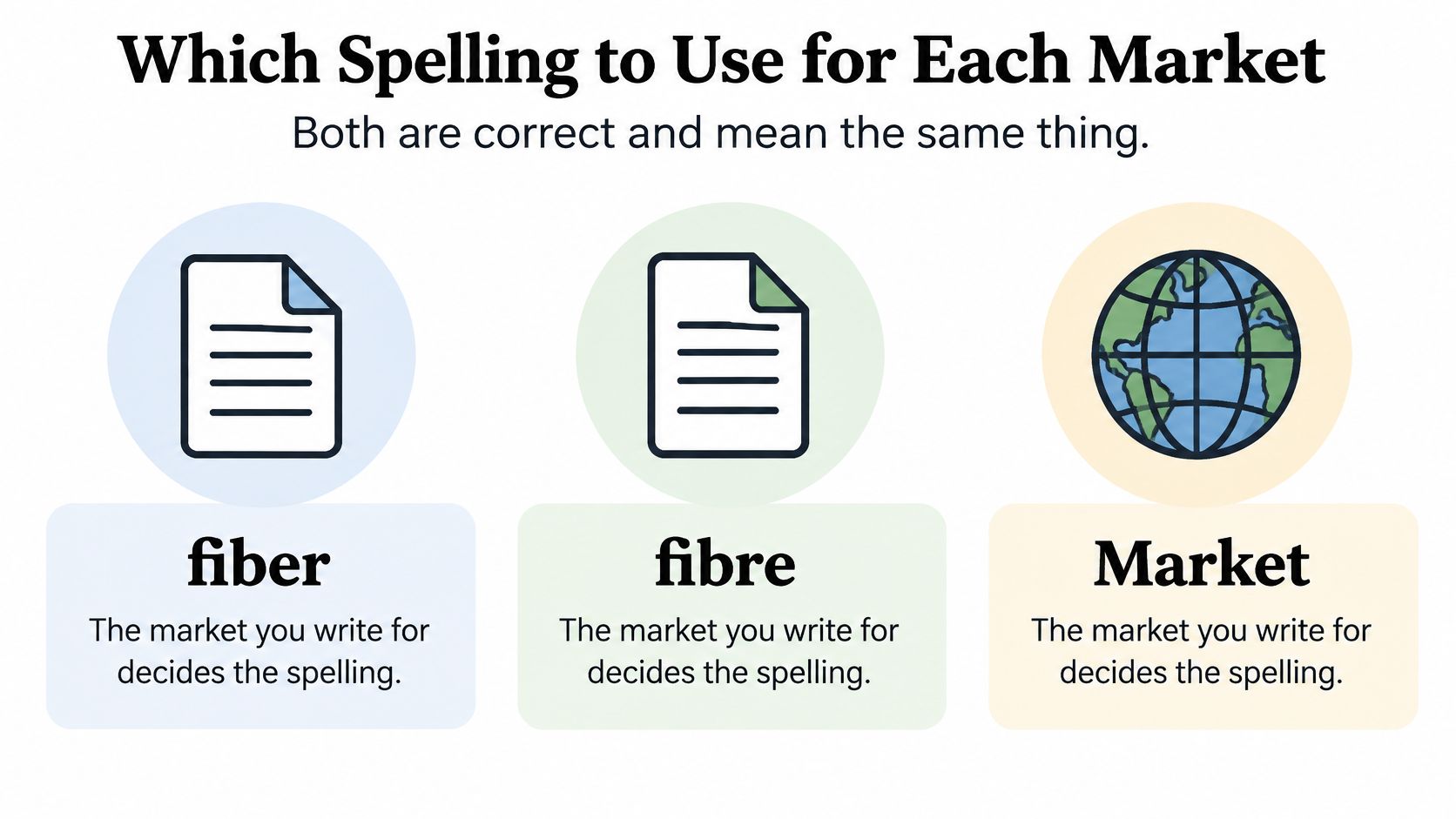
Which Spelling to Use for Each Market
Both spellings are correct and mean the same thing, so you don't choose by definition. You choose by audience. On food packaging the choice runs deeper still: a box printed for the UK reads fibre and the equivalent US box reads fiber, and each term sits inside that market's own labelling rules for what counts as dietary roughage. Two spellings, one word, and potentially two legal definitions. That is why market selection deserves more care than a dictionary check.
Fibre and fiber preference by market
| Market | Preferred spelling | Usage pattern | Practical choice |
|---|---|---|---|
| United States | fiber | Dominant across published writing | Use fiber |
| United Kingdom | fibre | Dominant across published writing | Use fibre |
| Australia | fibre | Strong preference for fibre | Use fibre |
| New Zealand | fibre | Strong preference for fibre | Use fibre |
| India | fiber | Mixed usage; fiber more common in edited text | Use fiber, but check the publisher's style guide |
The pattern across edited usage is consistent: fiber dominates American writing, while fibre dominates British, Irish, Australian, and New Zealand writing. Indian usage splits more evenly, with fiber appearing more often in technical and internationally published text. Treat these preferences as localization heuristics. A publisher, exam board, or industry convention can override the local majority, and a house style outranks geography every time.
Where the Majority Does Not Decide
A US medical device manual uses fiber throughout because American engineering and medical contexts default to that form. British-oriented telecommunications documentation keeps fibre, even when the same company sells into other markets. Neither document is wrong. Each follows its sector and its reader.
Food labels add a second layer that grammar explainers skip. When a regulator defines fibre or fiber for a nutrition panel, the spelling on the pack tracks the legal definition behind it. Copy written for both markets may need two label texts, because each spelling signals which rulebook applies.
Apply the same logic by situation. A US website, school assignment, or government document uses fiber. A UK, Irish, Australian, New Zealand, or wider Commonwealth report uses fibre. For an Indian audience, start with fiber and then confirm the publisher's rule. For multilingual product copy, create one locale per version, en-US or en-GB, rather than mixing forms. Signage and menus you can't edit are a reading task: recognize both forms there and move on.
If you're formalizing those choices for a team, Pure Write's picks for clearer content is a useful starting point for comparing style guides before you lock a house rule. The same market-first logic applies to pairs covered in the favor and favour spelling guide.
The Five Step Consistency Check
- Identify the main market: Name the primary audience before you edit a single word.
- Check the governing guide: Confirm the client, publisher, or exam board preference.
- Select one spelling: Apply it to the whole document, not just the first occurrence.
- Search for the other variant: Replace it in headings, captions, tables, and metadata.
- Check hidden text: Review alt text, file names, and embedded labels in graphics.
Practical rule: Decide per document and per locale, not per word. Consistency matters more than which of the two correct spellings you picked.
Meaning and Pronunciation Stay the Same
These aren't two words that happen to look alike. They're orthographic variants of one word, and that distinction should shape how you learn, teach, and edit them.
Merriam-Webster treats the British form as a variant of the American headword. Its entry lists fibre as a chiefly British spelling of fiber, covering threadlike plant or artificial material and dietary roughage. Pronunciation doesn't change when the final letters swap. A reader who hears the word can't tell which spelling you intended, and a learner doesn't need two vocabulary entries for it.
Fibre and fiber compared on the criteria readers check
| Criterion | Fibre (British) | Fiber (American) |
|---|---|---|
| Dictionary status | Chiefly British spelling of fiber | Standard US spelling |
| Pronunciation | Same as fiber | Same as fibre |
| Core meanings | Threadlike strand, plant or artificial material, dietary roughage, muscle tissue, figurative toughness | Same meanings |
| Typical use | British, Irish, Australian, New Zealand and Commonwealth documents | US documents, US labels, many US engineering and medical texts |
| Shared spelling pattern | centre, litre, theatre | center, liter, theater |
| Editing rule | Keep -re across the whole document | Keep -er across the whole document |
The Pattern Behind the Pair
This word follows a broader -re/-er pattern. The University of Catalonia guidance on British and American spelling gives fibre in British English and fiber in American English alongside centre/center and litre/liter, and explains that words of French, Latin, or Greek origin ending in consonant plus -re often retain -re in British English but use final -er in American English.
That pattern gives you a practical test. If your document says centre and litre, it should say fibre. If it says center and liter, it should say fiber. Changing only one word in the set leaves a document that looks half localized.
- Pronunciation stays fixed: You don't need a separate spoken form for either spelling.
- Core meanings stay fixed: Strand, material, roughage, tissue, and toughness apply to both.
- Spelling pattern changes: The variety you choose controls -re or -er across related words.
Consider the pair in a sentence. "The fibre in this fabric" and "The fiber in this fabric" describe the same material in the same way. Only the regional signal differs.
Convert the whole document to one variety, not just this word, because spellcheckers, proofreaders, and style validation tools flag mixed forms even when meaning is identical.
There's one qualification. Meaning can appear to split in nutrition and regulation, but that split comes from classification rules, not from the letters themselves.
Where the Two Spellings Came From
The spelling split is much younger than the word itself, and that order matters. Standardization changed how the word was written; it never created a difference in what the word meant.
The word entered English in the late 14th century through Middle French, from Latin fibra, originally referring to a lobe of the liver. That's a long way from breakfast cereal or broadband. Over the following centuries the word accumulated the senses English speakers still use: threadlike structures in animal bodies, plant tissue, textile material, and the figurative toughness behind talk of moral fibre. All of that meaning developed while both -re and -er spellings circulated in print. Etymological records accordingly treat fiber as the American form of the same word, rather than as a separate coinage.
The transatlantic split arrived with the standardization of national Englishes. In the United States, spelling reform associated with Noah Webster's dictionaries and schoolbooks favored written forms closer to pronunciation, and -er became the American standard for fibre and its -re relatives like centre and theatre. British usage consolidated around -re. Once each side's dictionaries and schools had settled the matter, the outcome was geographic rather than semantic.
Two conclusions follow for editors.
First, neither spelling is more original in a way that should govern modern copy. You're applying a national convention, not recovering a purer form. The same question of which variant counts as primary arises with other pairs, such as blond and blonde in English usage.
Second, the letters themselves are semantically empty. Where a real difference does emerge, as with a fibre declaration on a UK food label versus a fiber declaration on a US one, the divergence comes from each country's regulatory definition of the term, not from the spelling. That gap between orthography and classification is the point most spelling guides miss, and it's what determines how much weight the choice of form can carry.
Fibre and Fiber in Nutrition, Textiles, Optics and Biology
Context changes how much weight the spelling carries. In some fields, swapping -re for -er changes nothing except regional appearance. In others, the term sits inside a regulatory definition or a named standard, and then you need to check more than spelling.

Fibre and fiber terms by context
| Context | Common spelling | Example term | What changes |
|---|---|---|---|
| Nutrition | fiber (US), fibre (UK) | dietary fiber, soluble fibre | Labelling rules differ by country, so check the regulator's definition |
| Textiles | fiber (US), fibre (UK) | natural fiber, cotton fibre | Spelling only; meaning unchanged |
| Composites | fiber or fibre | carbon fibre, carbon fiber | Spelling follows the brand's or publisher's market |
| Optics and telecom | fibre (UK), fiber (US) | optical fibre, fibre optic cable, Fibre Channel | Standards bodies and vendors set the term |
| Biology | fibre (UK), fiber (US) | muscle fibre, nerve fiber | Follow the journal's house style |
Nutrition and Textiles
Nutrition is the context where readers most often misjudge the issue. A US writer says, "Oats are a good source of soluble fiber." A UK writer says, "Oats are a good source of soluble fibre." The sentence means the same thing in both varieties. What may differ is the label framework behind a grams-per-serving claim, which is a regulatory question addressed in the next section.
Textiles are simpler. Natural fiber in a US product description and cotton fibre in a British one refer to threadlike material in exactly the same sense. A garment label, a fabric specification, or a care instruction doesn't change its material when the spelling changes. Match the spelling to the market that will buy or inspect the product, and keep fiber content lists internally consistent.
Composites, Optics and Biology
Composites sit between those extremes. You'll see carbon fibre and carbon fiber in sporting goods, including graphite fly rods, where brands write for their home market or their export market. The material doesn't change with the catalog. What changes is the signal about who published the specification. If you're editing a manufacturer's document, don't convert a branded product name without checking first. Convert generic references to the house variety and leave proper names intact.
Optics and telecom require the same caution with named terms. Optical fibre and fibre optic cable are conventional in British-oriented documentation, while US documentation commonly uses fiber forms. Fibre Channel, however, is a named standard, so you reproduce that spelling as given rather than localizing it to match the rest of your document. Standards bodies and vendors set those names, and a copy editor who normalizes them creates an error while trying to remove one.
Biology follows the journal rather than the country alone. Muscle fibre suits a British house style, and nerve fiber suits a US one. The tissue being described is identical. Before submission, check whether the journal requires American or British spelling across the manuscript, because a single converted term won't fix a paper that mixes varieties elsewhere.
The field sets the term and the market sets the spelling. Named standards are the exception, and they keep the spelling their owners gave them.
Why a Fiber Label Can Mean Something Different
Two cereal boxes can share every word except one letter and still describe different things. Spelling marks the language variety. Classification marks what the regulator counts. Grammar explainers stop at the first layer, which is where the practical problem begins.
A shopper comparing a UK packet labelled fibre with a US packet labelled fiber will read the numbers as equivalents. That reading assumes both regulators measured the same ingredients the same way. The assumption fails when one jurisdiction counts an added ingredient as fiber and another does not.
A 2024 peer-reviewed terminology roundtable on dietary fiber definitions identified "inconsistencies and ambiguities" in how dietary fiber is defined. The extra letter is not the issue. The issue is that classification rules differ between countries, so identical terms can sit on top of different measurement methods.
What to verify on a fiber label
| Label term | What to verify | Why it may differ |
|---|---|---|
| Dietary fiber (grams per serving) | The regulator's definition for that country | Ingredients counted as fiber vary by jurisdiction |
| Added functional fiber | Whether it appears in the ingredient list | It may not be counted the same as naturally present fiber |
| Resistant starch | Whether the label files it under fiber | Classification can differ between regulators |
| Prebiotic fiber | The exact claim wording and the stated amount | It is a marketing term, not a fixed measure |
Three Checks Before You Compare Two Labels
- Read the serving size first: A larger serving can make a weaker product look stronger.
- Compare per 100 g where possible: A common basis removes serving size differences from the comparison.
- Scan the ingredient list for added fibers: Terms such as resistant starch, functional fiber, or prebiotic fiber may involve regulatory distinctions beyond spelling.
The same caution applies in medical conversations. If a clinician or dietitian has set a daily target, confirm whether a foreign label's figure refers to total dietary fiber, an added ingredient, or a category that exists under only one regulator's rules. Language questions often hide this kind of practical trap, much as everyday vocabulary does when you check how to say tissue in Spanish before a pharmacy visit.
The spelling tells you which English you are reading. The regulator's definition tells you what the number means.
Spelling Tips for Travelers and Language Learners
Reading both spellings is a recognition skill. Writing one consistently is an editing discipline. Travelers, expats, and learners need both, and the two tasks fail in different ways.

Three Reading Situations
On menus and packaging, either spelling can appear with the same meaning. The letters are not the part worth pausing over. What the spelling can tell you is which jurisdiction probably wrote the label, because a fibre figure on a British packet and a fiber figure on an American one can sit under different regulatory definitions of what counts toward the total.
In English tests and textbooks, the examiner's or publisher's variety sets the expected spelling. A learner preparing with British materials should write fibre, centre, and litre as a set. A learner using US materials should write fiber, center, and liter. Mixing sets can cost marks even when every individual word is a real English spelling.
In flashcards and vocabulary apps, store both forms under one entry with a note on your preferred variety. Two separate cards teach a false lesson, that English has two words here with two meanings. One card with a locale note teaches the true one, which is the pattern Wiktionary reflects by treating fibre and fiber as orthographic variants used for dietary material, textiles, composites, and optical communications.
When you write, keep one spelling per document and match it to the expected variety. That includes messages to a landlord abroad, a CV for a foreign employer, and notes you'll share with a clinician. Your reader may not comment on mixed spelling, but automated proofreading and style validation often will.
How Translate AI Helps With Both Spellings
Translate AI is a live translator app built for two-way conversations, with voice translation across its supported languages. Spelling rarely matters in speech, since fibre and fiber sound identical. Where a voice translator earns its place is the moment a written label becomes a spoken question: asking a pharmacist what a packet contains, or checking with a shopkeeper whether an ingredient is present.
That limits what the app should be asked to do. A conversation can clarify what a word means, but it cannot tell you whether a foreign label's fiber figure follows the same regulatory definition you know from home. For anything that affects a health decision, confirm the exact label or medical terms with a person: a pharmacist, a clinician, or a dietitian.
- Translate AI on the App Store: Download the live translator for real-time two-way conversations.
Fibre vs Fiber Keyword Variants for Search
Searchers type the spelling they learned, not your house style. A well localized page still needs a plan for the other variant, and in nutrition the stakes run higher than rankings. A UK reader searching "fibre" may want the carbohydrate line on a British label, while a US reader typing "fiber" expects the dietary fiber figure defined under American food rules. Same word family, different regulatory object. Pages that treat the two spellings as fully interchangeable miss that some searchers are chasing a legal definition rather than a synonym.
The head terms split by intent. Fibre vs fiber and fiber vs fibre carry comparison intent and form the most common query shape. Fiber or fibre signals a spelling check. Fibre meaning and fiber meaning signal definition intent, where the label distinction above becomes the key answer. Market terms follow the product or the label, so US pages target dietary fiber and fiber optic cable, while UK, Irish, and Australian pages target dietary fibre, optical fibre, and carbon fibre.
The Page Level Rule
- Pick the page locale: Decide whether the page serves a US or a British and Commonwealth audience.
- Choose the primary keyword in that spelling: Use it in the title, URL, and first heading.
- Add the other variant once: Place it in body text, the meta description, a subheading, or image alt text so searchers using either spelling can find the page.
Keep one spelling as the page's visible standard. A page that alternates forms to chase both keywords reads as careless, and it undermines the consistency advice you're giving readers.
Don't build near-duplicate pages that differ only by spelling. They compete with each other and confuse readers who land on the wrong one. Where a page must exist in both locales, publish separate versions with hreflang and canonical tags, and localize the full spelling set, not just this one word. Search visibility follows the same principle as editing: one locale, applied completely, beats two spellings applied halfway.
The practical payoff is a reader who searches either spelling, lands on the right page, and still knows the label question to ask. As noted earlier, a live translator can carry that conversation into the shop or clinic, where the spelling is the smallest difference and the definition behind it is the one that counts.