

English French Translation: Grammar, Idioms and Live Tips
You're at a hotel desk, checking a French message before you speak. The words look right, but will they sound polite, preserve your booking details, and get the response you need? Good English-French translation means checking what the other person will understand, not just whether the sentence looks grammatical.
Where English and French Translation Breaks Down
| Error zone | English habit | French reality | Typical slip |
|---|---|---|---|
| Word order | Adjective before noun, as in a red car | Most adjectives follow the noun, as in une voiture rouge | Literal English order sounds unnatural |
| Gender | Few nouns or pronouns carry gender | Every noun has gender and adjectives must agree | Wrong agreement on adjectives and past participles |
| False friends | Similar spelling feels safe | Meanings diverge, as attendre means to wait | Confident but wrong word choice |
| Register | One form of you covers all situations | Tu for friends, vous for strangers and formal settings | Too blunt or too stiff |
| Idioms | Expressions feel translatable word by word | Many expressions have no direct equivalent | Literal rendering reverses the intent |
| Numbers and punctuation | Comma for thousands, point for decimals | Space for thousands, comma for decimals, as in 1 234,56 | Prices and quotes misread |
English and French fail in predictable places. Some slips merely sound awkward; others change what someone believes you want, promise, or understand. The most consequential errors can look perfectly correct on the page.
Say you need another towel at a hotel. You translate Give me a towel as Donnez-moi une serviette. The grammar works, but the direct command can sound abrupt when you intended an ordinary request.
Pourriez-vous me donner une serviette, s'il vous plaît ? makes that intention clearer. You haven't changed the object you need. You've changed the relationship between the speaker and the listener.
Meaning check: Ask both whether the translation says the right thing and whether it invites the right interpretation.
Match the check to the situation
For a booking, concentrate on names, dates, amounts, and conditions. For a workplace message, check the deadline and the strength of the request. For casual conversation, pay attention to familiarity, humor, and implied meaning.
Not every unfamiliar construction needs correction. French can express the same idea with a different word order, tense, or level of explicitness.
Find the error zone that matches your conversation, then use its corresponding check below. Don't polish the wording before you've confirmed the meaning.
Sample Translations for Spoken and Written Contexts
| Context | English | French | Note |
|---|---|---|---|
| Restaurant bill (spoken) | Could we have the bill, please? | L'addition, s'il vous plaît. | Polite and standard |
| Hotel check-in (spoken) | I have a reservation under Smith. | J'ai une réservation au nom de Smith. | Name phrase is key |
| Asking directions (spoken) | Is the station far from here? | La gare est loin d'ici ? | Neutral register |
| Casual farewell (spoken) | See you later! | À tout à l'heure ! | Informal, fine for friends |
| Follow-up email (written) | Could you send me the report by Friday? | Pourriez-vous m'envoyer le rapport d'ici vendredi ? | Formal vous for a colleague you don't know well |
| Medication instruction (written) | Take one tablet twice a day with food. | Prenez un comprimé deux fois par jour, pendant les repas. | Confirm with a pharmacist or clinician |
| Rental clause (written) | The deposit is refundable within 14 days. | Le dépôt est remboursable sous 14 jours. | Confirm with a human reviewer before signing |
These are illustrative translations, not interchangeable scripts for every situation. The medication wording and rental deadline are examples, not treatment instructions or statements of tenancy law.
Spoken French doesn't need to reproduce every English word. The restaurant request works as a short noun phrase because the setting supplies the missing context. At hotel check-in, au nom de Smith communicates whose name the reservation is under, rather than translating under word for word.
Choose wording that fits the task
The directions question is neutral conversational French, especially when introduced with a greeting. If you're unsure how to open the exchange, these ways to say hello in French help establish a polite starting point.
À tout à l'heure implies that you expect to see the person again relatively soon, usually later that day. It isn't a universal replacement for every English farewell.
The email uses pourriez-vous to make a courteous request. However, d'ici vendredi doesn't settle whether the recipient should deliver before Friday begins or by a particular time on Friday. If that distinction matters, specify the time.
A natural sentence can still leave the practical instruction unresolved.
Treat specialist wording differently
For medication, pendant les repas means during meals, which may be narrower than the intended meaning of with food. A pharmacist or clinician should confirm the actual instruction, including dosage and timing.
For a rental clause, dépôt may need a more specific legal term. The sentence also doesn't identify when the refund period starts.
This is why contextual equivalence matters: an English-to-French questionnaire adaptation study required contextual decisions for terms including withdrawal and convenience. Specialist language needs its intended function preserved, not merely recognizable vocabulary.
Syntax and Gender Rules That Change Sentence Meaning
Compare a red car with une voiture rouge. Think of a French sentence as a chain of matching links: choosing a noun affects the words attached to it, although not every later word changes. A translator must manage both the order of those links and their agreement.
Word order and time
Une voiture rouge places the adjective after the noun. That's a useful starting pattern, but not a universal rule: some common adjectives come before nouns, and position can affect meaning.
Object pronouns follow another pattern. English puts him after the verb in I see him; French puts le before the conjugated verb in je le vois. Translating in English word order won't produce a dependable French sentence.
Now compare I have worked here for five years with je travaille ici depuis cinq ans. When the work continues now, French normally uses the present tense with depuis. A literal j'ai travaillé ici depuis cinq ans isn't the appropriate default for that ongoing situation.
Check the timeline before choosing the tense: did the activity finish, or is it still happening?
Gender and agreement
Elle est partie and il est parti both describe someone leaving, but the written past participle changes. French distinguishes il and elle, and plural ils and elles; dedicated English-French gender-agreement evaluation work addresses the decisions that English can leave unstated.
Grammatical gender isn't the same as a person's gender. A noun such as personne is grammatically feminine regardless of whom it describes. Don't infer someone's identity from a noun ending.
Use this routine:
- Identify the referent. Establish which person, object, or group the sentence describes.
- Choose the noun and pronoun. If a person's gender isn't known, ask when relevant or rephrase instead of guessing.
- Check the dependent words. Review determiners, adjectives, pronouns, and any past participles that require agreement.
Agreement rules depend on the construction. The practical goal isn't to make every ending match mechanically; it's to check which words depend on the noun or subject you've chosen.
False Friends That Mislead Even Confident Speakers
| English word | Tempting French | Real French meaning | Correct French |
|---|---|---|---|
| actually | actuellement | currently | en fait |
| eventually | éventuellement | possibly | finalement |
| library | librairie | bookshop | bibliothèque |
| attend (an event) | attendre | to wait | assister à |
| sensible (reasonable) | sensible | sensitive | raisonnable |
| bless | blesser | to wound | bénir |
| pain (suffering) | pain | bread | douleur |
I'm attending the meeting calls for j'assiste à la réunion, not j'attends la réunion. The latter means you're waiting for the meeting. The spelling looks helpful precisely where it can mislead you.
The OECD Style Guide identifies false friends, semantic calques, and competing translations as recurring terminology difficulties. A familiar-looking word isn't evidence that you've found the right equivalent.
Read the role, not just the word
Often used to correct or clarify a statement, en fait is helpful. Actuellement indicates something occurring in the present. Replacing one with the other alters the sentence's intent.
Eventually concerns a later outcome, while éventuellement introduces possibility. Finalement works for many eventual outcomes, but a sentence about gradual future change might need à terme instead.
The other pairs follow the same principle. A librairie sells books; a bibliothèque is a library. A sensible person in French is sensitive, not necessarily reasonable. Blesser concerns injury, and pain belongs on the bread plate, not in a symptom description.
Practical rule: Translate the action or idea before choosing the word that resembles it.
For an unfamiliar term, make these checks:
- Read the verb and object. Is someone attending an event, waiting for transport, or waiting for another person?
- Identify the subject area. A medical symptom needs different scrutiny from a café order.
- Test the whole sentence. Replace the candidate with its plain-English meaning and see whether the message still makes sense.
A wrong verb can turn participation into waiting, and a wrong noun can obscure a symptom. If a word feels suspiciously easy, check it in a second dictionary or terminology source before using it in a conversation or document.
Register and Idioms That Change the Tone
A translation of cream skimming as la crème de la crème may sound polished, but it changes the point. A 2025 translation analysis documents this substitution: prioritizing easy cases became the best of the best. Grammatical fluency didn't preserve the speaker's intent.
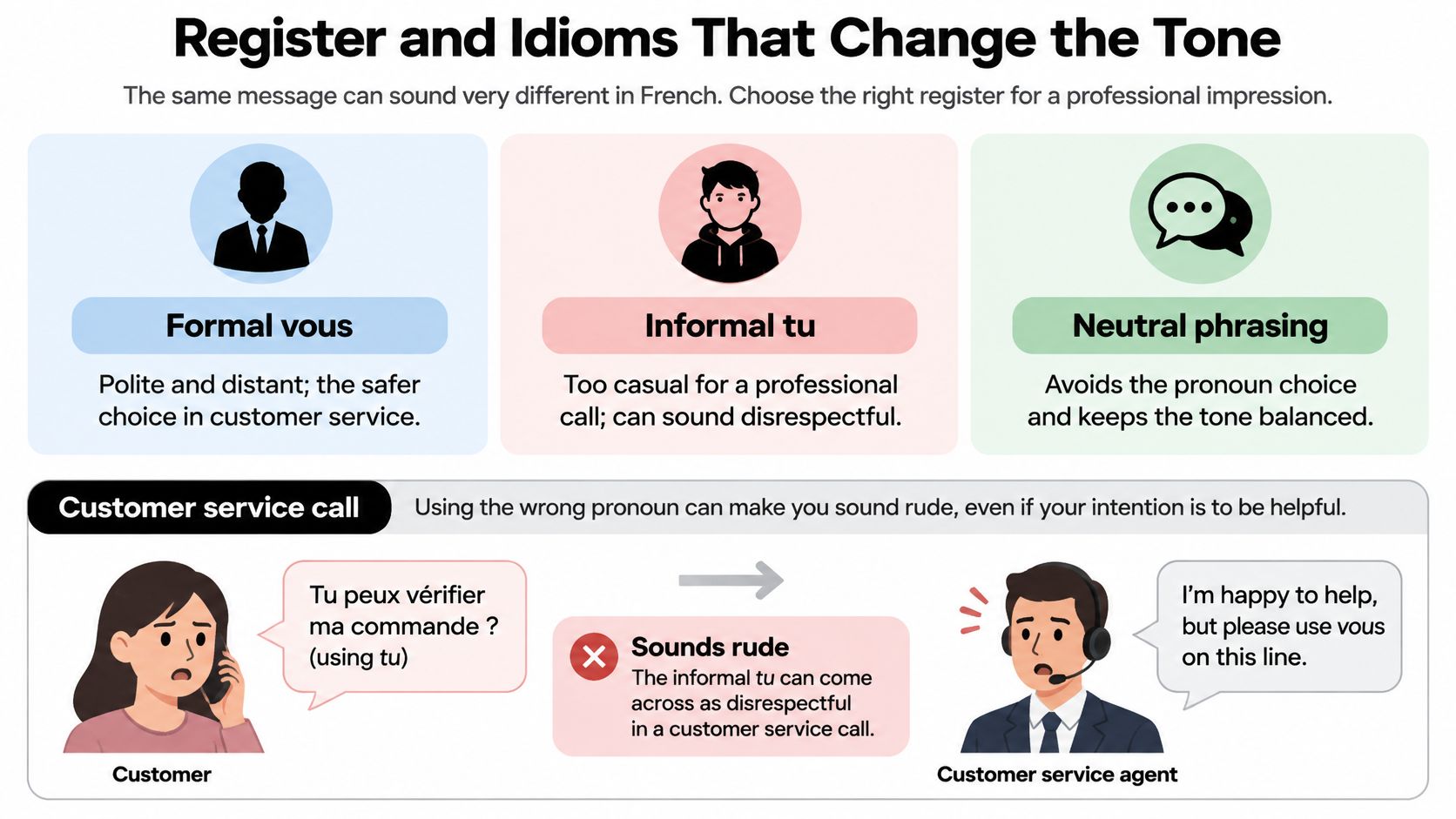
Customer service creates a similar challenge with familiarity. These choices help distinguish respectful distance from unwanted closeness.
Choose a relationship before a pronoun
On a customer service call, tu peux vérifier ? can sound overfamiliar to someone you don't know. Pourriez-vous vérifier ? maintains professional distance. Yet formal vous can sound unexpectedly distant between close friends who normally use tu.
- Formal vous is the safer starting point with an unfamiliar customer, receptionist, or professional contact.
- Informal tu fits established familiarity, not a relaxed English tone.
- Neutral phrasing can avoid the choice, as in Est-ce possible de vérifier ?
Regional vocabulary needs similar care. Courriel is widely used in Quebec for email, while char can mean car in informal Quebec speech. For an unfamiliar audience, voiture avoids the strongly regional, conversational flavor of char.
Preserve the intention of an idiom
For cream skimming, a plain description such as ne choisir que les cas faciles communicates the relevant behavior. It doesn't preserve the cream metaphor, but it preserves the criticism.
Keep an idiom only when the French equivalent carries the same intent. Otherwise, paraphrase and ask a brief clarifying question, such as whether the speaker means selecting the easy cases.
For additional listening practice, use this video alongside the tone checks.
Farewells also communicate familiarity and expectations; these French goodbye expressions help distinguish the options. Before speaking, ask whether the line would sound polite, sarcastic, professional, or rude to the intended listener, not merely whether the words are correct.
Numbers, Dates and Punctuation to Convert
| Convention | English form | French form | Where it matters |
|---|---|---|---|
| Thousands separator | 1,234.56 | 1 234,56 | Invoices and prices |
| Decimal separator | 3.5 kg | 3,5 kg | Recipes and dosages |
| Quotation marks | “Bonjour” | « Bonjour » | Written copy and signage |
| Date order | 12/05/2026, meaning December 5 in US order | 5 décembre 2026 for that date; 12/05/2026 normally means 12 May in France | Bookings and deadlines |
| Clock time | 3:30 PM | 15 h 30 | Timetables and schedules |
| Currency | $10.00 or €10.00 | 10,00 $ (Canada) or 10,00 € (France) | Prices and fees |
These are formatting examples, not actual prices, appointments, or dosage recommendations. The British Columbia government's French-writing guide specifies a space for thousands, a comma for decimals, and French guillemets with non-breaking interior spaces.
A number can retain all its digits and still become misleading. An ambiguous date can send someone to a station on the wrong day; an unclear decimal can compromise a measurement.
Proofread values separately from sentences
- Scan every value. Mark numbers, units, dates, times, currency symbols, and quotation marks before reviewing the surrounding prose.
- Convert the convention, not the quantity. Change punctuation and placement without accidentally changing the amount. Keep currency identity explicit when a dollar symbol could be ambiguous.
- Write ambiguous dates in words. Spell out the month and include the year where needed. Confirm that both people mean the same calendar day.
Don't automatically change a software version's punctuation or rewrite an identifier as an ordinary number. Those strings may need to remain exact.
Follow the document's style guide consistently. Microsoft's France localization guide generally spells out cardinal numbers from zero through nine, while allowing numerals where the number itself is the focus. General prose, software interfaces, and institutional documents don't always use identical rules.
How to Keep Live Voice Translation Accurate
If you're explaining a changed meeting time, separate the change from its reason. A short turn such as The meeting is tomorrow. It starts after lunch is easier to verify than a long sentence containing corrections, pronouns, and interruptions.
Use these habits during a two-way conversation.
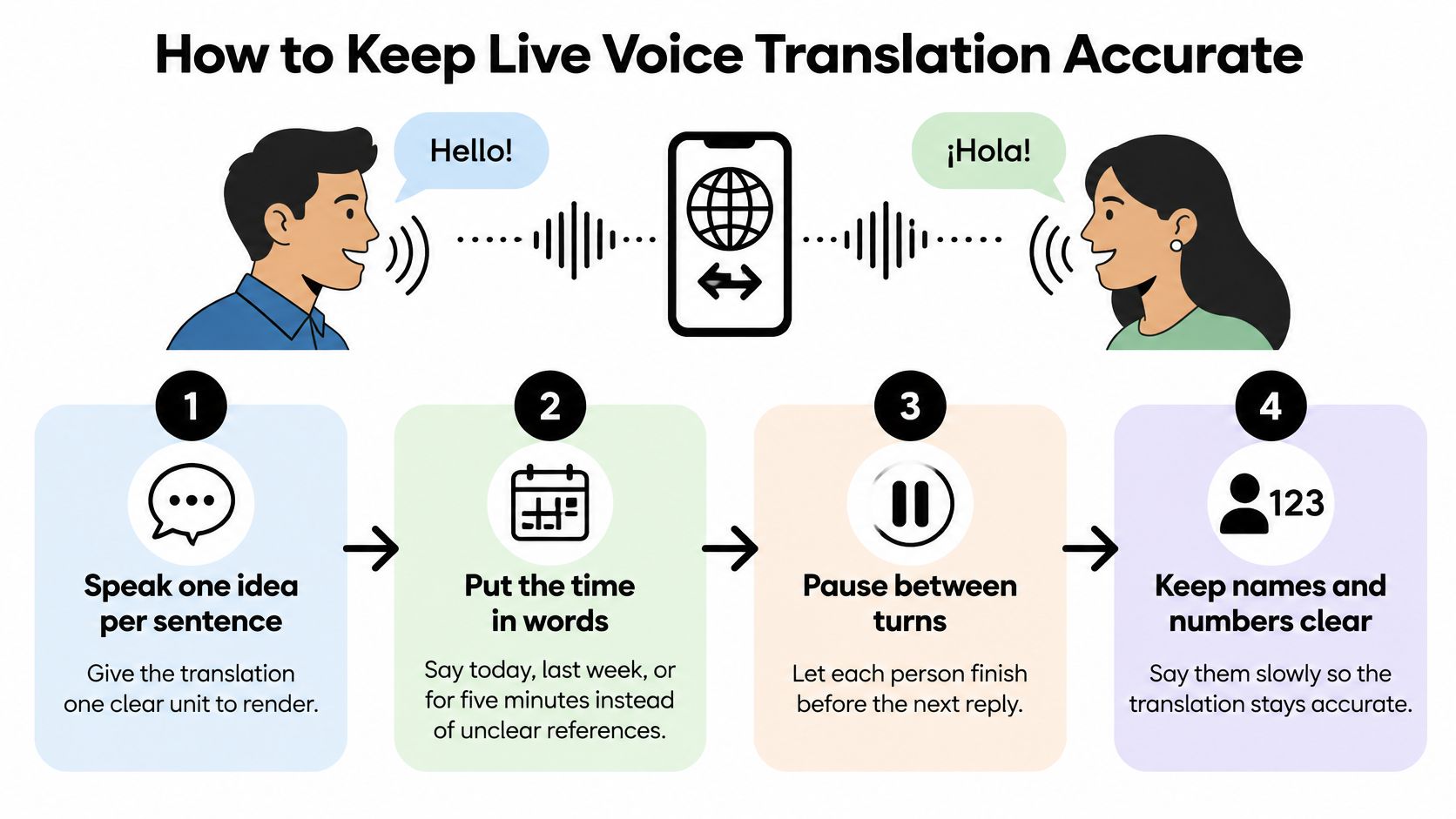
- Speak one idea per sentence. Give each turn a clear subject and action. Separate an explanation from a request so the listener can confirm each.
- Put the time in words. Say today, last week, or for five years rather than relying on shared assumptions. This helps distinguish a completed action from an ongoing one.
- Name people and objects. Replace an unclear they with the reception staff, or it with the booking confirmation. The translator then has a clearer referent.
- Replace idioms before speaking. Say that a proposal is too expensive rather than reaching for a colorful expression. Plain phrasing reduces the need to interpret figurative intent.
- Pause and read before answering. Let the other person finish, then inspect the translated text. If the sentence doesn't match the topic, clarify instead of replying to a guessed meaning.
- Confirm with a short paraphrase. Ask whether the meeting is moving to Thursday, for example. Confirmation exposes misunderstandings that a simple nod won't reveal.
- Repeat names, numbers, and dates. Say them slowly, then repeat them and check the written result. Spell names rather than assuming a familiar pronunciation produces the right spelling.
- Repeat commitments in the other language. Restate who will do what and when. Let the other person correct the commitment before either of you acts.
Check the displayed meaning
In Translate AI, our translation is shown and spoken immediately after speaking, and speaker mode supports hands-free chats. Keep the screen available when names, conditions, or commitments need inspection; this French-English translation app guide provides related context.
Before you respond: Check who acted, when it happened, and whether the action is finished.
A dedicated French-English tense-consistency study found that conventional BLEU and COMET comparisons weren't sufficient to measure tense-prediction ability. A fluent French sentence can still misstate time or completion status. When the timeline matters, verify it explicitly rather than trusting smooth delivery.
Confirm High-Stakes Phrases Before You Act
Use live translation for everyday exchanges such as ordering food, directions, and small talk. Confirm phrases involving money, health, legal obligations, contracts, or deadlines before acting on them.
- Prices and fees: Write the amount in both language formats and confirm the currency and total in text before paying.
- Medical instructions: Ask a pharmacist, clinician, or qualified medical-language reviewer to check the instruction before following it.
- Contracts: Translate the French back into English and compare obligations, exclusions, and conditions. Back-translation can expose discrepancies, but it doesn't replace qualified legal review.
- Deadlines: Confirm the day, written date, and time, with the month spelled out.
For public-facing travel information, Waymap's resource on translation management systems for transit operators offers context for managing multilingual passenger communication. Treat a translated instruction and an authoritative confirmation as different things.
Get Translate AI
Our two-way mode lets you speak English while your partner hears French, and vice versa. You can read on-screen text before answering or use speaker mode for hands-free chats. Get the app from the Translate AI App Store listing, then run a low-stakes conversation with a French speaker and compare the output with the sample translations.
Translate AI offers instant voice translation in over 80 languages, including English and French, for two-way conversations. Visit Translate AI to get started, then test a hotel check-in or restaurant request while checking the tone, names, and displayed meaning before you reply.