

Difference Between in and on Explained Clearly
You're at a hotel desk, checking your next booking. You say, “I arrive in Monday in the bus,” and the clerk pauses before confirming your plans. The natural version is, “I arrive on Monday on the bus.”
You know the words. The difficult part is choosing the small word between them.
Why In and On Still Sound Wrong
The difference between in and on isn't just inside versus outside. English speakers describe places, vehicles, times, and messages through familiar patterns that don't always match their physical shape.
A city, a room, and a month can all be treated as bounded spaces. A day occupies a position on a calendar, a bus is treated like a transport platform, and a car is treated as an enclosure. Similarly, information sits in an email, while a conversation happens on Zoom.
The hotel exchange is a useful starting point because the listener can understand your meaning even when the prepositions sound unusual.

Why a physical rule isn't enough
English didn't develop these distinctions all at once. A historical study published in Studies About Languages describes how in and on overlapped in Old English and earlier Middle English before becoming more specialized.
That history helps explain why useful rules coexist with expressions you learn as phrases. You don't need to calculate whether your feet touch a bus floor before saying on the bus.
By the end, you'll be able to choose in or on for place, time, transport, devices, and media, and recognize the regional pairs that don't have a universal answer.
Keep these questions in mind:
- Containment: Am I describing something within a bounded area?
- Surface: Is something supported by or attached to a surface?
- Route: Am I locating something along a road or line?
- Vehicle convention: Which expression normally goes with this vehicle?
- Time or media convention: Am I naming a period, day, channel, or document?
Screenshot the chart before reading the exceptions, especially street names and weekend phrases.
The In or On Choice Chart
When to choose in or on
| Context | Choose | Model phrase | Test |
|---|---|---|---|
| City, country, room | in | in London; in Japan; in the kitchen | Bounded area or interior |
| Month, season, year, part of day | in | in July; in 2026; in the morning | Broad period or general part of day |
| Day or calendar date | on | on Monday; on 8 July; on Monday morning | Names one day |
| Surface, wall, or building floor | on | on the table; on the third floor | Contact or level |
| Bus, train, or plane | on | on the bus; on the train | Public transport as a platform |
| Car or taxi | in | in the car; in a taxi | Enclosed private vehicle |
| Road or street as a route | on | on the road; on the street | Position along a line |
| Email, document, or photo | in | in an email; in the photo | Message or file as a container |
| Phone, Zoom, internet, or TV | on | on Zoom; on the internet | Channel or platform |
Use the Test column before inventing a new rule. Find the kind of thing you're describing, then choose the model phrase closest to your meaning.
The year in in 2026 is an example of grammar, not a prediction. You can replace it with the year relevant to your plans.
Read the phrase, not just the object
For bounded places, imagine the location as an area: in London, in Japan, in the kitchen, or in the garden. A garden doesn't need a roof to take in. Its boundary matters more than whether it's indoors.
For time, distinguish a broad period from a named day. Say in July, in winter, and in the morning, but on Monday and on Monday morning. The general part-of-day expression is an important exception to the shortcut that in means a period longer than a day.
Surfaces and levels take familiar on phrases: on the table, on the wall, and on the third floor. Transport needs its own row because the ordinary passenger expressions are on the bus, on the train, and on the plane, but in the car and in a taxi.
Roads require a meaning check. On the road describes a route, while in the street can emphasize the roadway as an area; on the street often locates something along that street.
For communication, separate content from the channel carrying it. The address can be in an email, the instructions in a document, and your colleague in a photo, while you speak on the phone or on Zoom and watch something on TV.
Use frequency as context, not a guessing strategy
A study of prepositions in ESL textbooks reports that the British National Corpus contains about 0.35 occurrences of on for every in, approximately one on for every 2.9 uses of in; its textbook corpus contained 234 instances of in and 112 of on.
That doesn't mean you should choose in whenever you're unsure. It means these are everyday patterns worth practicing as complete phrases.
For a quick editing pass, try in first with a city, room, month, or year. Try on first with a day, surface, bus, or communication platform you join.
Place and Transport Side by Side
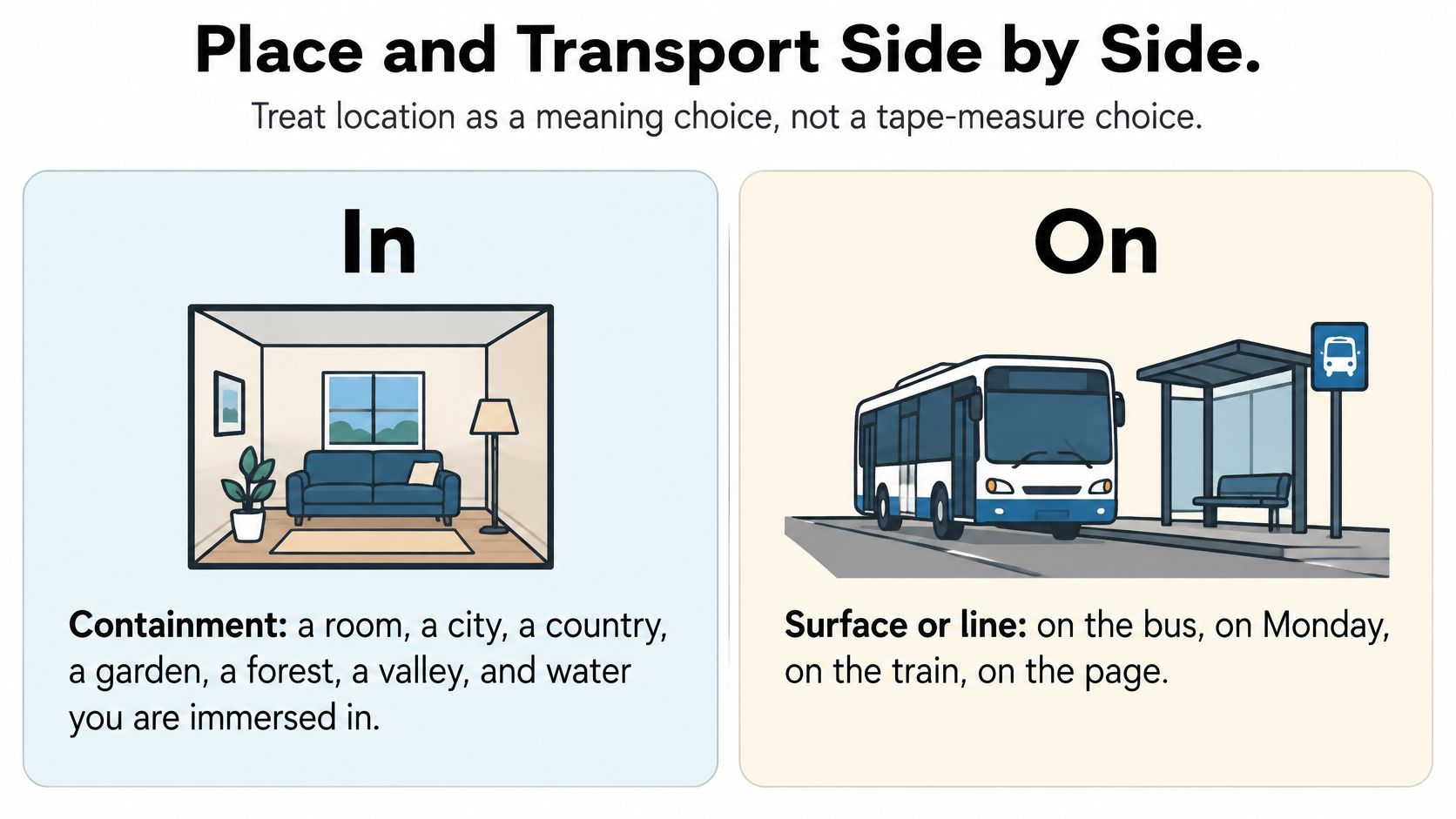
Treat location as a meaning choice, not a tape-measure choice. The useful question isn't how large an object is, but how English normally presents your relationship to it.
Use this visual to compare containment with surface and transport expressions.
When both choices are possible
Containment includes in the room, in the garden, in a forest, in a valley, and in the sea. You're within the relevant space, even if there are no walls.
Surface, line, and level expressions include on the roof, on the island, on the coast, and on the road. Cambridge's grammar guide to on includes surfaces, roads, coastlines, building floors, and public transport among its uses.
Place pairs that change meaning
| Setting | Prefer | Avoid | Frame |
|---|---|---|---|
| Swimming versus boating | in the water; on the water | Swapping the pair for these intended meanings | Immersion versus surface |
| Room corner versus street junction | in the corner; on the corner | Swapping the pair for these locations | Interior angle versus route junction |
| Picture on a wall | on the wall | in the wall | Surface; in means inside the structure |
| Island or coastline | on the island; on the coast | in the island | Surface or edge |
| Building level | on the second floor | in the second floor | Level along a vertical stack |
A swimmer is in the water. A boat is on the water, although part of its hull is below the surface.
A chair stands in the corner of a room. A café stands on the corner where streets meet.
Someone standing in the street may be occupying the roadway. A hotel on the street is located along it, not necessarily in the traffic.
The Avoid column isn't a claim that every alternative is impossible. Pipes can be in the wall, but a picture normally hangs on the wall.
Vehicles follow established passenger expressions
For ordinary travel, say on the bus, on the train, on the plane, and on the metro. Say in the car and in a taxi.
Think of a bus as a platform you occupy and a car as a container you sit in. This is a learning model, not a literal description of the vehicle.
Vehicle size alone won't give you a reliable answer. On the car usually places someone on the roof, hood, or exterior, not in a passenger seat.
For multilingual airport practice, pair your English sentence with this guide to saying airplane in Spanish. Keep the vehicle phrase together rather than translating each word separately.
Movement is a separate distinction: go into the house emphasizes crossing inside, and get onto the stage emphasizes moving to its surface. In and on usually describe the resulting location.
Use the video for an additional spoken explanation.
Before speaking, make a brief check: container, surface or route, or established transport phrase?
Time Calls and Messages Abroad
Suppose you're sending an itinerary to a hotel and arranging a meeting with a colleague. You need to distinguish the travel period, the arrival day, and the exact appointment time without making the message complicated.
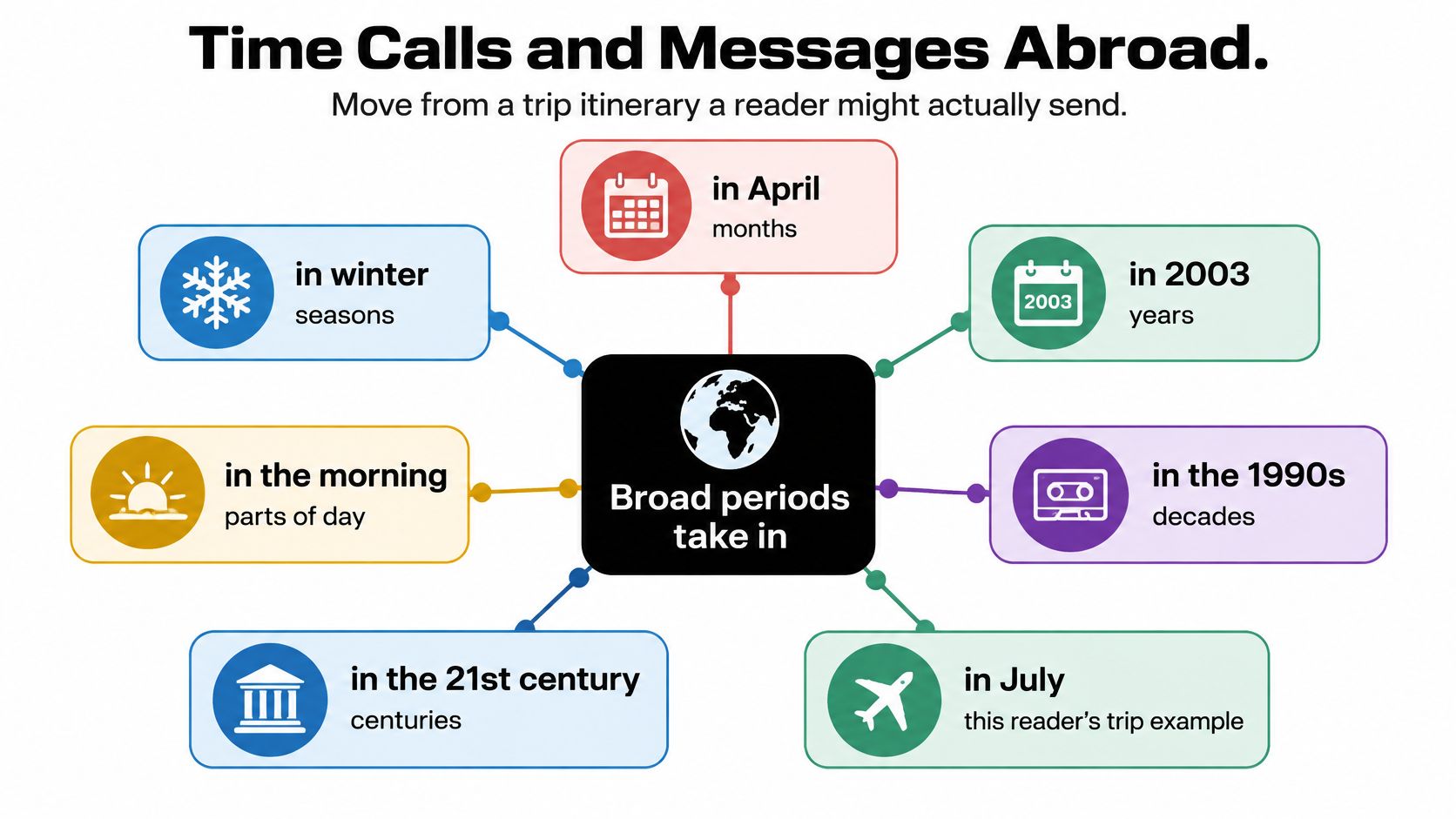
The British Council's guide to English prepositions distinguishes broad periods such as in April, in winter, in 2003, in the 1990s, and in the 21st century from named days and dates such as on Christmas Day, on April 1, and on February 8.
Use the diagram to group the broad-period expressions you're likely to need.
Build the itinerary from broad to specific
You can begin with the month, add the day, and finish with an exact time. For example: The meeting is in September, on Tuesday, at 9:45.
Each phrase answers a different question: which month, which day, and what time? You don't need to repeat all of them if the other person already knows the context.
Use at for the exact clock time, without trying to fit it into the in/on contrast. If saying the hour is the difficult part, practice telling the time in English separately.
The tricky mixed expression is Monday morning. Although in the morning is correct by itself, adding the day gives you on Monday morning, not in Monday morning.
Compare these useful arrival messages:
- General travel period: We arrive in July.
- Specific arrival date: We arrive on July 8.
- Day and part of day: We arrive on Monday morning.
For longer periods, in is the usual choice; for a named day or date, choose on. Keep general parts of the day, such as in the morning, as their own learned pattern.
Separate the conversation from its contents
At work, use on for participation through a channel: on a call, on Zoom, on Teams, on the internet, or on TV. Use in for information contained in words or a file: in an email, in a message, in the attachment, or in the document.
That distinction lets you describe both activities in a natural sentence: I'm on a call, but the address is in the email. You're participating in the call and locating information within the message.
Here are useful lines to keep ready:
- Availability: I am on a call.
- Finding information: The address is in the email.
- Sharing a meeting link: The Zoom link is in the message.
- Choosing a channel: Can we discuss it on Teams?
If both words feel possible, ask whether you're naming a span, a day, a channel, or a document.
Regional Pairs and Common Mixups
At a London hotel, a guest might say, “We're staying at the weekend.” An American guest might say, “We're staying on the weekend.” Both phrases are natural in their variety of English. Other differences come from the meaning of the whole phrase, not regional preference.
Follow the local pattern
For weekend plans, British English commonly uses at the weekend, while American English commonly uses on the weekend, as Cambridge's guide to on and onto notes. For example:
- British: Are you free at the weekend?
- American: Are you free on the weekend?
The phrase in the weekend is not the usual choice in either variety. When writing to a host or colleague, follow the expression they use.
Street expressions can also depend on the exact phrase and the speaker's variety. In the street can describe someone in the roadway, while on the street can describe a business located along it. Use the meaning to choose, rather than automatically swapping one preposition for the other.
Distinguish position, movement, and fixed phrases
She is in the house gives her location inside a space. She went into the house describes crossing its boundary. The difference is like the difference between being inside a room and stepping through its door.
For a surface, use on: The book is on the table. To emphasize movement to that surface, onto is possible: She put the book onto the table. The shorter put the book on the table is also natural.
Some combinations work as fixed expressions rather than descriptions of place. Learn on purpose, in fact, and carry on as complete phrases. In Please carry on, on expresses continuation, not location.
Use the intended meaning to edit
These corrections assume the ordinary travel or workplace meaning. A person could sit on a car, and something could be inside a table, but those are different situations.
Common mixups and better choices
| You might say | Prefer | Why |
|---|---|---|
| I live on London | I live in London | A city is treated as an area |
| See you in Monday | See you on Monday | Use on with a named day |
| The keys are in the table | The keys are on the table | The keys are resting on its surface |
| She is on the car | She is in the car | On the car suggests the exterior or roof |
| Call me in Zoom | Call me on Zoom | Use on for the meeting channel |
| It is on the email | It is in the email | The information is contained in the message |
| We arrive in July 8 | We arrive on July 8 | Use on with a specific date |
| Meet me in the weekend | Meet me on the weekend (US) or at the weekend (UK) | Weekend phrasing varies by region |
Before changing a preposition, identify the intended picture: inside a boundary, resting on a surface, moving toward one, or using a set expression. That keeps the correction true to the meaning.
Quick Tips for Learners
You don't need to memorize every exception before your next trip. Concentrate on the phrases you say, then check the choices that still slow you down.
Make a focused editing pass
- Start with the test: Use the chart's meaning column rather than inventing a rule from the object's shape.
- Read ahead: Look at the whole expression after the preposition. Morning and Monday morning don't take the same choice.
- Mark your draft: Circle each in and on in a message, identify its job, and change only the mismatches.
- Respect regional usage: Match street and weekend expressions to the English you're using.
- Avoid word-for-word swaps: Decide how the English phrase presents the situation before translating the preposition from your first language.
Don't change a correct phrase just because another version exists. Your task is to make your intended meaning clear, not to make every sentence follow one physical rule.
Learn meaningful contrasts as complete phrases
On time means at the scheduled time or without being late. In time means early enough for a purpose.
The train arrived on time comments on its schedule. We arrived in time to catch the train says you got there before it was too late.
Practice habit: Keep a short personal list of sentences you hesitate over, and rehearse the corrected versions aloud.
Start with arrival, availability, and information: We arrive in July. I am on a call. The address is in the email. Then add a few sentences based on mistakes you make.
Repeat those sentences until you can say them comfortably without checking a rule. Only then add less common exceptions; otherwise, you'll spend your practice time collecting rules instead of using English.
Practice the Choice Before You Speak
Choose the preposition before reading each answer. Then say the whole phrase aloud, because fluent speech depends on recalling phrases, not naming grammar categories.
- The hotel: In the hotel. You're describing a location within the building.
- Monday morning: On Monday morning. The expression names a day.
- The train: On the train. This is the usual passenger phrase.
- A taxi: In a taxi. You're riding inside it.
- July, with no day named: In July. You're giving the month.
- 8 July: On 8 July. You're giving a calendar date.
- An email: In an email. You're locating information within the message.
- A video call: On a call or on Zoom. You're naming the activity or platform.
Repair a complete sentence
I am in the bus in Friday morning becomes I am on the bus on Friday morning. Make both changes, then repeat the corrected sentence without pausing between the phrases.
The pin is on the message in the table becomes The pin is in the message on the table, assuming a printed message rests there. If you mean a digital message containing a map pin, the clearer sentence is The location pin is in the message.
For a repeatable speaking routine, use these ideas for practicing spoken English. Build your practice around sentences you'll need, not unrelated example lists.
Check a live sentence with Translate AI
If you freeze when a real conversation starts, Translate AI's live translator app supports two-way conversation, so you can hear the English line while practicing the preposition in context. Choose the languages, speak your intended message, and listen to the complete phrase rather than the preposition alone.
You can see how a conversation starts on the Translate AI website. Use a realistic hotel question or meeting arrangement, then try saying the English version yourself.
Correct the practice items aloud and save the choice chart. Before your next trip or call, rehearse one useful sentence combining your arrival day, vehicle, and meeting link: I arrive on Monday by train, and the meeting link is in the email.
Translate AI offers live, two-way voice translation for travel and workplace conversations. Practice an arrival message or meeting question, listen to how in and on fit the complete sentence, and visit Translate AI to try it with a conversation you need to have.